What to Do If Your Spouse Is Lying in Connecticut Divorce Court
Learn how to handle a spouse who lies in CT divorce court. Discover legal strategies, evidence requirements, and remedies for dishonesty in Connecticut divorce proceedings.
Need help with your divorce? We can help you untangle everything.
Get Started Today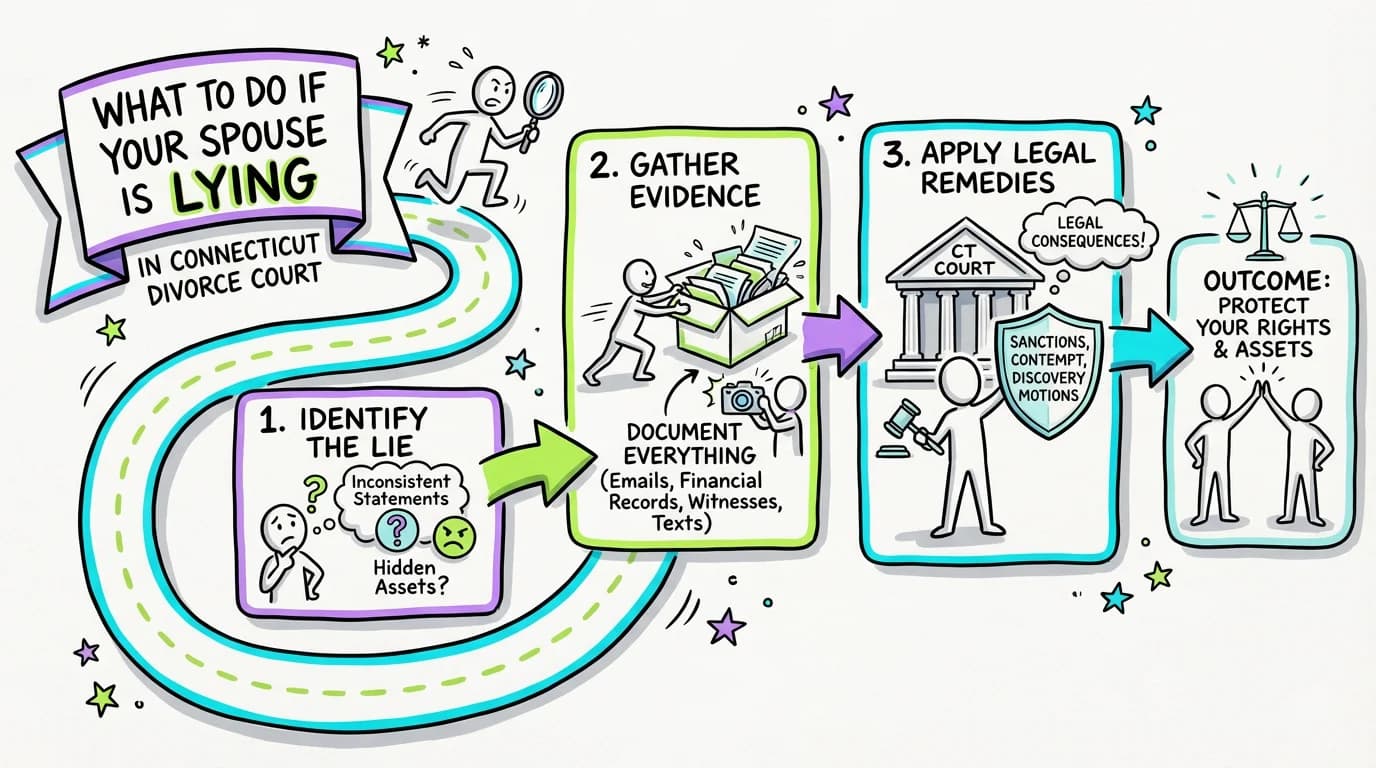
What to Do If Your Spouse Is Lying in Connecticut Divorce Court
If your spouse is lying in Connecticut divorce court, you must gather documentary evidence to contradict their false statements, work with your attorney to expose inconsistencies through cross-examination, and request court intervention through motions to compel discovery or contempt proceedings. Connecticut courts take dishonesty seriously—particularly regarding financial disclosures—and judges have broad authority to sanction untruthful parties, reopen judgments obtained through fraud, and award attorney's fees to the wronged spouse.
Understanding Why Lying Happens in Divorce Proceedings
Divorce brings out difficult emotions, and unfortunately, some spouses resort to dishonesty to gain advantages in property division, alimony, or child custody matters. The most common areas where lying occurs include income and asset disclosure on financial affidavits, claims about parenting involvement, allegations of misconduct, and hidden debts or expenses. Understanding that this behavior—while infuriating—is predictable can help you approach the situation strategically rather than emotionally.
Connecticut is a no-fault divorce state under C.G.S. § 46b-51, meaning you don't need to prove wrongdoing to obtain a divorce. However, dishonesty during proceedings can significantly impact how the court divides assets, awards alimony, and determines custody arrangements. Judges evaluate credibility carefully, and a spouse caught lying about one matter may find their testimony doubted on everything else. If you are unsure whether your spouse's specific actions meet the legal threshold for perjury or fraud, tools like Untangle’s AI legal chat can help you quickly understand legal definitions and prepare the right questions for your attorney.
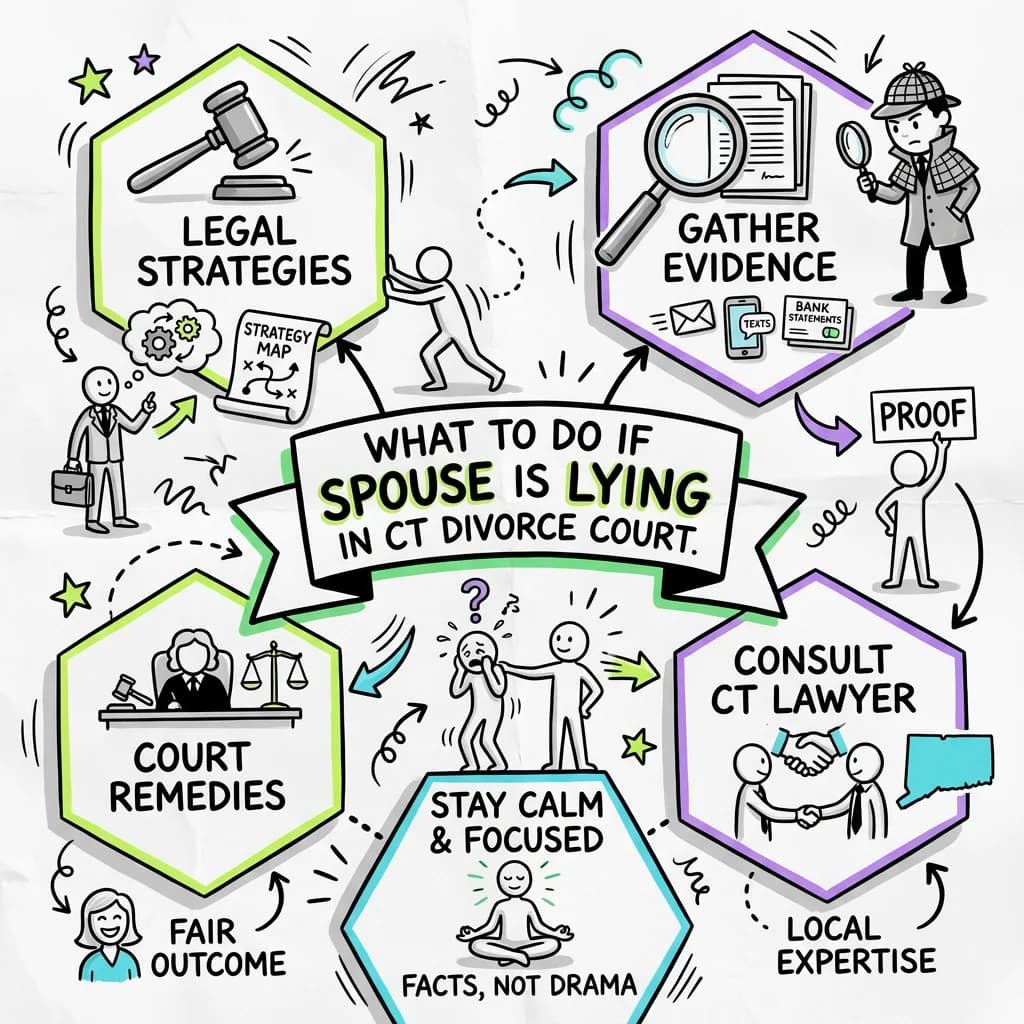
The key is responding methodically. Your instinct may be to confront your spouse or express outrage in court, but judges respond better to calm, documented evidence. Focus your energy on building an airtight case that lets the truth speak for itself.
Financial Dishonesty: The Most Common and Serious Problem
Sworn Financial Affidavits Are Legally Binding
In Connecticut divorce cases, both parties must file sworn financial affidavits under Practice Book Rule 25-30. These statements, submitted on official Judicial Branch forms (either the Short Form or Long Form Financial Affidavit), require parties to disclose all income, expenses, assets, and liabilities under penalty of perjury. Lying on these documents isn't just unethical—it's potentially criminal.
The mandatory disclosure requirements under Practice Book Rule 25-32 provide additional protection against financial deception. Within 60 days of a request, your spouse must produce three years of tax returns, W-2s and 1099s, 24 months of bank statements, retirement account statements, and business records for any closely held entities. This paper trail often reveals inconsistencies that verbal testimony alone cannot.
If your spouse's lifestyle doesn't match their claimed income, or you suspect hidden accounts, these discovery tools are your first line of defense. Tools like Untangle's financial organization features can help you compile and analyze the documents you receive, making it easier to spot discrepancies between what your spouse claims and what the records show.
What to Do When Financial Statements Don't Add Up
When you identify discrepancies, document everything systematically. Create a comparison showing what your spouse reported versus what the evidence reveals. For example, if they claim $60,000 annual income but their bank deposits total $95,000, that gap needs explanation. If they listed no retirement accounts but you found statements showing a 401(k) with $150,000, that's material concealment.
Your attorney can subpoena additional records from employers, banks, and financial institutions if voluntary discovery isn't producing complete information. In some cases, hiring a forensic accountant may be worthwhile, especially if your spouse owns a business or has complex investment holdings. These professionals specialize in tracing hidden assets and identifying underreported income.
Legal Remedies for Dishonesty in Connecticut Courts
Motion to Compel Discovery
When your spouse refuses to produce required documents or provides incomplete responses, Practice Book Rule 25-32A allows you to file a motion to compel. This motion must specify exactly what discovery you're seeking and what remedy you want. Your spouse must then explain to the court why they haven't complied—or demonstrate that they actually did comply properly. Drafting these formal requests requires precision; using Untangle’s document generation tools can help you organize the necessary information so your legal team can file motions more efficiently.
Courts take discovery violations seriously because the entire system depends on honest disclosure. Sanctions for non-compliance can include:
- Ordering immediate production of documents
- Prohibiting the non-compliant party from introducing certain evidence
- Drawing adverse inferences (assuming the hidden information is unfavorable)
- Awarding attorney's fees to the requesting party
- Finding the non-compliant party in contempt
Contempt of Court Proceedings
For more serious violations—particularly where your spouse has disobeyed a specific court order—Practice Book Rule 25-27 outlines the process for filing a motion for contempt. Your motion must clearly state the date and exact language of the order violated, the specific acts constituting contempt, and the relief you're requesting.
Under C.G.S. § 46b-87, when someone is found in contempt of family court orders, the court may award the petitioner reasonable attorney's fees and the costs of serving the contempt citation. This financial consequence, paid by the contemptuous party, serves as both punishment and deterrent.
Opening a Judgment Obtained Through Fraud
If you've already received a final divorce judgment but later discover your spouse lied about significant matters, Connecticut law provides a path to reopen the case. The landmark case of Sousa v. Sousa (164 A.3d 702) established that a party seeking to open a judgment beyond the normal four-month limitation period due to fraud must prove fraud "by clear and convincing evidence."
This is a high standard, but it protects innocent parties from being permanently bound by judgments obtained through deception. If you can demonstrate that your spouse intentionally concealed assets or made material misrepresentations that affected the court's decisions, the judgment may be reopened and modified.
Building Your Evidence Strategy
Document Everything Methodically
The most effective response to a lying spouse is overwhelming documentary evidence. Courts find documents more credible than testimony because they're created in real-time, often before litigation begins. Your evidence collection should include:
| Evidence Type | What It Proves | How to Obtain |
|---|---|---|
| Bank statements | Actual income and spending | Discovery request, subpoena |
| Tax returns | Reported income, deductions | Mandatory disclosure |
| Credit card statements | Lifestyle, hidden expenses | Discovery request |
| Social media posts | Lifestyle inconsistencies | Screenshot and preserve |
| Text messages/emails | Admissions, contradictions | Preserve on your devices |
| Witness statements | Corroboration of facts | Interviews, depositions |
| Employment records | Actual compensation | Subpoena to employer |
Using Untangle's document organization tools can help you keep all this evidence organized and easily accessible for your attorney. When you can quickly pull up the exact document that contradicts your spouse's testimony, you're in a much stronger position.
Effective Cross-Examination Preparation
Work closely with your attorney to prepare for cross-examining your spouse. The goal isn't theatrical "gotcha" moments—it's methodically leading your spouse through their own contradictions. Provide your attorney with specific questions to ask based on documents you've gathered, a timeline of statements your spouse has made, and identified inconsistencies between testimony and evidence.
Judges are experienced at evaluating credibility. When a witness is caught in clear contradictions, it affects how the court views everything else that person says. One proven lie can unravel an entire case built on false claims.
Custody and Parenting Disputes: A Special Concern
When lies involve your children—false allegations of abuse, misrepresentations about parenting involvement, or dishonest claims about the children's preferences—the stakes are especially high. Under C.G.S. § 46b-56, courts must make custody decisions based on the best interests of the child, considering factors like each parent's ability to meet the child's needs and the willingness to encourage a relationship with the other parent.
False allegations can backfire significantly. Judges understand that some parents weaponize accusations during contentious divorces. If your spouse makes false claims about you, document your actual parenting involvement thoroughly. Keep records of school pickups, medical appointments, extracurricular activities, and daily caregiving. If you're falsely accused of serious misconduct, work with your attorney immediately to request appropriate investigations or evaluations. Courts can appoint guardian ad litems to investigate and report on the children's actual circumstances, providing an independent perspective that cuts through conflicting parental claims.
Step-by-Step Action Plan
- Stay calm and strategic — Emotional reactions in court rarely help. Let the evidence speak for itself while you maintain composure.
- Document immediately — Start preserving evidence now. Screenshot social media posts, save emails and texts, and photograph any relevant physical evidence.
- Review financial affidavits carefully — Compare your spouse's sworn statements against records you have access to. Note every discrepancy, no matter how small.
- Request full mandatory disclosure — Invoke Practice Book Rule 25-32 to obtain tax returns, bank statements, and other financial records for the past 24-36 months.
- Organize your evidence — Create a clear, chronological record of lies and the evidence that contradicts them. Tools like Untangle's case preparation features can streamline this process.
- Work with your attorney on strategy — Share your findings and collaborate on the best approach—whether motions to compel, contempt proceedings, or cross-examination preparation.
- Consider expert witnesses — For complex financial matters, a forensic accountant can be invaluable. For custody issues, evaluators and therapists may provide crucial testimony.
- Prepare for trial — If settlement becomes impossible due to your spouse's dishonesty, be ready to present your case fully at trial where the truth can come out.
Cost and Consequence Comparison
| Action | Typical Cost Range | Potential Outcome |
|---|---|---|
| Motion to Compel | $500-$2,000 | Court-ordered production, possible sanctions |
| Contempt Motion | $1,000-$3,000 | Compliance orders, attorney fee awards |
| Forensic Accountant | $3,000-$15,000+ | Hidden asset discovery, expert testimony |
| Guardian ad Litem | $2,500-$10,000+ | Independent custody investigation |
| Opening Judgment (Fraud) | $5,000-$20,000+ | Judgment modification, asset recovery |
These costs must be weighed against potential recovery. If your spouse is hiding $100,000 in assets, spending $10,000 on a forensic accountant yields significant return. Discuss cost-benefit analysis with your attorney based on your specific circumstances.
When Self-Help Isn't Enough
While understanding your rights and organizing evidence are crucial steps you can take yourself, handling a dishonest spouse in court requires skilled legal representation. You should definitely work with an experienced family law attorney if:
- Your spouse has hired an aggressive attorney of their own
- Significant assets or income are being concealed
- False allegations have been made against you
- Children's custody or safety is at stake
- Your spouse has violated court orders
Connecticut family courts have significant discretion in how they handle dishonesty. An experienced attorney knows how to present evidence effectively, which motions will resonate with specific judges, and how to maximize the consequences your spouse faces for lying.
Remember that the goal isn't revenge—it's a fair outcome. Courts can only make just decisions when they have accurate information. By systematically exposing your spouse's lies through proper legal channels, you're not just protecting yourself; you're ensuring the court can fulfill its fundamental purpose of reaching an equitable resolution based on truth.
Frequently Asked Questions
How do I prove my spouse is hiding assets in a Connecticut divorce?
You can prove hidden assets by subpoenaing bank records, tax returns, and business documents, hiring a forensic accountant to trace funds, and using discovery tools like interrogatories and depositions to expose inconsistencies in your spouse's financial disclosures.
Can a CT divorce decree be overturned if my spouse lied on their financial affidavit?
Yes, Connecticut courts can reopen or modify a divorce judgment under C.G.S. § 46b-86 if you discover your spouse committed fraud on their sworn financial affidavit, typically within a limited time period after discovering the deception.
What are the penalties for lying under oath in Connecticut family court?
Lying under oath in Connecticut family court constitutes perjury, which can result in criminal charges, court sanctions, contempt findings, unfavorable case rulings, and an order to pay the other spouse's attorney's fees.
Can I request a forensic accountant during my Connecticut divorce?
Yes, you or your attorney can request that the court appoint a forensic accountant or hire one privately to investigate suspected hidden income, undisclosed assets, or fraudulent financial transfers during your CT divorce proceedings.
Will my spouse have to pay my legal fees if they lied in our Connecticut divorce?
Connecticut judges have discretion to order a dishonest spouse to pay the other party's attorney's fees as a sanction for litigation misconduct, particularly when the lies caused unnecessary legal expenses to uncover the truth.
Legal Citations
- • C.G.S. § 46b-51 View Source
- • C.G.S. § 46b-56 View Source
- • C.G.S. § 46b-87 View Source
- • Practice Book Rule 25-30 View Source
- • Practice Book Rule 25-32 View Source
- • Practice Book Rule 25-32A View Source
- • Practice Book Rule 25-27 View Source
- • Sousa v. Sousa, 164 A.3d 702 View Source