Quick Divorce in Connecticut: Nonadversarial Dissolution Explained
Learn how to get a quick divorce in Connecticut through nonadversarial dissolution. Understand the 30-day minimum timeline, requirements, and process.
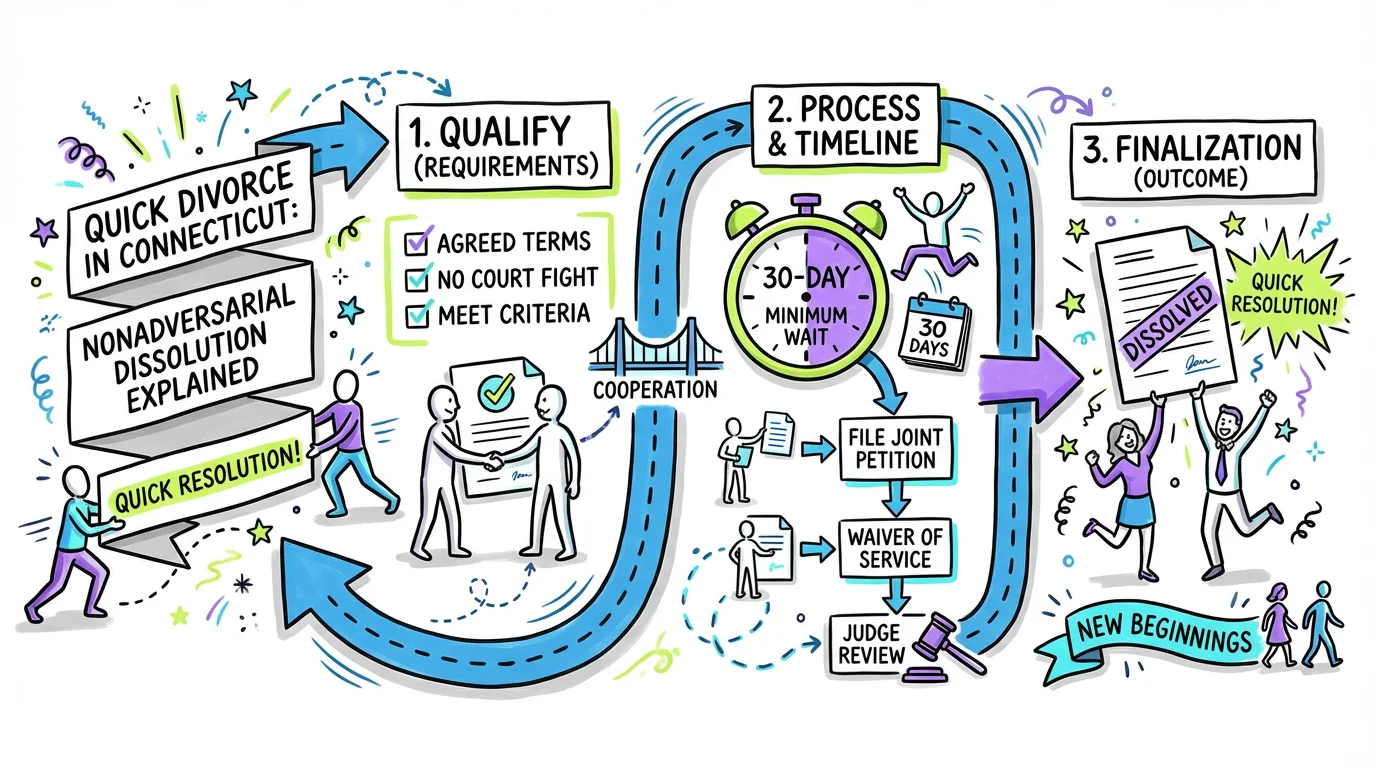
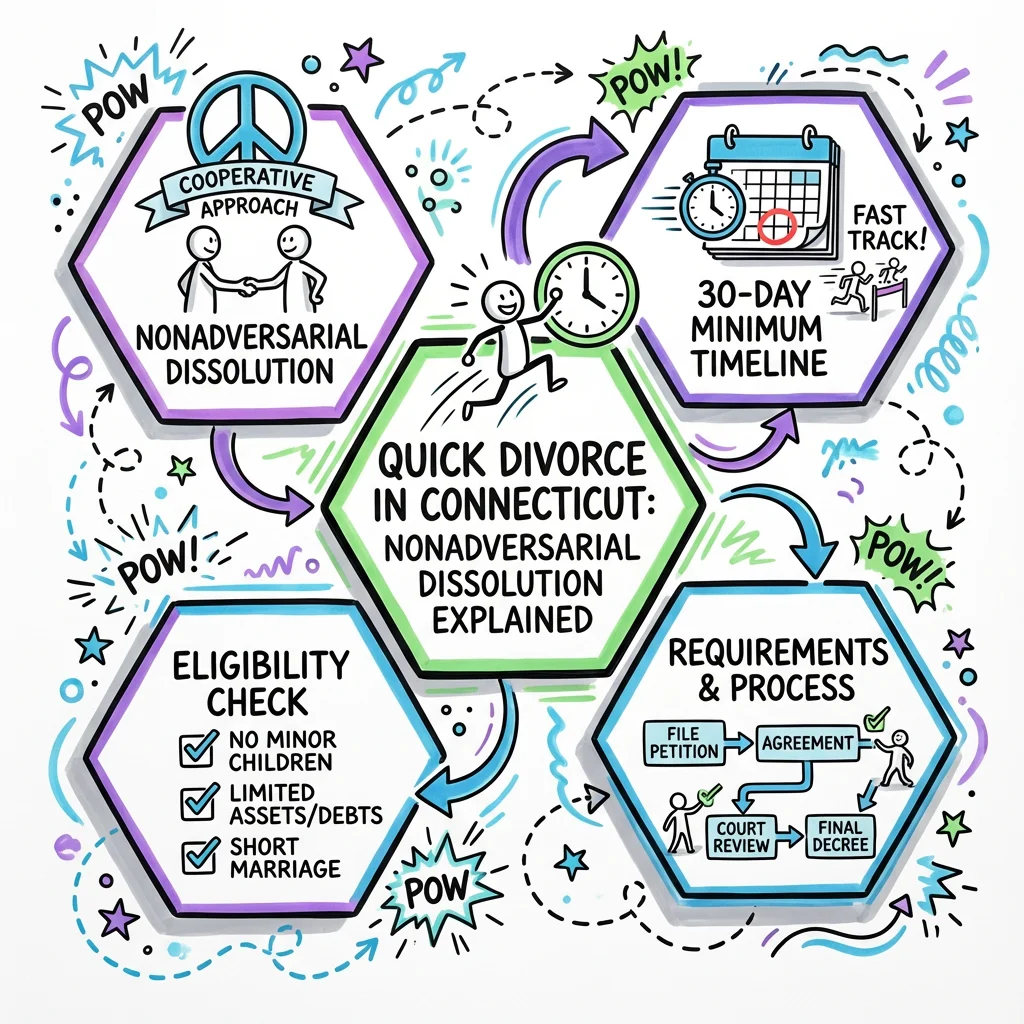
A "quick divorce" in Connecticut typically refers to the Nonadversarial Dissolution of Marriage, a simplified legal process allowed under C.G.S. § 46b-44a. This expedited track allows eligible couples to finalize their divorce in as little as 30 days without ever appearing in court. However, this process is strictly limited to couples with no children, no real estate, and limited assets who fully agree on all terms.
Understanding Connecticut's Nonadversarial Dissolution
Connecticut created the nonadversarial dissolution process to relieve court congestion and help couples with simple estates dissolve their marriages efficiently. Unlike a standard divorce, which requires a waiting period and formal court procedures, this process relies on a sworn joint petition where both spouses attest that they meet specific statutory strict criteria.
The key distinction of this process is its "simplified" nature. It is not available to everyone. It is designed specifically for short-term marriages where financial entanglements are minimal and there are no child custody issues to resolve. For couples who qualify, the process eliminates the adversarial "Plaintiff vs. Defendant" structure, replacing it with a cooperative filing as co-petitioners.
Under C.G.S. § 46b-44a, the court can grant the dissolution based solely on the paperwork filed, provided the judge finds the agreement fair and equitable. This statutory framework allows the court to process these cases rapidly, often issuing a decree immediately after the mandatory 30-day waiting period expires.
Requirements for a Quick Divorce in Connecticut
Eligibility for nonadversarial dissolution is strictly defined by state law. You cannot simply "choose" this path if you do not meet the criteria, even if you and your spouse agree on everything. If you fail to meet even one requirement, you must file a standard divorce complaint (though you can still proceed amicably).
Strict Eligibility Criteria
| Requirement | Limit/Condition |
|---|---|
| Children | NO children born to or adopted by the parties (and wife is not pregnant) |
| Real Estate | NO interest in title to real property (houses, land, condos) by either party |
| Marriage Length | Married for 9 years or less |
| Pension | NO defined benefit pension plans |
| Assets | Total property value typically must be under $80,000 (excluding debt) |
| Agreement | Full written agreement on all property division and debts |
| Residency | At least one spouse must be a Connecticut resident |
The requirement regarding children is absolute. If you have minor children, you cannot use the Nonadversarial Dissolution form, regardless of how well you agree on custody. You must file a standard action. However, tools like Untangle's AI-assisted mediation tool can still help you reach an agreement quickly for a standard uncontested filing.
Per Practice Book § 25-5B, automatic court orders still take effect immediately upon filing the joint petition. These orders prevent either party from depleting assets or incurring unreasonable debts during the brief waiting period.
The 30-Day Timeline Explained
Connecticut law establishes a minimum 30-day waiting period for nonadversarial dissolutions. Under C.G.S. § 46b-44c, the court assigns a disposition date no less than thirty days after the filing date. This is significantly faster than the standard divorce process, which historically required a 90-day waiting period (though waivers are now available for standard cases).
During this 30-day window, either party can change their mind. If one spouse files a notice of revocation under C.G.S. § 46b-44b, the nonadversarial action is terminated, and the couple must start over with a standard divorce complaint. This cooling-off period ensures that the expedited nature of the process doesn't lead to impulsive decisions.
If no revocation is filed, the court reviews the file on the disposition date. If the paperwork is perfect and the agreement is fair, the court may enter the decree of dissolution without a hearing. If the judge has questions about the asset division or debts, C.G.S. § 46b-44d requires a hearing to be scheduled, which would require an in-person appearance.
Alternatives If You Don't Qualify
Many couples want a "quick divorce" but have children or own a home, disqualifying them from the Nonadversarial Dissolution process. If this applies to you, you can still achieve a relatively fast divorce by filing a standard action and marking it as "Uncontested."
In a standard uncontested divorce:
- File a Complaint: One spouse sues the other, but you proceed amicably.
- Submit an Agreement: You file a comprehensive settlement agreement covering custody, support, and assets.
- Request a Waiver: You can file a "Motion to Waive Statutory Waiting Period" to bypass the standard delays, potentially finishing in under 60 days.
For these cases, accurate documentation is critical. Untangle's Parenting plan builder and Child support calculator are essential for creating the robust agreements required by the court for cases involving children.
Try our free CT child support calculator
Calculate your estimated child support using Connecticut's official guidelines formula.
Steps to Complete a Nonadversarial Divorce
-
Verify Eligibility - Double-check the strict criteria. Ensure you have no interest in real estate and no defined benefit pensions. If you are unsure, use Untangle's AI legal guidance to clarify the definitions.
-
Prepare the Joint Petition - Both spouses must complete and sign the Joint Petition for Nonadversarial Dissolution of Marriage (Form JD-FM-242). This form requires you to swear under oath that you meet all eligibility requirements.
-
Complete Financial Affidavits - Transparency is mandatory. If your gross annual income is less than $75,000 and total net assets are less than $75,000, you may use the Short Form Financial Affidavit. Otherwise, the Long Form Financial Affidavit is required.
-
Draft the Agreement - You must file a written settlement agreement detailing exactly how you will divide your limited assets and debts. The court must be able to see clearly who gets what.
-
File with the Court - Submit the petition, affidavits, agreement, and filing fee to the Superior Court clerk. The clerk will set your disposition date.
-
Wait 30 Days - If neither party revokes the petition, the court will review the file on the disposition date. You typically do not need to go to the courthouse unless notified.
Financial Disclosure Requirements
Even in a simplified divorce, full financial disclosure is non-negotiable. Practice Book § 25-30 requires sworn statements of income, expenses, assets, and liabilities. The court uses this information to verify that your asset division is equitable and that you truly qualify for the simplified process (e.g., confirming you don't exceed the asset cap).
Using Untangle's Automatic document generation tool can help you compile these figures accurately. Errors on your financial affidavit can lead to the court rejecting your petition or scheduling a hearing, defeating the purpose of the quick filing.
What Can Slow Down the Process
While the timeline is legally set at 30 days, certain issues can cause delays or rejection:
Incomplete Forms: This is the most common error. If you leave sections blank or forget to notarize signatures, the clerk may reject the filing or the judge may deny the dissolution.
Unclear Asset Division: If your settlement agreement is vague (e.g., "We will split everything fairly" instead of listing specific bank accounts), the judge cannot determine if it is equitable. Specificity is required.
Sudden Disagreements: If one spouse feels pressured or unsure, they can file a revocation. This immediately stops the quick divorce process. Ensuring both parties are truly ready before filing is crucial to avoiding wasted time.
When to Get Professional Help
Although the nonadversarial process is designed for self-represented parties ("pro se"), legal advice is often beneficial. If you are unsure whether a specific asset (like a 401k vs. a pension) disqualifies you, consulting a professional is wise.
If you discover you do not qualify for the nonadversarial process because of assets or children, the complexity of your case increases immediately. In such situations, using professional resources or comprehensive tools like Untangle's AI consultation can help you pivot to the standard divorce track while maintaining an amicable, efficient approach.
Frequently Asked Questions
What is the difference between a contested and uncontested divorce in Connecticut?
An uncontested divorce in CT means both spouses agree on all terms and file together as co-petitioners, while a contested divorce involves disputes that require judicial intervention and can take months or years to resolve.
How long does an uncontested divorce take in Connecticut?
An uncontested nonadversarial divorce in Connecticut can be finalized in as little as 30 days from filing, making it the fastest legal way to end a marriage in the state.
What are the requirements for a quick divorce in CT?
To qualify for Connecticut's nonadversarial dissolution, both spouses must fully agree on all terms including property division, debt allocation, and any child custody or support matters, and must file a notarized joint petition under C.G.S. § 46b-44a.
Do I have to go to court for an uncontested divorce in Connecticut?
No, Connecticut's nonadversarial dissolution process can often be completed without a court appearance when both parties have resolved all issues and properly filed their joint petition.
What is a no-fault divorce in Connecticut?
A no-fault divorce in Connecticut allows couples to dissolve their marriage by citing irretrievable breakdown without having to prove wrongdoing by either spouse, and this approach is used in both contested and uncontested cases.
Legal Citations
- • Practice Book § 25-5B - Automatic Orders upon Filing of Joint Petition View Source
- • Practice Book § 25-30 - Statements To Be Filed View Source
- • Practice Book § 25-50A - Case Management under Pathways View Source
- • Practice Book § 25-51 - When Motion for Default for Failure To Appear Does Not Apply View Source
- • Financial Affidavit Short Form (JD-FM-006) View Source
- • Financial Affidavit Long Form (JD-FM-006) View Source