What Happens to Your 401k in a Connecticut Divorce | Division of Retirement Assets
Learn how 401k accounts are divided in Connecticut divorce. Understand equitable distribution, QDROs, and how to protect your retirement savings.

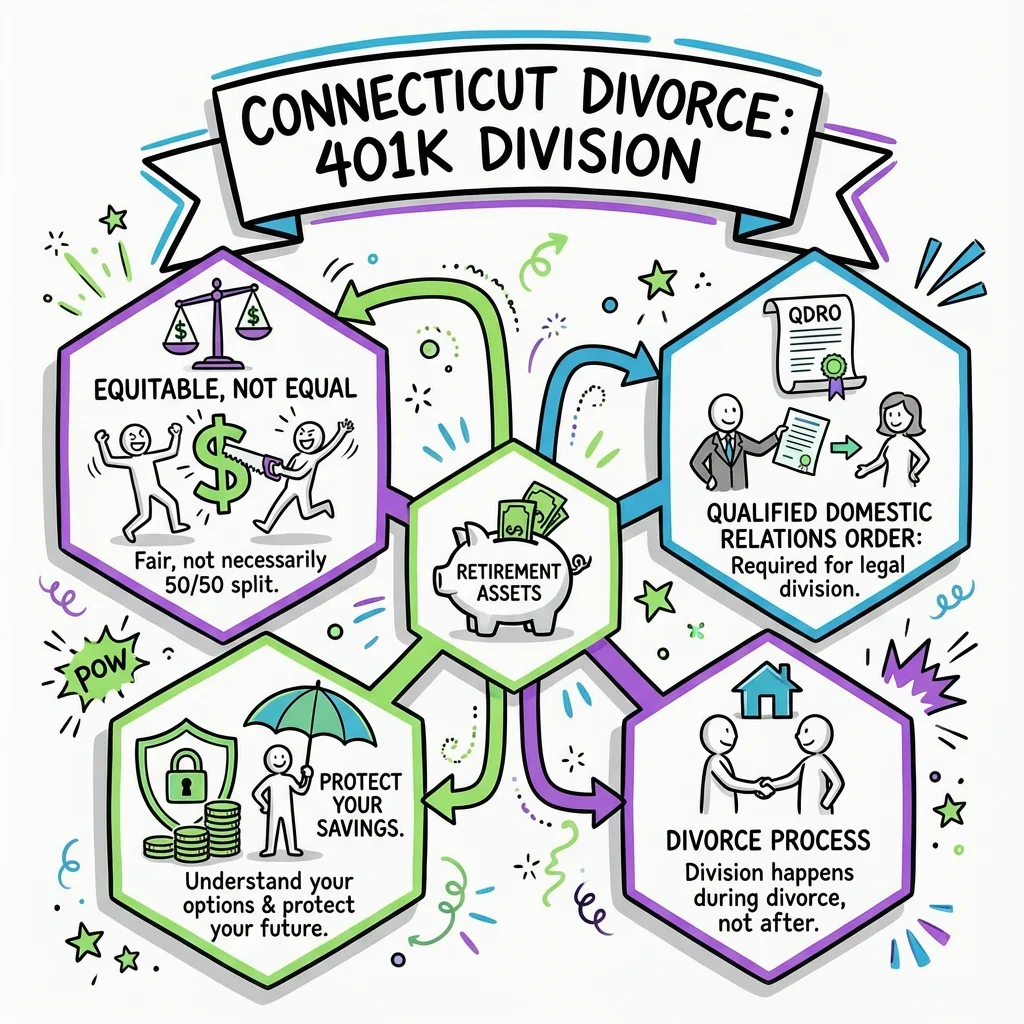
Your 401k is subject to division in a Connecticut divorce. Under Connecticut's equitable distribution laws, retirement accounts—including 401k plans, pensions, and IRAs—are considered marital property to the extent they were accumulated during the marriage. This means a court can assign all or part of your 401k to your spouse, regardless of whose name is on the account. However, "equitable" does not mean "equal," and Connecticut courts have broad discretion to divide retirement assets based on what is fair given your specific circumstances.
How Connecticut Courts View Retirement Assets
Connecticut is an "all-property" equitable distribution state, which gives courts significant flexibility when dividing assets. Under C.G.S. § 46b-81, the Superior Court may "assign to either spouse all or any part of the estate of the other spouse" at the time of divorce. This statute applies to all property owned by either party, including retirement accounts, regardless of when or how they were acquired.
What makes Connecticut unique is that courts can consider both marital and premarital portions of your 401k when making property division decisions. While the portion accumulated before marriage is often treated differently, it's not automatically excluded from division. The court weighs numerous factors including the length of your marriage, the cause of dissolution, each spouse's age and health, occupation, employability, and the opportunity for future asset acquisition.
The practical impact is significant: if you've been married for 20 years and built most of your 401k during that time, you should expect a substantial portion to be subject to division. Tools like Untangle's AI legal guidance can help you understand exactly what portion of your retirement accounts may be considered marital property, giving you clarity during an uncertain time.
The Equitable Distribution Factors That Affect Your 401k
When dividing your 401k, Connecticut courts don't simply split accounts down the middle. Instead, judges apply the factors outlined in C.G.S. § 46b-81 to determine what's fair. These factors include:
- Length of the marriage - Longer marriages typically result in more equal division of retirement assets
- Causes for dissolution - While Connecticut allows no-fault divorce, fault can still influence property division
- Age, health, and occupation of each spouse
- Amount and sources of income for both parties
- Vocational skills and employability - A spouse who sacrificed career advancement for the family may receive more
- Each spouse's liabilities and needs - Including future retirement needs
- Opportunity for future acquisition of capital assets and income
- Contribution of each spouse to the acquisition of marital property (including homemaker contributions)
The court also considers each spouse's contribution to the other's career development or education. If you worked while your spouse earned an advanced degree, that investment is recognized. Similarly, a spouse who stayed home to raise children enabled the other to focus on career and retirement savings—contributions that Connecticut courts value in property division.
Understanding how these factors apply to your situation can feel overwhelming. Untangle's Financial affidavit generation can help you organize the information judges consider, so you can see how your circumstances might influence the division of your retirement assets.
How 401k Division Actually Works: The QDRO Process
Dividing a 401k requires a specific legal document called a Qualified Domestic Relations Order (QDRO). A QDRO is a court order that instructs your 401k plan administrator to divide the account and transfer a specified portion to your former spouse's retirement account. Without a properly drafted QDRO, the division cannot occur—and mistakes can result in unexpected taxes or penalties.
The QDRO Timeline and Steps
- Reach agreement on division - Either through negotiation, mediation, or court order, determine what percentage or dollar amount will be transferred
- Draft the QDRO - This legal document must meet both IRS requirements and your specific plan's rules
- Pre-approve with plan administrator - Submit the draft QDRO to your 401k plan administrator to ensure it meets their requirements before the court signs it
- Court approval - The judge signs the QDRO as part of or after the divorce judgment
- Submit to plan administrator - The signed QDRO is sent to the plan for processing
- Account division - The plan creates a separate account for the receiving spouse (called the "alternate payee")
The receiving spouse then has options: leave the funds in a new retirement account, roll them into their own IRA or 401k, or take a distribution. Importantly, distributions taken incident to divorce under a QDRO are exempt from the 10% early withdrawal penalty (though income taxes still apply if the funds aren't rolled into another retirement account).
Common QDRO Pitfalls to Avoid
Many divorcing couples make costly mistakes with QDROs. The most common error is waiting too long to draft one—some people finalize their divorce without addressing retirement division, then struggle to enforce it years later. In Anketell v. Kulldorff, the Connecticut Appellate Court addressed a case where a defendant was required to transfer $175,000 from retirement funds and disputes arose over timing and interest, demonstrating how delayed transfers can create ongoing legal battles.
Another frequent mistake is using generic QDRO templates that don't match your specific plan's requirements. Each 401k plan has its own rules, and a QDRO that doesn't comply will be rejected. This is why pre-approval with the plan administrator is essential before seeking court signature.
Protecting Your 401k: What You Can and Cannot Do
Once divorce proceedings begin, Connecticut's automatic court orders severely limit what you can do with your 401k. Under Practice Book § 25-5, both parties are prohibited from "selling, transferring, encumbering, concealing, assigning, removing, or in any way disposing of any property" without written consent or court order. This means you cannot:
- Take loans against your 401k
- Make early withdrawals
- Change beneficiary designations
- Roll over funds to different accounts
- Adjust contribution levels significantly
These restrictions protect both spouses from having marital assets depleted during the divorce process. Violating automatic orders can result in contempt of court, and judges take a dim view of spouses who attempt to hide or diminish retirement assets.
What You Can Do to Protect Yourself
While you can't unilaterally move money, you can take steps to ensure a fair outcome:
- Gather complete documentation - Under Practice Book § 25-32, you'll need to produce statements for all financial accounts for the past 24 months, including retirement accounts
- Understand your vesting schedule - Not all 401k contributions may be fully vested, which affects the actual value subject to division
- Document premarital contributions - If you had 401k savings before marriage, gather statements showing the balance at the time of marriage
- Consider the tax implications - A 401k with $100,000 is worth less than $100,000 in a savings account due to future tax liability
Using Untangle's Complete asset inventory can help you compile the extensive financial records required for mandatory disclosure, ensuring you have everything needed to accurately value and protect your retirement assets.
Valuation and Tax Considerations
Not all assets are created equal when it comes to divorce division. Your 401k contains pre-tax dollars, meaning every dollar you eventually withdraw will be subject to income tax. This creates an important consideration: $50,000 in a 401k is not equivalent to $50,000 in a regular savings account.
| Asset Type | $50,000 Value | Approximate After-Tax Value* |
|---|---|---|
| 401k (Traditional) | $50,000 | $35,000 - $40,000 |
| Roth 401k | $50,000 | $50,000 |
| Savings Account | $50,000 | $50,000 |
| Home Equity | $50,000 | ~$47,000 (selling costs) |
*Estimates assume 20-30% future tax bracket; actual values depend on individual circumstances
Sophisticated negotiations account for these differences. You might negotiate to keep your full 401k while your spouse receives a larger share of other assets, or vice versa. In Nedder v. Nedder, the Connecticut Appellate Court affirmed that trial courts have authority to order specific assets be used for particular purposes, demonstrating the flexibility courts have in crafting equitable solutions.
The key is understanding what you're actually negotiating. Many people focus on the nominal dollar amounts without considering that different assets have different real values after taxes and fees are accounted for.
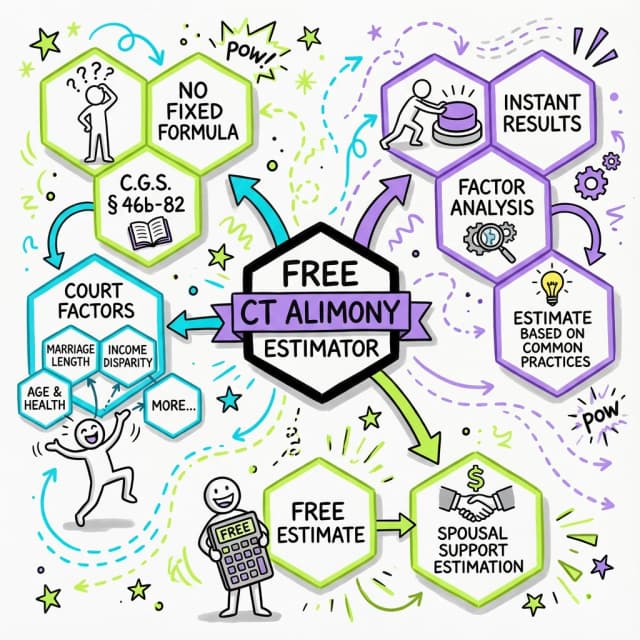
Try our free CT alimony calculator
Get an instant estimate based on Connecticut's statutory factors. No signup required.
Negotiating 401k Division: Options and Strategies
You have more control over how your 401k is divided than you might think—if you and your spouse can reach an agreement. Under C.G.S. § 46b-66, when parties submit a separation agreement addressing property division, the court will typically approve it as long as it's fair and equitable.
Common Division Approaches
Percentage Division: The most straightforward approach—each spouse receives a specified percentage of the 401k balance as of a certain date. A QDRO transfers that percentage to the alternate payee.
Offset Approach: Instead of dividing the 401k directly, one spouse keeps the entire account while the other receives equivalent value in other assets (such as home equity, savings, or reduced alimony payments).
Coverture Fraction: For long marriages where significant premarital contributions exist, the marital portion can be calculated using a formula that considers the length of marriage versus total years of contributions.
Future Payment: In some cases, especially with pensions or accounts that aren't immediately accessible, the division may be structured as future payments when benefits become available.
Each approach has advantages and disadvantages depending on your priorities, tax situation, and other assets available for division. If keeping your full 401k is important to you, an offset strategy might make sense—but only if you have other assets of sufficient value to make the trade equitable.
Financial Disclosure Requirements
Connecticut law requires comprehensive financial disclosure in divorce proceedings. Practice Book § 25-30 mandates that each party file sworn financial statements showing current income, expenses, assets, and liabilities. Your 401k must be listed on your Financial Affidavit, along with all other retirement accounts.
The mandatory disclosure rules under Practice Book § 25-32 are extensive. Within 60 days of a request, you must provide:
- Federal and state tax returns for the last three years
- W-2 and 1099 forms for the last three years
- Current year pay stubs
- Statements for all financial institution accounts for the past 24 months
- Documentation for retirement plans, including 401k statements
Attempting to hide or undervalue your 401k is not only unethical but also illegal. Courts have tools to discover hidden assets, and the consequences of dishonesty—including contempt charges and unfavorable property division—far outweigh any potential benefit.
When both parties provide complete information, negotiations become more productive and court proceedings move faster. Tools like Untangle's document generation can help you organize financial documents in the format Connecticut courts require, reducing stress and ensuring nothing is overlooked.
Timeline: When Does 401k Division Happen?
The actual division of your 401k typically occurs after your divorce is finalized, but the groundwork is laid throughout the divorce process.
| Stage | Timeline | 401k-Related Actions |
|---|---|---|
| Filing | Day 1 | Automatic orders freeze account changes |
| Disclosure | Within 60 days | Exchange 24 months of 401k statements |
| Resolution Plan | 30-60 days from return date | Identify whether 401k division is contested |
| Negotiation/Trial | Varies by track | Determine division terms |
| Judgment | End of case | QDRO terms included in orders |
| QDRO Processing | 30-90 days post-judgment | Plan administrator divides account |
Under Practice Book § 25-50A, Connecticut courts use a "Pathways" case management system that assigns cases to tracks based on complexity. Disputes over retirement asset division may result in assignment to Track B (moderate complexity) or Track C (complex), which affects how quickly your case moves through the system.
When Professional Help Is Essential
While many aspects of divorce can be navigated with good information and tools, 401k division often requires professional assistance. Consider consulting with a divorce attorney if:
- Your 401k represents a significant portion of your marital assets
- You have a pension or defined benefit plan in addition to a 401k
- You made substantial premarital contributions you want to protect
- Your spouse is self-employed or has complex compensation including stock options
- There are disputes about the valuation date or methodology
A Certified Divorce Financial Analyst (CDFA) can also provide valuable perspective on the long-term implications of different division scenarios, helping you understand how today's decisions affect your retirement security decades from now.
For straightforward situations where both spouses agree on division and simply need help executing the paperwork, Untangle's personalized task dashboard can help you prepare the necessary documents and understand each step, potentially reducing legal costs while ensuring nothing falls through the cracks.
Remember that protecting your financial future isn't selfish—it's responsible. Understanding your rights and options regarding 401k division helps you advocate effectively for yourself during one of life's most challenging transitions.
Frequently Asked Questions
What is a QDRO and do I need one to split my 401k in a Connecticut divorce?
A Qualified Domestic Relations Order (QDRO) is a legal document required to divide 401k accounts in divorce, as it directs your plan administrator to transfer a portion of your retirement funds to your ex-spouse without triggering taxes or penalties.
Is my 401k considered marital property in CT?
In Connecticut, your 401k is generally considered marital property to the extent it was accumulated during the marriage, though Connecticut's "all-property" equitable distribution laws give courts discretion to consider even premarital contributions when dividing assets.
Can I withdraw from my 401k during divorce to avoid splitting it?
Withdrawing from your 401k during divorce to avoid splitting it is not advisable, as you'll face a 10% early withdrawal penalty plus income taxes, and Connecticut courts may still account for the dissipated assets when dividing property.
How do I protect my premarital 401k contributions in a Connecticut divorce?
To protect premarital 401k contributions in Connecticut, you should gather account statements showing the balance at the time of marriage and document any growth attributable to premarital funds, though courts still have discretion to consider these assets under Connecticut's all-property distribution rules.
How long does it take to split a 401k after divorce in Connecticut?
Splitting a 401k after divorce typically takes 2-4 months once the QDRO is drafted and approved by both the court and your plan administrator, though complex plans or delays in paperwork can extend this timeline.
Legal Citations
- • C.G.S. § 46b-81 - Assignment of property and transfer of title View Source
- • C.G.S. § 46b-66 - Review of final agreement; incorporation into decree View Source
- • Practice Book § 25-5 - Automatic Orders upon Service of Complaint or Application View Source
- • Practice Book § 25-30 - Statements To Be Filed View Source
- • Practice Book § 25-32 - Mandatory Disclosure and Production View Source
- • Practice Book § 25-50A - Case Management under Pathways View Source
- • Anketell v. Kulldorff, 223 Conn. App. 345 View Source
- • Nedder v. Nedder, 226 Conn. App. 817 View Source
- • Financial Affidavit Long Form (JD-FM-006) View Source