Untangle vs Wealth Manager for Connecticut Divorce Planning: Which Is Right for High-Asset Cases?
Compare Untangle and traditional wealth managers for Connecticut high-asset divorce planning. Learn which approach best protects your assets, business interests, and financial future.
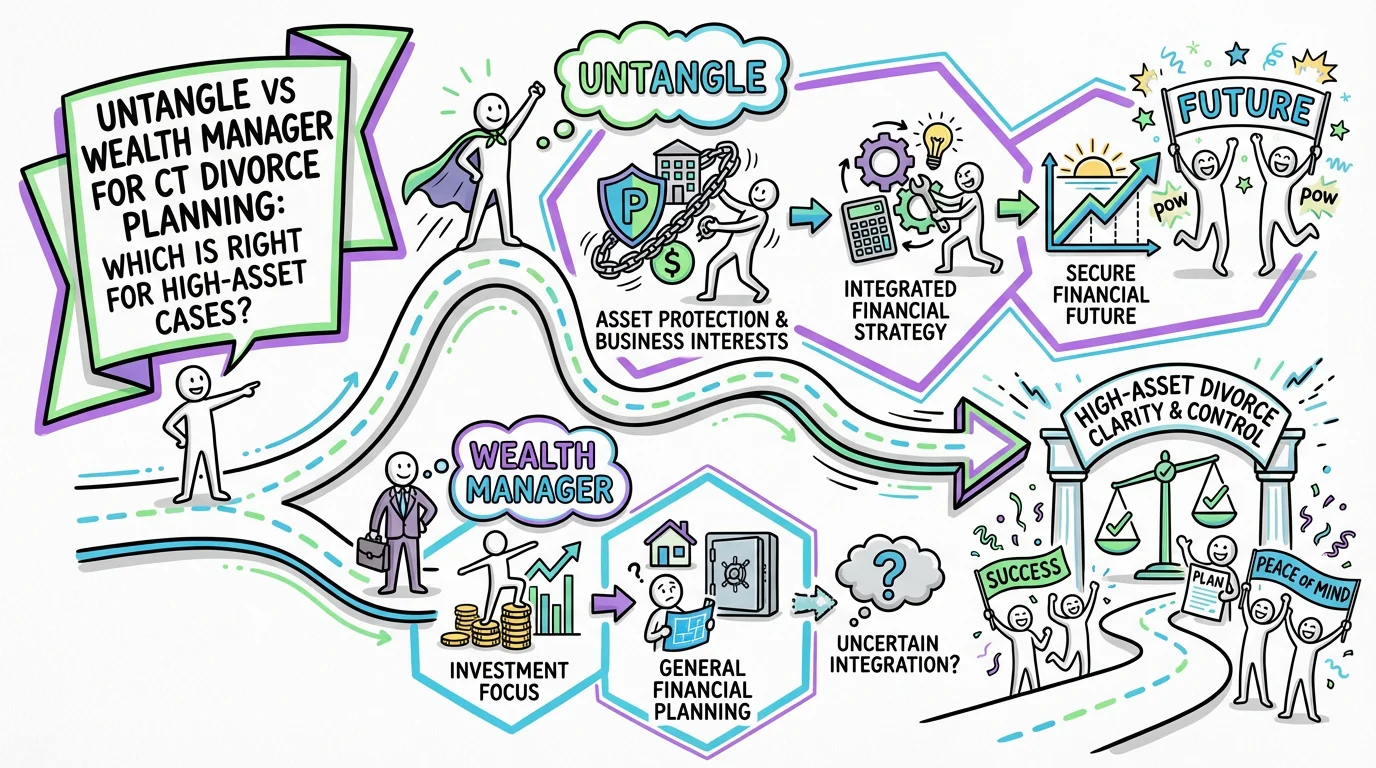
For high-asset Connecticut divorces, Untangle and traditional wealth managers serve fundamentally different purposes—and most people protecting significant wealth need elements of both. Untangle provides real-time divorce planning tools, document organization, and scenario modeling specifically designed for the divorce process itself, while wealth managers focus on long-term investment strategy and post-divorce financial planning. The key difference: Untangle helps you navigate the legal and financial complexities of dividing assets during divorce, while wealth managers help you grow and protect assets before and after the process concludes.
Understanding the Core Difference
When you're protecting substantial wealth or business interests in a Connecticut divorce, timing matters enormously. Connecticut operates under an "all property" equitable distribution system, meaning the court can divide virtually any asset either spouse owns, regardless of when or how it was acquired. Under C.G.S. § 46b-81, the Superior Court may "assign to either spouse all or any part of the estate of the other spouse." This sweeping authority makes strategic planning during the divorce process itself—not just before or after—absolutely critical.
Traditional wealth managers excel at portfolio management, tax-efficient investing, and retirement planning. They can help you understand how a proposed settlement might affect your long-term financial picture. However, most wealth managers lack specialized knowledge of Connecticut divorce law, court procedures, and the specific financial disclosures required by Practice Book Rule § 25-32. They typically aren't equipped to help you model different division scenarios, track mandatory disclosure deadlines, or organize the complex documentation required in high-asset cases.
Untangle's divorce planning platform fills this gap by providing tools specifically designed for the divorce process. Rather than replacing your wealth manager's expertise, Untangle helps you organize financial information, model settlement scenarios, and prepare for negotiations—all while keeping your professional advisors informed and aligned.
What Untangle Offers High-Asset Divorces
Untangle addresses the unique challenges that arise when substantial wealth is at stake in a Connecticut dissolution. The platform helps you organize and track the extensive financial documentation required under Connecticut's mandatory disclosure rules, which include three years of tax returns, 24 months of financial statements, and business valuations for closely held entities.
For Connecticut divorces involving significant assets, the Financial Affidavit is a cornerstone document. The Financial Affidavit Long Form (JD-FM-006) requires detailed disclosure of income, expenses, assets, and liabilities—and any errors or omissions can seriously damage your credibility with the court. Tools like Untangle's financial affidavit generation can help streamline this complex process and ensure your financial picture is complete and accurate before you file, reducing the risk of costly mistakes or accusations of hiding assets.
Perhaps most valuable for high-asset cases, Untangle enables you to model different property division scenarios. Connecticut courts consider numerous factors when dividing property, including each spouse's contribution to marital assets, future earning capacity, and the liquidity of particular assets. Being able to visualize how different divisions affect your overall financial position helps you negotiate from a position of knowledge rather than uncertainty. To gain this clarity, tools like Untangle's spouse financial comparison can help you visualize the potential impact of various asset divisions on both parties' financial futures, empowering more informed negotiation.
What Wealth Managers Bring to the Table
A skilled wealth manager provides perspective that extends far beyond the divorce itself. They can model how proposed settlements affect your retirement timeline, tax liability, and estate planning. For example, receiving the family home rather than investment accounts of equivalent value has dramatically different long-term implications—your wealth manager can quantify those differences.
Wealth managers also play a crucial role in post-divorce financial reconstruction. After a Connecticut divorce concludes, you'll likely need to restructure your investment portfolio, update beneficiary designations, revise your estate plan, and potentially adjust your risk tolerance. These are areas where wealth management expertise is irreplaceable.
However, wealth managers typically charge based on assets under management (AUM), often 0.5% to 1.5% annually. During divorce, when your asset base may be cut significantly and every dollar matters, this fee structure deserves careful consideration. Additionally, if your spouse also works with the same wealth management firm, conflicts of interest may arise that require you to seek advice elsewhere during the divorce process.
High-Asset Divorce Requirements in Connecticut
Connecticut's mandatory disclosure requirements are particularly rigorous when substantial assets are involved. Practice Book Rule § 25-32 requires automatic exchange of extensive financial documentation within 60 days of request. For high-asset cases, this typically includes:
| Document Category | Requirement | Time Period |
|---|---|---|
| Tax Returns | Federal and state, including K-1s | Last 3 years |
| Income Documentation | W-2s, 1099s, K-1s | Last 3 years + current year |
| Financial Accounts | All bank, brokerage, retirement statements | Past 24 months |
| Business Interests | Most recent balance sheet and P&L | Current year |
| Real Estate | Deeds, mortgages, equity statements | Current |
For closely held businesses, the disclosure requirements extend even further. You may need to produce years of business tax returns, shareholder agreements, buy-sell agreements, and formal business valuations. Managing this documentation manually is both time-consuming and error-prone. Tools like Untangle's complete asset inventory can help you track what's been produced, what's outstanding, and what deadlines are approaching for all your financial documentation.
The consequences of incomplete disclosure can be severe. Connecticut courts have broad discretion to draw adverse inferences from missing documentation, and in extreme cases, courts may impose sanctions or even reopen final judgments when parties have hidden assets.
Comparing Approaches for Key High-Asset Concerns
When evaluating Untangle versus a wealth manager for your Connecticut divorce, consider how each addresses your specific concerns:
| Concern | Untangle's Approach | Wealth Manager's Approach |
|---|---|---|
| Asset inventory and organization | Real-time tracking, document management, disclosure compliance | General overview, may rely on statements you provide |
| Settlement scenario modeling | CT-specific scenarios with statutory factors | Long-term portfolio projections |
| Business valuation coordination | Helps organize documentation for valuators | May recommend trusted valuators |
| Retirement account division | Models QDRO scenarios and tax implications | Advises on post-divorce investment strategy |
| Real-time process guidance | Step-by-step divorce navigation | General financial advice |
| Cost structure | Subscription-based, predictable | AUM-based (0.5%-1.5% annually) |
The Connecticut Supreme Court has affirmed that even unvested deferred compensation and complex executive benefits are subject to equitable distribution. In Czarzasty v. Czarzasty, the court addressed how unvested performance-based deferred compensation should be valued and divided. These sophisticated assets require both process expertise (understanding how Connecticut courts approach division) and financial expertise (understanding long-term value implications).
Protecting Business Interests
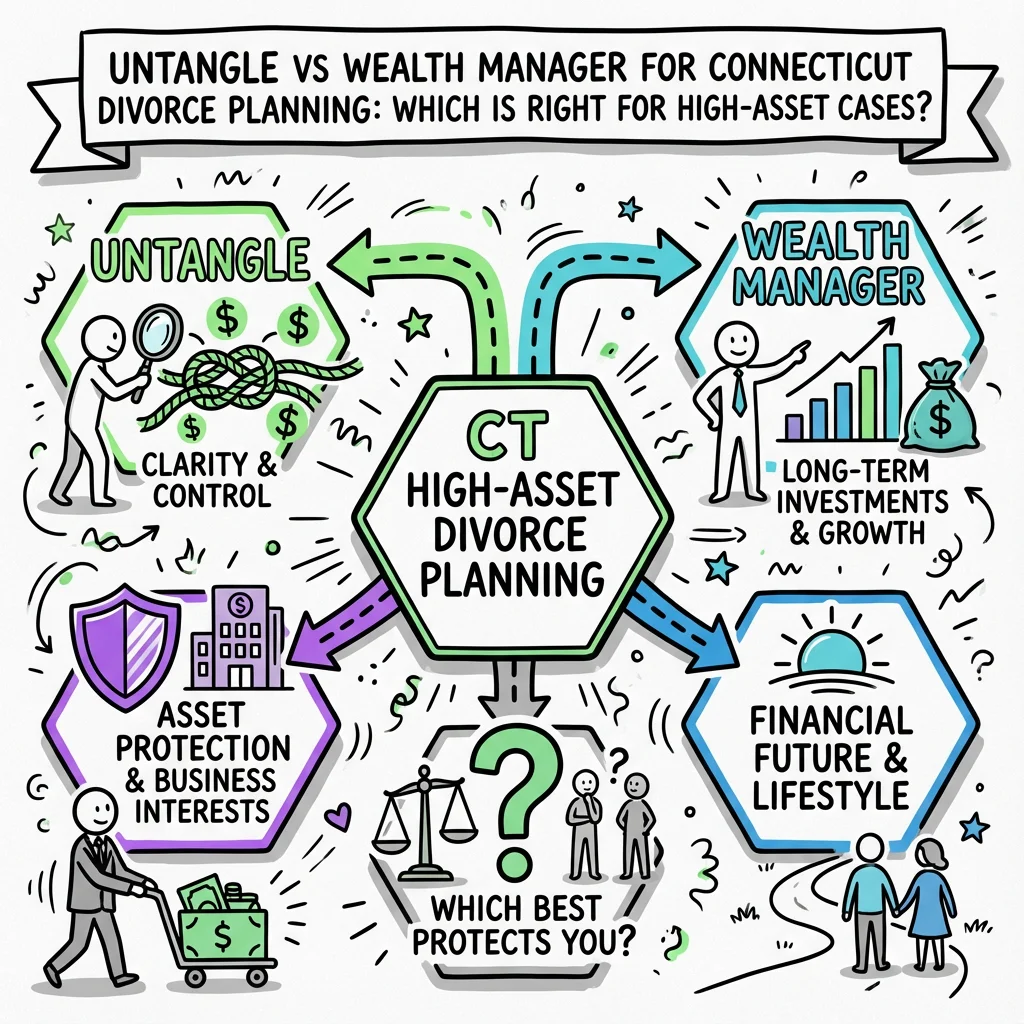
If you own a business or hold significant equity in a closely held company, your Connecticut divorce involves layers of complexity that neither tool alone can fully address. Under C.G.S. § 46b-81, the court can assign business interests to either spouse, order a buyout, or even mandate a sale when "in the judgment of the court it is the proper mode to carry the decree into effect."
Your wealth manager likely understands your business's value as an investment, but may not appreciate how Connecticut courts value businesses for divorce purposes. Courts often rely on multiple valuation methods—income approach, market approach, and asset approach—and may apply discounts for lack of marketability or minority interests. The valuation date, which is typically negotiated or set by the court, can dramatically affect results.
Untangle helps you prepare for these valuation discussions by organizing the financial documentation your business valuator will need. This includes profit and loss statements, balance sheets, tax returns, customer and vendor contracts, and compensation details for key employees. For these complex business valuations, features like Untangle's smart bank statement analysis can help you swiftly gather and prepare the granular financial data required by valuators, reducing preparation time and costs. Having this information organized and readily accessible can reduce valuation costs and ensure your expert has complete information to work with.
Practical Steps for High-Asset Divorce Protection
If you're facing a high-asset Connecticut divorce, consider this integrated approach:
-
Start with comprehensive organization - Before engaging any professional, use Untangle's platform to inventory all assets, debts, and income sources. This foundational step ensures you can communicate efficiently with any advisor you engage.
-
Understand automatic court orders - The moment a divorce complaint is served in Connecticut, Practice Book Rule § 25-5 imposes automatic orders that prohibit transferring, concealing, or dissipating assets. Violating these orders can result in contempt findings and adverse treatment in the final division.
-
Engage specialized professionals strategically - For truly complex estates, you may need a forensic accountant, business valuator, and family law attorney in addition to your existing wealth manager. Each serves a distinct purpose—don't expect any single professional to handle everything.
-
Model settlement scenarios before negotiating - Use Untangle's scenario tools to understand how different asset divisions affect your overall position. This preparation helps you negotiate rationally rather than emotionally.
-
Coordinate post-divorce financial planning - Once a settlement framework emerges, engage your wealth manager to model the long-term implications. They can help ensure the proposed division actually supports your future goals.
-
Document everything meticulously - Connecticut requires sworn financial statements (updated within 30 days before judgment) and certified compliance with discovery obligations. Incomplete or inaccurate filings can undermine your credibility and negotiating position.
When Both Approaches Work Together
The most effective approach for high-asset Connecticut divorces integrates Untangle's divorce-specific tools with traditional wealth management expertise. Consider this framework:
During divorce: Untangle serves as your primary organizational and planning tool. Use it to track disclosures, model scenarios, manage deadlines, and prepare for negotiations. Your wealth manager provides background analysis on how proposed settlements affect your long-term financial picture.
After divorce: Your wealth manager takes the lead in restructuring your portfolio, updating estate plans, and implementing the financial strategy for your post-divorce life. Untangle's records help ensure smooth transitions of accounts and accurate implementation of property division orders.
For retirement account divisions in particular, both perspectives matter. Qualified Domestic Relations Orders (QDROs) divide retirement assets without triggering immediate taxation, but they must be drafted precisely to comply with federal law and the specific plan's requirements. In Richman v. Wallman, the Connecticut Appellate Court addressed disputes over revised QDROs, highlighting how technical these instruments can be. Your wealth manager can advise on the long-term implications of different division approaches, while Untangle helps you track the QDRO drafting and approval process.
When to Seek Additional Professional Help
While Untangle provides powerful tools for divorce planning and organization, certain high-asset situations require specialized professional guidance:
-
Complex business valuations - If you own a business valued at over $1 million or with complicated ownership structures, engage a credentialed business valuator (CVA, ASA, or ABV) early in the process.
-
Executive compensation packages - Stock options, restricted stock units, deferred compensation, and pension benefits require specialized analysis to value and divide properly.
-
Interstate or international assets - Assets in multiple jurisdictions create enforcement and tax complications that require experienced legal counsel.
-
Premarital or postnuptial agreements - Under Practice Book Rule § 25-2A, enforcing or challenging these agreements requires specific procedural steps and tight deadlines.
-
Suspected hidden assets - If you believe your spouse is concealing wealth, a forensic accountant can trace funds and identify discrepancies that might otherwise go undetected.
The court may also appoint its own expert witnesses under Practice Book Rule § 25-33, particularly in cases where the parties' valuations differ significantly. Understanding when and how this might occur helps you prepare appropriately.
Making the Right Choice for Your Situation
For most high-asset Connecticut divorces, the question isn't whether to use Untangle or a wealth manager—it's how to use both most effectively. Untangle excels at the divorce process itself: organizing documentation, ensuring disclosure compliance, modeling settlement scenarios, and keeping you informed about deadlines and requirements. Your wealth manager excels at the broader financial picture: investment strategy, tax planning, and long-term wealth preservation.
The Connecticut divorce process is finite—typically lasting six months to two years for complex cases. During this period, Untangle's specialized tools provide value that general wealth management cannot replicate. Once your divorce concludes and you're implementing your settlement, your wealth manager's expertise becomes essential for building your financial future.
By using each resource where it provides the most value, you protect your wealth both during the divorce process and for the decades that follow.
Frequently Asked Questions
Do I need a CDFA or wealth manager for my Connecticut divorce?
For high-asset CT divorces, you may benefit from both—a CDFA (Certified Divorce Financial Analyst) helps with asset division strategy during the divorce process, while a wealth manager focuses on long-term investment and post-divorce financial planning.
When should I hire a financial advisor during my divorce in Connecticut?
You should engage divorce-specific financial help as early as possible in the process, ideally before filing, since Connecticut's "all property" equitable distribution system under C.G.S. § 46b-81 allows courts to divide virtually any asset either spouse owns.
What is the difference between divorce financial planning software and a financial planner?
Divorce planning software like Untangle provides real-time scenario modeling, document organization, and deadline tracking specifically for the divorce process, while financial planners typically focus on investment strategy and wealth growth before and after divorce concludes.
How much does divorce financial planning cost in CT compared to using software tools?
Traditional wealth managers and CDFAs typically charge hourly fees or a percentage of assets under management, while divorce planning software like Untangle offers a more affordable flat-rate or subscription model for document organization and scenario modeling.
Can I use both Untangle and a wealth manager for my Connecticut high-asset divorce?
Yes, most people protecting significant wealth in CT divorces benefit from using both—Untangle for navigating the legal and financial complexities of asset division during divorce, and a wealth manager for long-term financial planning afterward.
Legal Citations
- • Practice Book Rule § 25-32 - Mandatory Disclosure and Production View Source
- • Practice Book Rule § 25-5 - Automatic Orders upon Service of Complaint or Application View Source
- • Practice Book Rule § 25-2A - Premarital and Postnuptial Agreements View Source
- • Practice Book Rule § 25-33 - Judicial Appointment of Expert Witnesses View Source
- • Czarzasty v. Czarzasty, 922 A.2d 272 View Source
- • Richman v. Wallman, 161 A.3d 666 View Source
- • Financial Affidavit Long Form (JD-FM-006) View Source