Untangle vs Courthouse Filing Speed in Connecticut: Which Gets Your Divorce Done Faster?
Compare Untangle's streamlined divorce process to traditional Connecticut courthouse filing. Learn which option minimizes delays and gets your divorce finalized fastest.
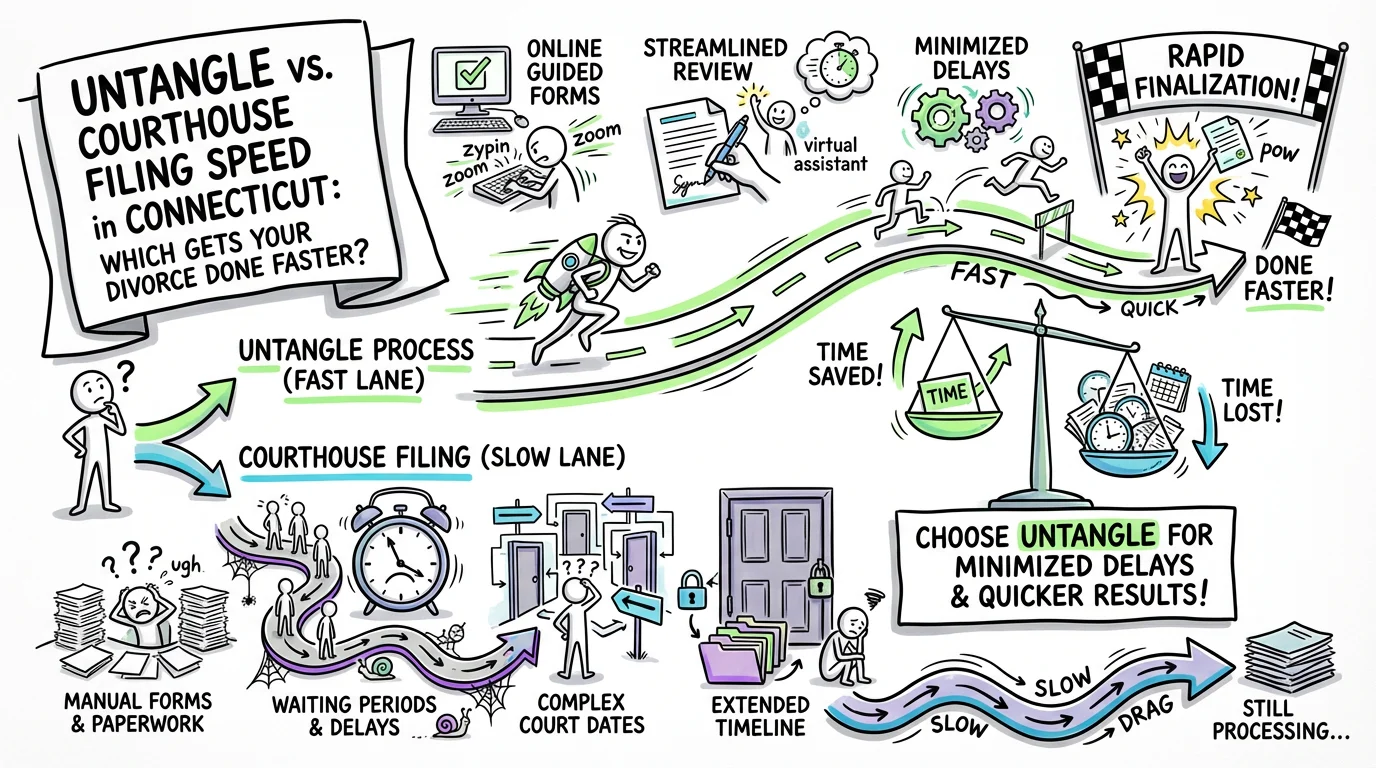
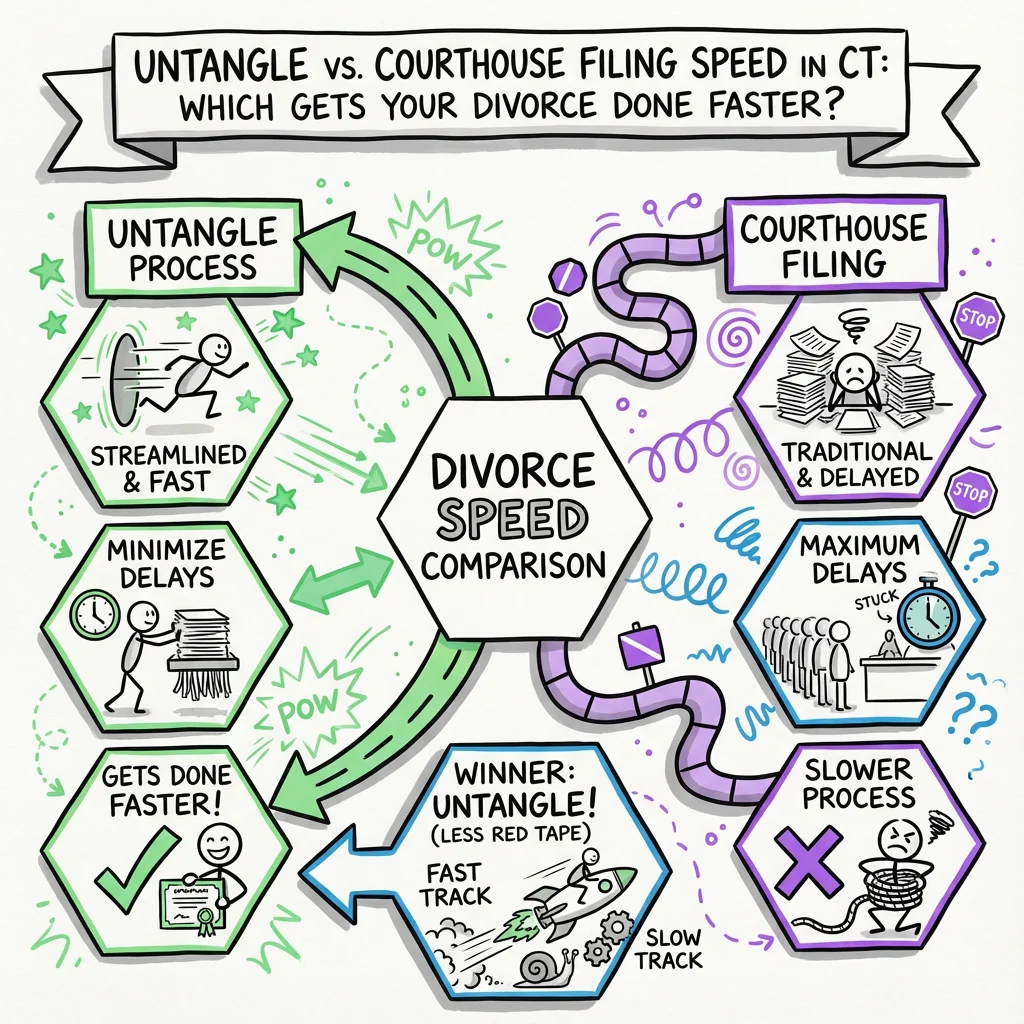
Using Untangle to prepare and file your Connecticut divorce can save you weeks of delays compared to navigating the courthouse process on your own. While both paths must follow Connecticut's mandatory 30-day minimum waiting period for uncontested divorces, the difference lies in preparation time, error rates, and scheduling efficiency. Traditional self-filing typically involves multiple courthouse trips, rejected paperwork, and scheduling confusion—delays that can add months to your timeline. Untangle streamlines the entire preparation process, ensuring your documents are complete and court-ready from day one.
Understanding Connecticut's Divorce Timeline Requirements
Connecticut law establishes specific timeframes that apply regardless of how you file. For a nonadversarial (uncontested) dissolution, C.G.S. § 46b-44c mandates that the court assign a disposition date "not less than thirty days after the date on which the parties filed the joint petition." This 30-day minimum is a legal floor—it's the absolute fastest any Connecticut divorce can be finalized, and it applies whether you use Untangle, an attorney, or file everything yourself at the courthouse.
For contested divorces or cases where one spouse files alone, the timeline extends significantly. Under C.G.S. § 46b-67, the court generally cannot proceed on a complaint until "following the second day after which a complaint for dissolution or legal separation is made returnable." The return date is typically set about six weeks after filing, meaning contested cases have a built-in delay of nearly two months before substantive proceedings can even begin.
What this means practically: your filing method doesn't change these statutory minimums, but it dramatically affects how much time you spend getting TO that starting line. The real question isn't "can Untangle make the court move faster?" but rather "how quickly can I get properly filed and avoid delays that extend my case beyond the minimum?"
Where Traditional Courthouse Filing Creates Delays
Filing directly at the Connecticut courthouse sounds straightforward until you experience it firsthand. The process involves obtaining the correct forms, completing them accurately, coordinating service of process on your spouse (if not filing jointly), preparing all required financial disclosures, and ensuring everything meets the court's formatting and content requirements. Each step presents opportunities for delay.
Document Preparation Bottlenecks
Connecticut requires specific forms and information that many people struggle to compile correctly. Practice Book Rule § 25-2 requires that every complaint state the date and place of marriage, jurisdictional facts, information about all minor children, and details about any state support involvement. Missing any of these elements can result in rejection at the filing window. The Financial Affidavit (Form JD-FM-006) requires detailed income, expense, asset, and liability information that must be sworn and notarized—another step that requires coordination and accuracy.
Practice Book Rule § 25-30 adds another layer of complexity: sworn financial statements must be filed at least five business days before any hearing involving alimony or support, and updated statements are required within 30 days before judgment. Miss these deadlines, and your hearing gets postponed. Untangle's document generation tools guide you through each requirement step-by-step, flagging missing information before you ever approach the courthouse.
The Rejection-Revision Cycle
Courthouse clerks routinely reject filings for technical deficiencies—wrong form versions, missing signatures, incomplete information, or improper formatting. Each rejection means returning home, making corrections, and scheduling another trip to the courthouse. For people juggling work schedules and childcare, this cycle can stretch a single filing attempt across weeks.
The Summons (Form JD-FM-003) alone requires precise completion to properly initiate your case. When filing a joint petition under C.G.S. § 46b-44a, both parties must provide notarized attestations that specific conditions exist—if these attestations are incomplete or improperly executed, your joint filing fails.
How Untangle Accelerates the Process
Untangle addresses the friction points that slow down traditional filing by front-loading the preparation work into a guided digital experience. Rather than researching form requirements, tracking down documents, and hoping you've assembled everything correctly, you answer questions and let the platform compile your paperwork.
Intelligent Document Assembly
The platform generates court-ready documents based on your specific situation. For couples pursuing Connecticut's nonadversarial dissolution pathway, Untangle ensures your joint petition contains all attestations required under C.G.S. § 46b-44a—including the sworn statements about residency, agreement on all issues, and the absence of minor children (or completion of required parenting provisions if children are involved). This eliminates the guesswork that leads to rejected filings.
Untangle's intelligent document generation asks the questions the court requires answers to, then populates the correct forms automatically. You're not hunting through the Judicial Branch website trying to determine which of dozens of family forms apply to your situation.
Financial Affidavit Automation
The financial affidavit is where many self-filers struggle most. Connecticut courts require comprehensive disclosure of income sources, monthly expenses, assets, and debts. The Short Form Financial Affidavit applies when neither party's net income exceeds $75,000 annually and total assets are under $75,000—but you need to know that threshold exists and accurately calculate whether you qualify.
Untangle's financial affidavit tools help you organize this information systematically, ensuring your affidavit is complete and mathematically consistent. Inconsistencies between stated income and reported expenses are a red flag that can trigger additional court scrutiny and delays.
Speed Comparison: Filing Methods in Connecticut
| Factor | Traditional Courthouse Filing | Untangle-Prepared Filing |
|---|---|---|
| Document preparation time | 5-20+ hours researching and completing forms | 1-3 hours with guided interview |
| Risk of rejection | High—common for self-filers | Low—documents validated before submission |
| Trips to courthouse | Multiple (filing, corrections, hearing) | Minimized (documents ready on first attempt) |
| Minimum legal timeline | 30 days (uncontested) | 30 days (uncontested) |
| Typical actual timeline | 3-6 months | 30-90 days for uncontested cases |
| Service of process coordination | Your responsibility to arrange | Guidance provided; joint filing eliminates need |
| Financial disclosure errors | Common cause of delays | Automated validation reduces errors |
Try our free CT alimony calculator
Get an instant estimate based on Connecticut's statutory factors. No signup required.
The Pathways System and Why Preparation Matters
Connecticut's family courts use a case management system called "Pathways" that assigns cases to different tracks based on complexity. Under Practice Book Rule § 25-50A, after filing you'll be assigned a Resolution Plan Date set 30-60 days from the return date. At this meeting, a family relations counselor evaluates your case and recommends Track A (minimal court intervention), Track B (moderate complexity), or Track C (complex/high-conflict).
Cases that arrive well-organized with complete documentation and clear agreements between spouses are more likely to land on Track A—the fastest path to resolution. Arriving with incomplete paperwork, missing disclosures, or obvious disputes signals to the court that your case needs more oversight, potentially extending your timeline by months.
This is where Untangle's AI-assisted mediation provides significant value. The platform helps couples work through property division, support questions, and (if applicable) parenting arrangements before filing. Presenting the court with a comprehensive settlement agreement on day one dramatically improves your odds of a streamlined Track A experience.
Step-by-Step: Fastest Path to Connecticut Divorce Finalization
-
Confirm eligibility for nonadversarial dissolution — You and your spouse agree on all terms, and at least one of you meets Connecticut residency requirements. If you have minor children, you must also agree on custody, visitation, and support arrangements.
-
Gather financial documentation — Bank statements, pay stubs, tax returns, retirement account statements, mortgage documents, and debt records. Having these ready accelerates affidavit completion.
-
Complete the Untangle interview process — Answer questions about your marriage, assets, debts, income, and agreements. Tools like Untangle's Personalized task dashboard can guide you through every step, breaking down the complex process into manageable actions. The platform generates your joint petition, settlement agreement, and financial affidavits.
-
Review and sign documents — Both parties must sign and notarize the joint petition attestations. Untangle provides clear instructions on notarization requirements.
-
File with the court — Submit your complete package to the Superior Court for your judicial district. Pay the filing fee (currently around $360 for dissolution cases).
-
Wait the mandatory 30-day period — Under C.G.S. § 46b-44c, no disposition can occur sooner than 30 days after filing.
-
Attend your disposition date — If no revocation has been filed and all paperwork is in order, the court enters your dissolution decree on or within five days of this date.
When Speed Seekers Should Consider Additional Help
While Untangle accelerates the standard divorce process significantly, some situations benefit from attorney involvement even when speed is the priority. If your spouse is uncooperative or has stopped communicating, you may need to file a traditional (adversarial) complaint under C.G.S. § 46b-45 and arrange formal service of process—a more complex procedure that benefits from legal guidance.
Similarly, if you have substantial assets, business interests, or pension/retirement divisions, the financial stakes may warrant attorney review even if you and your spouse fundamentally agree. An error in how retirement assets are divided, for example, can have consequences that long outlast the time saved by rushing through the process.
Untangle's AI legal guidance can provide immediate answers to procedural questions during your preparation. However, for direct representation or review of complex assets, consulting a local family law attorney is recommended. This hybrid approach—using Untangle for preparation and seeking targeted legal advice when needed—often delivers both speed and peace of mind.
Avoiding Common Delays: What Slows Down Connecticut Divorces
Understanding what causes delays helps you avoid them:
- Incomplete financial disclosure — Courts require full transparency. Omitting assets or income sources triggers discovery disputes and delays judgment.
- Unresolved parenting issues — If you have minor children and haven't agreed on parenting arrangements, expect the court to order mediation or evaluation before proceeding.
- Parent education program requirements — Connecticut requires divorcing parents to complete a court-approved parenting education program. Failure to complete it before judgment delays finalization.
- Missing Certificate of Compliance — Form JD-FM-175 confirms you've met all pre-judgment requirements. Forgetting this simple form can postpone your decree.
- Automatic orders violations — Under Practice Book Rule § 25-5B, automatic restraining orders take effect immediately upon filing. Violating these orders (like canceling insurance or hiding assets) can result in contempt proceedings that derail your timeline.
Untangle's checklist system tracks all these requirements, sending reminders and confirmations as you complete each step. This systematic approach eliminates the "I didn't know I needed that" surprises that extend divorce timelines.
Frequently Asked Questions
What is the fastest way to get divorced in Connecticut?
The fastest way to get divorced in CT is through an uncontested (nonadversarial) dissolution, which has a mandatory minimum 30-day waiting period under Connecticut law, though using a preparation service like Untangle can help you reach that starting line faster by avoiding paperwork errors and multiple courthouse trips.
How long does an uncontested divorce take in Connecticut?
An uncontested divorce in Connecticut takes a minimum of 30 days from filing under C.G.S. § 46b-44c, but the total timeline depends on how quickly you prepare error-free documents—self-filers often face additional weeks or months due to rejected paperwork and scheduling delays.
How many times do I have to go to the courthouse to file for divorce in CT?
Traditional self-filing in Connecticut typically requires multiple courthouse trips to file paperwork, correct errors, and attend hearings, while online divorce preparation services like Untangle can reduce or eliminate many of these visits by ensuring documents are complete and court-ready from the start.
What causes delays when filing for divorce at a Connecticut courthouse?
Common delays when self-filing at a CT courthouse include rejected paperwork due to errors or missing information, scheduling confusion, long wait times for hearing dates, and the need for multiple trips to correct mistakes.
How long does a contested divorce take in Connecticut compared to uncontested?
A contested divorce in Connecticut takes significantly longer than uncontested cases, with a built-in delay of nearly two months before substantive proceedings can begin since the court cannot proceed until after the return date, which is typically set about six weeks after filing.
Legal Citations
- • Connecticut Practice Book Rule § 25-2 - Complaints for Dissolution of Marriage View Source
- • Connecticut Practice Book Rule § 25-5B - Automatic Orders upon Filing of Joint Petition View Source
- • Connecticut Practice Book Rule § 25-30 - Statements To Be Filed View Source
- • Connecticut Practice Book Rule § 25-50A - Case Management under Pathways View Source
- • C.G.S. § 46b-44c - Waiver of time periods View Source
- • C.G.S. § 46b-67 - Waiting period View Source
- • C.G.S. § 46b-44a - Joint petition View Source
- • C.G.S. § 46b-45 - Service of process View Source
- • Form JD-FM-003 - Summons Family Actions View Source
- • Form JD-FM-006 - Financial Affidavit Short Form View Source
- • Form JD-FM-175 - Certificate of Compliance View Source