Connecticut Parenting Plan Guide: Creating Child-Focused Custody Agreements
Learn how to create a comprehensive Connecticut parenting plan that protects your children's best interests during divorce, including custody schedules and decision-making.
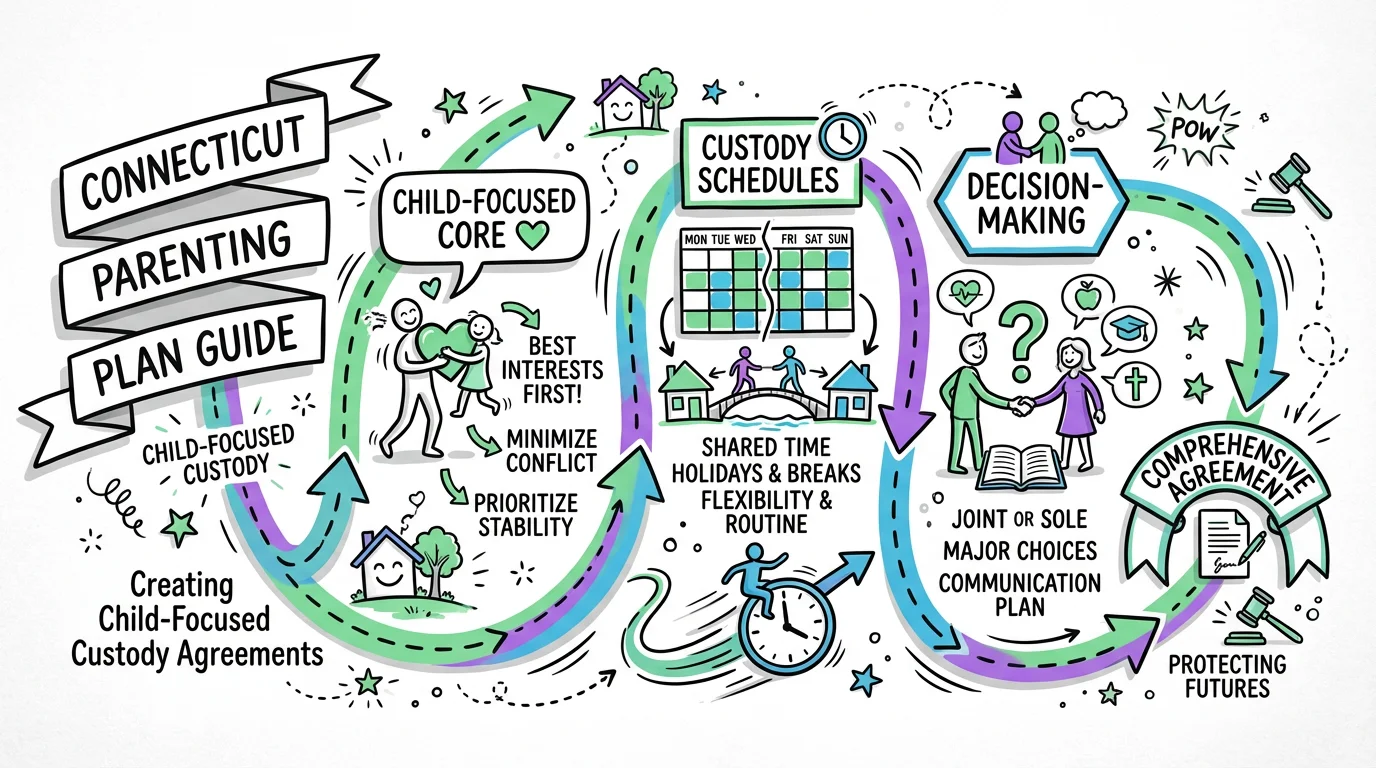
A parenting plan in Connecticut is a detailed written agreement that outlines how divorced or separated parents will share responsibilities for raising their children. Under C.G.S. § 46b-56a, Connecticut courts may require parents seeking joint custody to submit a "parental responsibility plan" that addresses physical custody schedules, legal custody decisions, and how parents will resolve future disputes. Untangle's parenting plan builder helps Connecticut parents create comprehensive, court-ready plans that prioritize their children's wellbeing while ensuring all legal requirements are met.
Understanding Connecticut Parenting Plans
Connecticut law recognizes that children benefit from maintaining meaningful relationships with both parents after divorce. The statutory framework under C.G.S. § 46b-56 gives courts broad authority to make orders regarding "custody, care, education, visitation and support of the children" based on the best interests of the child standard. A well-crafted parenting plan transforms these legal requirements into a practical roadmap for co-parenting success.
The parenting plan serves multiple purposes in Connecticut family court. First, it demonstrates to the judge that parents have thoughtfully considered their children's needs and can work together on important decisions. Second, it provides clear expectations that reduce future conflicts between co-parents. Third, it creates an enforceable document that can be incorporated into your divorce decree, giving both parents legal recourse if the agreement is violated.
For protective parents—those whose primary concern is ensuring their children's safety and stability—a detailed parenting plan is especially important. The plan allows you to build in specific protections, establish clear boundaries, and create accountability measures that serve your children's best interests while maintaining appropriate boundaries with your co-parent.
Key Components of a Connecticut Parenting Plan
Physical Custody Schedule
The physical custody schedule determines where your children will live and when they will spend time with each parent. Connecticut courts can award joint physical custody, where children split time between homes, or primary physical custody to one parent with visitation rights for the other. Under C.G.S. § 46b-56a, joint custody means "physical custody shall be shared by the parents in such a way as to assure the child of continuing contact with both parents."
Your parenting plan should address regular weekly schedules, including school-year and summer arrangements. Consider your children's ages, school locations, extracurricular activities, and each parent's work schedule when designing this section. For younger children, more frequent transitions may help maintain attachment to both parents, while older children may prefer longer stretches in each home to maintain social connections.
Holiday and vacation schedules require careful planning. Most Connecticut parenting plans alternate major holidays (Thanksgiving, winter break, spring break) between parents and specify how birthdays, Mother's Day, Father's Day, and other special occasions will be handled. Using schedule templates within Untangle can help you adopt common holiday rotation patterns that comply with Connecticut court expectations.
Legal Custody and Decision-Making
Legal custody determines which parent has authority to make major decisions about your children's lives. Connecticut distinguishes between joint legal custody—where both parents share decision-making authority—and sole legal custody, where one parent has final say. As noted in D. K. v. D. F., courts carefully evaluate whether joint legal custody serves the children's best interests, particularly when parents have difficulty communicating.
Your parenting plan should specify how decisions will be made in key areas including education (school selection, special education services, tutoring), healthcare (medical treatment, mental health care, medication decisions), religious upbringing, and extracurricular activities. Some parents divide decision-making authority by category, while others require mutual agreement on all major decisions with a dispute resolution process if they cannot agree.
For day-to-day decisions, the plan typically grants authority to whichever parent has physical custody at the time. However, your plan should clarify how parents will communicate about daily matters, share information about school performance, and coordinate on issues that affect both households.
The Best Interests Standard in Connecticut
Connecticut courts evaluate all custody arrangements—including parenting plans—through the lens of the "best interests of the child" standard established in C.G.S. § 46b-56. Understanding this standard helps you create a parenting plan that courts will readily approve and that genuinely serves your children's needs.
The statute directs courts to consider several factors when making custody determinations, including the child's developmental needs, the quality of each parent's relationship with the child, the child's adjustment to home and community, and each parent's ability to facilitate a relationship between the child and the other parent. Courts also consider the stability of proposed living arrangements and the child's preferences if the child is of sufficient age and maturity.
When safety concerns exist, courts take them very seriously. If there is a history of domestic violence, substance abuse, or child abuse, your parenting plan should address these concerns directly. You may request supervised visitation, restrictions on overnight stays, or other protective measures. Connecticut courts have authority under C.G.S. § 46b-56 to order "therapy, counseling and drug or alcohol screening" when warranted, and your parenting plan can request these safeguards.
Creating Your Parenting Plan Step by Step
Step 1: Gather Essential Information
Before drafting your parenting plan, compile detailed information about your children's current schedules, routines, and needs. This includes school schedules and locations, medical providers and any ongoing treatments, extracurricular activities and commitments, and special needs or accommodations. Having all documentation ready, such as report cards, medical records, and activity schedules, ensures your plan reflects reality rather than assumptions.
You will also need to complete the Affidavit Concerning Children (Form JD-FM-164), which provides the court with required information under Practice Book Rule § 25-57. This form discloses where the children have lived for the past five years and whether other court cases involve the same children. Accurate completion of this form is jurisdictional, meaning the court cannot proceed without it.
Step 2: Develop Your Proposed Schedule
Create a realistic custody schedule that accounts for both parents' work schedules, your children's activities, and practical logistics like transportation. Consider how transitions will occur—where exchanges happen, who is responsible for transportation, and how you'll handle schedule changes. You should also account for the geographic distance between homes, as a 50/50 schedule becomes significantly harder to maintain if parents live in different school districts.
Visualizing the schedule is crucial to spotting potential conflicts. Using Untangle's automated parenting plan tools allows you to map out different custody arrangements, overlay holidays, and see where overlaps might occur before they become problems in real life. This proactive approach helps reduce friction once the plan is in place.
Step 3: Address Communication and Conflict Resolution
Your parenting plan should establish clear communication protocols between co-parents to minimize direct conflict. This might include designated methods of communication (email, text, or a specific co-parenting app), expected response times for non-emergency matters, and rules about discussing parenting issues in front of children. Establishing these ground rules protects the children from being caught in the middle of adult disagreements.
Additionally, include a dispute resolution process for when you cannot agree on major decisions. Many plans require parents to attend mediation before returning to court, which saves time and legal fees. This tiered approach to conflict resolution demonstrates to the court that you are committed to solving problems constructively.
Step 4: Include Safety Provisions
If you have concerns about your children's safety, build appropriate protections into your plan. These might include restrictions on introducing children to new romantic partners, requirements for car seats and safe transportation, prohibitions on alcohol or drug use during parenting time, or supervised visitation arrangements. Be specific about the conditions that would trigger these provisions and how compliance will be verified.
When drafting safety provisions, ensure there is a clear "nexus" or connection between the restriction and the child's wellbeing. Courts are more likely to enforce restrictions that are directly tied to safety concerns rather than those that appear to be attempts to control the other parent's personal life.
Step 5: Plan for Modifications
Life circumstances change, and your parenting plan should anticipate this reality. Under C.G.S. § 46b-56a and Practice Book Rule § 25-26, custody orders can be modified when there is a substantial change in circumstances. Your plan should establish how parents will communicate about needed changes and whether you'll attempt to agree on modifications before seeking court intervention.
Defining what constitutes a "major change" in the plan itself can prevent frivolous modification requests. For example, you might specify that a move of more than 20 miles or a change in a child's school constitutes grounds for reviewing the physical custody schedule.

Parenting Plan Comparison: Common Custody Arrangements
| Arrangement | Physical Time Split | Decision-Making | Best For |
|---|---|---|---|
| Joint Physical & Legal | 50/50 or near-equal | Shared decisions | High-cooperation parents with flexible schedules |
| Primary Physical/Joint Legal | 60-80% with one parent | Shared major decisions | Different work schedules; maintaining stability |
| Primary Physical/Sole Legal | 60-80% with one parent | One parent decides | Communication difficulties; safety concerns |
| Supervised Visitation | Varies | Typically sole | Active safety concerns; gradual reintroduction |
Connecticut Court Requirements for Parenting Plans
Connecticut courts have specific expectations for parenting plans submitted as part of dissolution proceedings. Under Practice Book Rule § 25-50A, your case will be assigned to a "Pathways" track that determines the level of court involvement based on complexity. Cases involving custody disputes are typically assigned to Track B (moderate) or Track C (complex), which involve more court dates and potentially a family relations evaluation.
Both parents in a Connecticut divorce must complete a court-mandated parenting education program under C.G.S. § 46b-69b. This program educates parents on "the impact on children of the restructuring of families" and is typically required before the divorce can be finalized. If you cannot complete the program due to hardship or other valid reasons, you may request relief using Form JD-FM-149.
When submitting your parenting plan, ensure it complies with automatic court orders that take effect when a divorce is filed. Under Practice Book Rule § 25-5, parents are prohibited from permanently removing children from Connecticut without written consent of the other parent or court order. Your parenting plan cannot conflict with these automatic orders unless you obtain specific court approval to do so.
How Untangle Helps Protective Parents
Creating a comprehensive parenting plan while managing the emotional stress of divorce is challenging, especially when your primary focus is protecting your children. The Untangle step-by-step parenting plan builder guides you through each required element, ensuring you don't overlook important provisions that could affect your children's safety and wellbeing.
Beyond just the plan itself, maintaining organized records is vital. Untangle's children's information management feature can help you compile evidence of your children's routines, needs, and any safety concerns in a format that's easy to share with your legal team or the court.
For parents navigating high-conflict situations, Untangle provides resources for documenting incidents, tracking communication patterns, and building a record that supports your case. This documentation can be valuable if you need to request modifications to your parenting plan in the future or demonstrate non-compliance by your co-parent.
When to Seek Professional Help
While many Connecticut parents can negotiate parenting plans through mediation or direct discussion, some situations require professional legal assistance. If your co-parent has a history of domestic violence, substance abuse, or child abuse, consult with a family law attorney before agreeing to any custody arrangement. Similarly, if your co-parent is threatening to relocate with the children or is refusing to follow temporary custody orders, legal intervention may be necessary.
Connecticut courts may appoint a guardian ad litem under C.G.S. § 46b-54 to represent your children's interests in contested custody cases. The guardian ad litem investigates the family situation and makes recommendations to the court about custody and visitation. If your case involves complex issues or significant disagreements, this appointment can help ensure your children's voices are heard.
Even in less contentious situations, having an attorney review your parenting plan before submitting it to the court can prevent costly mistakes. An experienced Connecticut family law attorney can identify potential problems, suggest language that protects your interests, and ensure your plan complies with current legal requirements.
Frequently Asked Questions
How does the Untangle app help create a Connecticut parenting plan?
Untangle's parenting plan feature guides Connecticut parents through creating comprehensive, court-ready custody agreements that meet all legal requirements under C.G.S. § 46b-56a while prioritizing children's wellbeing.
What scheduling options are available in Untangle's parenting plan feature?
Untangle offers flexible custody calendar features that help parents create detailed physical custody schedules, including holiday rotations, vacation time, and day-to-day parenting arrangements tailored to each family's needs.
Is a parenting plan created with Untangle legally binding in Connecticut?
A parenting plan created with Untangle becomes legally binding once it is approved by the Connecticut family court and incorporated into your divorce decree, giving both parents legal recourse if the agreement is violated.
What should be included in a Connecticut parenting plan?
Under Connecticut law, a parenting plan should address physical custody schedules, legal custody decisions about education and healthcare, holiday and vacation arrangements, and procedures for resolving future disputes between co-parents.
How can protective parents use Untangle to ensure their children's safety in a parenting plan?
Untangle helps protective parents build in specific protections, establish clear boundaries, and create accountability measures within their parenting plan to ensure their children's safety and stability after divorce.
Legal Citations
- • C.G.S. § 46b-56 - Orders re custody, care, education, visitation and support of children View Source
- • C.G.S. § 46b-56a - Joint custody, Parental responsibility plan View Source
- • C.G.S. § 46b-54 - Appointment of counsel or guardian ad litem for a minor child View Source
- • C.G.S. § 46b-69b - Parenting education program View Source
- • Practice Book Rule § 25-50A - Case Management under Pathways View Source
- • Practice Book Rule § 25-5 - Automatic Orders upon Service of Complaint View Source
- • Practice Book Rule § 25-57 - Affidavit concerning Children View Source
- • Practice Book Rule § 25-26 - Modification of Custody, Alimony or Support View Source
- • D. K. v. D. F., 235 Conn. App. 59 View Source
- • Form JD-FM-164 - Affidavit Concerning Children View Source
- • Form JD-FM-149 - Request for Relief from Judgment - Parent Education Program View Source