Military Divorce in Connecticut: Complete Guide for Service Members and Spouses
Navigate Connecticut military divorce with confidence. Learn about USFSPA, pension division, deployment custody rules, and special protections for service members and spouses.
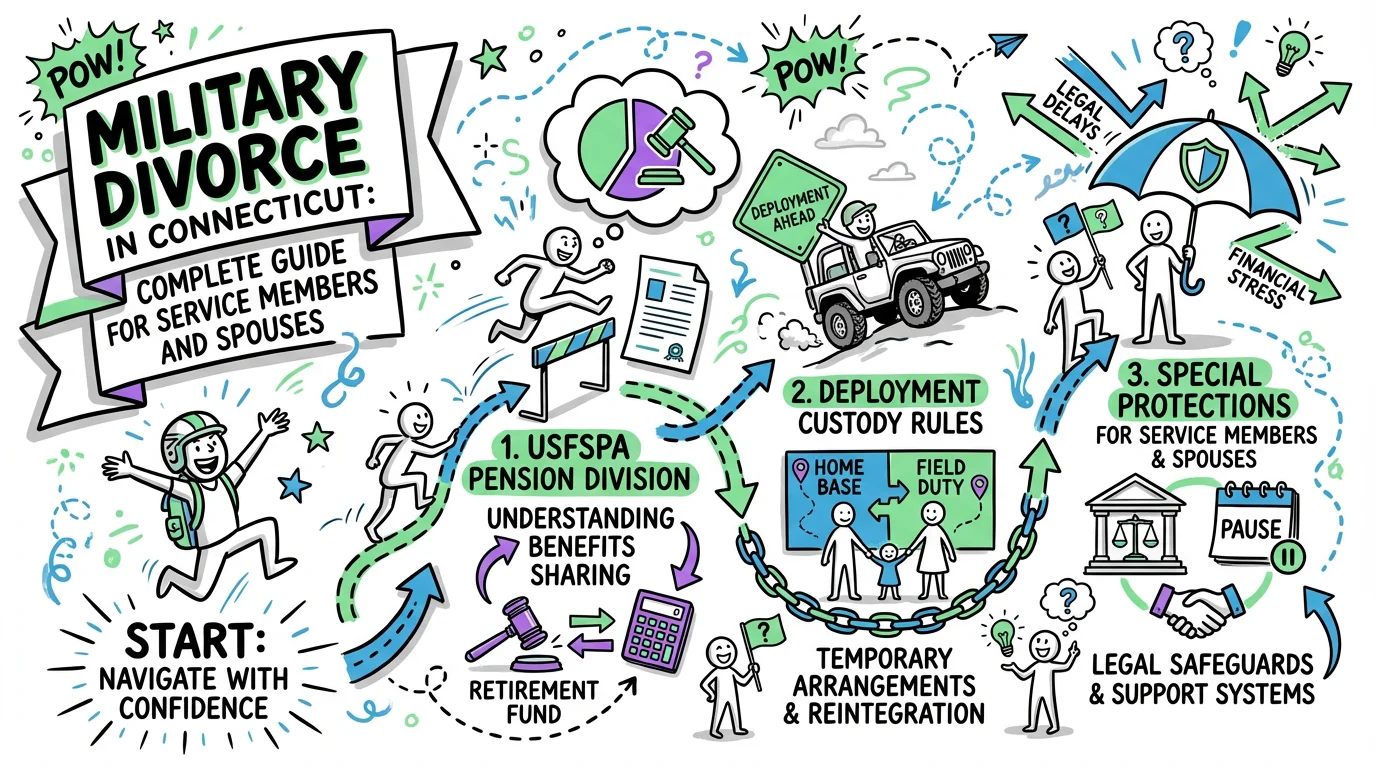
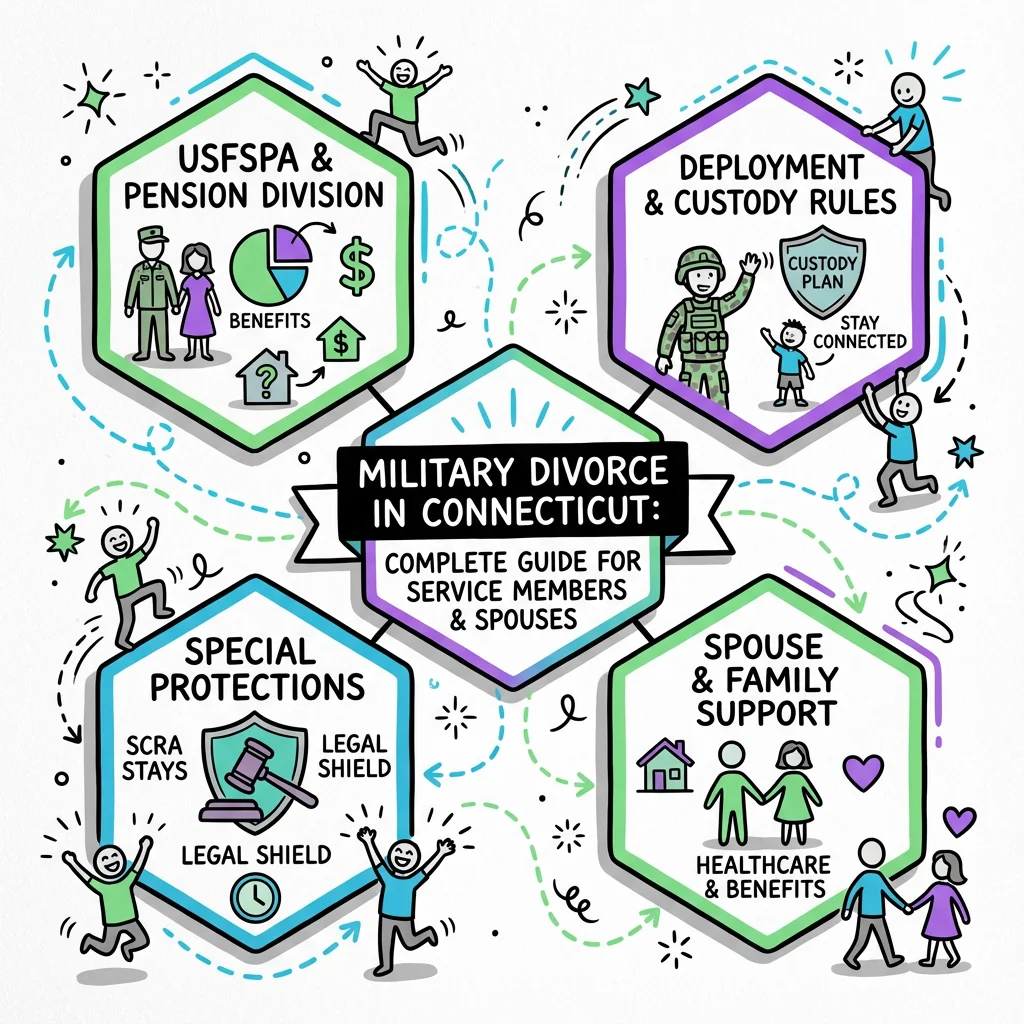
Military divorces in Connecticut operate under both state law (C.G.S. § 46b-81) and federal regulations like the Uniformed Services Former Spouses' Protection Act (USFSPA). While the legal process mirrors civilian divorce, service members face unique requirements for establishing jurisdiction, dividing military pensions, and calculating child support based on total compensation including non-taxable allowances. Navigating these federal and state intersections is critical to protecting rights under the Servicemembers Civil Relief Act (SCRA) and Connecticut's custody statutes.
Understanding Connecticut's Jurisdiction Over Military Divorces
Establishing proper jurisdiction is often the first hurdle in a military divorce. Under C.G.S. § 46b-44, Connecticut requires that either party has established residence in the state before filing a dissolution complaint. For military families, this can be complicated because service members often maintain legal residence in one state while stationed in another.
Connecticut courts can exercise jurisdiction if the service member claims Connecticut as their state of legal residence, if the non-military spouse resides in Connecticut, or if the service member is stationed in Connecticut and has established sufficient ties to the state. The choice of jurisdiction matters significantly because different states have different rules about dividing military pensions and benefits—making this decision one of the most consequential in the entire divorce process.
Military spouses should carefully evaluate their options before filing. If you've been stationed in multiple states or your spouse is deployed, you may have a choice of where to file. Tools like Untangle's automatic document generation can help you organize the residency documentation you'll need regardless of which state you choose.
Dividing Military Retirement Benefits
The Uniformed Services Former Spouses' Protection Act (USFSPA)
The USFSPA allows state courts to treat military retirement pay as marital property subject to division during divorce. This federal law doesn't require courts to divide the pension—it simply gives them permission to do so. Connecticut courts apply the same equitable distribution principles under C.G.S. § 46b-81 to military retirement as they do to civilian retirement accounts, considering factors like the length of the marriage, each spouse's contributions, and the parties' respective economic circumstances.
For a former spouse to receive direct payments from the Defense Finance and Accounting Service (DFAS), the marriage must have overlapped with at least 10 years of creditable military service—known as the "10/10 rule." However, even if this threshold isn't met, the court can still award a portion of the retirement; it simply means the service member must make the payments directly rather than through DFAS.
The division of military retirement requires specific language in the divorce decree or a separate military pension division order. Getting this language wrong can result in years of litigation or lost benefits. Untangle's asset disclosure tools can help you understand what information you'll need to collect, though you should always have a military divorce attorney review any pension division order before it's finalized.
Calculating Your Share of Military Retirement
The most common formula for dividing military retirement is the "marital fraction" approach: the former spouse receives a percentage equal to (months of marriage during military service ÷ total months of military service) × 50% (or another percentage as ordered). For example, if a couple was married for 15 years while the service member completed 20 years of service, the marital fraction would be 75%, and the former spouse might receive 37.5% of the gross retired pay.
Recent changes to federal law have capped the amount that can be divided to the amount the service member would have received at the time of divorce—meaning if a service member divorces as an E-6 but retires as an E-8, the former spouse's share is calculated based on E-6 pay. Understanding these calculations is critical for both parties to ensure fair negotiations.
Survivor Benefit Plan (SBP) Coverage
The Survivor Benefit Plan provides continued income to a designated beneficiary if the retiree dies. For military spouses, securing SBP coverage as part of the divorce settlement can be essential financial protection. Without it, your share of the military retirement ends when your former spouse dies—which could leave you without expected income.
SBP coverage must be elected within one year of the divorce, and the divorce decree should specifically address whether the former spouse will be designated as the SBP beneficiary. The premium for SBP is deducted from the gross retired pay before the division, so both parties share the cost proportionally. Courts can order SBP coverage as part of the property settlement under C.G.S. § 46b-81.
Military Child Support Considerations
Calculating Support with Military Income
Connecticut's Child Support Guidelines specifically include "military personnel fringe benefit payments" as part of gross income under Section 46b-215a-1(11)(A)(vii). This means that Basic Allowance for Housing (BAH), Basic Allowance for Subsistence (BAS), and other military allowances are factored into the child support calculation—even though these allowances may not be taxable income.
This distinction is important because military families often rely heavily on these allowances. A service member's base pay might appear modest, but when BAH and BAS are added, the total compensation can be substantially higher. Both parents need to accurately report all military compensation on their Financial Affidavit (Form JD-FM-006-LONG), which must be filed at least five business days before any support hearing under Practice Book Rule § 25-30.
Untangle's financial affidavit generation tool can help you identify and organize all the income sources that need to be disclosed, ensuring nothing is overlooked during the support calculation process.
Enforcement Through Military Channels
If a service member fails to pay court-ordered child support, enforcement options extend beyond civilian remedies. The military takes support obligations seriously—failure to support dependents can result in disciplinary action under the Uniform Code of Military Justice. Additionally, involuntary allotments can be established to garnish military pay for child and spousal support.
| Enforcement Method | How It Works | Best For |
|---|---|---|
| Voluntary Allotment | Service member authorizes automatic deduction | Cooperative situations |
| Involuntary Allotment | Court-ordered garnishment through DFAS | Non-payment situations |
| Command Intervention | Contact service member's commanding officer | Urgent situations |
| UCMJ Action | Military disciplinary proceedings | Repeated violations |
Custody and Deployment Considerations
Connecticut's Military Custody Protections
Connecticut law provides specific protections for military parents facing custody disputes during deployment. Under C.G.S. § 46b-56e, the court can issue temporary custody or visitation orders when a parent is deployed. This statute defines "Armed Forces" broadly to include all branches and reserve components, including the Connecticut National Guard performing duty under Title 32.
The law recognizes that deployment is not a choice in the traditional sense and that a service member's absence due to military orders should not permanently alter custody arrangements. Courts can enter temporary modifications that preserve the deploying parent's rights while ensuring the children's needs are met during the deployment period.
Creating a Family Care Plan
Military parents should proactively address custody issues in their divorce agreement. A well-drafted parenting plan should include provisions for:
- Communication during deployment (video calls, emails, recorded messages)
- Temporary custody arrangements if the custodial parent deploys
- Makeup parenting time when deployment ends
- Delegation of visitation rights to grandparents or stepparents during deployment
- Procedures for modifying the plan when orders change
Creating a detailed parenting plan is crucial, especially with the unique circumstances of military life. Tools like Untangle's parenting plan builder can guide you through incorporating clauses for communication, temporary custody, and make-up parenting time during deployments, ensuring your children's stability.
Practice Book Rule § 25-26 governs modification of custody orders, requiring that any changes demonstrate a substantial change in circumstances. Deployment itself may constitute such a change, but having clear provisions in your original agreement can minimize court involvement when orders arrive unexpectedly.
Try our free CT child support calculator
Calculate your estimated child support using Connecticut's official guidelines formula.
The Servicemembers Civil Relief Act (SCRA)
Protections for Service Members During Divorce
The SCRA provides important protections for service members who cannot participate in legal proceedings due to military duties. If your spouse is a service member, they may be entitled to a stay (postponement) of divorce proceedings if their military service materially affects their ability to defend the case.
This protection isn't automatic—the service member must request the stay and show that military duties prevent their participation and that they'll be able to participate after a specific date. Stays can be granted for at least 90 days, with possible extensions. While this can delay your divorce, courts will eventually proceed if the service member fails to make reasonable efforts to participate.
For military spouses seeking divorce, understanding SCRA protections helps set realistic expectations about timelines. A deployed spouse can legitimately delay proceedings, so planning for this possibility is important.
Interest Rate Protections and Financial Implications
The SCRA caps interest rates at 6% on debts incurred before active duty military service begins. This protection applies to credit cards, mortgages, car loans, and other installment debts, potentially reducing monthly payments significantly. To receive this benefit, the service member must provide the creditor with a written notice and a copy of their military orders.
In the context of divorce, this interest rate cap can alter the valuation of marital debt. If a joint debt qualifies for the reduced rate, the future cost of servicing that debt is lower, which should be factored into equitable distribution discussions. Conversely, if a service member spouse has not yet applied for this benefit on eligible pre-service debts, doing so before the divorce is finalized could preserve marital assets by reducing interest payments.
Healthcare and Benefits Considerations
TRICARE Coverage After Divorce
Continued TRICARE coverage for former spouses depends on meeting the "20/20/20" or "20/20/15" rules:
| Rule | Requirements | Coverage |
|---|---|---|
| 20/20/20 | 20+ years of marriage, 20+ years of military service, 20+ years overlap | Full TRICARE coverage for life |
| 20/20/15 | 20+ years of marriage, 20+ years of service, 15-19 years overlap | Transitional TRICARE for one year |
| Neither Met | Less than 15 years of overlap | No TRICARE eligibility |
If you don't qualify for continued TRICARE, you'll need to plan for health insurance costs in your post-divorce budget. This should factor into alimony negotiations under C.G.S. § 46b-82, which requires courts to consider each party's needs and ability to maintain their standard of living.
Commissary, Exchange, and Other Benefits
Former spouses who meet the strict 20/20/20 rule retain full access to military commissaries (grocery stores), exchanges (department stores), and Morale, Welfare, and Recreation (MWR) facilities. These privileges offer significant financial benefits, including tax-free shopping and discounted goods, which can equate to thousands of dollars in annual savings for a household.
For spouses who do not meet the 20/20/20 criteria, these benefits terminate strictly on the date the divorce decree is entered. Because the loss of access to cheaper groceries and goods affects the non-military spouse's post-divorce budget, this increase in living expenses should be quantified and presented during alimony negotiations. The economic impact of losing military base privileges is often overlooked but plays a real role in a former spouse's financial independence.
Steps to Navigate Your Connecticut Military Divorce
-
Determine jurisdiction – Evaluate whether Connecticut is the best state to file based on residency requirements under C.G.S. § 46b-44 and how different states treat military benefits.
-
Gather military-specific documents – Collect Leave and Earnings Statements (LES), retirement point statements, service records, and benefit election forms. Practice Book Rule § 25-32 requires disclosure of financial documents within 60 days of request.
-
Calculate total military compensation – Include base pay, BAH, BAS, special pays, and bonuses when completing your Financial Affidavit.
-
Understand pension division options – Research how USFSPA applies to your situation and whether you meet the 10/10 rule for direct DFAS payments.
-
Address deployment scenarios – Build flexibility into custody agreements that account for military obligations under C.G.S. § 46b-56e.
-
Secure SBP coverage if applicable – Ensure the divorce decree specifically addresses Survivor Benefit Plan elections.
-
Plan for healthcare transitions – Determine TRICARE eligibility and budget for alternative coverage if needed.
-
Verify order language – Military pension division orders require specific language that DFAS will accept—errors can delay payments for months or years.
Untangle's personalized task dashboard can help you organize these complex requirements into manageable steps, ensuring you address military-specific issues that civilian divorce guides often overlook.
When to Work with a Military Divorce Attorney
While Connecticut allows uncontested divorces to proceed without attorneys, military divorces involve specialized federal laws that interact with state procedures in complex ways. Consider professional legal help if:
- You have significant military retirement benefits at stake
- Your spouse is or will be a military retiree
- One spouse is deployed or will deploy during proceedings
- You're unsure about jurisdiction options
- You need to secure SBP coverage
- Child custody involves potential deployments or relocations
Many military installations offer free legal assistance through JAG offices, though they typically cannot represent service members in contested divorce proceedings. Legal aid organizations and military spouse support groups can also provide referrals to attorneys experienced in military divorce.
Even if you work with an attorney, understanding the basics yourself helps you make informed decisions and ask the right questions. Untangle's AI consultation can supplement professional advice by helping you track deadlines, organize documents, and understand what's happening at each stage of your case.
Frequently Asked Questions
How does the Untangle app help with military divorce paperwork in Connecticut?
Untangle's divorce document preparation feature helps military families organize residency documentation, pension division paperwork, and other complex forms required under both Connecticut law and federal military regulations like USFSPA.
What federal laws affect military divorce in CT that civilians don't have to worry about?
Military divorces in Connecticut are governed by additional federal laws including the Uniformed Services Former Spouses' Protection Act (USFSPA) for pension division and the Servicemembers Civil Relief Act (SCRA) which can delay proceedings during deployment.
Can I file for divorce in Connecticut if my military spouse is stationed in another state?
Yes, Connecticut courts can exercise jurisdiction over your military divorce if you reside in Connecticut as the non-military spouse, even if your service member spouse is stationed elsewhere.
How much does Untangle cost for military divorce planning?
Untangle offers divorce planning tools and document preparation features for military families, with pricing details available on their website that may vary based on the level of service needed.
Why does it matter which state I file for military divorce in?
The state where you file significantly impacts how military pensions and benefits are divided because different states have different rules about dividing military retirement pay under the USFSPA.
Legal Citations
- • Section 46b-215a-1(11)(A)(vii) (Child Support Guidelines - Military fringe benefits) View Source
- • Connecticut Practice Book Rule § 25-26 (Modification of Custody, Alimony or Support) View Source
- • Connecticut Practice Book Rule § 25-30 (Statements To Be Filed) View Source
- • Connecticut Practice Book Rule § 25-32 (Mandatory Disclosure and Production) View Source
- • Financial Affidavit Long Form (JD-FM-006-LONG) View Source