Untangle Free Trial for Connecticut Divorce: Complete Guide to DIY Dissolution
Learn how Untangle's free trial helps Connecticut residents navigate DIY divorce. Discover costs, features, and step-by-step guidance for uncontested dissolution.
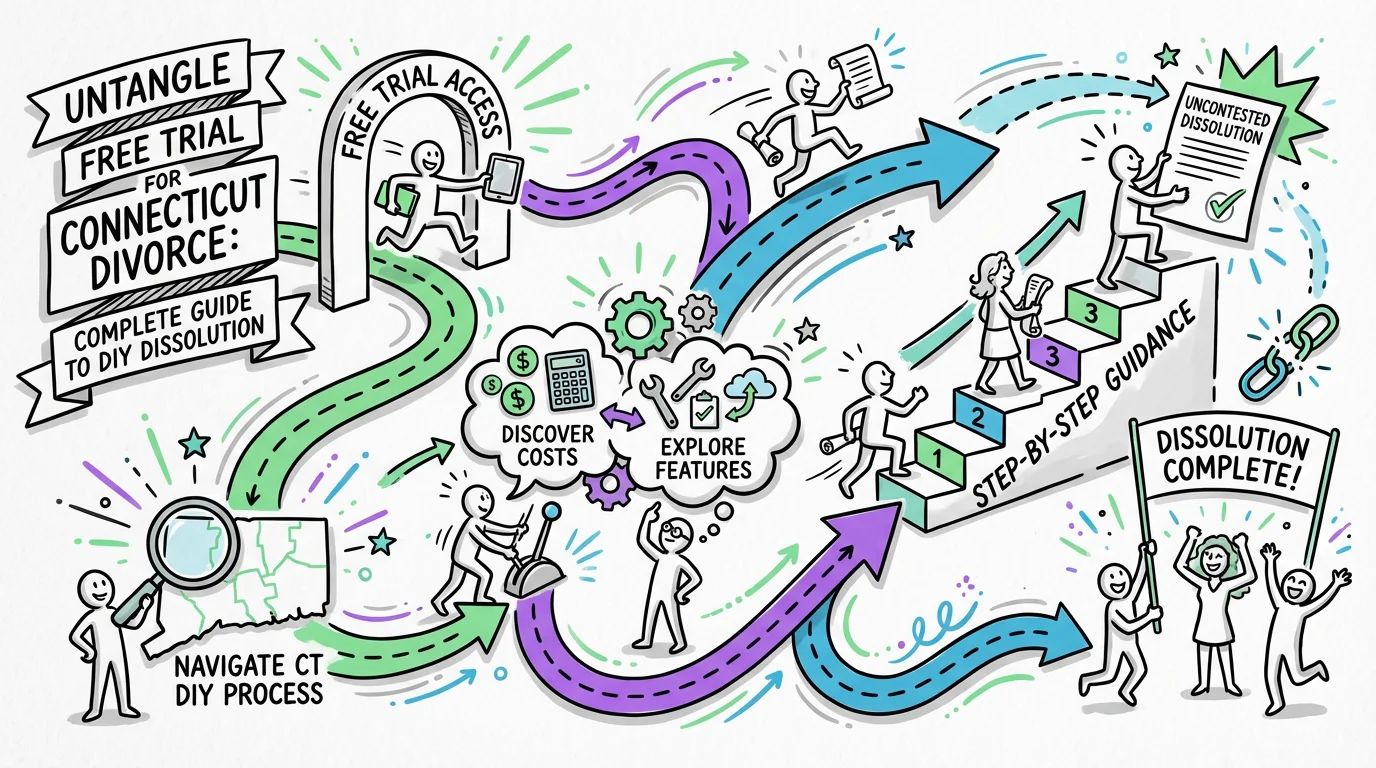
Untangle offers a free trial that allows Connecticut residents to explore divorce planning tools, generate required court forms, and understand their options before committing to any paid services. The free trial gives you access to core features like asset and debt organization, property division analysis, and guidance on Connecticut's nonadversarial dissolution process—helping you determine whether a DIY divorce is right for your situation before spending money on attorneys or premium services.
Why Budget-Conscious Couples Choose DIY Divorce in Connecticut
Connecticut law specifically encourages couples who can reach agreements on their own to pursue a streamlined, cost-effective divorce path. Under C.G.S. § 46b-44a, Connecticut provides a "nonadversarial dissolution of marriage" option that allows couples to file a joint petition when they meet certain conditions. This process eliminates the need for expensive litigation when both spouses can agree on how to divide assets, handle debts, and address any custody matters.
The financial appeal of DIY divorce is substantial. Traditional contested divorces in Connecticut can cost $15,000 to $50,000 or more in attorney fees, while an uncontested divorce handled primarily by the parties themselves may cost only court filing fees and minimal professional assistance. For budget-conscious couples, the savings can be redirected toward establishing separate households, securing children's needs, or building financial stability for the future.
However, DIY divorce requires organization, attention to detail, and a solid understanding of Connecticut's requirements. This is where Untangle's divorce planning tools become invaluable—they help you organize your financial information, understand what the court requires, and prepare documents without the hourly billing of traditional legal services.
What You Get with Untangle's Free Trial
The free trial provides meaningful access to divorce planning features that help Connecticut residents determine whether they can successfully navigate an uncontested dissolution. Rather than offering a watered-down preview, the trial gives you functional tools to start organizing your divorce.
Financial Organization Tools
One of the most time-consuming aspects of any Connecticut divorce is gathering and organizing financial information. Connecticut Practice Book Rule § 25-30 requires both parties to file sworn financial statements showing current income, expenses, assets, and liabilities. These statements must be filed at least five business days before certain hearings and updated within 30 days before final judgment.
Untangle's complete asset inventory features help you catalog everything the court needs to see: bank accounts, retirement funds, real estate, vehicles, credit cards, loans, and personal property. The platform organizes this information in a format that translates directly to Connecticut's required financial affidavit forms. Rather than scrambling to gather documents at the last minute, you build a comprehensive financial picture over time.
Property Division Analysis
Connecticut follows equitable distribution principles, meaning marital property is divided fairly but not necessarily equally. Understanding how a court might view your assets helps you negotiate a settlement agreement that both parties—and the court—will find acceptable.
The free trial includes access to financial comparison tools that help you categorize assets as marital or separate property, estimate values, and explore different division scenarios. This analysis becomes the foundation for the settlement agreement you'll submit with your joint petition under C.G.S. § 46b-44a.
Form Guidance and Preparation
Connecticut divorce requires multiple forms filed in a specific sequence. The free trial helps you understand which forms apply to your situation and what information each requires. Untangle's automatic document generation tools can help streamline this process, guiding you through the necessary fields for essential court documents. Key forms include:
- JD-FM-159 (Divorce Complaint) - The initial complaint that starts your dissolution action
- JD-FM-006-Short (Financial Affidavit Short Form) - Used when neither party's net income exceeds $75,000 per year and total assets are less than $75,000
- JD-FM-158 (Notice of Automatic Court Orders) - Required notice about restrictions that take effect upon filing
- JD-FM-175 (Certificate of Compliance) - Confirms completion of required disclosures
Navigating the court's procedural requirements can be just as challenging as the substantive issues. The court clerk will expect every document to be formatted correctly and filled out completely. Missing a signature or checking the wrong box can lead to your paperwork being returned, restarting the clock on your mandatory waiting period and potentially delaying your ability to move on with your life.
Connecticut Nonadversarial Dissolution Requirements
To qualify for Connecticut's streamlined nonadversarial process, couples must meet specific conditions at the time of filing. Understanding these requirements helps you determine whether DIY divorce is realistic for your situation.
Eligibility Conditions
Under C.G.S. § 46b-44a, at least one spouse must reside in Connecticut at the time of filing. Both parties must attest under oath that they've reached agreement on all issues, including property division, debt allocation, and any matters involving minor children. The joint petition must be notarized and filed in the judicial district where one of the parties lives.
The law provides important protections even in this simplified process. According to C.G.S. § 46b-44b, either party can revoke the joint petition at any time before the court enters the final decree by filing a notice of revocation with the court clerk. This notice must also be sent to the other party by first-class mail. If one party revokes, the entire action is dismissed—though either party can then file for divorce through the traditional process.
Timeline and Court Review
Connecticut law establishes a minimum waiting period for nonadversarial dissolutions. Per C.G.S. § 46b-44c, all nonadversarial dissolution actions receive a disposition date not less than 30 days after the joint petition filing date. If no revocation has been filed and the court approves your settlement agreement, the court may enter a decree of dissolution on or within five days after the disposition date.
The court doesn't simply rubber-stamp settlement agreements. Under C.G.S. § 46b-44d, if the court cannot determine whether your settlement agreement is "fair and equitable," the matter gets docketed for a hearing within 30 days. The court will then require both parties to appear and explain the agreement. This review protects both parties from agreements that might be one-sided or fail to address important issues.
Cost Comparison: DIY vs. Attorney-Assisted Divorce
Understanding the real costs of different divorce approaches helps budget-conscious couples make informed decisions. The table below compares typical expenses for Connecticut divorces:
| Expense Category | Full DIY | Untangle + Limited Help | Full Attorney Representation |
|---|---|---|---|
| Court Filing Fee | $360 | $360 | $360 |
| Service of Process | $0 (joint filing) | $0 (joint filing) | $50-100 |
| Divorce Planning Software | Free trial / $99-299 | $99-299 | N/A |
| Attorney Consultation | $0 | $200-500 (1-2 hours) | Included |
| Attorney Drafting | $0 | $0-500 (review only) | $3,000-7,000 |
| Litigation/Negotiation | $0 | $0 | $5,000-20,000+ |
| Total Estimated Cost | $360-659 | $659-1,659 | $8,400-27,500+ |
These figures assume an uncontested divorce with moderate complexity. Contested divorces with custody disputes, business valuations, or hidden assets can easily exceed $50,000 per party.
The middle column represents a smart compromise for many couples: using planning tools to do the organizational heavy lifting, then paying an attorney for a brief consultation or document review before filing. This approach captures most of the cost savings while adding professional oversight for peace of mind.
Try our free CT child support calculator
Calculate your estimated child support using Connecticut's official guidelines formula.
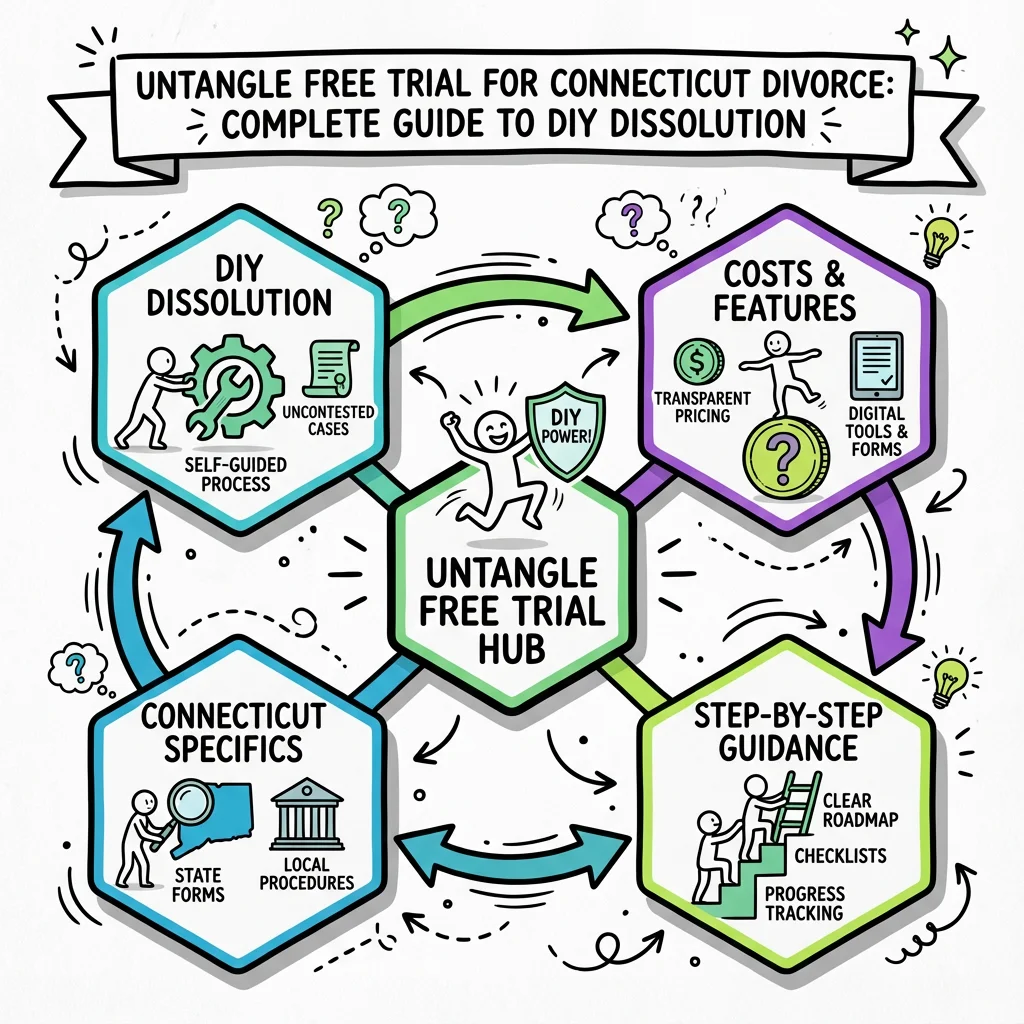
Step-by-Step Process for DIY Divorce in Connecticut
Following a structured process increases your chances of a smooth, affordable divorce. Here's how to proceed:
-
Determine Eligibility - Confirm at least one spouse has been a Connecticut resident and that you and your spouse can agree on all major issues. If you have disputes about property, custody, or support that you cannot resolve, nonadversarial dissolution isn't available.
-
Gather Financial Documents - Collect bank statements, tax returns, pay stubs, retirement account statements, mortgage documents, loan statements, and vehicle titles. Tools like a personalized task dashboard can help organize your process, while detailed inventory features ensure you don't miss anything the court requires.
-
Complete Financial Affidavits - Both parties must complete sworn financial statements. If neither party's net income exceeds $75,000 and total assets are under $75,000, use form JD-FM-006-Short. Otherwise, the long-form financial affidavit is required. Untangle's financial affidavit generation tools can guide you through this critical step, ensuring accuracy and compliance with Connecticut's specific requirements.
-
Draft Your Settlement Agreement - This document specifies exactly how you'll divide property, allocate debts, and handle any child-related matters. The court reviews this agreement for fairness, so it must address all issues comprehensively.
-
Calculate Child Support (If Applicable) - Connecticut requires child support calculations using the official Child Support and Arrearage Guidelines worksheet (form CCSG-001). A digital calculator can help you run accurate numbers using the state's required methodology.
-
Prepare and File the Joint Petition - Complete form JD-FM-159 and all accompanying documents. File in the judicial district where either spouse resides. Pay the filing fee (currently $360).
-
Wait for Disposition Date - The court assigns a date at least 30 days from filing. Use this time to ensure all documents are in order and your settlement agreement addresses everything the court needs to see.
-
Receive Final Decree - If the court finds your agreement fair and equitable, you'll receive your decree of dissolution without needing a court appearance. If the court has questions, you'll be scheduled for a brief hearing.
Common Mistakes That Derail DIY Divorces
Understanding what goes wrong helps you avoid pitfalls that could delay your divorce or force you into more expensive contested proceedings.
Incomplete Financial Disclosure
Connecticut courts take financial disclosure seriously. Practice Book Rule § 25-5B makes automatic orders effective immediately upon filing a joint petition, including requirements that both parties file sworn financial statements. Incomplete or inaccurate financial affidavits can lead to rejected agreements or, worse, fraud allegations that convert a simple divorce into complex litigation.
Digital income and expense tracking features help ensure you capture every account, asset, and liability. The platform prompts you for commonly forgotten items like retirement accounts, life insurance cash values, and outstanding tax obligations.
Vague Settlement Agreements
Courts reject settlement agreements that leave important issues unresolved. Your agreement must specifically address:
- Division of each significant asset (not just "we'll split everything 50/50")
- Allocation of each debt and who's responsible for payment
- Custody and visitation schedules (if you have children)
- Child support amounts calculated per Connecticut guidelines
- Whether either party will receive alimony (and if so, amount and duration)
- Health insurance coverage during and after divorce
- Tax filing status and dependency exemptions
The more specific your agreement, the more likely the court approves it without requiring a hearing. With automatic document generation, you can draft comprehensive and specific settlement agreements that address all required elements.
Forgetting Automatic Orders
Upon filing, automatic orders under Practice Book Rule § 25-5B immediately restrict both parties from selling assets, incurring unusual debts, changing insurance beneficiaries, and other actions that could prejudice the other party. Violating these orders—even accidentally—can result in contempt findings that complicate your divorce and add costs.
These orders are comprehensive, covering everything from removing children from the state to cancelling credit cards. They are designed to maintain the "status quo" while the divorce is pending. It is crucial to review the full text of the automatic orders (printed on form JD-FM-158) immediately upon filing or being served, as ignorance of these specific prohibitions is not accepted as a valid defense by the court.
When DIY Divorce Isn't Enough
While many Connecticut couples successfully navigate uncontested divorce on their own, some situations genuinely require professional legal assistance.
Consider consulting an attorney if your divorce involves complex assets like business ownership, stock options, or multiple real estate properties. Situations involving domestic violence, substance abuse concerns, or significant power imbalances between spouses also warrant professional involvement. If you suspect your spouse is hiding assets or providing inaccurate financial information, an attorney can help you investigate and protect your interests.
Couples with substantial retirement assets should understand how QDROs (Qualified Domestic Relations Orders) work before agreeing to divide 401(k)s or pensions. An error in retirement division can cost thousands in taxes and penalties.
Even in these situations, divorce planning tools reduce the time attorneys spend gathering and organizing information—which directly reduces your legal bills. Many attorneys offer discounted rates when clients arrive with organized financial information and a clear understanding of their goals.
Making Your Decision
The free trial exists precisely so you can explore whether DIY divorce works for your situation without financial commitment. Start by entering your basic financial information and seeing how the platform organizes it. Run through the property division tools to understand how different scenarios might work. Review the Connecticut court forms to assess whether you feel comfortable completing them.
If the process feels manageable and you and your spouse communicate well enough to reach agreements, DIY divorce through Connecticut's nonadversarial process can save you thousands while giving you control over your own dissolution. If you encounter issues that feel overwhelming, you've lost nothing—and you've gained valuable information about what professional help you actually need.
C.G.S. § 46b-63 even allows either spouse to request restoration of a birth name or former name as part of the dissolution decree, so don't forget to include this in your agreement if name restoration matters to you.
Getting started with Untangle's free trial takes just a few minutes and requires no credit card. You'll quickly see whether the DIY path makes sense for your Connecticut divorce—and if it does, you'll have taken the first concrete step toward an affordable, amicable resolution.
Frequently Asked Questions
How do I sign up for Untangle's free trial for Connecticut divorce?
You can sign up for Untangle's free trial by visiting their website and creating an account, which gives you immediate access to core divorce planning tools, form generation, and property division analysis without entering payment information.
Does Untangle offer a money-back guarantee if I'm not satisfied with their CT divorce services?
Untangle offers a free trial so you can explore all core features before committing to any paid services, allowing you to make an informed decision without financial risk.
Can I preview all Connecticut divorce forms before paying for Untangle?
Yes, Untangle's free trial allows you to generate and review required Connecticut court forms, including those needed for nonadversarial dissolution under C.G.S. § 46b-44a, before upgrading to paid services.
What features are included in Untangle's free trial for Connecticut divorce?
The free trial includes access to asset and debt organization tools, property division analysis, guidance on Connecticut's nonadversarial dissolution process, and the ability to generate required court forms.
How long does the Untangle free trial last for CT divorce planning?
Untangle's free trial gives you time to explore their divorce planning tools and determine whether a DIY divorce is right for your Connecticut situation before committing to any paid features.
Legal Citations
- • C.G.S. § 46b-44a View Source
- • C.G.S. § 46b-44b View Source
- • C.G.S. § 46b-44c View Source
- • C.G.S. § 46b-44d View Source
- • C.G.S. § 46b-63 View Source
- • Practice Book Rule § 25-30 View Source
- • Practice Book Rule § 25-5B View Source