Untangle for High Asset Divorce in Connecticut: Protecting Complex Wealth
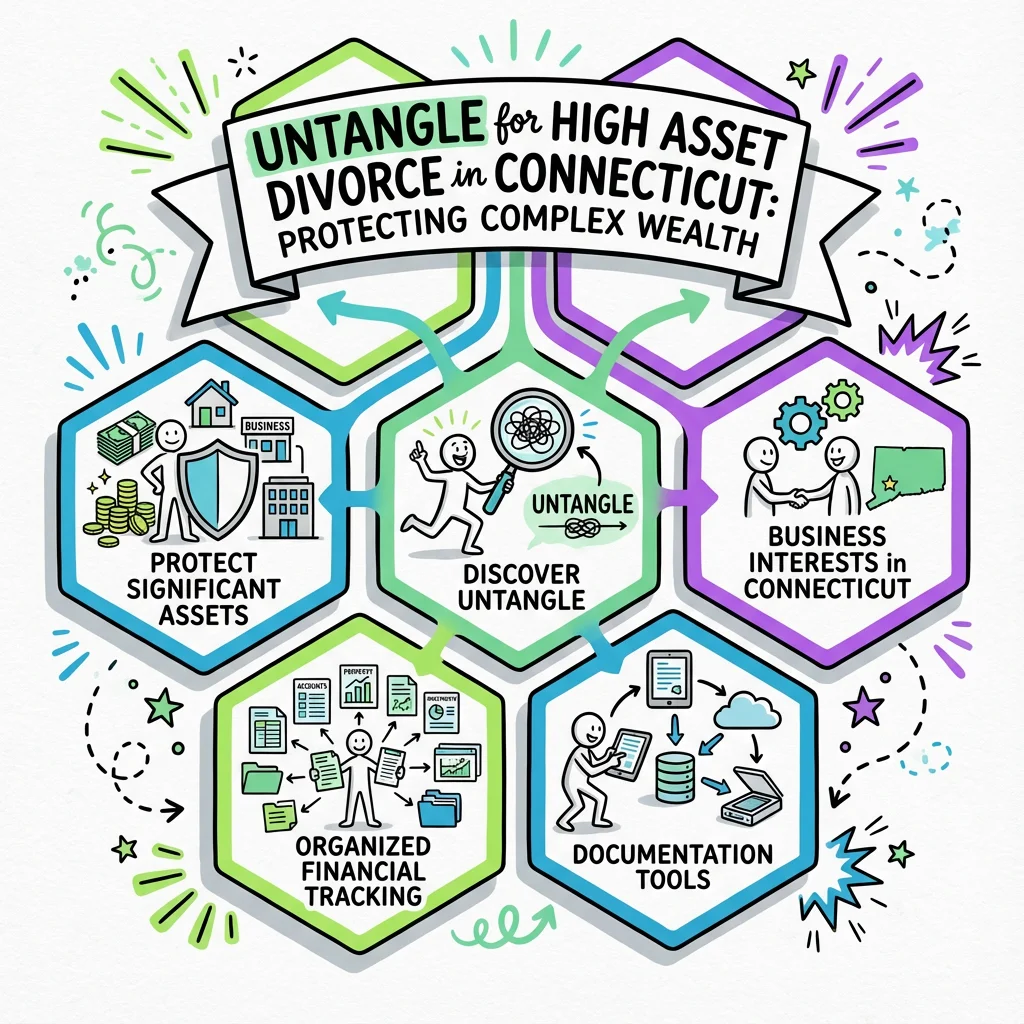
Discover how Untangle helps protect significant assets and business interests in Connecticut high asset divorces with organized financial tracking and documentation tools.

Untangle is a powerful digital platform designed to help individuals navigating high asset divorces in Connecticut organize complex financial portfolios, track multiple asset categories, and prepare comprehensive documentation that protects substantial wealth and business interests. For couples with significant assets—including business ownership, investment portfolios, real estate holdings, retirement accounts, and stock options—Untangle provides the organizational framework essential for equitable property division under Connecticut's complex statutory requirements.
Why High Asset Divorces Require Specialized Organization
Connecticut follows an "equitable distribution" model under C.G.S. § 46b-81, which grants courts broad discretion to assign "all or any part of the estate of the other spouse" when dissolving a marriage. Unlike community property states with fixed 50/50 splits, Connecticut judges consider numerous factors including the length of marriage, each spouse's contribution to the marital estate, and the causes of the dissolution. This discretionary approach makes thorough financial documentation absolutely critical—the spouse with better-organized records often achieves more favorable outcomes.
High asset divorces present unique challenges that standard divorce processes simply aren't designed to handle. When your marital estate includes closely held businesses, deferred compensation packages, investment real estate, or complex retirement structures, the traditional paper-based approach quickly becomes overwhelming. Missing documentation or disorganized records can lead to asset undervaluation, missed discovery deadlines, or worse—forfeiture of assets you're entitled to receive.
The stakes in high asset CT divorces are substantially higher than typical dissolutions. A single overlooked stock option grant or mischaracterized business asset can represent hundreds of thousands of dollars. Tools like Untangle's Complete asset inventory provide the systematic organization that high-net-worth individuals need to ensure nothing falls through the cracks during this critical process.
Connecticut's Mandatory Disclosure Requirements for Complex Estates
Under Practice Book Rule § 25-32, Connecticut requires automatic disclosure of extensive financial documentation within 60 days of a proper request. For high asset cases, this mandatory production includes three years of federal and state tax returns with all K-1 schedules for closely held entities, 24 months of statements for every financial institution account, and documentation for retirement plans, stock options, and deferred compensation arrangements.
The scope of required disclosure in complex divorces is staggering. You'll need to produce brokerage statements, business valuations, partnership agreements, stock option agreements, restricted stock unit documentation, pension statements, and real estate records—all organized in a way that allows your legal team to quickly identify, categorize, and value each asset. The landmark Connecticut case Wendt v. Wendt demonstrated how courts scrutinize every aspect of complex financial portfolios in high-stakes dissolutions.
To manage this demanding documentation efficiently and accurately, tools like Untangle's Smart bank statement analysis and Debt and liability tracking help you gather, categorize, and track every financial detail, ensuring compliance with strict Connecticut timelines.
Protecting Business Interests in Connecticut Divorce
Business ownership represents one of the most contested areas in high asset Connecticut divorces. Whether you own a professional practice, family business, or equity stake in a larger enterprise, courts will need to determine both the business's value and the appropriate treatment of that value in the property division. Under C.G.S. § 46b-81, courts can assign business interests to either spouse or order liquidation if necessary to effectuate an equitable distribution.
Business valuation in divorce typically requires professional appraisers who examine multiple methodologies—asset-based approaches, income capitalization, and market comparisons. The process demands extensive documentation: profit and loss statements, balance sheets, accounts receivable aging reports, customer concentration data, and owner compensation analysis. Missing or incomplete records can result in unfavorable valuations that don't reflect the business's true worth.
For business owners, Untangle's Complete asset inventory specifically aids in compiling the necessary documentation for accurate valuation, ensuring your appraiser has the complete picture to protect your interests.
Real Estate and Investment Portfolio Tracking
High asset divorces often involve multiple real estate holdings and diverse investment portfolios requiring careful categorization and valuation. Under C.G.S. § 46b-66a, Connecticut courts have authority to order conveyance of real property titles as part of the dissolution decree. Additionally, C.G.S. § 46b-80 provides prejudgment remedies including lis pendens filings to protect real estate interests during the divorce process.
Investment portfolios present their own documentation challenges. You'll need cost basis information for capital gains calculations, dividend reinvestment records, and documentation of any separate property claims for inherited or pre-marital investments. Connecticut courts can consider the origin of assets when making equitable distribution decisions, making the distinction between marital and separate property crucial for high-net-worth individuals.
To simplify the complexities of tracking and valuing diverse portfolios and real estate holdings, tools like Untangle's Complete asset inventory can help you meticulously document each asset, including cost basis and separate property claims, for accurate division.
| Asset Category | Key Documentation Needed | Valuation Considerations |
|---|---|---|
| Primary Residence | Deed, mortgage statements, improvement records | Current market value, encumbrances, capital gains exclusion |
| Investment Real Estate | Purchase documents, depreciation schedules, rental income | Cap rate analysis, 1031 exchange history |
| Brokerage Accounts | 24 months statements, cost basis records | Current value, tax implications of liquidation |
| Retirement Accounts | Plan documents, QDRO requirements, vesting schedules | Present value, survivor benefits, early withdrawal penalties |
| Business Interests | Operating agreements, valuations, K-1s | Fair market value, liquidity discounts, goodwill |
| Stock Options/RSUs | Grant agreements, vesting schedules, exercise prices | Intrinsic value, tax treatment, unvested portions |
Automatic Orders and Asset Protection
The moment a divorce complaint is served in Connecticut, Practice Book Rule § 25-5 triggers automatic orders that significantly restrict what either spouse can do with marital assets. These orders prohibit selling, transferring, encumbering, or otherwise disposing of property except in the usual course of business or for reasonable living expenses. Violating these orders can result in severe court sanctions and adverse inferences at trial.
For high-net-worth individuals, these automatic orders require careful attention to ongoing financial activities. Routine business operations, investment rebalancing, and real estate transactions may all require court approval once the case begins. Understanding exactly what falls within "usual course of business" versus what requires judicial permission is essential to avoiding claims of dissipation or contempt.
Maintaining a clear record of all transactions that demonstrates compliance with Connecticut's automatic orders is crucial. This documentation becomes invaluable if your spouse later claims improper asset transfers or hidden wealth.
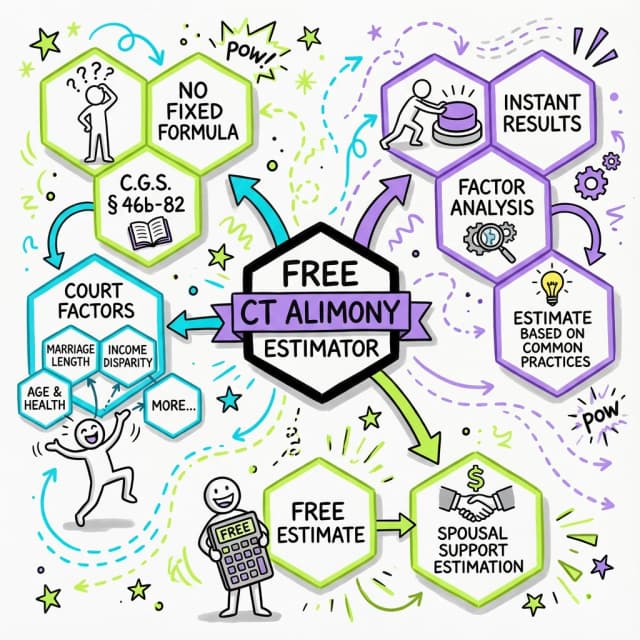
Try our free CT alimony calculator
Get an instant estimate based on Connecticut's statutory factors. No signup required.
Financial Affidavit Preparation for Complex Estates
Connecticut's sworn financial affidavit (Form JD-FM-006) must be filed at least five business days before any hearing on financial matters, and updated within 30 days of judgment under Practice Book Rule § 25-30. For high asset cases, accurately completing this document requires comprehensive organization of income sources, expense categories, asset values, and liability information across potentially dozens of accounts and holdings.
The financial affidavit is a sworn statement—meaning inaccuracies can constitute perjury and lead to court sanctions. In complex estates, ensuring every account is listed, every income source captured, and every asset properly valued requires meticulous preparation. Courts take financial disclosure violations seriously, and the Brown v. Brown case illustrates how Connecticut appellate courts scrutinize financial arrangements in divorce cases.
Rather than scrambling to gather information before deadlines, tools like Untangle's Financial affidavit generation ensure you have organized, current data ready, allowing you to accurately complete required court filings with confidence.
Working with Your Professional Team
High asset divorces typically require a team of professionals beyond your divorce attorney: forensic accountants, business valuators, tax advisors, and sometimes financial planners or investment advisors. Coordinating among these professionals and ensuring everyone has access to necessary documentation is a significant organizational challenge.
Your attorney will guide legal strategy and court filings. Your forensic accountant will analyze financial records for hidden assets, undisclosed income, or irregularities. Business valuators will prepare formal appraisals. Tax advisors ensure property division proposals account for after-tax consequences. Each professional needs specific documentation to perform their role effectively.
This coordination is particularly important for maintaining accurate records as the case evolves over months or even years.
Steps to Protect High-Value Assets in Connecticut Divorce
- Compile comprehensive asset inventory - List every bank account, investment account, retirement plan, real estate holding, business interest, vehicle, valuable personal property, and other asset regardless of whose name appears on the title.
- Gather 24+ months of financial statements - Connecticut's mandatory disclosure rules require two years of account statements, so begin organizing these immediately.
- Document separate property claims - If you have assets from inheritance, pre-marital holdings, or gifts, gather documentation proving the separate character and any tracing records.
- Secure business records - Obtain copies of operating agreements, shareholder agreements, buy-sell provisions, recent valuations, and tax returns including K-1 schedules.
- Review prenuptial or postnuptial agreements - Under Practice Book Rule § 25-2A, enforcement requires specific claims filed within designated timeframes.
- Identify expert witnesses needed - Determine early whether you'll need forensic accountants, business valuators, or other experts and begin gathering materials for their review.
- Establish secure document storage - Upload everything to a secure platform that can assist with inventorying like Untangle's Case details management where you can organize, track, and share documents with your legal team.
Cost Considerations for High Asset Divorces
High asset divorces involve substantially higher costs than typical dissolutions, but the investment in proper preparation often generates significant returns in terms of asset protection. Under C.G.S. § 46b-62, courts can order one spouse to contribute to the other's attorney fees based on their respective financial abilities and the criteria in the alimony statute.
| Cost Category | Typical Range | Factors Affecting Cost |
|---|---|---|
| Attorney Fees | $25,000 - $200,000+ | Complexity, contentiousness, trial vs. settlement |
| Forensic Accountant | $5,000 - $50,000+ | Scope of analysis, number of entities |
| Business Valuation | $5,000 - $30,000+ | Business complexity, methodology disputes |
| Real Estate Appraisals | $500 - $3,000 per property | Property type, location, complexity |
| Financial Planning | $2,000 - $10,000+ | Scope of analysis, settlement modeling |
Investing in organization tools like Untangle can actually reduce overall professional fees by minimizing the time attorneys and accountants spend gathering and organizing documents—tasks typically billed at hourly rates.
When Professional Help Is Essential
While Untangle provides powerful organization tools for high asset divorce, certain situations require immediate professional intervention. If you suspect your spouse is hiding assets, manipulating business finances, or planning to dissipate marital property, contact a divorce attorney immediately. Connecticut's prejudgment remedy provisions under C.G.S. § 46b-80 allow courts to freeze assets and issue protective orders, but only if you act quickly.
Similarly, if your spouse has already filed for divorce, the automatic orders under Practice Book Rule § 25-5 take effect upon service. Understanding your rights and obligations under these orders requires legal guidance specific to your situation. An experienced Connecticut high asset divorce attorney can help you navigate these complex requirements while robust organizational tools can assist your legal team in protecting your interests effectively.
For individuals with significant wealth or business interests at stake, the combination of sophisticated legal representation and robust organizational tools like Untangle provides the comprehensive approach necessary to protect what you've spent years building.
Frequently Asked Questions
How much does Untangle cost for high asset divorce cases?
Untangle offers tiered pricing plans that vary based on the complexity of your financial portfolio, with premium features designed specifically for high net worth divorces typically available in higher-tier subscriptions.
What types of assets can Untangle track during a Connecticut divorce?
Untangle can track multiple asset categories including business interests, investment portfolios, real estate holdings, retirement accounts, stock options, and deferred compensation packages commonly found in high asset CT divorces.
How does Untangle help organize finances for equitable distribution in CT?
Untangle provides a centralized digital platform to compile comprehensive financial documentation, categorize assets, and prepare organized records that support favorable outcomes under Connecticut's discretionary equitable distribution model.
Can Untangle help find hidden assets in a high net worth Connecticut divorce?
While Untangle is primarily an organizational tool rather than a forensic discovery platform, its systematic tracking features can help identify discrepancies and overlooked assets like stock option grants or deferred compensation.
What makes Untangle different from other divorce financial planning software?
Untangle is specifically designed for complex, high asset divorces and offers specialized features for tracking multiple asset categories, business interests, and investment portfolios that standard divorce software may not adequately address.
Legal Citations
- • Practice Book Rule § 25-32 - Mandatory Disclosure and Production View Source
- • Wendt v. Wendt, 59 Conn. App. 656 View Source
- • Practice Book Rule § 25-5 - Automatic Orders upon Service of Complaint View Source
- • Financial Affidavit Long Form (JD-FM-006) View Source
- • Practice Book Rule § 25-30 - Statements To Be Filed View Source
- • Brown v. Brown, 199 Conn. App. 134 View Source
- • Practice Book Rule § 25-2A - Premarital and Postnuptial Agreements View Source