Using Untangle for Contested Divorce in Connecticut: Your Strategic Advantage
Learn how Untangle helps you navigate a contested divorce in Connecticut when your spouse won't cooperate. Get organized, stay prepared, and protect your interests.
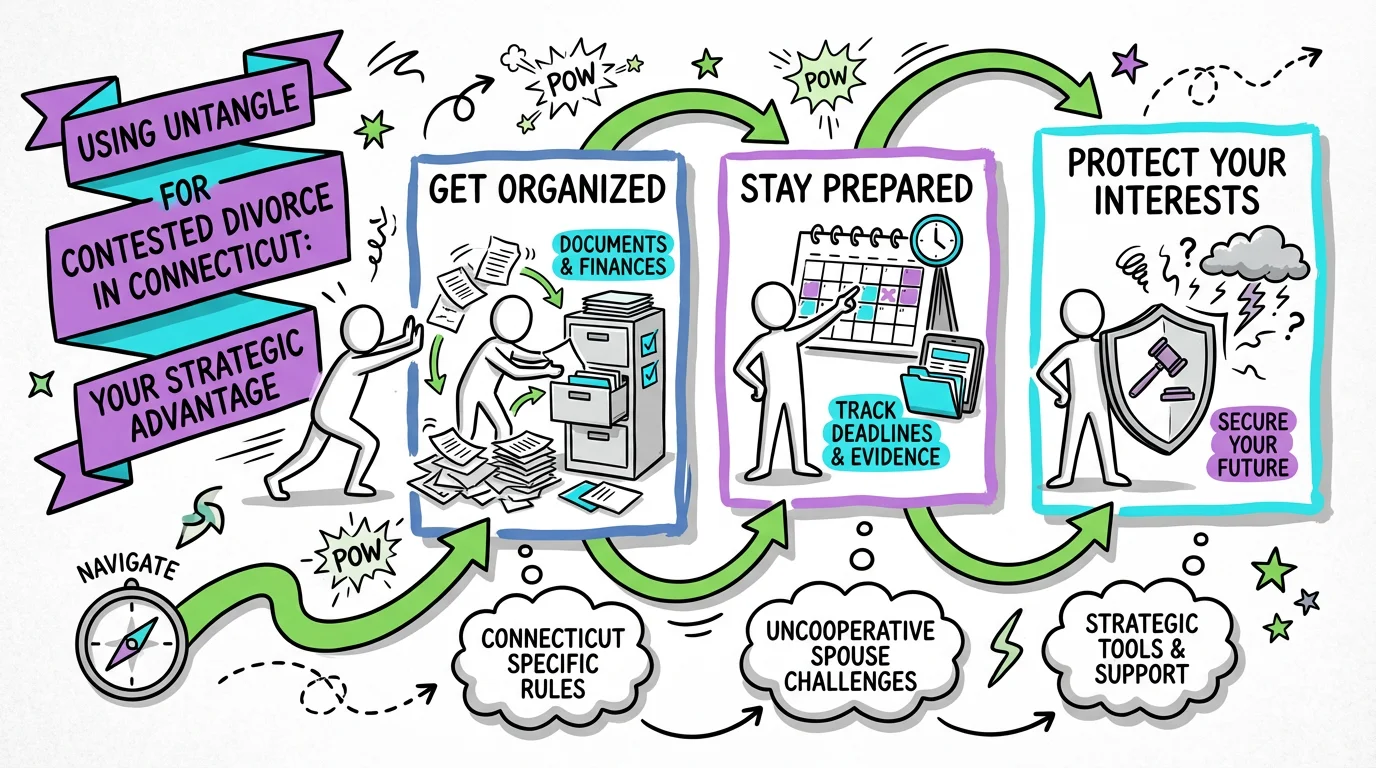
For those facing a contested divorce in Connecticut where a spouse refuses to cooperate, Untangle serves as a strategic command center for managing the complex documentation, deadlines, and financial disclosures required by law. Unlike uncontested divorces where both parties work together, contested cases demand meticulous preparation, strategic thinking, and complete command of your financial information—exactly what Untangle is designed to help you achieve.
Understanding Contested Divorce in Connecticut
A contested divorce occurs when spouses cannot agree on one or more critical issues: property division, alimony, child custody, or child support. In Connecticut, the court has broad authority under C.G.S. § 46b-81 to assign property from either spouse's estate and under C.G.S. § 46b-82 to order alimony based on numerous statutory factors. When your spouse won't cooperate, these decisions ultimately fall to a judge—making your preparation and documentation absolutely critical to protecting your interests. To better understand how these statutes and their implications apply to your specific situation, Untangle's AI legal guidance can provide instant answers based on Connecticut law, helping you navigate the legal complexities.
Connecticut's no-fault divorce system means you don't need to prove wrongdoing to dissolve your marriage. Under C.G.S. § 46b-40, a divorce can be granted simply because "the marriage has broken down irretrievably." However, while the grounds for divorce may be straightforward, the disputes over money, property, and children can be anything but. Your spouse's lack of cooperation doesn't prevent you from moving forward—it simply means you need to be better prepared than they are.
The Connecticut court system uses a "Pathways" case management approach under Practice Book Rule § 25-50A, which assigns contested cases to different tracks based on complexity. High-conflict cases typically land on Track B (moderate complexity) or Track C (complex), meaning more court appearances, longer timelines, and greater need for organized documentation. Understanding this process helps you mentally prepare for the road ahead while gathering the evidence you'll need.
Why Organization Matters in Contested Cases
In a contested divorce, information is power. Connecticut's mandatory disclosure rules under Practice Book Rule § 25-32 require extensive financial documentation within 60 days of a request, including three years of tax returns, 24 months of bank statements, retirement account statements, and detailed pay stubs. When your spouse isn't cooperating, they may attempt to hide assets, delay production, or provide incomplete information—making your own thorough documentation essential for exposing discrepancies.
Courts make decisions based on evidence, and the spouse who presents clear, organized, and complete financial information gains credibility. Judges see hundreds of cases, and they recognize when one party has taken the process seriously versus when someone is scrambling to gather documents at the last minute. Untangle's case management tools help you build a comprehensive financial picture that demonstrates your preparedness and reliability to the court.
Beyond court appearances, organized documentation protects you during the often-lengthy negotiation process. Even contentious cases frequently settle before trial, but settlement requires knowing exactly what you're entitled to. When you have complete visibility into marital assets, income sources, and expenses, you can evaluate whether a settlement offer is fair or whether it's worth proceeding to trial. This knowledge is your leverage.
The Connecticut Contested Divorce Process
Filing and Service
The contested divorce process begins when one spouse files a Dissolution of Marriage Complaint (Form JD-FM-159) with the Superior Court, along with a Summons (Form JD-FM-003), in the judicial district where either spouse resides. Tools like Untangle's automatic document generation can streamline the creation of essential court forms like the Dissolution of Marriage Complaint and Summons, ensuring accuracy and saving you valuable time during this critical first step. Under C.G.S. § 46b-45, the filing spouse must ensure proper service of the complaint along with a blank appearance form. Your spouse then has the opportunity to file an Answer or Cross Complaint under Practice Book Rule § 25-9, potentially asserting their own grounds or claims.
Once the complaint is filed and served, automatic court orders take effect under Practice Book Rule § 25-5. These orders prohibit both parties from transferring or hiding assets, canceling insurance policies, or removing children from Connecticut without consent. These protections apply equally to both parties—meaning your uncooperative spouse is legally bound by the same restrictions you are. Violations of automatic orders can result in contempt findings, which courts take seriously.
The 90-day waiting period required by C.G.S. § 46b-67 provides a minimum timeframe before the court can finalize any divorce. However, contested cases almost always take significantly longer—often 12 to 24 months depending on complexity, court congestion, and your spouse's level of obstruction. Planning for this extended timeline helps you budget appropriately and maintain emotional stamina throughout the process.
Discovery and Financial Disclosure
Discovery is where contested divorces become document-intensive. Practice Book Rule § 25-32 mandates the automatic exchange of extensive financial records, but your spouse's cooperation level often determines whether you receive complete information voluntarily or must compel it through court motions. Common discovery tools include interrogatories (written questions), requests for production (document demands), and depositions (sworn testimony).
When a spouse is uncooperative, discovery can become a battleground. Your spouse may "forget" to disclose accounts, claim documents are unavailable, or provide incomplete responses. This is where your own meticulous record-keeping becomes invaluable. If you've tracked household expenses, identified all marital accounts, and documented your spouse's lifestyle, you can demonstrate to the court what should exist—forcing your spouse to explain discrepancies.
Using Untangle's financial affidavit builder allows you to create a comprehensive picture of marital finances from your perspective. When you've carefully documented income, expenses, and assets throughout the marriage, you have evidence to counter any attempts at financial manipulation. The platform helps you organize bank statements, tax documents, and expense records in a format that's ready for court presentation or attorney review.
Strategic Advantages of Using Untangle
Centralized Document Management
Contested divorces generate mountains of paperwork: court filings, financial statements, correspondence, discovery responses, and evidence. Losing track of a single document can undermine your position. Untangle provides a centralized location for all divorce-related documents, ensuring you can access critical information instantly—whether you're preparing for a court appearance or responding to your attorney's request.
The platform's organization system mirrors what experienced divorce attorneys need from their clients. When your documents are properly categorized and easily searchable, you save attorney time (and therefore fees) and demonstrate to the court that you're a credible, organized party. Judges notice when one spouse arrives with meticulously prepared exhibits while the other fumbles through disorganized papers.
Financial Analysis and Preparation
Property division in Connecticut follows an "equitable distribution" model under C.G.S. § 46b-81, where courts consider factors including each spouse's contribution to the marriage, duration of the marriage, causes for dissolution, and each party's age, health, and earning capacity. The statute gives judges broad discretion, which means your presentation of financial information can significantly influence outcomes.
Untangle's financial affidavit tools help you understand the complete marital estate—assets, debts, income streams, and expenses. This visibility is crucial when your spouse may be hiding assets or understating income. By tracking spending patterns and identifying all accounts, you build a foundation for fair division even when your spouse isn't forthcoming with information.
For child support calculations, Connecticut uses the Child Support Guidelines under Section 46b-215a-2c, which apply a formula based on both parents' net weekly income. Understanding how these calculations work—and having accurate income documentation—ensures you receive (or pay) the correct amount. Untangle helps you gather and organize the income verification documents required for accurate guideline calculations.
Timeline and Deadline Tracking
Missing a court deadline in a contested divorce can be catastrophic. Under Practice Book Rule § 25-50A, failure to comply with scheduling orders can result in "penalties." In extreme cases, this might mean having claims dismissed, being held in contempt, or losing the ability to present certain evidence. When you're managing the emotional stress of a contentious divorce, it's easy to lose track of deadlines.
Untangle helps you maintain awareness of critical dates: discovery deadlines, motion filing dates, court appearances, and document production requirements. This proactive approach prevents the scramble of last-minute preparation and ensures you're always ready for the next step in your case.
Try our free CT child support calculator
Calculate your estimated child support using Connecticut's official guidelines formula.

What to Expect: Contested Divorce Timeline and Costs
| Stage | Typical Timeframe | Key Activities |
|---|---|---|
| Filing and Service | 2-4 weeks | Complaint filed, spouse served, automatic orders take effect |
| Response Period | 30 days after service | Spouse files Answer or Cross Complaint |
| Resolution Plan Conference | 30-60 days from return date | Case assigned to track, scheduling order issued |
| Discovery | 3-6 months | Financial disclosure, interrogatories, depositions |
| Motions and Temporary Orders | Ongoing | Pendente lite support, custody arrangements |
| Mediation/Settlement Attempts | 1-3 months | Court-ordered or voluntary negotiation |
| Trial Preparation | 1-3 months | Witness preparation, exhibit organization |
| Trial | 1-5 days | Presentation of evidence, judicial decision |
| Total Duration | 12-24+ months | Varies significantly by complexity |
Contested divorces in Connecticut typically cost significantly more than uncontested cases due to attorney fees, expert witnesses (forensic accountants, custody evaluators, appraisers), court costs, and discovery expenses. While specific costs vary widely, preparation and organization can substantially reduce expenses by minimizing attorney time spent gathering and organizing your information.
Practical Steps for the Contested Divorce Fighter
-
Secure copies of all financial records immediately. Before your spouse can hide or destroy documents, gather tax returns, bank statements, investment accounts, retirement statements, mortgage documents, and credit card statements. Consider uploading these to Untangle's secure asset inventory for streamlined organization and preparation.
-
Document everything going forward. Keep records of all communications with your spouse, especially regarding children or finances. Note dates, times, and content of significant interactions. This contemporaneous documentation carries weight in court.
-
Create a comprehensive asset inventory. List all marital property—real estate, vehicles, bank accounts, investments, retirement funds, businesses, valuables—with approximate values and documentation. Don't forget digital assets, frequent flyer miles, and other often-overlooked items.
-
Understand your household finances. If your spouse handled the money, educate yourself quickly. Review credit reports, identify all accounts, and understand your family's true income and expenses. Untangle's expense tracking system can help you build this comprehensive picture systematically.
-
Comply fully with all court orders and deadlines. Your credibility depends on your own behavior. Follow automatic orders scrupulously, meet all disclosure requirements, and never give your spouse ammunition to claim you're the uncooperative party.
-
Consult with a qualified family law attorney. While Untangle helps you organize and prepare, contested divorces involve complex legal strategy that requires professional guidance. Come to your attorney consultations prepared with organized documents to make the most of your time.
When DIY Isn't Enough: Getting Professional Help
Contested divorces in Connecticut are fundamentally adversarial legal proceedings, and while Untangle provides essential organizational support, most contested cases require experienced legal representation. An attorney brings strategic knowledge, courtroom experience, and the ability to navigate complex procedural rules that can determine outcomes.
Look for a Connecticut family law attorney with specific experience in contested cases and courtroom trials—not all divorce attorneys regularly litigate. Bring your organized Untangle documents to initial consultations, as this preparation demonstrates seriousness and allows the attorney to quickly assess your situation. The investment in proper legal representation typically pays dividends in better outcomes and reduced long-term conflict.
Remember that even highly contested cases can settle before trial when both parties recognize the costs and uncertainties of litigation. Your thorough preparation through Untangle gives you the knowledge and confidence to negotiate effectively while remaining fully prepared to proceed to trial if necessary. Being organized isn't just about winning—it's about knowing your worth and refusing to accept less.
Frequently Asked Questions
How much does Untangle cost for managing a contested divorce in Connecticut?
Untangle offers various pricing tiers for divorce preparation, and you should visit their official website for current pricing as costs may vary based on the features and complexity level you need for your contested case.
What documents can Untangle help me organize for my CT contested divorce?
Untangle helps you organize financial disclosures, asset documentation, expense records, property valuations, and other critical paperwork required for Connecticut's mandatory discovery process in contested divorces.
Are there alternatives to Untangle for preparing a complex Connecticut divorce case?
Alternatives include other divorce preparation apps like OurFamilyWizard, Divorce Planner Pro, and traditional spreadsheet-based tracking, though you should evaluate which platform best handles Connecticut's specific financial affidavit and disclosure requirements.
Can I use Untangle without a lawyer for my contested divorce in CT?
While Untangle helps you organize documents and financial information, contested divorces in Connecticut typically benefit from legal representation due to complex court procedures, and the app is best used as a preparation tool alongside professional legal advice.
How long does a contested divorce take in Connecticut, and can Untangle speed up the process?
Contested divorces in Connecticut typically take 12-24 months depending on complexity and court track assignment, and while Untangle can't shorten court timelines, it can help you respond faster to discovery requests and stay organized throughout the process.
Legal Citations
- • C.G.S. § 46b-81 View Source
- • C.G.S. § 46b-82 View Source
- • C.G.S. § 46b-40 View Source
- • Practice Book Rule § 25-50A View Source
- • Practice Book Rule § 25-32 View Source
- • C.G.S. § 46b-45 View Source
- • Practice Book Rule § 25-9 View Source
- • Practice Book Rule § 25-5 View Source
- • C.G.S. § 46b-67 View Source
- • Section 46b-215a-2c View Source