Connecticut Divorce Timeline: How Long Does a CT Divorce Take?
Learn how long a Connecticut divorce takes. Discover the fastest paths, mandatory waiting periods, and what factors affect your CT divorce timeline.

The fastest possible Connecticut divorce takes approximately 35 days using the nonadversarial dissolution process, but most divorces take 3-12 months depending on complexity and whether both spouses agree on all issues. Connecticut law requires a minimum 90-day waiting period for traditional contested divorces, though couples who qualify for the streamlined nonadversarial path can finalize their divorce in as little as 30 days after filing their joint petition.
Understanding Connecticut's Divorce Timeline Options
Connecticut offers two primary paths to divorce, each with dramatically different timelines. The path you qualify for depends entirely on your specific circumstances—whether you have children, own significant assets, and most importantly, whether you and your spouse can agree on all terms of your separation.
The traditional divorce process involves filing a complaint, serving your spouse, and navigating through case management conferences, potential mediation, and possibly trial. Even in the most cooperative scenarios, this path requires a minimum waiting period before the court will finalize your divorce. For couples with disputes over property division, alimony, or child custody, the process can extend well beyond a year.
The nonadversarial dissolution process, governed by C.G.S. § 46b-44a, provides a significantly faster alternative for qualifying couples. This streamlined path eliminates many procedural steps and can result in a final divorce decree in approximately 35 days from filing. However, strict eligibility requirements mean this expedited option isn't available to everyone. Tools like Untangle's Free AI consultation can help you quickly determine which path applies to your situation.
The Nonadversarial Dissolution: Connecticut's Fastest Path
For couples seeking the quickest resolution, Connecticut's nonadversarial dissolution offers the most direct route. Under C.G.S. § 46b-44c, the court must assign a disposition date "not less than thirty days after the date on which the parties filed the joint petition." This means if you file on day one and all paperwork is in order, your divorce can be finalized on day 31.
To qualify for this expedited process, both spouses must file a joint petition attesting under oath that specific conditions exist. You must have reached a complete settlement agreement covering all aspects of your divorce, including property division, debt allocation, and any support arrangements. Both parties must genuinely want the divorce—this process isn't available when one spouse is reluctant or uncooperative.
The nonadversarial path works best for couples without minor children, those with limited assets, and spouses who have already worked through the emotional aspects of their separation. If the court reviews your settlement agreement and determines it's fair and equitable, they can enter your divorce decree without requiring either party to appear in person under C.G.S. § 46b-44d. Using Untangle's Automatic document generation tools can help ensure your agreement covers all required elements and presents information in a format courts expect to see.
Traditional Divorce Timeline: What to Expect
For couples who don't qualify for nonadversarial dissolution—or who have unresolved disputes—the traditional divorce process follows a different timeline governed by C.G.S. § 46b-67. This statute establishes that unless parties reach a full agreement before the return date, the court may proceed on the complaint "following the second day after which a complaint for dissolution or legal separation is made returnable."
Connecticut's Pathways case management system, detailed in Practice Book Rule § 25-50A, assigns cases to one of three tracks based on complexity. Within 30-60 days of filing, you'll meet with a family relations counselor who evaluates your case and recommends Track A (minimal court time needed), Track B (moderate complexity), or Track C (complex cases requiring significant court resources). This initial assessment significantly impacts your overall timeline.
The scheduling order issued after your Pathways conference establishes deadlines for discovery, mandatory disclosures, and future court dates. Failure to comply with these deadlines can result in sanctions, adding both time and cost to your divorce. Staying organized with these requirements is crucial—Untangle's Personalized task dashboard helps you track deadlines and ensure you never miss a critical filing date.
Factors That Speed Up or Slow Down Your Divorce
| Factor | Impact on Timeline | Typical Time Added |
|---|---|---|
| Full agreement on all issues | Significantly faster | Can save 3-6 months |
| Minor children involved | Slower (parenting plan required) | 1-3 months |
| Complex assets (businesses, pensions) | Slower (valuations needed) | 2-6 months |
| Spouse won't cooperate | Much slower | 3-12+ months |
| Need for discovery | Slower | 2-4 months |
| Court backlog in your district | Variable | 1-3 months |
The single biggest factor affecting your divorce timeline is agreement. Couples who enter the process having already discussed and resolved major issues move through the system dramatically faster than those who rely on the court to make decisions for them. Every contested issue requires additional court appearances, potential mediation, and possibly expert witnesses—each adding weeks or months to your timeline.
Financial complexity also plays a significant role. Practice Book Rule § 25-30 requires each party to file sworn financial statements at least five business days before any hearing. For simple cases, completing the Short Form Financial Affidavit (JD-FM-006-Short) takes minimal time. However, couples with business interests, retirement accounts requiring valuation, or disputed asset values may need professional appraisals that extend the process considerably. Untangle's Financial affidavit generation can simplify this complex step, ensuring accuracy and compliance.
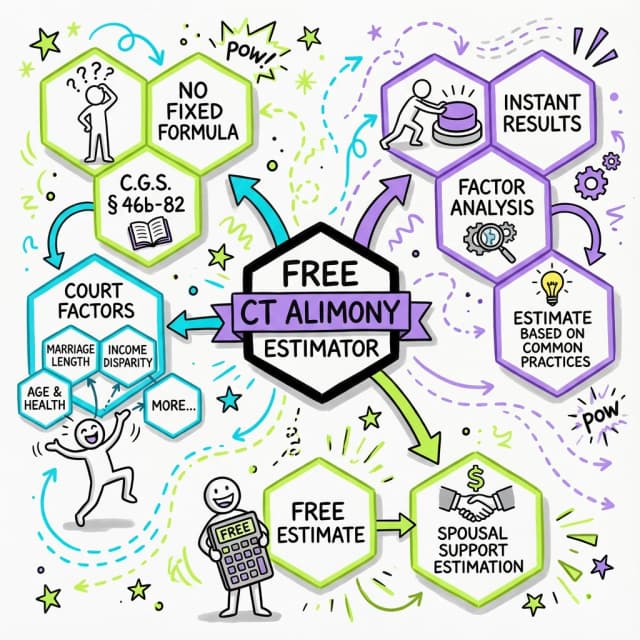
Try our free CT alimony calculator
Get an instant estimate based on Connecticut's statutory factors. No signup required.

Step-by-Step Timeline for a Connecticut Divorce
-
File your complaint or joint petition (Day 1) - Submit your divorce complaint (JD-FM-159) or joint nonadversarial petition along with required documents including the Notice of Automatic Court Orders (JD-FM-158) and your financial affidavit.
-
Serve your spouse (Days 1-30 for traditional divorce) - In traditional divorces, you must properly serve your spouse. Nonadversarial cases skip this step since both parties file together.
-
Waiting period begins (Traditional: 90 days minimum; Nonadversarial: 30 days) - The clock starts running on mandatory waiting periods. Use this time productively to gather documents and work toward agreement.
-
Pathways conference (Traditional only, 30-60 days after filing) - Meet with a family relations counselor who assesses your case complexity and assigns a case management track.
-
Discovery and negotiation (Traditional only, varies) - Exchange financial information, negotiate settlement terms, and attempt to resolve disputes outside of court.
-
Final hearing or disposition date - For nonadversarial cases, the court reviews your agreement and may enter judgment without a hearing. Traditional cases require a final hearing where the judge approves your agreement or makes decisions on contested issues.
-
Judgment enters - Your divorce is final when the judge signs the decree. Connecticut divorces are effective immediately—there's no additional waiting period after judgment.
Realistic Timeline Expectations by Case Type
| Case Type | Minimum Timeline | Typical Timeline | Maximum Timeline |
|---|---|---|---|
| Nonadversarial (no kids, simple assets) | 30-35 days | 35-45 days | 60 days |
| Uncontested (agreement reached quickly) | 90 days | 3-4 months | 6 months |
| Contested but settles before trial | 6 months | 8-12 months | 18 months |
| Fully contested (goes to trial) | 12 months | 18-24 months | 3+ years |
Understanding where your case likely falls helps set realistic expectations. The nonadversarial path truly is remarkably fast by divorce standards—just over a month from filing to final decree. But remember, this requires complete agreement before you even file.
For traditional divorces, the 90-day statutory waiting period represents an absolute minimum, not a realistic target. Even cooperative couples with simple finances typically need 3-4 months to complete all required steps, file necessary documents, and secure a court date.
How to Speed Up Your Connecticut Divorce
The most effective way to accelerate your divorce is reaching agreement with your spouse before filing. Every issue you can resolve privately—property division, debt allocation, support arrangements, parenting schedules—eliminates a potential court battle. Consider working with a mediator if direct negotiation proves difficult.
Prepare your documents in advance. Gather tax returns, bank statements, retirement account statements, and property deeds before you file. Having this information ready means you can complete your financial affidavit quickly and respond to any discovery requests without delay. Missing documents are one of the most common causes of divorce delays.
File in the right district. Connecticut allows you to file in the judicial district where either spouse resides. Some districts have significantly longer backlogs than others. If you have flexibility about which district to use, research current wait times. Also consider the nonadversarial path seriously—if you can negotiate a complete agreement, the time savings are substantial.
When Professional Help Makes Sense
While many Connecticut couples successfully navigate straightforward divorces independently, certain situations warrant professional guidance. If your spouse has hired an attorney, proceeding without one puts you at a significant disadvantage. Complex financial situations—business ownership, stock options, pension valuations—require expertise to ensure you receive your fair share.
High-conflict situations also benefit from professional intervention. When communication has broken down completely, a skilled family law attorney or mediator can facilitate progress where direct negotiation has failed. The cost of professional help often pays for itself in faster resolution and better outcomes.
For couples with relatively simple situations who want to move quickly, Untangle's AI legal guidance provides the support to handle your divorce efficiently without the high cost of traditional legal representation. The platform walks you through each step, ensures your documents are complete, and helps you avoid common mistakes that cause delays. Whether you're pursuing the nonadversarial path or navigating a traditional dissolution, having the right support makes all the difference in achieving the fast, friction-free divorce you're seeking.
Frequently Asked Questions
How long does Untangle's online divorce process take in Connecticut?
Using Untangle for a Connecticut divorce can take as little as 35 days for couples who qualify for the nonadversarial dissolution process, though most divorces take 3-12 months depending on complexity and agreement between spouses.
Is Untangle divorce available in Connecticut?
Yes, Untangle is available for Connecticut residents and can guide couples through both the expedited nonadversarial dissolution process (35 days) and the traditional divorce process (90+ days).
What is the step-by-step process for using Untangle for a CT divorce?
Untangle guides you through completing a divorce assessment, determining your eligibility for Connecticut's nonadversarial or traditional divorce path, preparing all required paperwork, and filing your joint petition or complaint with the court.
How does Untangle compare to other online divorce services in Connecticut?
Untangle specializes in Connecticut-specific divorce requirements and helps couples determine if they qualify for the faster 35-day nonadversarial dissolution, which many generic online divorce services may not properly address.
What is the minimum waiting period for a Connecticut divorce?
Connecticut requires a 90-day waiting period for traditional contested divorces, but couples using the nonadversarial dissolution process can finalize their divorce in approximately 30 days after filing their joint petition.
Legal Citations
- • C.G.S. § 46b-44a View Source
- • C.G.S. § 46b-44c View Source
- • C.G.S. § 46b-44d View Source
- • C.G.S. § 46b-67 View Source
- • Practice Book Rule § 25-50A View Source
- • Practice Book Rule § 25-30 View Source
- • JD-FM-159 View Source
- • JD-FM-158 View Source
- • JD-FM-006-Short View Source