Same Day Divorce in Connecticut: What You Need to Know About Fast Divorce Options
Connecticut does not offer same day divorce. Learn about the fastest legal divorce options, including the 30-day nonadversarial process and how to minimize delays.
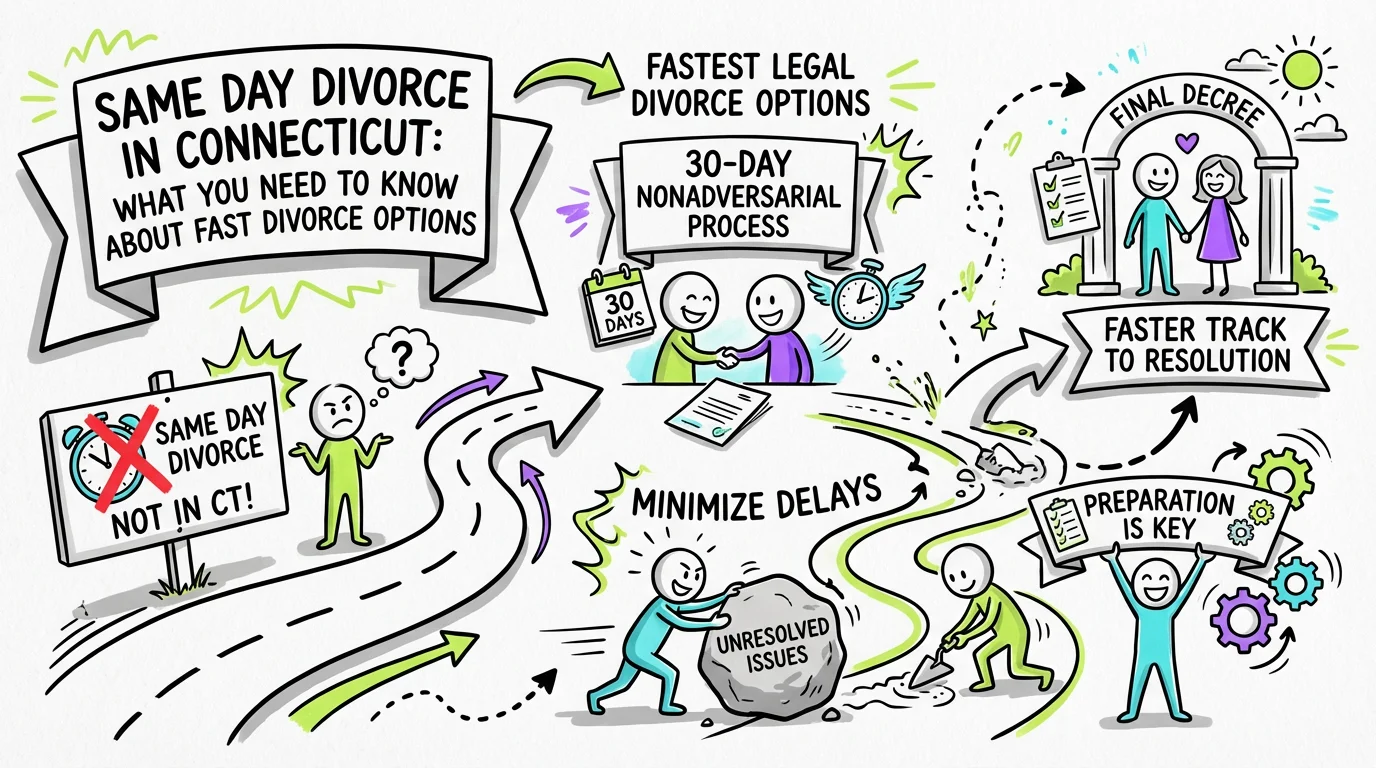
Connecticut does not offer same day divorce services. State law requires a mandatory minimum of 30 days between filing a joint divorce petition and the court entering a final decree, even when both spouses fully agree on all terms. This waiting period exists under C.G.S. § 46b-44c, which mandates that "all nonadversarial dissolution actions shall be assigned a disposition date not less than thirty days after the date on which the parties filed the joint petition." While this may be frustrating if you're hoping to finalize everything immediately, the 30-day minimum is actually Connecticut's fastest path to divorce.
Understanding Connecticut's Fastest Divorce Option
The quickest route to divorce in Connecticut is the nonadversarial dissolution process, designed specifically for couples who agree on everything and want to avoid lengthy court battles. Under C.G.S. § 46b-44a, you and your spouse can file a joint petition together rather than having one person sue the other. This collaborative approach eliminates the typical back-and-forth of traditional divorce proceedings and removes several procedural hurdles that can extend timelines by months.
To qualify for this expedited track, both spouses must attest under oath that specific conditions exist at the time of filing. These typically include full agreement on property division, any support arrangements, and—if you have children—custody and parenting plans. The petition must be notarized and filed in the judicial district where at least one spouse resides. Because you're filing together, the automatic restraining orders that protect marital assets take effect immediately for both parties under Practice Book Rule § 25-5B.
The beauty of this process is its simplicity: if your paperwork is complete and your agreement is fair, the court can enter your divorce decree without either party ever appearing in person. Under C.G.S. § 46b-44d, as long as the court determines your settlement agreement is "fair and equitable," you may receive your final decree on or within five days of your disposition date without a hearing. However, if the court has questions about your agreement, they'll schedule a hearing within 30 days of your original disposition date.
Why Connecticut Requires a 30-Day Waiting Period
The mandatory waiting period serves several important purposes under Connecticut family law. First, it provides a cooling-off period—a chance for either spouse to reconsider before the divorce becomes final. Under C.G.S. § 46b-44c, either party can file a notice of revocation before the disposition date, effectively withdrawing consent and converting the case to a traditional contested divorce track.
Second, the waiting period gives the court time to review your settlement agreement and financial disclosures. Connecticut courts have a duty to ensure divorce agreements are fair and equitable, particularly when children are involved. This review helps protect spouses from signing away rights they may not fully understand or from agreements made under duress. The case of Dubinsky v. Riccio, 194 Conn. App. 588 highlights how inadequate advice during divorce proceedings can lead to parties giving up important rights—a risk the court review process helps minimize.
Finally, the 30-day window allows for processing of required documents, including sworn financial statements that must be filed under Practice Book Rule § 25-30. These statements, which detail income, expenses, assets, and liabilities, are essential for the court to evaluate whether your proposed agreement fairly addresses both parties' financial situations.
What Determines How Long Your Connecticut Divorce Takes
While 30 days is the legal minimum for agreed divorces, actual timelines vary significantly based on several factors. Understanding what causes delays can help you avoid them and move through the process as efficiently as possible.
| Divorce Type | Minimum Timeline | Typical Timeline | Key Requirements |
|---|---|---|---|
| Nonadversarial (Joint Petition) | 30 days | 30-45 days | Full agreement, joint filing, complete paperwork |
| Uncontested (One Plaintiff) | 90 days | 3-6 months | Agreement reached, defendant served, return date waited |
| Contested | 90+ days | 9-18 months | Court hearings, discovery, possible trial |
Completeness of paperwork is the single biggest factor you can control. Missing or incorrect forms, unsigned documents, or incomplete financial affidavits will delay your case. The court requires specific forms including the Financial Affidavit (JD-FM-006 for most cases) and various certificates. Tools like Untangle's automatic document generation can help ensure you have everything ready before filing, reducing the risk of delays from incomplete submissions.
Agreement between spouses dramatically affects timeline. The moment any issue becomes contested—whether it's property division, support, or parenting arrangements—your case shifts to a different track. Under Practice Book Rule § 25-50A, contested cases are assigned to "pathways" that involve case management conferences, possible mediation, and scheduled court events. Track C (complex) cases can take well over a year to resolve.
Court schedules and backlogs also play a role. While the law sets minimums, actual disposition dates depend on court availability. Some judicial districts move faster than others, though the 30-day minimum applies statewide.
Steps to Get the Fastest Divorce in Connecticut
Follow this process to achieve the quickest possible divorce under Connecticut law:
-
Confirm you qualify for nonadversarial dissolution. Both spouses must agree on all issues: property division, debt allocation, alimony (if any), and child custody/support if you have minor children. Any disagreement disqualifies you from this expedited track.
-
Gather required documents before filing. You'll need your marriage certificate, financial records, and any documentation supporting your proposed property division. Complete the sworn Financial Affidavit (use the Financial Affidavit Short Form (JD-FM-006-Short) if neither spouse's income exceeds $75,000 and total assets are under $75,000).
-
Draft a comprehensive settlement agreement. This document must address every aspect of your divorce: property, debts, support, and—if applicable—detailed parenting plans. The more thorough your agreement, the less likely the court will have questions that require a hearing. Tools like Untangle's AI-assisted mediation can help you create a complete agreement that addresses all required elements.
-
File the joint petition together. Both spouses must sign the notarized petition attesting that your marriage has broken down irretrievably and that all required conditions exist. File in the judicial district where at least one of you resides.
-
Submit your financial affidavits with the petition. Under Practice Book Rule § 25-5B, sworn financial statements must be filed with the joint petition in nonadversarial cases—don't wait until later.
-
Wait for your disposition date. This will be at least 30 days from filing. Use this time to ensure you haven't missed anything and that both spouses remain committed to the agreement.
-
Receive your final decree. If everything is in order and neither party revokes consent, the court enters your dissolution decree on or within five days of the disposition date under C.G.S. § 46b-44c.
Common Reasons Fast Divorces Get Delayed
Even couples who agree on everything can face unexpected delays. Understanding these pitfalls helps you avoid them and stay on the fastest track possible.
Incomplete or incorrect financial disclosures are among the most common causes of delay. The court takes financial affidavits seriously—they're sworn statements submitted under oath. Errors, omissions, or inconsistencies between spouses' statements can raise red flags that require clarification or additional hearings. Using Untangle's financial affidavit generation can help ensure your disclosures are complete and consistent.
Settlement agreements that raise fairness concerns can also slow things down. Under C.G.S. § 46b-44d, if the court "cannot determine whether such settlement agreement is fair and equitable," they must schedule a hearing within 30 days of your original disposition date. Agreements where one spouse receives dramatically less than they might otherwise be entitled to, or where child support deviates significantly from guidelines, often trigger this review.
Last-minute changes or cold feet can derail the entire process. Either spouse can file a notice of revocation before the disposition date, which moves your case to the regular family docket and eliminates the streamlined process entirely. If you're unsure about any terms, it's better to address concerns before filing than to revoke after.
Missing required programs can also cause problems. If you have minor children, Connecticut requires completion of a parent education program. While this can sometimes be completed during the 30-day waiting period, failing to do so can delay your final decree.

Try our free CT alimony calculator
Get an instant estimate based on Connecticut's statutory factors. No signup required.
How Nonadversarial Divorce Differs from Traditional Divorce
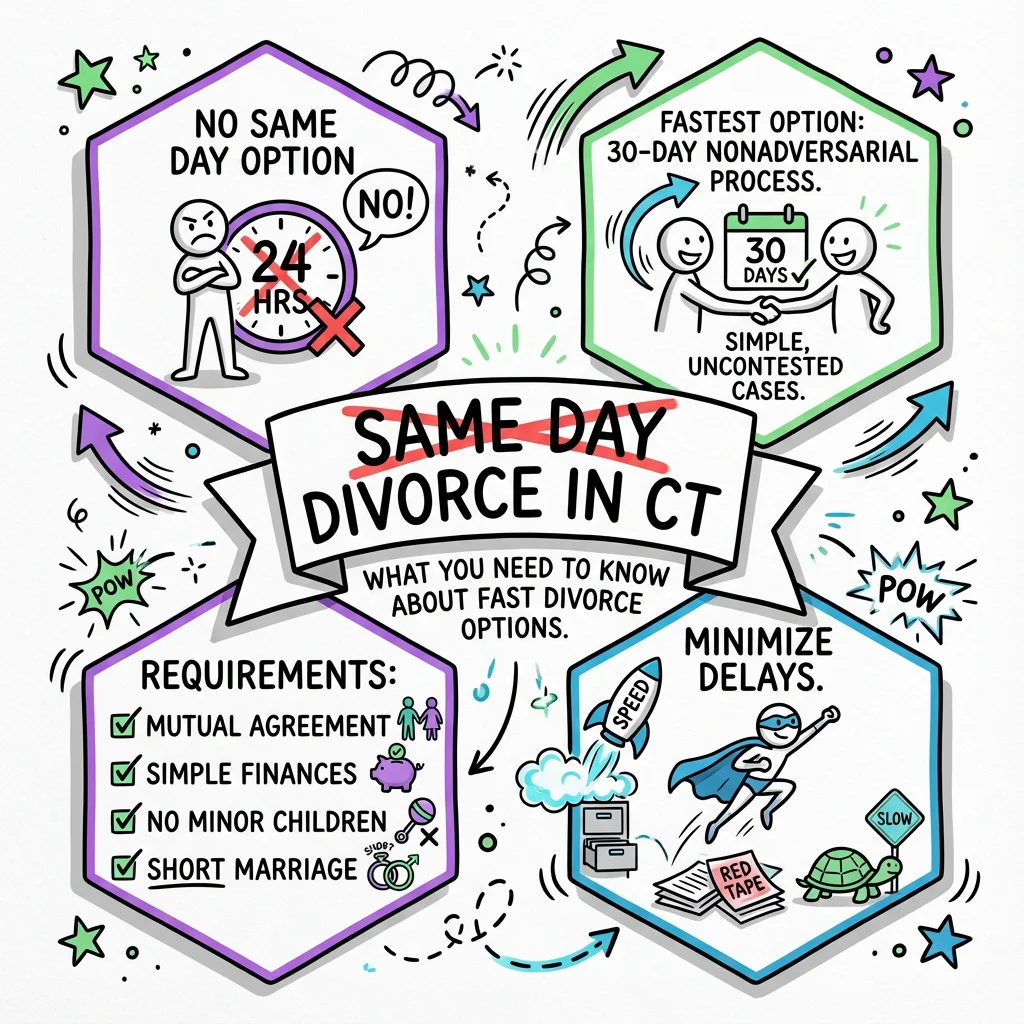
Understanding the difference between these two paths helps explain why the joint petition route is significantly faster.
In traditional contested divorce, one spouse files a complaint, serves the other, and then waits for the return date before proceedings can really begin. Under C.G.S. § 46b-67, the court cannot proceed on the complaint until "the second day after which a complaint for dissolution is made returnable"—typically about 90 days after filing. From there, cases enter the pathways system under Practice Book Rule § 25-50A, where they're classified as Track A (minimal court involvement), Track B (moderate), or Track C (complex) based on the level of dispute.
In nonadversarial divorce under C.G.S. § 46b-44a, both spouses file together from day one. There's no need to serve anyone, no return date to wait for, and no adversarial posturing. The 30-day period is purely administrative—time for the court to review your agreement and for either party to reconsider. This collaborative approach under C.G.S. § 46b-51 requires both parties to "execute a written stipulation that their marriage has broken down irretrievably," eliminating the need to prove fault or breakdown through other means.
The practical difference is substantial. What takes 30-45 days in a nonadversarial case routinely takes 6-18 months in contested matters—and costs significantly more in attorney fees, court costs, and emotional toll.
Using Technology to Speed Up Your Divorce Process
While you can't bypass Connecticut's 30-day minimum, you can eliminate many factors that cause divorces to take longer than necessary. Modern divorce technology focuses on reducing friction in the process—getting paperwork right the first time, ensuring agreements are complete, and keeping both spouses informed and aligned.
Untangle's personalized task dashboard helps couples work through the key decisions—property division, support calculations, and parenting arrangements—before filing. By reaching full agreement before you submit your joint petition, you maximize your chances of the court approving your agreement without requiring a hearing. The platform also helps organize financial information needed for your sworn affidavits, reducing errors that cause delays.
For couples who need guidance but want to maintain control of their timeline, mediation can be a valuable tool. A neutral mediator helps you reach agreement on disputed issues without the delays of court hearings. Many couples who thought they'd have a contested divorce find they can resolve differences through mediation and ultimately qualify for the faster nonadversarial track.
When You Should Slow Down Despite Wanting Speed
While efficiency is valuable, rushing through divorce can create problems that last far longer than any time saved. Consider slowing down if:
You're unsure about the terms. Settlement agreements in Connecticut divorce are extremely difficult to modify after the fact. If you're agreeing to something just to get it over with, you may regret that decision for years. Take time to understand what you're signing, even if it means extending your timeline slightly.
There are significant assets or debts involved. Complex financial situations require careful analysis. Pension valuations, business ownership questions, and tax implications of property transfers all deserve proper attention. The 30-day minimum doesn't account for the time needed to properly value and divide substantial assets.
You have concerns about hidden assets. The nonadversarial process relies on both spouses being honest in their financial disclosures. If you suspect your spouse isn't being forthcoming, the expedited track may not protect your interests. Discovery tools available in traditional divorce proceedings exist for good reason.
Children's long-term interests are at stake. Parenting plans established during divorce often govern arrangements for years. Custody agreements, holiday schedules, decision-making authority, and support calculations all deserve careful thought. Your children's wellbeing shouldn't be sacrificed for a faster timeline.
When to Get Professional Help
Even with Connecticut's streamlined nonadversarial process, professional guidance can be valuable—and sometimes essential. Consider consulting with a family law attorney if your situation involves retirement accounts or pensions requiring QDROs, real estate in multiple states, business ownership or partnership interests, significant disparity in income or assets between spouses, or any history of domestic violence or coercion.
An attorney can review your proposed settlement agreement before filing to ensure it protects your interests and is likely to pass court review. Many attorneys offer limited-scope representation—reviewing documents and providing advice without handling the entire case—which can be cost-effective for couples using the nonadversarial track.
For straightforward situations, Untangle's case details management can help you navigate the process, prepare your documents, and reach agreement with your spouse—all while keeping your case on track for the fastest possible resolution under Connecticut law. While same day divorce isn't available anywhere in Connecticut, a well-prepared nonadversarial case can have you legally single in just over a month.
Frequently Asked Questions
What is the fastest way to get a divorce in Connecticut?
The fastest divorce option in Connecticut is the nonadversarial dissolution process, which allows couples who agree on all terms to finalize their divorce in as little as 30 days after filing a joint petition.
Why does Connecticut require a 30-day waiting period for divorce?
Connecticut law under C.G.S. § 46b-44c mandates a minimum 30-day waiting period between filing and finalization to ensure both parties have adequate time to consider the decision and allow courts to review the agreement.
Can I get a divorce in CT without going to court?
Yes, if you and your spouse file a nonadversarial joint petition with complete paperwork and a fair agreement, the court can enter your divorce decree without either party appearing in person.
What states allow quickie divorces faster than Connecticut?
Some states like Nevada have shorter residency requirements and waiting periods, but Connecticut's 30-day nonadversarial process is among the faster options when both spouses agree on all terms.
What do I need to qualify for Connecticut's expedited divorce process?
To qualify for Connecticut's nonadversarial dissolution, both spouses must agree on property division, support arrangements, and custody plans (if applicable), and file a notarized joint petition in the judicial district where at least one spouse lives.
Legal Citations
- • Practice Book Rule § 25-5B View Source
- • Practice Book Rule § 25-30 View Source
- • Practice Book Rule § 25-50A View Source
- • Dubinsky v. Riccio, 194 Conn. App. 588 View Source
- • Financial Affidavit Short Form (JD-FM-006-Short) View Source