Connecticut Parenting Plan Template: Complete Guide for Divorcing Parents
Learn how to create a comprehensive Connecticut parenting plan for divorce. Includes custody schedules, decision-making authority, required forms, and court requirements.
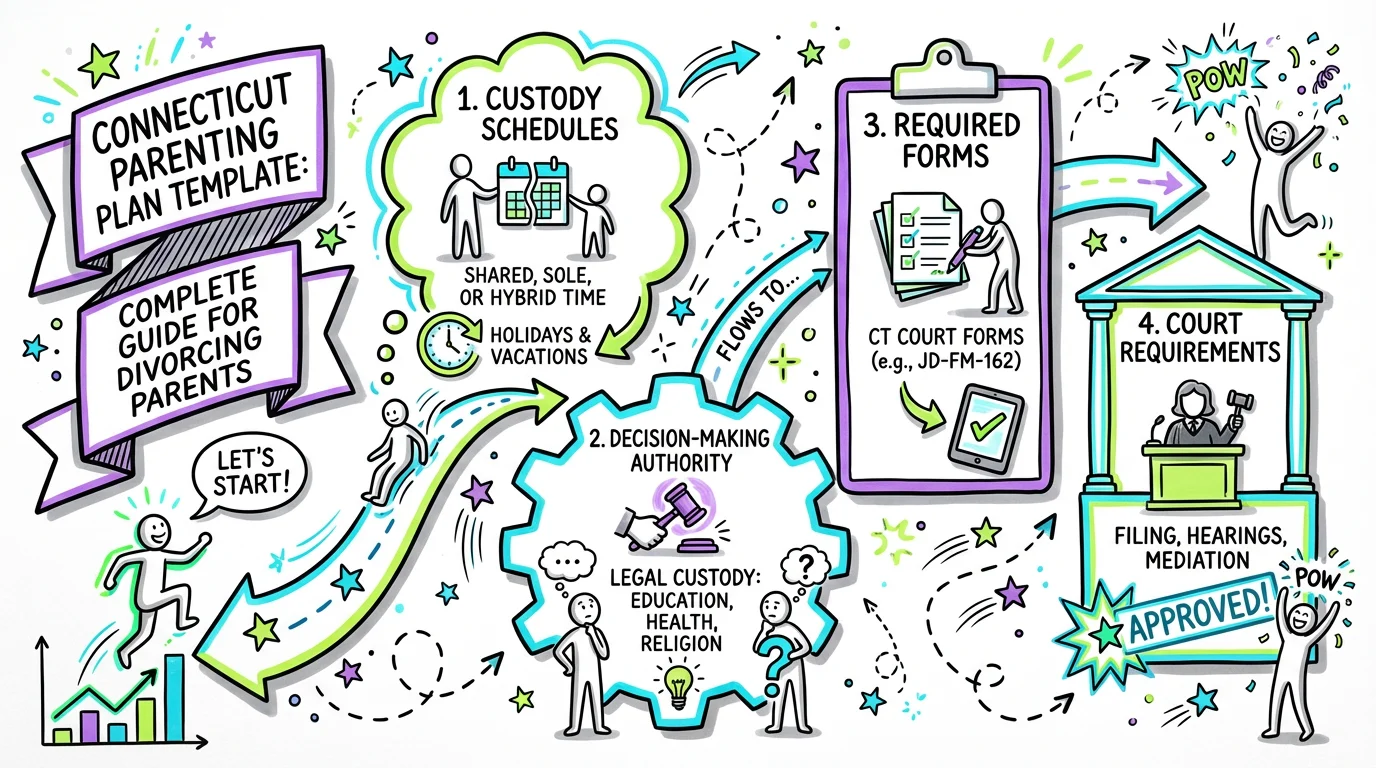
A parenting plan in Connecticut is a detailed written agreement that acts as a template for how you and your co-parent will share responsibilities for raising your children after divorce. Connecticut law under C.G.S. § 46b-56a requires parents seeking joint custody to submit a "parental responsibility plan" that addresses decision-making authority, physical custody schedules, and dispute resolution. While the court provides standard forms, creating a customized plan that covers your specific family dynamic is essential for long-term stability and avoiding future court battles.
Understanding Connecticut's Parenting Plan Requirements
Connecticut courts prioritize the "best interests of the child" in all custody decisions, and your parenting plan serves as the roadmap for how you'll co-parent moving forward. Under C.G.S. § 46b-56, the court has broad authority to make orders regarding custody, care, education, visitation, and support of children. When parents agree on these matters, the court reviews the agreement to ensure it serves the children's best interests before incorporating it into the final divorce decree.
The legal framework distinguishes between two types of custody that your plan must address. Legal custody refers to decision-making authority over major aspects of your child's life, including education, healthcare, and religious upbringing. Physical custody determines where your child lives and the schedule for time with each parent. Connecticut courts can award these jointly or to one parent, and your parenting plan should clearly specify how both will work in your situation.
Creating a thorough parenting plan at the outset of your divorce can prevent countless future conflicts and court appearances. Parents who take time to address potential issues proactively—from holiday schedules to how they'll communicate about the children—typically experience smoother co-parenting relationships and better outcomes for their children. By treating your plan as a living document rather than just a form to file, you create a stable environment for your children to thrive.
Essential Components of a Connecticut Parenting Plan
Physical Custody and Residential Schedule
The residential schedule forms the backbone of your parenting plan, specifying exactly when your children will be with each parent. Connecticut Practice Book Rule § 25-5 includes automatic orders that prevent either parent from permanently removing children from the state without consent, establishing stability from the moment divorce papers are filed. Your plan should build on this foundation with a detailed, workable schedule.
Effective residential schedules account for your children's ages, school calendars, extracurricular activities, and both parents' work schedules. For younger children, more frequent transitions with shorter stays often work better, while older children and teenagers may prefer longer stretches with each parent. Whatever schedule you choose, specificity is your friend—include exact days and times for exchanges, pickup and drop-off locations, and who provides transportation.
Consider using tools like Untangle's Parenting Plan Builder to visualize different custody arrangements and calculate the percentage of time with each parent. This can be particularly helpful when negotiating, as you can see exactly how different schedules affect overall parenting time and identify potential conflicts before they happen.
Legal Custody and Decision-Making Authority
Legal custody determines which parent—or both parents together—makes major decisions about your children's lives. C.G.S. § 46b-56a defines joint custody as providing "joint decision-making by the parents," but your plan should specify exactly how this works in practice. Will you need to agree on all major decisions, or will one parent have final say in certain areas?
Your parenting plan should address decision-making in these key categories:
- Education: School selection, special education services, tutoring, educational testing
- Healthcare: Medical, dental, and vision care, mental health treatment, medications
- Religious upbringing: Religious education, ceremonies, observance requirements
- Extracurricular activities: Sports, lessons, camps, and how costs are divided
- Travel: Protocols for out-of-state or international travel with the children
For protective parents particularly concerned about their children's wellbeing, building in consultation requirements and notification procedures for major decisions provides an additional layer of involvement. Tools like Untangle's Children's Information Management can help you keep track of all these important details – from doctor's appointments to school records – ensuring you have immediate access to necessary information and can easily share updates when required.
Holiday and Vacation Schedules
Holiday scheduling often becomes one of the most emotionally charged aspects of parenting plans. Your plan should address major holidays (Thanksgiving, Christmas/Hanukkah, Easter/Passover, Fourth of July), school breaks (winter, spring, summer), special days (birthdays, Mother's Day, Father's Day), and any holidays significant to your family's cultural or religious traditions. Without clear definitions here, holidays can become sources of significant stress rather than celebration.
Common approaches include alternating holidays annually (Parent A has Thanksgiving in even years, Parent B in odd years), splitting holidays (morning with one parent, afternoon/evening with the other), or duplicating celebrations (each parent hosts their own birthday party). The best approach depends on your children's ages, the distance between homes, and your family's traditions. Being specific about what defines a holiday—does Thanksgiving start Wednesday night or Thursday morning?—prevents misunderstandings.
Summer vacation schedules deserve particular attention, especially for school-age children. Many parents specify blocks of uninterrupted time for extended vacations, notification requirements for travel plans, and how summer custody differs from the school-year schedule. This planning ensures both parents get meaningful downtime with the children while respecting the other's schedule.
Creating Your Parental Responsibility Plan
Step 1: Document Your Current Arrangements
Before negotiating anything new, document your current parenting arrangement in detail. Who handles morning routines? Who takes the children to medical appointments? Who attends school events? This baseline information helps ensure your plan reflects reality and identifies areas where adjustments might be needed. Recognizing the existing division of labor helps prevent creating an aspirational plan that fails in practice because it ignores current logistics.
Step 2: Assess Your Children's Needs
Consider each child individually—their ages, temperaments, school situations, medical needs, and relationships with each parent. A teenager's needs differ dramatically from a toddler's, and your plan should reflect that flexibility. Children with special needs may require additional provisions for therapy appointments, medication management, or specialized care. Tailoring the plan to the child rather than fitting the child to a plan is crucial for long-term success.
Step 3: Draft the Core Schedule
Start with your regular weekly schedule, then layer in holiday and vacation schedules. Be specific about logistical details to avoid ambiguity. Key elements to define include:
- Transition Times: Which exact days and times children transfer between parents
- Logistics: Pickup and drop-off procedures and locations
- Flexibility: How you'll handle schedule changes or makeup time
- Right of First Refusal: Offering the other parent childcare time before using a babysitter
- Communication: Protocols for phone calls and video chats between homes
Step 4: Address Decision-Making Protocols
Specify how you'll make decisions together, including communication methods, timeframes for responses, and what happens if you can't agree. This is the "governance" part of your parenting partnership. Some plans include provisions for mediation before returning to court, which saves time and money. Defining whether communication happens via email, text, or a dedicated app helps keep interactions focused and documented.
Step 5: Include Dispute Resolution Procedures
Connecticut encourages parents to resolve disputes outside of court when possible. Your plan might include a commitment to attempt mediation, consultation with a parenting coordinator, or other alternative dispute resolution methods before filing motions. This clause acts as a safety valve, providing a structured way to handle the inevitable disagreements that arise during years of co-parenting without immediately resorting to litigation.
Parenting Plan Comparison: Common Custody Arrangements in Connecticut
| Arrangement | Physical Custody Split | Best For | Considerations |
|---|---|---|---|
| Primary with One Parent | 70-80% / 20-30% | Young children, significant distance between homes | Provides stability; non-primary parent gets meaningful time |
| Equal Time (Week On/Week Off) | 50% / 50% | Older children, parents living close by | Requires excellent co-parent communication |
| 2-2-3 Rotation | 50% / 50% | Families wanting frequent contact with both parents | More transitions; works well for adaptable children |
| 3-4-4-3 Schedule | 50% / 50% | Balance between stability and equal time | Children never go more than 4 days without seeing either parent |
| Primary During School Year | Varies by season | Parents in different school districts | Summer schedule differs significantly from school year |
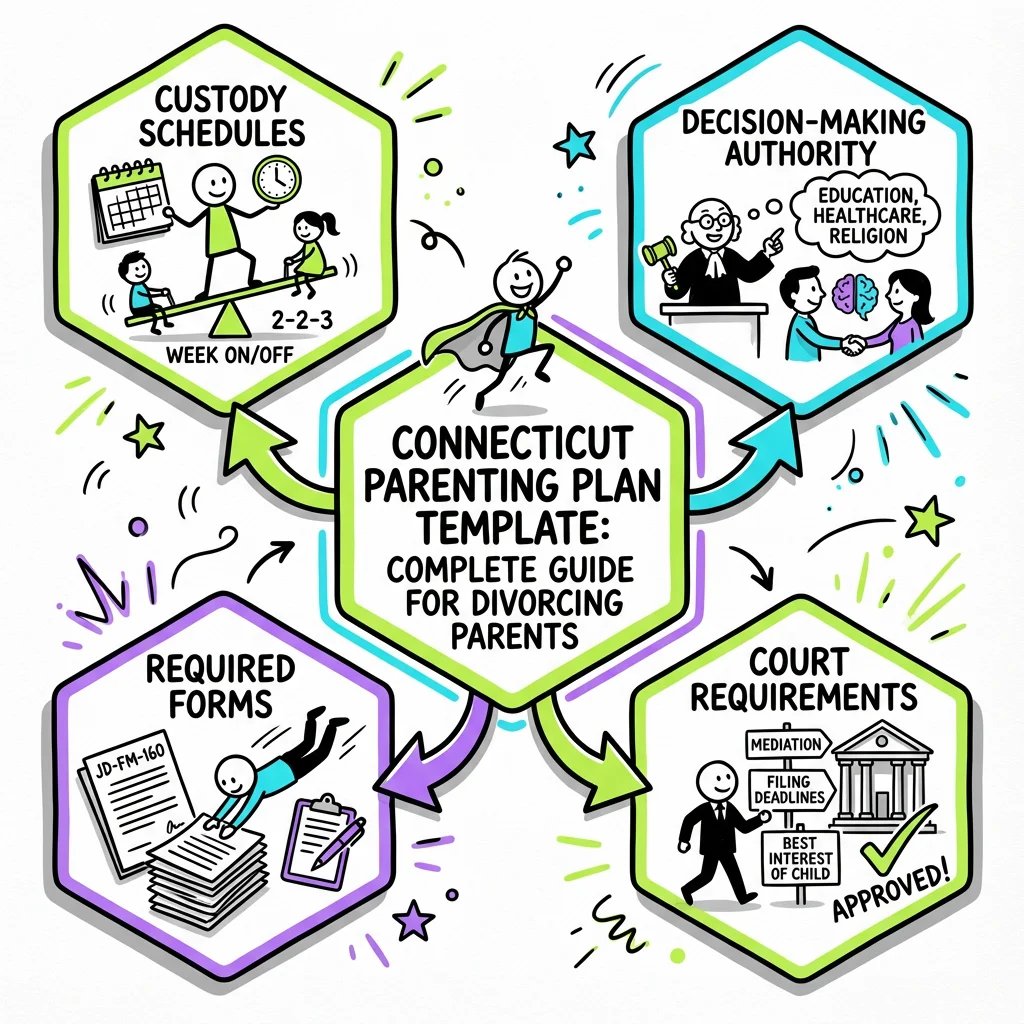
Required Court Forms and Documentation
Connecticut requires specific documentation when submitting your parenting plan to the court. Under Practice Book Rule § 25-57, before any custody order is issued, you must file an Affidavit Concerning Children that includes jurisdictional information required by the UCCJEA (Uniform Child Custody Jurisdiction and Enforcement Act).
Key forms include:
- Notice of Automatic Court Orders (JD-FM-158): Outlines restrictions that apply immediately upon filing, including prohibitions on removing children from Connecticut
- Certificate of Compliance (JD-FM-175): Confirms you've met various filing requirements
- Parenting Education Program Documentation: Under C.G.S. § 46b-69b, Connecticut requires both parents to complete a parenting education program, and you may need to file proof of completion
The parenting education program required by the court covers the impact of divorce on children and strategies for co-parenting effectively. Keeping track of your completion and filing the necessary proof can be another item on your divorce checklist. Tools like Untangle's Parent Education Tracking can help you manage these requirements and ensure you meet court mandates efficiently.
Tools like Untangle's Automatic Document Generation can help you organize the forms and information you'll need, ensuring nothing falls through the cracks during this complex process. This automation can be invaluable for ensuring consistency across the multiple documents required by the court.
How Connecticut Courts Evaluate Parenting Plans
When reviewing your parenting plan, Connecticut courts examine whether it serves the best interests of the children. Under C.G.S. § 46b-66, the court inquires into "the respective fitness [of each parent] to have physical custody of or rights of visitation with any minor child" before approving any agreement.
Factors courts consider include each parent's relationship with the children, the children's current living situation, stability and continuity of care, each parent's mental and physical health, and any history of domestic violence or substance abuse. If concerns exist about a child's safety or wellbeing, the court may appoint a guardian ad litem under C.G.S. § 46b-54 to represent the child's interests and make recommendations.
For protective parents, building appropriate safeguards into your parenting plan—such as supervised visitation requirements, drug testing provisions, or restrictions on overnight guests—may be necessary if there are legitimate concerns about the other parent. Courts take child safety seriously, and well-documented concerns supported by evidence will be given appropriate weight. Documentation is key in these scenarios, and organizing your evidence systematically is essential.
The Pathways Program and Your Parenting Plan
Connecticut's family courts use the Pathways program to manage divorce cases, including custody matters. Under Practice Book Rule § 25-50A, within 30-60 days of filing, you'll meet with a family relations counselor who assesses your case and recommends a track: Track A for cases likely to settle quickly, Track B for moderate complexity, or Track C for highly contested matters.
Your preparation before the Pathways meeting matters significantly. Coming with a thoughtful parenting plan draft—even if not yet agreed upon—demonstrates your commitment to your children's wellbeing and can help the process move more smoothly. The family relations counselor can identify areas of agreement and disagreement and recommend appropriate resources. Being prepared allows you to advocate more effectively for the track and resources that best fit your family's needs.
Understanding how your case will proceed through the court system helps you prepare appropriately. Untangle's Case Management features can help you track important dates and deadlines as your divorce progresses through the Connecticut court system, ensuring you never miss a critical filing or appearance.
When Professional Help Is Essential
While many parents successfully negotiate parenting plans together or through mediation, certain situations warrant professional legal assistance. If there's any history of domestic violence, substance abuse, mental health concerns, or child abuse or neglect, you should work with an experienced family law attorney who can ensure appropriate protections are built into your plan.
Similarly, if your co-parent is uncooperative, has threatened to relocate with the children, or if you anticipate significant conflict over custody, professional guidance becomes essential. Connecticut's automatic orders under Practice Book Rule § 25-5 provide some immediate protections, but a comprehensive legal strategy may be necessary to protect your children's interests.
Even in amicable divorces, having an attorney review your parenting plan before signing ensures you haven't overlooked important provisions and that the agreement will be enforceable. The cost of legal review upfront is minimal compared to the expense and stress of returning to court to fix problems later. For parents navigating these difficult decisions, Untangle's AI Legal Guidance provides answers to specific questions about custody and court procedures.
Frequently Asked Questions
What must be included in a Connecticut parenting plan?
A Connecticut parenting plan must include decision-making authority (legal custody), physical custody schedules, holiday and vacation arrangements, communication methods between parents, and a process for resolving future disputes as required under C.G.S. § 46b-56a.
How do I create a holiday custody schedule in CT?
Create a holiday custody schedule by alternating major holidays annually, specifying exact pickup and drop-off times, and addressing school breaks, birthdays, and religious holidays in writing within your parenting plan.
Does Connecticut require a parenting plan for divorce?
Yes, Connecticut requires parents seeking joint custody to submit a "parental responsibility plan" under C.G.S. § 46b-56a that the court reviews to ensure it serves the children's best interests before approving the divorce.
What is the best parenting plan for toddlers in Connecticut?
The best parenting plan for toddlers in Connecticut typically includes shorter, more frequent visits with the non-custodial parent to maintain attachment while minimizing overnight separations, adjusted as the child develops.
How detailed should a CT parenting plan be for high-conflict divorce?
High-conflict parenting plans in Connecticut should be extremely detailed, specifying exact exchange locations, communication methods (often limited to email or parenting apps), and step-by-step procedures for every scenario to minimize direct contact and disputes.
Legal Citations
- • Connecticut Practice Book Rule § 25-5 - Automatic Orders upon Service of Complaint View Source
- • Connecticut Practice Book Rule § 25-50A - Case Management under Pathways View Source
- • Connecticut Practice Book Rule § 25-57 - Affidavit concerning Children View Source
- • JD-FM-158 - Notice of Automatic Court Orders View Source
- • JD-FM-175 - Certificate of Compliance View Source