Online Divorce vs. Lawyer for Uncontested Divorce in Connecticut: Which Is Right for You?
Compare online divorce services vs. hiring a lawyer for uncontested divorce in Connecticut. Learn costs, timelines, and when each option makes sense.
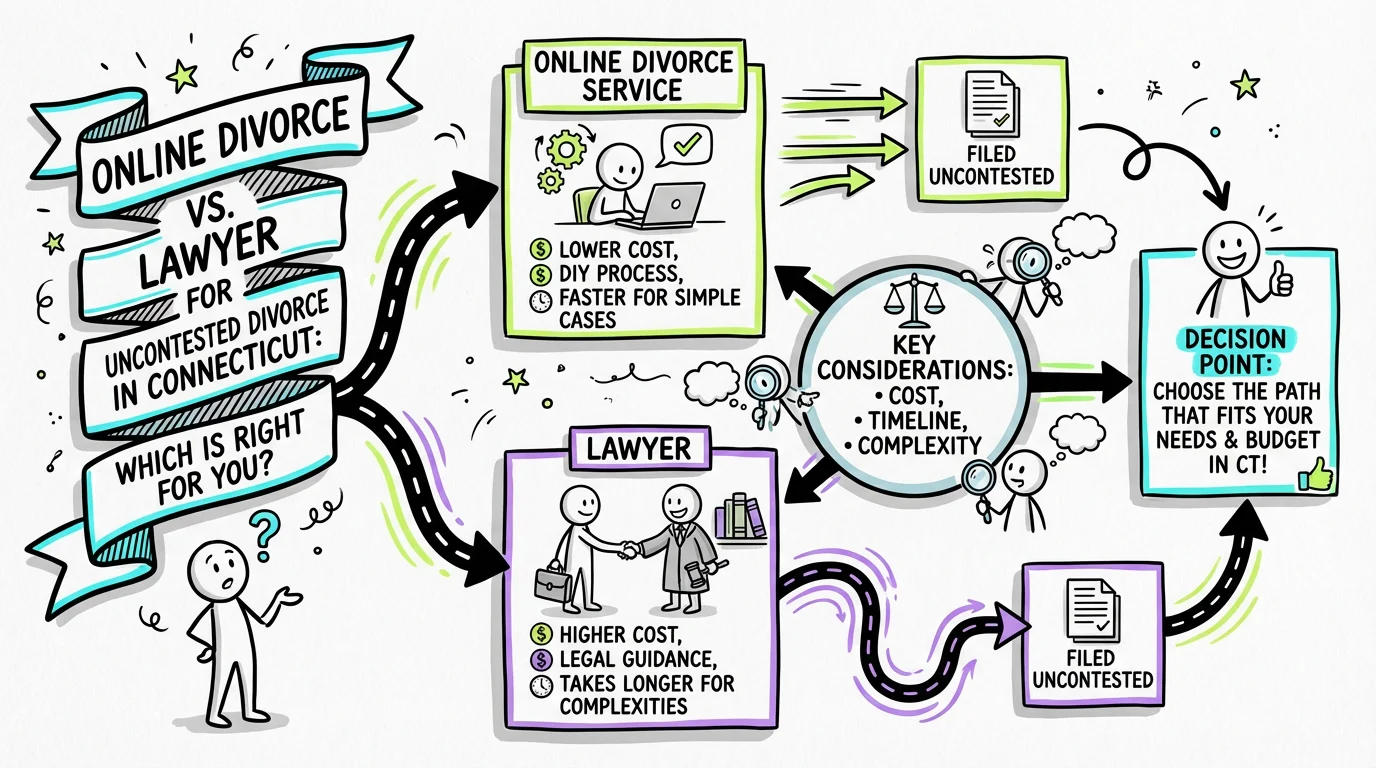
For couples who agree on all terms of their divorce, Connecticut offers a streamlined "nonadversarial dissolution" process that can work well with either online divorce services or attorney representation. Online divorce services cost significantly less ($150-$500 for document preparation) compared to attorney fees ($1,500-$5,000+ even for uncontested cases), but attorneys provide legal advice, court representation, and protection against mistakes that could affect you for years. The right choice depends on your specific circumstances—particularly whether you have children, significant assets, or complex financial situations.
Understanding Connecticut's Nonadversarial Dissolution Process
Connecticut law specifically accommodates couples who want to divorce amicably through a "nonadversarial dissolution" pathway. Under C.G.S. § 46b-44a, married couples can file a joint petition together rather than having one spouse "sue" the other. This collaborative approach reflects the reality that many divorcing couples simply want to move forward respectfully rather than engage in adversarial litigation.
To qualify for this streamlined process, both parties must attest under oath that certain conditions exist—primarily that the marriage has broken down irretrievably and that they've reached agreement on all major issues. This includes custody and visitation arrangements for children, child support, alimony (if any), and division of property and debts. The joint petition must be notarized and filed in the judicial district where either spouse resides.
The timeline for nonadversarial dissolution is notably faster than contested divorces. According to C.G.S. § 46b-44c, courts assign a disposition date no less than thirty days after filing the joint petition. If neither party files a notice of revocation before that date, the court can enter a final decree of dissolution on or within five days of the disposition date. This means couples could potentially finalize their divorce in as little as 35 days—a stark contrast to contested cases that can drag on for months or years.
What Online Divorce Services Actually Provide
Online divorce services in Connecticut primarily function as document preparation platforms. They guide you through questionnaires about your marriage, assets, children, and desired outcomes, then generate the court forms you need to file. These services do not provide legal advice, represent you in court, or negotiate on your behalf—they simply produce paperwork based on your inputs.
For a truly uncontested Connecticut divorce, you'll need several key documents: the joint petition for nonadversarial dissolution, sworn financial affidavits from both parties, a separation agreement outlining all terms, and if you have children, a parenting plan. Online services can generate these forms, but they cannot ensure the terms you've agreed upon are fair, enforceable, or in compliance with Connecticut law. Tools like Untangle's case details management can help you understand what information you'll need to gather and organize before using any document preparation service.
The financial affidavit requirement deserves special attention. Under Practice Book Rule § 25-30, each party must file a sworn statement showing current income, expenses, assets, and liabilities at least five business days before any hearing. If your gross income is under $75,000 and total assets are less than $75,000, you can use the Short Form Financial Affidavit (JD-FM-006). Online services will ask you to input this information, but they won't verify its accuracy or help you understand what should be included. Mistakes on financial affidavits can constitute perjury and may invalidate your agreement later.
What an Attorney Provides in Uncontested Divorces
Even in amicable divorces, attorneys serve roles that document preparation services cannot. An attorney reviews your entire situation and identifies issues you may not have considered—pension division, tax implications of alimony, health insurance coverage, or how your agreement might affect future modifications. They ensure your separation agreement is legally enforceable and actually reflects what you intend.
Connecticut courts must approve separation agreements before incorporating them into divorce decrees. Under C.G.S. § 46b-66, judges inquire into the financial resources and actual needs of both parties, and if children are involved, their best interests. The court can reject agreements it finds unconscionable or contrary to public policy. An attorney helps you craft an agreement that will pass judicial scrutiny the first time, avoiding delays and additional hearings.
For couples with children, attorney guidance becomes particularly valuable. Connecticut requires parenting plans to address custody, visitation schedules, decision-making authority, and support calculations. The Connecticut Child Support Guidelines create presumptive support amounts, but deviations are permitted when parties can cite specific reasons and the agreement still serves the child's best interests. An attorney ensures your child-related agreements comply with these requirements while protecting your relationship with your children.
Side-by-Side Comparison: Online Services vs. Attorney Representation
| Factor | Online Divorce Service | Attorney Representation |
|---|---|---|
| Cost | $150-$500 for document prep | $1,500-$5,000+ (uncontested) |
| Legal Advice | Not provided | Comprehensive guidance |
| Document Preparation | Automated forms | Customized drafting |
| Court Appearance | You represent yourself | Attorney appears with you |
| Negotiation Help | None | Facilitates discussions |
| Error Protection | Limited | Attorney reviews everything |
| Timeline | Same as DIY (30+ days) | Same, potentially faster |
| Complex Assets | Not recommended | Strongly recommended |
| Children Involved | Proceed with caution | Highly recommended |
| Best For | Simple, short marriages | Most situations |
The cost difference is significant but must be weighed against potential long-term consequences. A poorly drafted separation agreement could cost thousands to modify later, and some provisions may not be modifiable at all. Untangle's financial comparison tools can help you evaluate whether your proposed terms are within typical ranges for Connecticut divorces, giving you baseline information regardless of which path you choose.
When Online Divorce Makes Sense in Connecticut
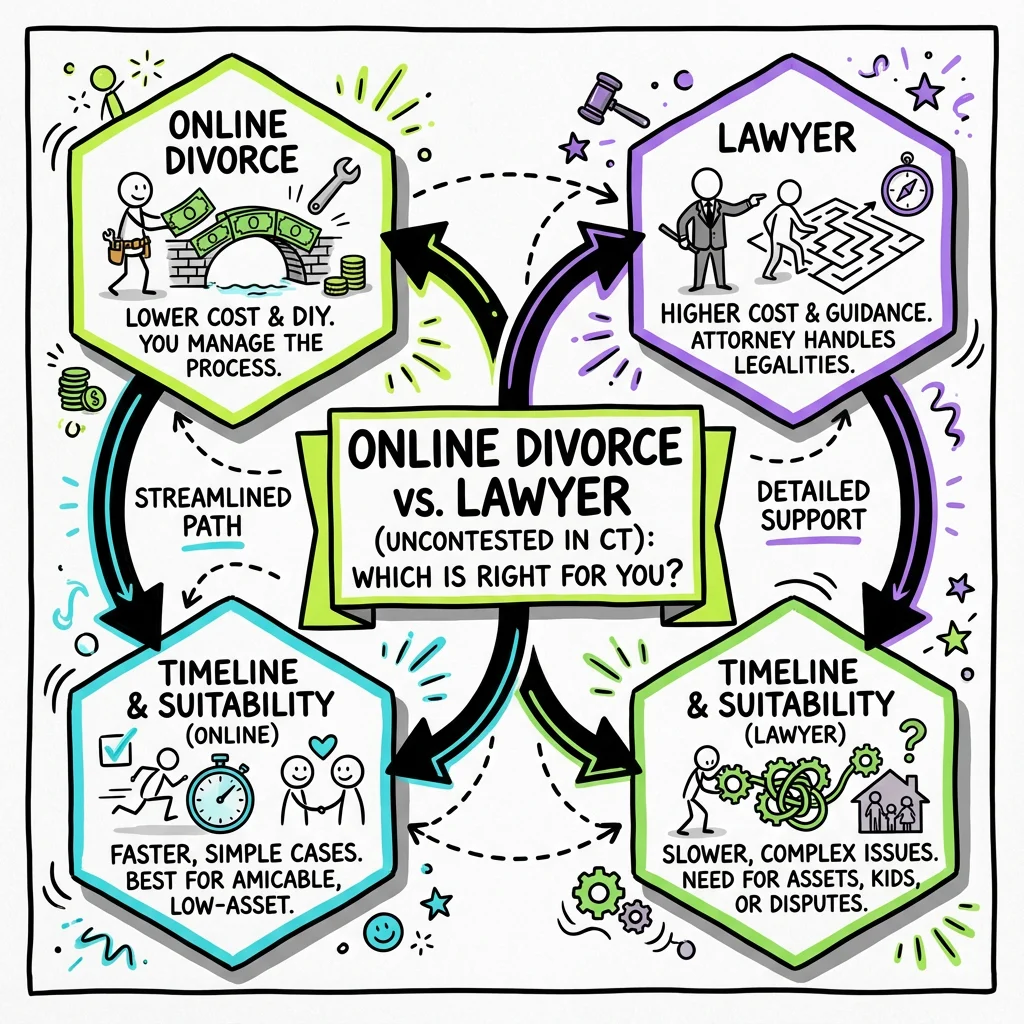
Online divorce services work best for couples with straightforward situations. If you've been married a short time, have no children, own no real estate together, have limited retirement accounts, and both agree completely on how to divide what you do have, document preparation services can provide genuine value at a fraction of attorney costs.
The ideal candidate for online divorce in CT has already resolved all issues through direct communication with their spouse. Both parties understand their financial situations, have exchanged all relevant information openly, and trust each other to follow through on commitments. There's no history of domestic violence, hidden assets, or power imbalances that might lead one spouse to agree to unfair terms.
Even in these ideal situations, consider having an attorney review your completed documents before filing. Many Connecticut family law attorneys offer "unbundled" services—reviewing specific documents or providing limited consultation without handling your entire case. This middle-ground approach gives you the cost savings of DIY preparation with professional oversight for peace of mind. Untangle's personalized task dashboard can help you prepare everything an attorney would need for an efficient review session.
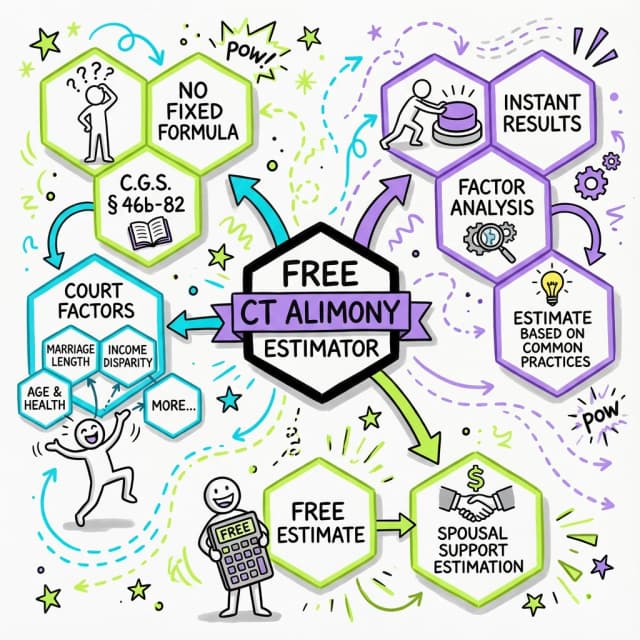
Try our free CT alimony calculator
Get an instant estimate based on Connecticut's statutory factors. No signup required.
When You Should Hire an Attorney
Certain circumstances strongly favor attorney representation regardless of how amicable your divorce seems. If you have minor children, own a home together, have retirement accounts or pensions to divide, own a business, or if one spouse earns significantly more than the other, professional guidance protects both parties' interests.
Child-related issues add complexity that document preparation services cannot navigate. Connecticut's Pathways case management system, outlined in Practice Book Rule § 25-50A, channels cases into different tracks based on complexity. Cases involving children require resolution plans developed with family relations counselors, and courts scrutinize child support and custody arrangements carefully. The automatic court orders under Practice Book Rule § 25-5 impose immediate restrictions on both parents regarding the children—restrictions that remain until modified by court order.
Property division in longer marriages often involves assets that aren't immediately obvious. QDROs (Qualified Domestic Relations Orders) are required to divide retirement accounts without tax penalties. Business valuations may be necessary. Debts must be allocated, and creditors aren't bound by your agreement—meaning you could remain liable for debts your spouse agreed to pay. Attorneys understand these complexities and draft agreements that actually protect you.
Steps to Complete an Uncontested Divorce in Connecticut
-
Gather financial information - Collect tax returns, pay stubs, bank statements, retirement account statements, mortgage documents, and debt records. Both spouses need complete financial pictures before any agreement can be drafted. Untangle's complete asset inventory can help you compile and categorize these documents efficiently.
-
Discuss and agree on all terms - Work through custody arrangements (if applicable), property division, debt allocation, and whether either spouse will pay alimony. Write down what you've agreed to, even informally.
-
Choose your approach - Decide whether to use online document services, hire attorneys, or use a hybrid approach with document preparation plus attorney review.
-
Prepare and file your joint petition - Complete the joint petition for nonadversarial dissolution and all required attachments, including sworn financial affidavits. File in the judicial district where either spouse resides and pay the filing fee.
-
Wait the mandatory period - Connecticut requires at least 30 days between filing and the disposition date. Use this time to ensure all paperwork is complete and filed correctly.
-
Attend the disposition hearing - Even in nonadversarial cases, you may need to appear briefly. The judge reviews your agreement, confirms both parties understand and accept the terms, and enters the final decree if everything is in order.
-
File post-judgment documents - Complete any required documentation after the divorce is final, such as transferring property titles or filing QDROs.
Costs and Timeline Breakdown
| Expense Category | Online/DIY | With Attorney |
|---|---|---|
| Court Filing Fee | ~$350 | ~$350 |
| Document Preparation | $150-$500 | Included in fees |
| Attorney Fees | $0-$500 (review only) | $1,500-$5,000+ |
| Parenting Education | $125 per parent (if children) | Same |
| Document Recording | $50-$150 | Same |
| Total Range | $500-$1,125 | $2,000-$6,000+ |
Timeline remains relatively consistent regardless of approach. The 30-day minimum waiting period is statutory and cannot be waived. Most uncontested divorces finalize within 60-90 days of filing when all paperwork is complete and correct. Errors or incomplete filings can add weeks or months—another argument for professional review even when using online services.
Protecting Your Agreement Long-Term
Your separation agreement becomes a court order once incorporated into the divorce decree. Understanding what can and cannot be modified later matters significantly when drafting terms. Child support and custody arrangements can typically be modified when circumstances change substantially. Alimony can sometimes be modified depending on how it's structured. Property division, however, is generally final—what's done is done.
This finality means getting property division right the first time is essential. Online services generate agreements based on what you tell them, with no verification or analysis. If you undervalue an asset, overlook a debt, or misunderstand how something should be divided, you may have no recourse later. Connecticut courts set high bars for reopening property settlements, typically requiring proof of fraud or mutual mistake.
For couples using online services, at minimum have a certified public accountant or financial planner review asset valuations before finalizing. Consider Untangle's smart bank statement analysis to ensure you're accounting for all marital property and understanding the true value of what you're receiving. An agreement that looks equal on paper may not be equal in reality when tax implications, liquidity, and future growth are considered.
When to Get Professional Help
Even if you start with online divorce services, certain developments should prompt you to consult an attorney. If your spouse suddenly becomes uncooperative, if you discover assets you didn't know existed, if disagreements emerge about children, or if you simply feel unsure about what you're signing, stop and get professional guidance.
Connecticut offers resources for people who cannot afford full attorney representation. Court service centers provide information (not legal advice) about procedures and forms. Some attorneys offer sliding-scale fees or payment plans. Legal aid organizations serve income-eligible individuals. The cost of a consultation—typically $150-$300—is minimal compared to the cost of fixing a problematic divorce agreement years later.
Ultimately, the choice between online divorce and attorney representation isn't about being adversarial or amicable—it's about ensuring your agreement protects both parties fairly and stands up over time. Many amicable couples choose attorney representation precisely because they want their good relationship to continue, and a well-drafted agreement prevents future conflicts. Whatever path you choose, take time to understand exactly what you're agreeing to before signing documents that will affect your life for years to come.
Frequently Asked Questions
When do I need a lawyer instead of online divorce for an uncontested divorce in Connecticut?
You should hire a lawyer if you have children, significant assets, retirement accounts, real estate, business interests, or complex debt situations, even if your divorce is uncontested.
How much does online divorce cost compared to hiring a lawyer in CT?
Online divorce services in Connecticut typically cost $150-$500 for document preparation, while attorney fees for uncontested divorces range from $1,500-$5,000 or more.
What are the risks of filing for divorce in Connecticut without an attorney?
Filing without an attorney risks making legal mistakes in property division, support calculations, or custody arrangements that could negatively affect your finances and parental rights for years.
Can online divorce services handle property division in Connecticut?
Online divorce services can prepare paperwork for simple property division, but they cannot provide legal advice on equitable distribution or protect your interests in complex asset situations.
How long does an uncontested online divorce take in Connecticut?
Connecticut's nonadversarial dissolution process requires a minimum of 30 days from filing before the court can enter a final divorce decree, whether you use online services or an attorney.
Legal Citations
- • C.G.S. § 46b-44a View Source
- • C.G.S. § 46b-44c View Source
- • Practice Book Rule § 25-30 View Source
- • C.G.S. § 46b-66 View Source
- • Practice Book Rule § 25-50A View Source
- • Practice Book Rule § 25-5 View Source