Military Divorce Resources Online in Connecticut: Complete Guide for Service Members and Spouses
Find military divorce resources online for Connecticut. Learn about USFSPA, military pension division, deployment custody, and benefits for service members and spouses.
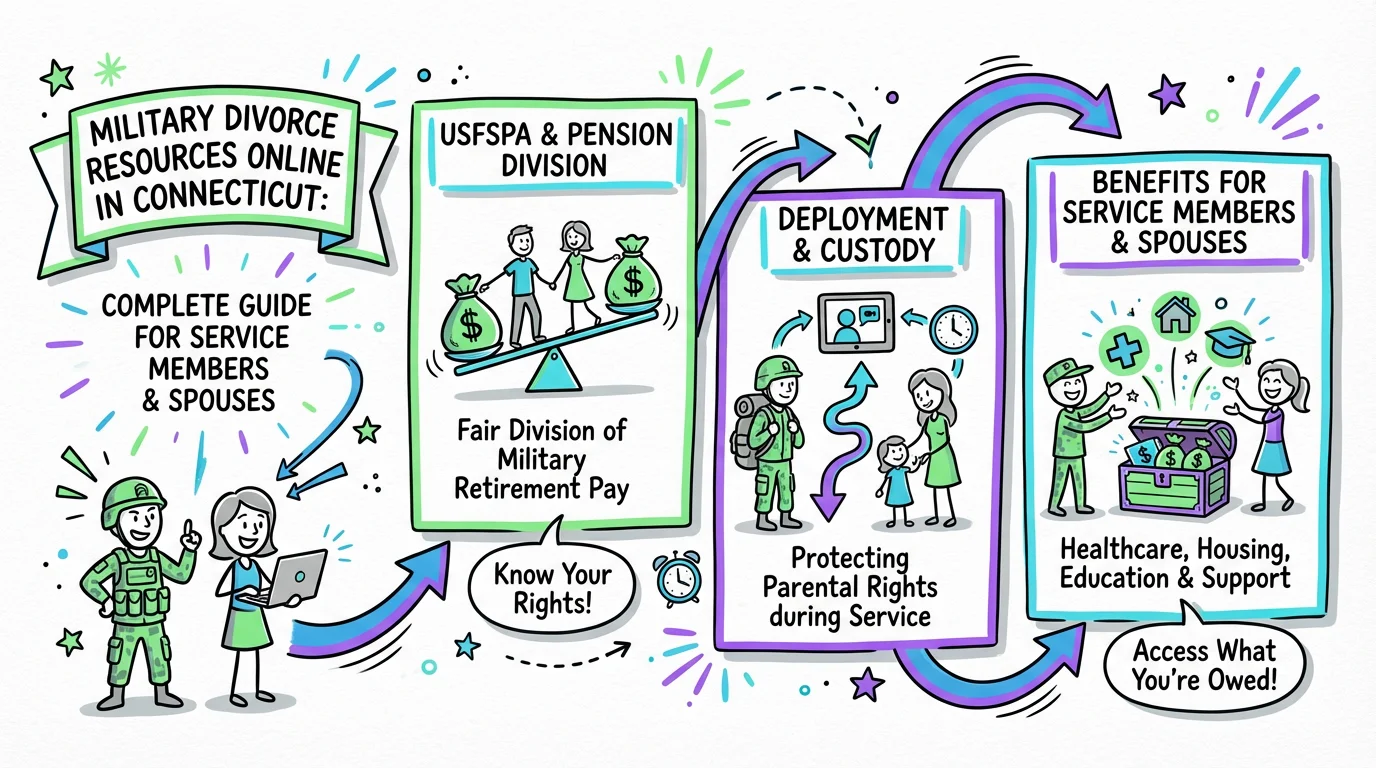
Military families facing divorce in Connecticut can access numerous online resources including the Connecticut Judicial Branch's self-service forms, Military OneSource legal assistance, JAG offices at nearby installations, and specialized tools like Untangle's Complete asset inventory which can help organize military-specific financial documents such as Leave and Earnings Statements (LES), Thrift Savings Plan (TSP) statements, and military pension valuations. These resources address the unique complexities of military divorce, including the Uniformed Services Former Spouses' Protection Act (USFSPA), deployment-related custody considerations, and the proper division of military benefits.
Understanding Military Divorce in Connecticut
Military divorce involves layers of federal law that interact with Connecticut's state divorce statutes, creating a unique legal landscape that requires specialized knowledge. Unlike civilian divorces, military divorces must account for federal protections under the Servicemembers Civil Relief Act (SCRA), the division of military retirement pay under USFSPA, and the continuation of benefits through programs like the 20/20/20 rule. Connecticut courts have jurisdiction over military divorces when one spouse meets the state residency requirement, but federal laws often dictate how certain assets and benefits are handled.
Connecticut recognizes that military service creates unique circumstances for families. Under C.G.S. § 46b-44, a divorce complaint can be filed once either party has established residence in the state, which is particularly important for military families who may be stationed elsewhere but maintain Connecticut as their home of record. The state also has specific provisions protecting the custody rights of deploying service members under C.G.S. § 46b-56e, ensuring that military service doesn't unfairly impact a parent's relationship with their children.
For military spouses researching their options online, understanding which resources apply to your specific situation is crucial. Whether you're the service member or the civilian spouse, the intersection of federal military regulations and Connecticut family law requires careful navigation. Accessing the right information early can clarify how these laws interact and help you compile the military-specific documents essential to your case.
Essential Online Resources for Military Divorce
Connecticut Judicial Branch Self-Service Center
The Connecticut Judicial Branch provides online access to all forms needed for divorce proceedings, including the Divorce Complaint (Form JD-FM-159) and the Summons for Family Actions (Form JD-FM-003). Military families should also download the Financial Affidavit Short Form (JD-FM-006-short), which requires detailed disclosure of all income sources—including military pay and allowances.
When completing financial disclosures, military families must understand that Connecticut's child support guidelines specifically include "military personnel fringe benefit payments" as part of gross income. This means Basic Allowance for Housing (BAH), Basic Allowance for Subsistence (BAS), and other military allowances may be considered when calculating support obligations. The Child Support Guidelines Worksheet (Form CCSG-001) available online can help you understand how these calculations work. To ensure accuracy and simplify this complex disclosure process, consider using tools like Untangle's Financial affidavit generation to automatically compile your military-specific financial details and streamline form completion.
Military OneSource and JAG Legal Assistance
Military OneSource (militaryonesource.mil) offers free, confidential legal consultations for active-duty service members, National Guard, reservists, and their families. While they cannot represent you in court, staff attorneys can explain your rights, review documents, and help you understand how federal military laws interact with Connecticut divorce procedures. This resource is available 24/7 and can be accessed entirely online or by phone.
Judge Advocate General (JAG) offices at installations like the Naval Submarine Base New London in Groton provide legal assistance to eligible service members and dependents. Services typically include document review, explanation of military-specific divorce issues, and referrals to civilian attorneys who specialize in military family law. While in-person appointments are available, many JAG offices now offer virtual consultations, making this resource accessible even if you're not stationed near the installation.
Division of Military Retirement Pay
Understanding USFSPA and Connecticut Law
The Uniformed Services Former Spouses' Protection Act (USFSPA) allows state courts to treat military retirement pay as marital property subject to division in divorce. In Connecticut, courts apply equitable distribution principles, meaning military pensions are divided fairly—though not necessarily equally—based on factors like length of marriage, length of military service during the marriage, and each spouse's contributions to the service member's career.
The case of Wald v. Cortland-Wald demonstrates how Connecticut courts handle military benefits in divorce proceedings. In this case, the court approved an agreement where the service member would transfer twelve months of G.I. Bill benefits to the former spouse as part of the dissolution settlement. This illustrates that military benefits beyond just retirement pay—including education benefits—can be addressed in Connecticut divorce agreements.
To receive direct payment from the Defense Finance and Accounting Service (DFAS), the marriage must have overlapped with at least 10 years of creditable military service. However, even if you don't qualify for direct DFAS payment, you may still be entitled to a portion of the retirement pay—it would simply be paid through the service member rather than directly. Understanding these distinctions is essential when negotiating your settlement, and tools like Untangle's Spouse financial comparison can help you model different scenarios for retirement division and other financial aspects of your settlement.
Key Documents for Military Pension Division
| Document | Purpose | Where to Obtain |
|---|---|---|
| Leave and Earnings Statement (LES) | Shows current pay, allowances, and deductions | myPay website |
| Statement of Service | Verifies creditable service time | Personnel office or online records |
| High-3 Average Pay | Calculates retirement benefit value | Recent LES statements |
| Survivor Benefit Plan (SBP) Statement | Shows current SBP elections | DFAS |
| Thrift Savings Plan (TSP) Statement | Reports TSP account balance | TSP.gov |
A military pension is often one of the largest marital assets, and proper valuation requires understanding military-specific terminology and calculations. The "disposable retired pay" formula, coverture fractions, and hypothetical versus actual retirement scenarios can significantly impact what each spouse receives. Working with a Certified Divorce Financial Analyst (CDFA) who understands military retirement can help ensure accurate calculations.
Deployment and Custody Protections
Connecticut's Deployment Custody Statute
Connecticut law provides specific protections for military parents facing deployment. Under C.G.S. § 46b-56e, "deploy" is defined as military service in compliance with orders for combat operations, contingency operations, peacekeeping operations, or remote tours of duty. The statute covers all branches including Army, Navy, Marine Corps, Coast Guard, Air Force, Space Force, and reserve components including the Connecticut National Guard.
This law recognizes that deployment is not voluntary abandonment of parental responsibilities. When a parent receives deployment orders, Connecticut courts can establish temporary custody arrangements that preserve the deploying parent's relationship with their children while ensuring stability during the absence. Importantly, deployment itself cannot be used as the sole basis for permanently modifying custody—a protection that gives service members peace of mind when answering the call to duty.
The statute also addresses communication rights during deployment, ensuring that the deployed parent maintains meaningful contact with their children through video calls, phone calls, and other available technology. Upon return from deployment, the custody arrangement can revert to the pre-deployment order, and any temporary modifications made during deployment cannot automatically become permanent without a full hearing. When creating temporary or permanent custody arrangements that comply with C.G.S. § 46b-56e, a tool like Untangle's Parenting plan builder can help you structure detailed agreements that address deployment schedules, communication protocols, and temporary caregiver designations.
Practical Steps for Deploying Parents
- File a family care plan before deployment - Document your custody arrangement and emergency contacts
- Request temporary modification if needed - Use Form JD-FM-159 to request court-approved temporary arrangements
- Designate a caregiver - Many service members designate family members to exercise visitation on their behalf
- Document communication - Keep records of all contact with children during deployment
- Request expedited hearings - Connecticut courts can expedite hearings for deploying service members
The Notice of Automatic Court Orders (Form JD-FM-158) that accompanies every Connecticut divorce filing includes provisions that protect both parties and children during the divorce process. Understanding these automatic orders is especially important for military families where one parent may be subject to military orders requiring relocation or deployment.
Try our free CT child support calculator
Calculate your estimated child support using Connecticut's official guidelines formula.
Military Benefits After Divorce
The 20/20/20 and 20/20/15 Rules
Former military spouses may be eligible to retain certain benefits after divorce depending on the length of the marriage and its overlap with military service. The "20/20/20 rule" applies when:
- The marriage lasted at least 20 years
- The service member performed at least 20 years of creditable service
- There was at least 20 years of overlap between the marriage and the military service
Former spouses meeting these criteria retain full commissary, exchange, and medical benefits (TRICARE) as if they were still married to an active-duty or retired service member. The "20/20/15 rule" provides transitional benefits for one year when the overlap is 15-19 years rather than 20.
Understanding these benefit calculations requires careful documentation of both the marriage dates and the service member's creditable service time. Even if you're close to qualifying for the 20/20/20 rule, there may be strategic reasons to delay finalizing your divorce until you meet the threshold. This is an area where proper planning can mean the difference between maintaining health coverage and losing it entirely.
Other Benefits Considerations
| Benefit | Eligibility After Divorce | Notes |
|---|---|---|
| TRICARE | 20/20/20 or transitional | Lost if former spouse remarries before age 55 |
| Commissary/Exchange | 20/20/20 only | Requires valid ID card |
| Space-A Travel | Not available | Ends upon divorce |
| Survivor Benefit Plan (SBP) | Must be addressed in decree | Former spouse can be designated beneficiary |
| VA Benefits | Not divisible | Service-connected disability separate from retirement |
It's crucial to understand that VA disability compensation is treated differently than military retirement pay. While retirement pay can be divided as marital property under USFSPA, VA disability benefits are specifically protected from division. However, when a retiree waives retirement pay to receive VA disability (which is tax-free), this can reduce the amount available for division with a former spouse—a concept known as the "disability offset" that has been addressed in Connecticut courts.
Financial Organization for Military Divorce
Gathering Military-Specific Documents
Military divorces require documentation that civilian divorces do not. Beyond standard financial records, you'll need to gather military pay records, benefits statements, and service documentation. The Certificate of Compliance (Form JD-FM-175) requires both parties to certify they have provided complete financial disclosure, making thorough document collection essential.
Start by obtaining recent Leave and Earnings Statements (LES), which detail not just base pay but all allowances, special pays, and deductions. You'll also need TSP statements showing both traditional and Roth balances, and any records of TSP loans. If the service member has already retired, gather Retiree Account Statements (RAS) from DFAS showing current retirement pay and any existing allotments or garnishments.
Organizing and tracking the numerous military-specific documents needed for an accurate financial picture is critical. The ability to upload LES statements, TSP records, and benefit documentation in one secure location makes it easier to share information with attorneys or mediators.
Understanding the Military Financial Picture
Military compensation is complex, with multiple components that may or may not be included in calculations for support or property division. Base pay is straightforward, but allowances like BAH and BAS require careful analysis. While Connecticut includes military fringe benefits in gross income for child support calculations, the treatment of these allowances in property division and spousal support may differ.
Special pays—including hazardous duty pay, flight pay, sea pay, and combat zone tax exclusions—add another layer of complexity. These pays may be temporary or contingent on specific assignments, raising questions about whether they should be included in support calculations. Working with professionals who understand military compensation structure helps ensure accurate financial analysis.
When to Seek Professional Help
While online resources provide valuable information and tools, military divorce often requires professional guidance due to its complexity. Consider consulting an attorney if your case involves:
- Significant military retirement benefits to divide
- Disputes over the characterization of disability pay versus retirement pay
- Questions about whether you qualify for continued benefits under the 20/20/20 rule
- A service member stationed overseas or facing imminent deployment
- Interstate jurisdictional issues (common in military families)
The Connecticut Bar Association's Lawyer Referral Service can connect you with attorneys who specialize in military family law. Many offer free initial consultations to help you understand your options. Additionally, the American Academy of Matrimonial Lawyers maintains a directory of attorneys with military divorce experience.
For military families who are aligned on the major issues and seeking an uncontested divorce, online legal technology can provide guided support through the process while helping you understand the military-specific considerations that must be addressed in your agreement. Platform resources can help you prepare thorough documentation and understand your options before—or alongside—professional legal consultation.
Frequently Asked Questions
What free legal assistance programs are available for military divorce in Connecticut?
Connecticut military families can access free legal assistance through JAG offices at nearby installations, Military OneSource legal consultations, and the Connecticut Legal Services program for qualifying service members and spouses.
Does Military OneSource provide divorce support services?
Yes, Military OneSource offers free confidential support including up to 12 non-medical counseling sessions, legal consultations, financial counseling, and referrals to local resources for service members and their families going through divorce.
Where can I find military divorce forms and documents online in CT?
Connecticut military divorce forms are available through the Connecticut Judicial Branch's self-service center, and specialized tools like Untangle can help organize military-specific documents such as LES statements, TSP records, and pension valuations.
How is military retirement pay divided in a Connecticut divorce?
Military retirement pay in Connecticut is divided according to the Uniformed Services Former Spouses' Protection Act (USFSPA), which allows state courts to treat military retirement as marital property subject to equitable distribution.
Are there support groups for military families going through divorce in Connecticut?
Yes, military families in Connecticut can find support through Military OneSource's non-medical counseling, family readiness groups at nearby installations, and online communities specifically designed for military spouses experiencing divorce.
Legal Citations
- • Wald v. Cortland-Wald, 226 Conn. App. 752 View Source
- • C.G.S. § 46b-44 - Residency requirement View Source
- • C.G.S. § 46b-56e - Orders of custody and visitation regarding deploying parent View Source
- • Form JD-FM-159 - Divorce Complaint (Dissolution of Marriage) View Source
- • Form JD-FM-003 - Summons Family Actions View Source
- • Form JD-FM-006-short - Financial Affidavit Short Form View Source
- • Form CCSG-001 - Worksheet for Child Support and Arrearage Guidelines View Source
- • Form JD-FM-158 - Notice of Automatic Court Orders View Source
- • Form JD-FM-175 - Certificate of Compliance View Source