How to Prepare for a Contested Divorce in Connecticut | Complete Guide
Learn how to prepare for a contested divorce in Connecticut. Expert guidance on gathering documents, understanding court procedures, and protecting your interests.

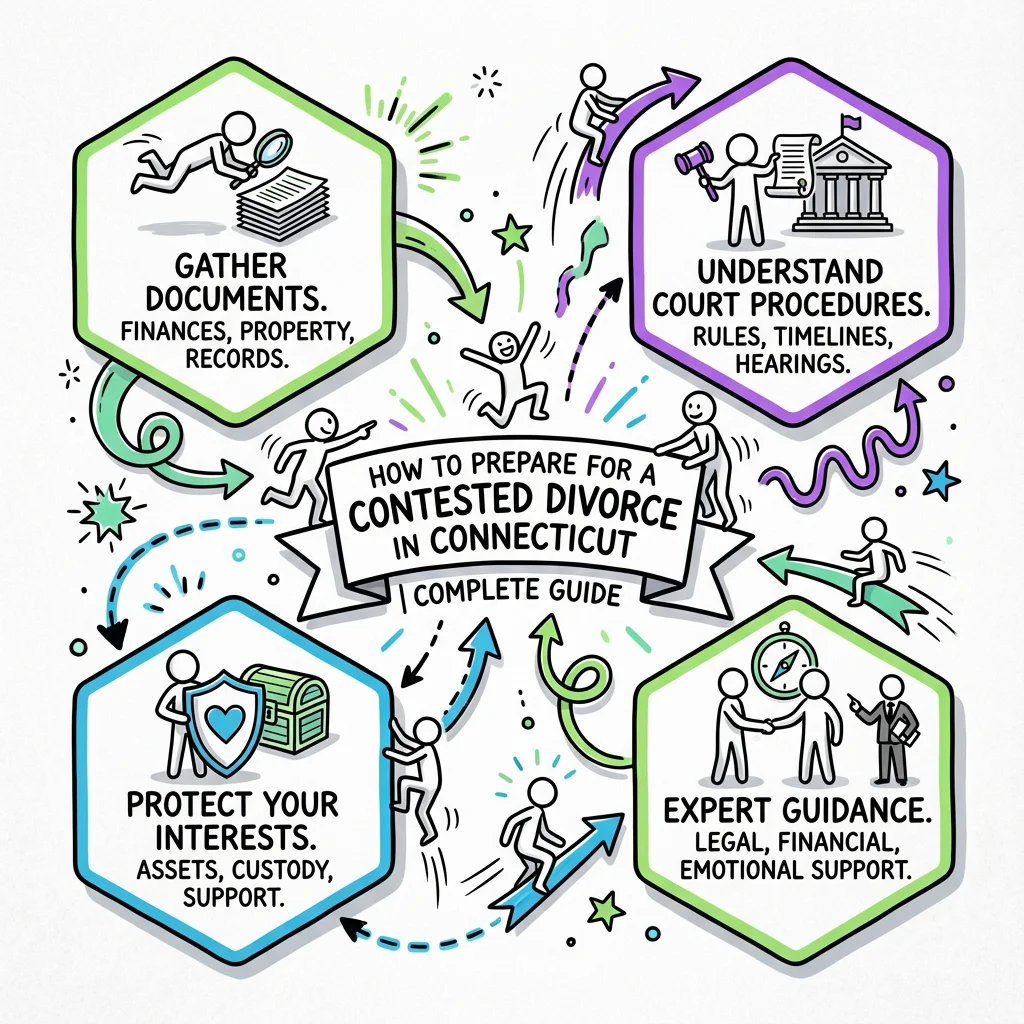
Preparing for a contested divorce in Connecticut requires gathering comprehensive financial documentation, understanding mandatory disclosure requirements, and developing a clear strategy for custody and property disputes. When your spouse won't cooperate, preparation becomes your greatest advantage—the more organized and documented you are before filing, the stronger your position when facing a court battle.
Understanding What Makes a Divorce "Contested"
A contested divorce occurs when you and your spouse cannot agree on one or more key issues: property division, alimony, child custody, child support, or even whether to divorce at all. Unlike uncontested divorces where both parties work together toward a settlement, contested cases require court intervention to resolve disputes. Under C.G.S. § 46b-67, the court cannot proceed on your complaint until at least 90 days after the return date, giving both parties time to prepare—and in contested cases, you'll need every day of that period.
Connecticut follows an "equitable distribution" model under C.G.S. § 46b-81, meaning the court divides marital property fairly but not necessarily equally. This discretion gives judges significant power to weigh factors like each spouse's contribution to the marriage, earning capacity, and conduct. When your spouse is uncooperative, you can expect them to argue for interpretations that favor their interests—making your documentation and preparation critical to presenting your side effectively.
The stakes in contested divorces extend beyond finances. If you have children, custody and parenting time become battlegrounds under C.G.S. § 46b-56, where the court must determine what arrangement serves the children's best interests. Your preparation for these disputes requires not just legal documents but evidence of your involvement in your children's lives, understanding of their needs, and ability to co-parent—even when your spouse makes cooperation difficult.
Gathering Essential Financial Documents
Connecticut's mandatory disclosure rules under Practice Book § 25-32 require you to exchange extensive financial documentation within 60 days of a request. However, waiting until after filing to gather these documents puts you at a disadvantage. Start collecting now, while you still have easy access to household records.
Documents You Must Gather
| Document Type | Timeframe Required | Why It Matters |
|---|---|---|
| Federal & state tax returns | Last 3 years | Establishes income history and potential hidden assets |
| W-2s, 1099s, K-1s | Last 3 years + current year | Verifies all income sources |
| Pay stubs | Current year + last stub from prior year | Shows current earnings |
| Bank statements | Past 24 months | Tracks asset movement and spending patterns |
| Retirement account statements | Past 24 months | Documents marital vs. separate contributions |
| Brokerage/investment accounts | Past 24 months | Captures full investment picture |
| Mortgage documents & deeds | All current | Establishes property ownership |
| Business records (if applicable) | Last 3 years | Values business interests |
Make copies of everything before your spouse realizes divorce is imminent. In contested cases, documents sometimes "disappear" or become difficult to access once proceedings begin. Store copies in a secure location outside your home—a safety deposit box, trusted family member's house, or secure cloud storage that only you can access.
The Financial Affidavit (Form JD-FM-006) you'll file with the court requires detailed information about your income, expenses, assets, and liabilities. Under Practice Book § 25-30, you must file this sworn statement at least five business days before any hearing on alimony, support, or counsel fees. Having your documents organized in advance means you can complete this accurately—and catch any discrepancies in your spouse's affidavit. Leverage Untangle's financial affidavit generation features to ensure accuracy and completeness in this critical court document.
Understanding Automatic Court Orders
The moment a divorce complaint is served in Connecticut, automatic court orders take effect under Practice Book § 25-5. These orders apply to both parties and remain in force until the court modifies them or enters a final judgment. Understanding these restrictions helps you avoid costly mistakes that could hurt your case.
What You Cannot Do Once Divorce Proceedings Begin
- Move children out of state: You cannot permanently remove minor children from Connecticut without written consent from your spouse or a court order
- Dissipate assets: You cannot sell, transfer, encumber, or dispose of marital property except for reasonable living expenses or in the ordinary course of business
- Cancel insurance: You cannot remove your spouse from health insurance, life insurance, or other policies
- Incur unusual debt: You cannot take on significant new debts that could affect marital assets
- Change beneficiaries: You cannot alter beneficiary designations on insurance policies or retirement accounts
Violating these automatic orders can result in contempt findings and seriously damage your credibility with the court. If you need to take any restricted action—for example, selling an asset to pay legal fees—you must obtain court permission first. The Notice of Automatic Court Orders (Form JD-FM-158) outlines these restrictions in detail.
When your spouse is uncooperative, document any violations of automatic orders they commit. Take screenshots, save emails, and keep a detailed log with dates and descriptions. This evidence can become powerful leverage in negotiations or court hearings.
The Pathways Case Management System
Connecticut's courts use the Pathways system under Practice Book § 25-50A to manage divorce cases based on their complexity. Understanding this system helps you prepare for what's ahead in your contested case.
How Pathways Works
Within 30-60 days of filing, you'll attend a Resolution Plan Date meeting with a family relations counselor. This counselor evaluates your case and recommends one of three tracks:
| Track | Case Type | What to Expect |
|---|---|---|
| Track A | Minimal conflict, likely settlement | Limited court appearances, faster resolution |
| Track B | Moderate issues, some disagreement | More court oversight, possible mediation |
| Track C | Complex, highly contested | Extensive discovery, multiple hearings, possible trial |
If you're facing a contested divorce with an uncooperative spouse, expect to be placed on Track B or Track C. The court will issue a scheduling order setting dates for discovery completion, pretrial conferences, and trial. Missing these deadlines can result in sanctions or dismissal of your claims.
Prepare for the Resolution Plan Date by having a clear sense of which issues are negotiable and which are not. The counselor will assess settlement likelihood, so approaching this meeting strategically helps ensure your case receives appropriate court resources. Tools like Untangle's personalized task dashboard can help you organize your priorities and identify potential compromise areas before this critical meeting.
Building Your Custody Case
When children are involved in a contested divorce, custody disputes often become the most emotionally charged aspect of the proceedings. Under C.G.S. § 46b-56, Connecticut courts make custody decisions based on the children's best interests, considering factors like each parent's willingness to encourage the child's relationship with the other parent.
Documenting Your Parental Involvement
Start creating a detailed record of your day-to-day involvement in your children's lives:
- Keep a parenting journal: Document school pickups, homework help, medical appointments, extracurricular activities, and quality time
- Save communications: Keep text messages and emails showing you coordinate parenting responsibilities
- Collect third-party evidence: Teachers, coaches, and doctors can provide statements about your involvement
- Document your spouse's behavior: If your spouse interferes with your parenting time or speaks negatively about you to the children, keep records
- Create a proposed parenting plan: Show the court you've thoughtfully considered your children's needs. Untangle's parenting plan builder can help you articulate a detailed and child-focused proposal.
The Affidavit Concerning Children (Form JD-FM-164) must be filed with your divorce complaint, disclosing information about your children's living situation and any prior custody proceedings. Complete this form carefully—inaccuracies can undermine your credibility.
Connecticut requires parents with minor children to complete a parent education program before the court grants a divorce. If you're facing a highly contested custody battle, demonstrating your commitment to your children's wellbeing—including completing this program promptly—signals to the court that you prioritize their needs over conflict with your spouse.
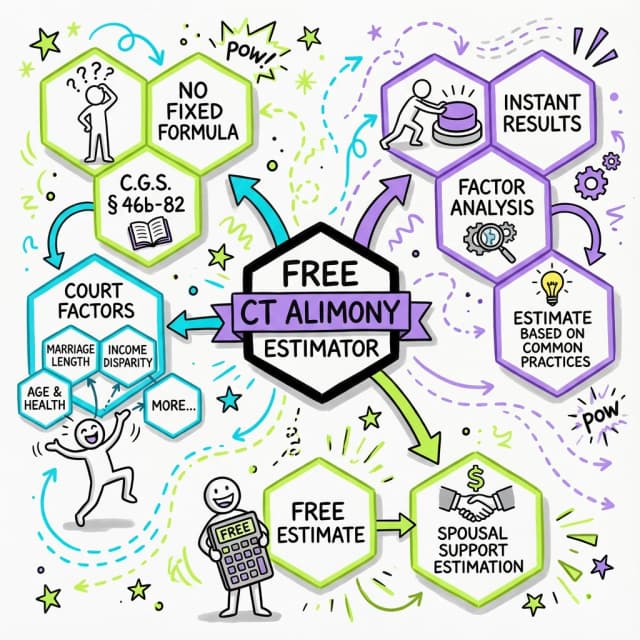
Try our free CT alimony calculator
Get an instant estimate based on Connecticut's statutory factors. No signup required.
Filing and Serving the Divorce Complaint
Under C.G.S. § 46b-45, you file for divorce in the Superior Court for the judicial district where either you or your spouse lives. If you're filing first, you'll need to complete several forms:
- Summons Family Actions (Form JD-FM-003): The official court summons served on your spouse
- Divorce Complaint (Form JD-FM-159): States the grounds for divorce and relief you're seeking
- Notice of Automatic Court Orders (Form JD-FM-158): Informs your spouse of restrictions now in effect
- Affidavit Concerning Children (Form JD-FM-164): Required if you have minor children
Your complaint must be served on your spouse by a state marshal or other authorized person—you cannot serve it yourself. After service, your spouse has time to respond with an Answer and potentially a Cross Complaint under Practice Book § 25-9, stating their own claims and grounds for divorce.
If your spouse is actively avoiding service, document all attempts. The court has procedures for alternative service when a spouse evades process servers, but you'll need to show good faith efforts at traditional service first.
Preparing for Financial Disputes
Property division in contested divorces often becomes a battle over valuation, characterization (marital vs. separate property), and equitable distribution factors. Under C.G.S. § 46b-81, the court considers each spouse's contribution to the marriage, age, health, occupation, employability, needs, and even conduct when dividing assets.
Strategies for Protecting Your Financial Interests
- Identify all assets: Don't overlook retirement accounts, stock options, business interests, intellectual property, or potential inheritances
- Trace separate property: If you brought assets into the marriage or received them as gifts/inheritance, gather documentation proving their separate nature
- Value complex assets: You may need appraisers for real estate, business valuators for companies, or actuaries for pensions
- Document hidden income: If your spouse is self-employed or paid in cash, look for lifestyle inconsistencies that suggest unreported income
- Track dissipation: If your spouse wasted marital assets during the marriage breakdown, document these expenditures
The Child Support Guidelines Worksheet (Form CCSG-001) will be used to calculate support obligations. Understanding how this worksheet works helps you anticipate likely outcomes and identify areas where your spouse might understate income or overstate expenses. Untangle's complete asset inventory features can help you catalog and value marital property systematically, ensuring nothing is overlooked.
Alimony Considerations in Contested Cases
Connecticut courts have broad discretion in awarding alimony under C.G.S. § 46b-82. The statute lists factors including length of marriage, causes of dissolution, age, health, occupation, employability, income, vocational skills, and each spouse's contribution to the marriage—including homemaking and childcare.
Preparing for Alimony Disputes
If you're likely to pay alimony, gather evidence supporting your position:
- Documentation of your spouse's earning capacity and employment history
- Evidence of your spouse's education, skills, and job opportunities
- Records showing your spouse's access to assets or income sources
- Your own financial obligations and ability to pay
If you're likely to receive alimony, prepare to demonstrate:
- Your contributions to your spouse's career or education
- Sacrifices you made for the family (reduced work hours, career pauses)
- Your current financial needs and budget
- Barriers to becoming self-supporting (age, health, outdated skills)
In contested cases, these disputes often require expert witnesses—vocational evaluators who can assess earning capacity, or financial experts who can analyze complex income streams. Building your case now means you'll be ready when these issues reach the courtroom.
Creating a Realistic Timeline
Contested divorces in Connecticut take longer than uncontested ones. While the statutory minimum waiting period is 90 days under C.G.S. § 46b-67, contested cases typically take 12-18 months or longer, depending on complexity and court backlogs.
| Phase | Typical Duration | Key Activities |
|---|---|---|
| Pre-filing preparation | 1-3 months | Document gathering, attorney selection, strategy |
| Filing through Resolution Plan Date | 1-2 months | Service, initial appearances, track assignment |
| Discovery | 3-6 months | Mandatory disclosure, depositions, interrogatories |
| Pretrial proceedings | 2-4 months | Motions, conferences, settlement negotiations |
| Trial preparation | 1-2 months | Witness preparation, exhibit organization |
| Trial | Days to weeks | Presenting your case to the judge |
| Post-trial | 1-2 months | Court's decision, potential appeals |
This timeline assumes no significant delays. Contested cases with hidden assets, custody evaluations, or business valuations can take considerably longer. Planning for this marathon rather than a sprint helps you maintain focus and resources throughout the process. Untangle's case management tools can help you stay organized and prepared for each phase.
When to Get Professional Help
While understanding the process empowers you to participate actively in your case, contested divorces with uncooperative spouses typically require professional legal representation. Consider consulting an attorney when:
- Significant assets or debts are at stake
- Your spouse has already hired an attorney
- Custody disputes involve allegations of abuse, neglect, or parental alienation
- Your spouse owns a business or has complex income sources
- You're concerned about hidden assets or income
- Domestic violence is a factor (seek a protective order immediately)
An experienced Connecticut family law attorney understands local court procedures, judges' tendencies, and strategic approaches that can make the difference between favorable and unfavorable outcomes. Even if you want to handle portions of your case yourself, a consultation can help you understand your rights and avoid critical mistakes.
Preparing for a contested divorce is challenging, but thorough preparation gives you confidence and control in an otherwise uncertain situation. By gathering documents, understanding procedures, and building your case systematically, you transform from someone reacting to your spouse's actions into someone actively shaping the outcome of your divorce.
Frequently Asked Questions
What documents do I need to gather before filing for a contested divorce in Connecticut?
You should gather financial records including tax returns, bank statements, pay stubs, retirement account statements, property deeds, mortgage documents, credit card statements, and any prenuptial agreements before filing.
How long does a contested divorce take in CT from start to finish?
A contested divorce in Connecticut typically takes 12 to 18 months or longer, depending on the complexity of asset division, custody disputes, and court scheduling, with a mandatory 90-day waiting period after the return date.
How do I find hidden assets before divorce in Connecticut?
You can uncover hidden assets through formal discovery requests, subpoenas for financial records, hiring a forensic accountant, and reviewing tax returns, business records, and lifestyle expenses that don't match reported income.
What happens during contested divorce proceedings in Connecticut court?
Contested divorce proceedings in CT include mandatory financial disclosures, discovery exchanges, possible mediation, pretrial hearings, and ultimately a trial where a judge decides unresolved issues like property division, custody, and support.
How should I organize my finances before filing for divorce in Connecticut?
Open individual bank accounts, establish credit in your own name, create copies of all joint financial records, inventory household assets, and document your monthly expenses to prepare for financial disclosures and support calculations.
Legal Citations
- • C.G.S. § 46b-67 View Source
- • C.G.S. § 46b-81 View Source
- • C.G.S. § 46b-56 View Source
- • Practice Book § 25-32 View Source
- • C.G.S. § 46b-45 View Source
- • C.G.S. § 46b-82 View Source