How to File an Uncontested Divorce in Connecticut: Complete Step-by-Step Guide
Learn how to file an uncontested divorce in Connecticut. Step-by-step guide covering joint petition requirements, forms, costs, and the 30-day process.
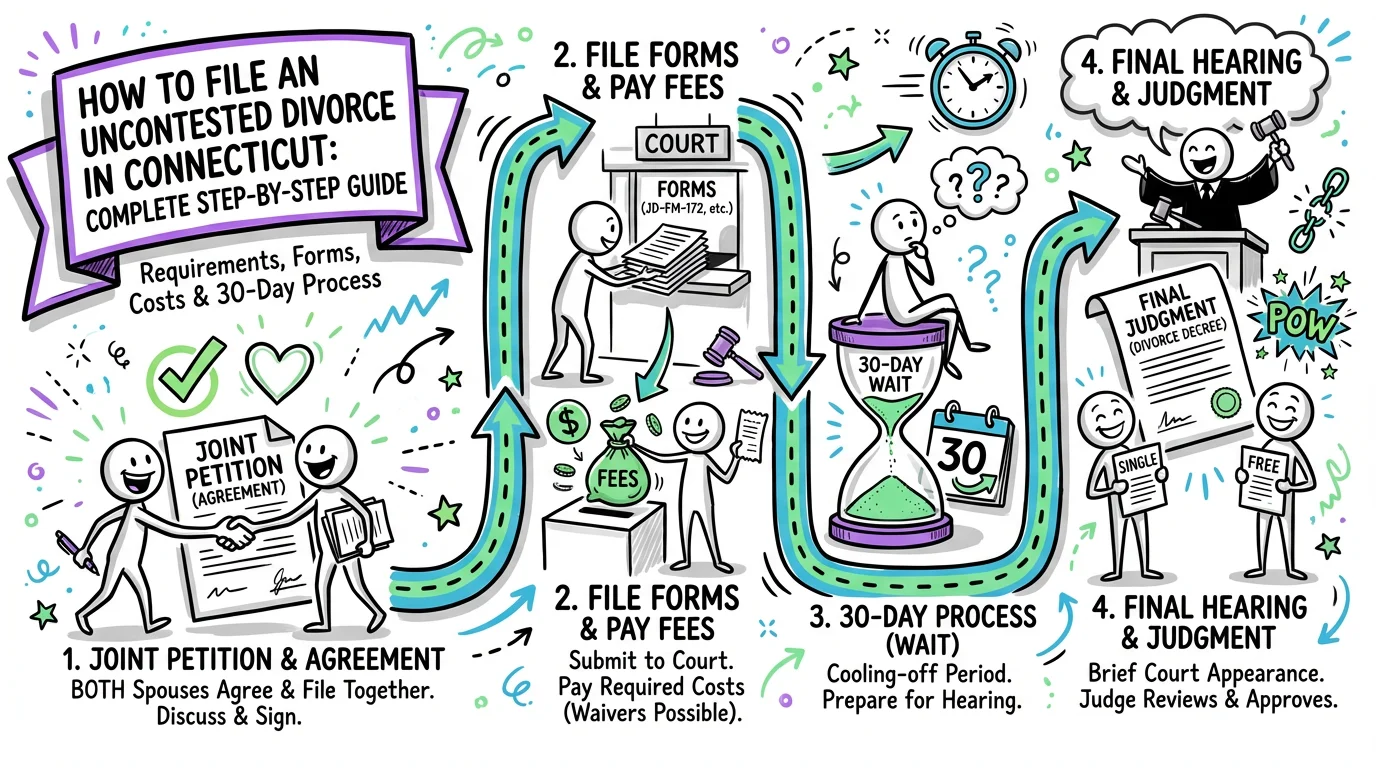
To file an uncontested divorce in Connecticut, you and your spouse must file a joint petition for nonadversarial dissolution of marriage in the judicial district where either of you resides. Both parties must sign a notarized attestation confirming you have no minor children together, have resolved all property and financial matters, and agree your marriage has irretrievably broken down. Under C.G.S. § 46b-44a, this streamlined process can result in a final divorce decree in as little as 30 days from filing.
Understanding Connecticut's Nonadversarial Divorce Process
Connecticut offers a special "nonadversarial" divorce track specifically designed for couples who agree on all terms of their separation. This process is faster, less expensive, and significantly less stressful than a traditional contested divorce. The key distinction is that both spouses file together as joint petitioners rather than one spouse suing the other.
For this process to work, Connecticut law requires that you meet specific eligibility criteria. According to C.G.S. § 46b-44a, you must attest under oath that: (1) your marriage has irretrievably broken down, (2) you have no minor children together, and (3) you've reached a complete agreement on all financial matters including property division and alimony. If you have minor children, you'll need to use the standard dissolution process, though you can still proceed on an uncontested basis if you agree on custody, support, and parenting time.
The benefits of the nonadversarial route extend beyond speed. You'll typically avoid multiple court appearances, reduce legal fees substantially, and maintain a more cooperative relationship with your soon-to-be ex-spouse—which can be particularly valuable if you'll continue to interact through mutual friends, shared social circles, or business connections. Tools like Untangle's task dashboard can help you determine early on whether you qualify for this streamlined process.
Eligibility Requirements for Uncontested Divorce in CT
Before beginning the filing process, you need to confirm you meet Connecticut's requirements for an uncontested divorce. The court defines an "uncontested matter" under Practice Book § 25-49 as one where both parties appear and no aspect is disputed. This means complete agreement on every issue—there's no middle ground.
Residency Requirements
At least one spouse must be a Connecticut resident at the time of filing. You'll file in the judicial district where that spouse lives. Connecticut has 13 judicial districts, so you'll want to identify the correct courthouse for your location. If you moved to Connecticut specifically to obtain a divorce, you may need to establish residency for a period before the court will accept jurisdiction.
Critically, Connecticut law requires that at least one spouse must have resided in the state for at least 12 months before the final divorce decree can be granted. While you can file the petition before hitting this 12-month mark, the court cannot finalize the dissolution until the residency requirement is met. For most couples already living in the state, this is a formality, but recent movers should check their timeline carefully.
No Minor Children Requirement for Nonadversarial Track
The expedited nonadversarial process under C.G.S. § 46b-44a is only available to couples without minor children from the marriage. This includes biological children, adopted children, and any children for whom you share legal responsibility. If you have minor children, you can still pursue an uncontested divorce, but you'll use the standard dissolution process—which requires addressing custody, visitation, and child support before the court will grant your divorce.
Additionally, the wife cannot be pregnant at the time of filing or judgment for the nonadversarial process. If a pregnancy exists, the court requires paternity and support issues to be addressed, which falls outside the scope of the simplified track. Couples with adult children (over age 18) can use the nonadversarial process, provided there are no disputes regarding educational support for those children up to age 23.
Complete Agreement on All Issues
Both spouses must agree on every aspect of the divorce, including:
- Division of all marital property (real estate, vehicles, retirement accounts, investments)
- Division of marital debts (mortgages, credit cards, loans)
- Whether either spouse will receive alimony and for how long
- Distribution of personal property and household items
If there's even one disputed issue, your case no longer qualifies as uncontested. However, many couples who initially disagree on certain points can reach consensus through negotiation or mediation. Tools like Untangle's AI legal chat can help you and your spouse work through potential sticking points and find common ground before filing.
Required Forms and Documents
Connecticut requires specific forms for an uncontested divorce filing. Having all documents properly completed before you visit the courthouse will save time and prevent delays.
Essential Forms for Filing
| Form Number | Form Name | Purpose |
|---|---|---|
| JD-FM-159 | Divorce Complaint | Primary petition stating grounds and requests |
| JD-FM-003 | Summons - Family Actions | Official court summons (still required for joint filings) |
| JD-FM-006-Short | Financial Affidavit (Short Form) | Income/expense/asset disclosure (if income under $75,000) |
| JD-FM-158 | Notice of Automatic Court Orders | Acknowledges restraining orders on assets |
| JD-FM-175 | Certificate of Compliance | Confirms all required disclosures completed |
The Financial Affidavit is particularly important. Under Practice Book § 25-30, each party must file a sworn financial statement showing current income, expenses, assets, and liabilities. For most uncontested divorces where neither spouse earns more than $75,000 annually and total assets are under $75,000, you'll use the Short Form (JD-FM-006-Short). Higher-income couples must use the Long Form financial affidavit. Generating these detailed financial statements can be complex. Untangle's financial affidavit generation feature can simplify this process, ensuring accuracy and compliance with court requirements.
The Settlement Agreement
Perhaps the most critical document is your written settlement agreement. This comprehensive document outlines exactly how you and your spouse have agreed to divide everything. Under C.G.S. § 46b-66, the court must review this agreement to ensure it's fair and equitable to both parties before incorporating it into your divorce decree.
Your settlement agreement should address:
- Specific property division (who gets what, including account numbers and property addresses)
- Debt allocation (who is responsible for which debts)
- Alimony terms (amount, duration, and conditions for modification or termination)
- Any other agreements specific to your situation
Writing a thorough settlement agreement can feel overwhelming, but it's essential to get the details right. Untangle's automatic document generation can guide you through creating a comprehensive agreement that addresses all necessary elements and meets Connecticut court requirements.
Step-by-Step Filing Process
Once you've confirmed eligibility and gathered your documents, follow these steps to file your uncontested divorce in Connecticut.
Step 1: Complete All Required Forms
Both spouses should review each form carefully before signing. The joint petition must be notarized, with each party attesting under oath to the facts stated. Any errors or incomplete sections can delay your case or result in rejection at the clerk's office.
Take particular care with the financial affidavit. Under Practice Book § 25-5B, automatic orders take effect immediately upon filing a joint petition. These orders prohibit either spouse from selling, transferring, or encumbering assets; canceling insurance; or incurring unreasonable debts. False statements on financial documents can constitute perjury and will damage your credibility with the court.
Step 2: File with the Court Clerk
Bring your completed forms to the Superior Court clerk's office in the appropriate judicial district. You'll need:
- Original signed and notarized documents plus copies
- Filing fee (currently around $350, though fee waivers are available for those who qualify)
- Valid identification
The clerk will review your paperwork for completeness, assign a case number, and file-stamp your documents. You'll receive copies for your records. In some Connecticut courts, you may be able to file electronically, but check with your specific courthouse about e-filing availability for family matters. For courts that support it, Untangle's document generation feature can streamline your submission process, saving you time and ensuring your documents are properly prepared.
Step 3: Wait for Your Disposition Date
Under C.G.S. § 46b-44c, the court must assign a disposition date at least 30 days after you file your joint petition. This statutory waiting period is mandatory and gives both parties a "cooling off" period to reconsider before the divorce becomes final. The court uses this time to review your file administratively, ensuring all forms are present and the agreement appears facially valid.
During this 30-day window, you continue to be legally married. Either party can file a notice of revocation if they change their mind about proceeding with the divorce or the terms of the agreement. If a revocation is filed, the case may be converted to a standard family docket case, which follows the traditional contested divorce timeline. It is crucial to maintain financial stability and adhere to automatic orders during this waiting period.
Step 4: Court Review of Your Agreement
The court will review your settlement agreement to determine whether it's fair and equitable. According to C.G.S. § 46b-44d, if the court can make this determination from the documents alone, you may not need to appear in person. The judge looks for red flags such as one party receiving 100% of the assets without explanation, or waivers of alimony that might leave a spouse destitute. The goal is to ensure the agreement wasn't coerced and follows basic principles of equity.
If the court has questions or cannot determine fairness from the paperwork, you'll be scheduled for a hearing within 30 days of your original disposition date. This doesn't mean your divorce is denied; it simply means the judge needs clarification. You should attend this hearing prepared to answer questions about your finances and the reasoning behind your asset division.
Step 5: Entry of Final Decree
If no revocation is filed and the court approves your settlement agreement, the judge will enter a decree of dissolution of marriage on or shortly after your disposition date. This document officially ends your marriage and incorporates the terms of your settlement agreement as court orders. You will receive a copy of the Judgment File in the mail, or you can access it through the judicial website if you have e-filing access.
Once you have the decree, you may need to obtain certified copies from the court clerk for certain administrative tasks, such as changing your name on a driver's license, updating Social Security records, or refinancing a mortgage. If you requested a name change as part of your petition, the decree will serve as legal proof authorizing you to revert to your birth name or former name.
Try our free CT alimony calculator
Get an instant estimate based on Connecticut's statutory factors. No signup required.
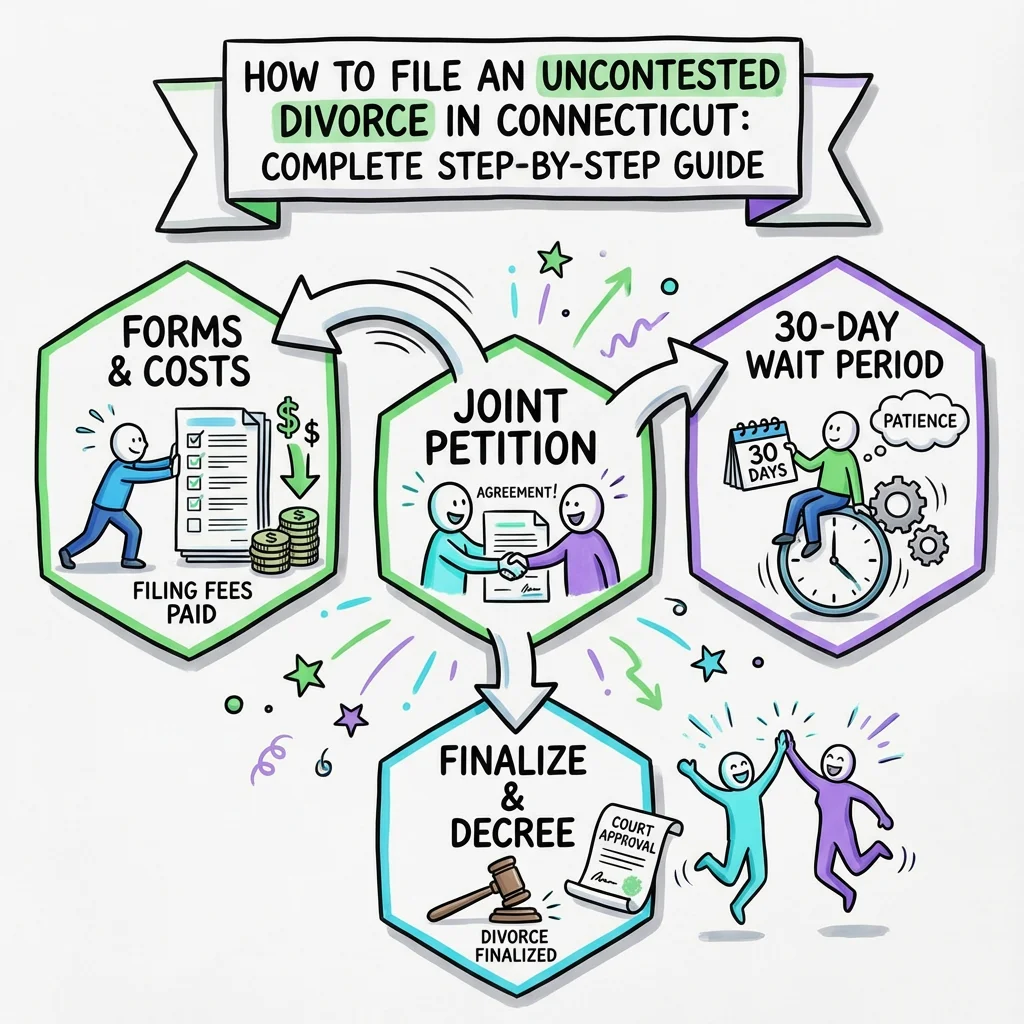
Timeline and Costs
Understanding what to expect in terms of time and money helps you plan accordingly for your uncontested divorce.
Timeline Comparison
| Divorce Type | Typical Timeline | Court Appearances |
|---|---|---|
| Nonadversarial (no children) | 30-45 days | Often none |
| Uncontested (with children) | 60-90 days | Usually 1 hearing |
| Contested divorce | 6-18 months | Multiple hearings |
The 30-day minimum waiting period for nonadversarial divorces is mandated by statute and cannot be waived. If the court schedules you for a hearing because it needs more information, add another 30 days to your timeline. Cases involving minor children take longer because the court must carefully review parenting plans and child support calculations.
Cost Breakdown
| Expense | Approximate Cost |
|---|---|
| Court filing fee | $350 |
| Certified copies of decree | $25-50 |
| Notary fees | $15-30 |
| DIY total | $390-430 |
| With attorney assistance | $1,500-3,000+ |
Fee waivers are available for individuals who meet income guidelines. Ask the clerk's office about the Application for Waiver of Fees if cost is a concern. Even if you don't qualify for a complete waiver, you may be eligible for a payment plan.
While many couples successfully complete uncontested divorces without attorneys, having legal guidance can prevent costly mistakes—especially when significant assets or retirement accounts are involved. Untangle's platform offers a middle-ground solution, providing the guidance and document preparation you need at a fraction of traditional legal costs.
What Happens After Filing
Once you file your joint petition, several things happen automatically and others require your attention.
Automatic Court Orders Take Effect
Per Practice Book § 25-5B, automatic orders become effective immediately upon filing. These orders restrain both parties from:
- Selling, transferring, or hiding marital assets
- Canceling or modifying insurance policies
- Taking on new, unreasonable debt
- Removing the other party from existing insurance coverage
Violating these orders can result in contempt of court charges and will seriously damage your case if any disputes arise.
Maintain Your Agreement
The weeks between filing and your disposition date can feel anticlimactic, but it's important to maintain the cooperative spirit that got you this far. Continue communicating respectfully with your spouse, honor any informal agreements you've made, and avoid any actions that could be perceived as violating the automatic orders.
Prepare for Possible Court Review
While many nonadversarial divorces are approved without a hearing, you should be prepared for the possibility that the court will want to see you. If your settlement agreement contains unusual provisions, significant alimony arrangements, or complex property divisions, the judge may have questions. Being prepared to explain your reasoning and demonstrate that both parties understand and agree to the terms will help your case proceed smoothly.
Special Considerations for Couples with Children
If you have minor children, you cannot use Connecticut's nonadversarial divorce process—but you can still pursue an uncontested divorce through the standard dissolution pathway. You'll need to agree on additional matters and complete extra requirements.
Required Agreements for Parents
Under C.G.S. § 46b-51, couples with children must submit agreements concerning custody, care, education, visitation, and support. Your parenting agreement should address:
- Legal custody (decision-making authority for major life decisions)
- Physical custody (where the children will primarily reside)
- Parenting time schedule (including holidays, vacations, and special occasions)
- Child support calculations using Connecticut's Child Support Guidelines (form CCSG-001)
- Health insurance coverage for children
- How you'll handle future disagreements about parenting
Parent Education Program
Connecticut requires both parents in a divorce involving minor children to complete a court-approved parent education program. This program covers the impact of divorce on children and strategies for effective co-parenting. Failure to complete this requirement can delay your divorce.
Pathways Case Management
Even uncontested cases with children go through Connecticut's Pathways case management system. Under Practice Book § 25-50A, you'll meet with a family relations counselor who will assess your case and recommend a track. Uncontested cases with full agreements typically receive Track A designation, requiring minimal court time and moving most quickly toward resolution.
When to Seek Professional Help
While uncontested divorces are designed to be manageable without extensive legal help, certain situations warrant professional guidance.
Consider consulting an attorney if:
- You have significant retirement accounts or pensions to divide
- Your settlement involves complex tax implications
- One spouse owned a business before or during the marriage
- There's a significant income disparity between spouses
- Real estate in multiple states is involved
- You have concerns about hidden assets
Even in these situations, you may not need full legal representation. Limited-scope representation (sometimes called "unbundled" legal services) allows you to hire an attorney for specific tasks—like reviewing your settlement agreement—without paying for full representation. Untangle's platform can help you prepare your documents and identify potential issues, while connecting you with legal professionals when specialized guidance is needed.
Remember, the goal of an uncontested divorce is to end your marriage fairly and efficiently. Taking the time to ensure your settlement agreement is comprehensive and equitable—whether through self-education, professional guidance, or tools designed to help—will serve you well long after the divorce is final.
Frequently Asked Questions
What are the requirements for an uncontested divorce in Connecticut?
To qualify for an uncontested divorce in CT, both spouses must agree the marriage has irretrievably broken down, have no minor children together, and have reached a complete agreement on all property division and financial matters including alimony.
How long does an uncontested divorce take in Connecticut?
Under C.G.S. § 46b-44a, Connecticut's nonadversarial uncontested divorce process can result in a final divorce decree in as little as 30 days from filing.
Can I file for an uncontested divorce in CT if we have children?
If you have minor children, you cannot use Connecticut's nonadversarial process, but you can still proceed with a standard uncontested dissolution if both spouses agree on custody, child support, and parenting time.
What is the difference between contested and uncontested divorce in Connecticut?
In an uncontested divorce, both spouses file together as joint petitioners and agree on all terms, while a contested divorce involves one spouse suing the other and typically requires court intervention to resolve disputes over property, support, or custody.
Do I need a lawyer to file for uncontested divorce in Connecticut?
While not legally required, filing without an attorney is possible in CT's nonadversarial divorce process, which is designed to be streamlined and can significantly reduce legal fees compared to contested divorces.
Legal Citations
- • C.G.S. § 46b-44a View Source
- • C.G.S. § 46b-66 View Source
- • C.G.S. § 46b-44c View Source
- • C.G.S. § 46b-44d View Source
- • C.G.S. § 46b-51 View Source