How Long Does Divorce Take in Connecticut? Timeline Guide
Learn how long divorce takes in Connecticut. Uncontested divorces can finalize in 35 days, while contested cases take 6-12+ months. Get timeline breakdowns.
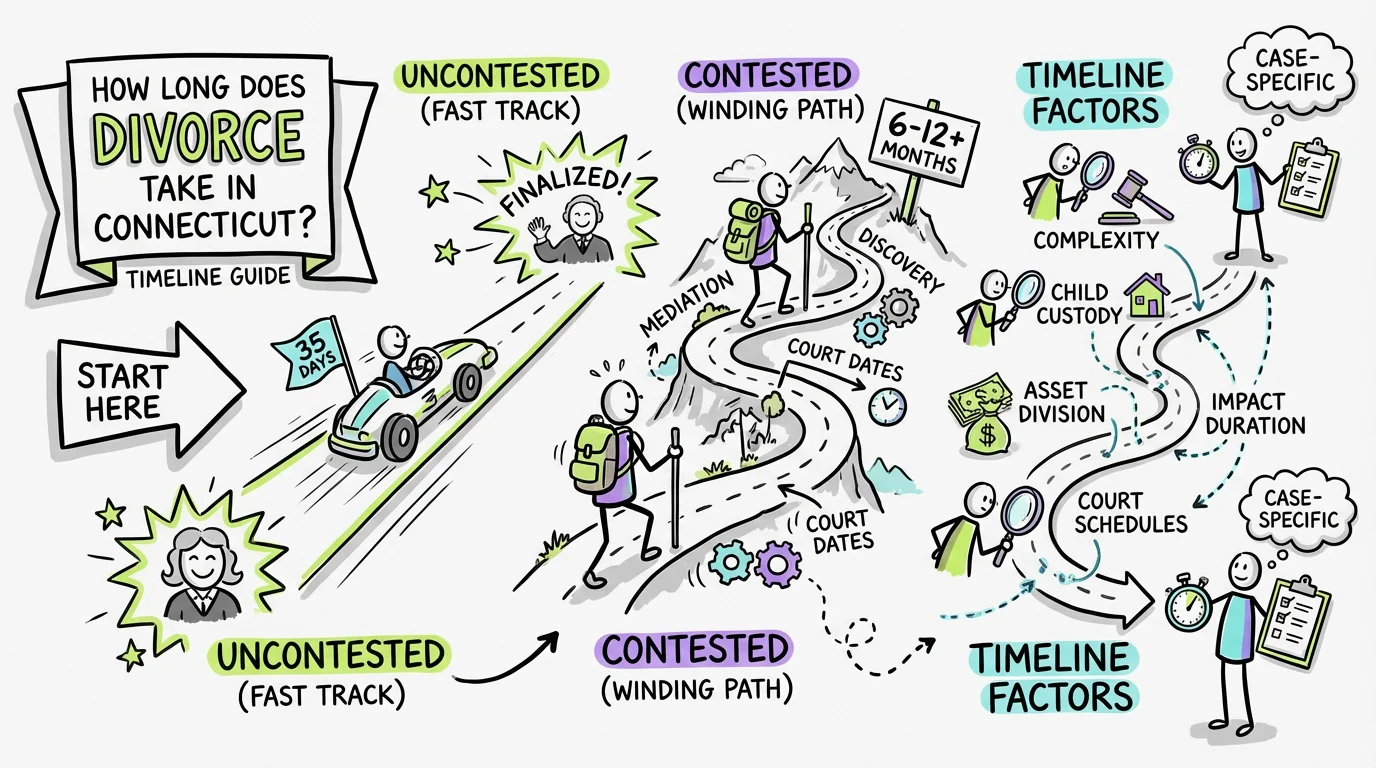
A Connecticut divorce can take as little as 35 days for an uncontested, nonadversarial case or stretch to 12 months or longer for contested matters involving disputes over property, custody, or support. The fastest path is Connecticut's nonadversarial dissolution process, where couples who agree on everything can receive their final decree just 30-35 days after filing their joint petition. Most traditional uncontested divorces take 3-4 months, while contested cases average 6-12 months depending on complexity.
Understanding Connecticut's Divorce Timeline Options
Connecticut offers several paths to divorce, each with different timeline implications. Your situation—specifically whether you and your spouse agree on terms—determines which route you'll take and how quickly you can finalize your divorce. The state has no mandatory separation period before filing, which already puts you ahead of many other states.
The key factor affecting your timeline is whether your divorce is contested or uncontested. In an uncontested divorce, both parties agree on all major issues including property division, alimony, and child custody. A contested divorce means you disagree on one or more significant terms and need the court's intervention to resolve those disputes. Even if you start with disagreements, many couples reach settlement before trial through negotiation or mediation.
Connecticut's court system uses a "Pathways" case management system that assigns divorce cases to different tracks based on complexity. Under Practice Book Rule § 25-50A, cases are assigned to Track A (minimal court time needed), Track B (moderate complexity), or Track C (complex cases requiring significant court involvement). Your track assignment happens early in the process and directly impacts your timeline.
The Fastest Option: Nonadversarial Dissolution
Connecticut's nonadversarial dissolution process represents the absolute fastest way to divorce in the state. Under C.G.S. § 46b-44a, couples can file a joint petition if they meet specific requirements and have already resolved all issues. This streamlined process bypasses many traditional divorce steps.
To qualify for nonadversarial dissolution, you must attest under oath that you've reached a complete agreement on property division, debt allocation, alimony, and (if applicable) child custody and support. Both parties must sign a notarized joint petition, and you'll need to submit your signed separation agreement along with sworn financial affidavits at the time of filing. The Short Form Financial Affidavit works for couples where neither party earns more than $75,000 annually and total assets are under $75,000.
According to C.G.S. § 46b-44c, the court must assign a disposition date no less than 30 days after filing. If neither party files a notice of revocation during that period, the court can enter your divorce decree on or within five days of the disposition date—meaning you could be legally divorced in as few as 35 days from filing. Tools like Untangle's automatic document generation can help ensure your agreement covers all required terms so you qualify for this expedited process.
Traditional Uncontested Divorce Timeline
If you and your spouse agree on divorce terms but don't qualify for (or don't choose) the nonadversarial process, you'll follow the standard uncontested divorce path. This typically takes 3-4 months from filing to final decree.
The process begins when one spouse files a complaint for dissolution. Under Connecticut law, the case cannot proceed to judgment until after the return date—the date the defendant must respond—unless both parties reach an agreement beforehand. C.G.S. § 46b-67 establishes that after the second day following the return date, the court may proceed on the complaint. Most uncontested cases are scheduled for an uncontested hearing within 60-90 days of the return date.
During this waiting period, both parties must complete required paperwork including financial affidavits and, for parents of minor children, a parenting education program. Practice Book Rule § 25-30 requires sworn financial statements to be filed at least five business days before any hearing and updated within 30 days of judgment. Getting your documents organized early prevents delays—Untangle's financial affidavit generation helps you gather and organize financial information systematically so nothing holds up your case.
Contested Divorce: What Extends the Timeline
Contested divorces take significantly longer because they involve disputes that require court intervention to resolve. When spouses cannot agree on property division, alimony, child custody, or child support, the court must gather information and ultimately make decisions for them.
Discovery is often the most time-consuming phase of a contested divorce. This formal process allows each party to request documents, ask written questions (interrogatories), and take depositions. Complex financial situations—business ownership, stock options, pensions, or hidden assets—can extend discovery for months. If one party isn't forthcoming with financial information, the other may need to file motions to compel disclosure, adding more time.
Custody disputes add another layer of complexity. The court may order a family relations evaluation, where a court-appointed professional assesses both parents and makes custody recommendations. These evaluations take weeks to complete, and scheduling can add further delays. If your case involves custody issues, the parenting education program requirement must also be fulfilled, though this is manageable—you can request relief using form JD-FM-149 if legitimate obstacles prevent completion.
Try our free CT alimony calculator
Get an instant estimate based on Connecticut's statutory factors. No signup required.
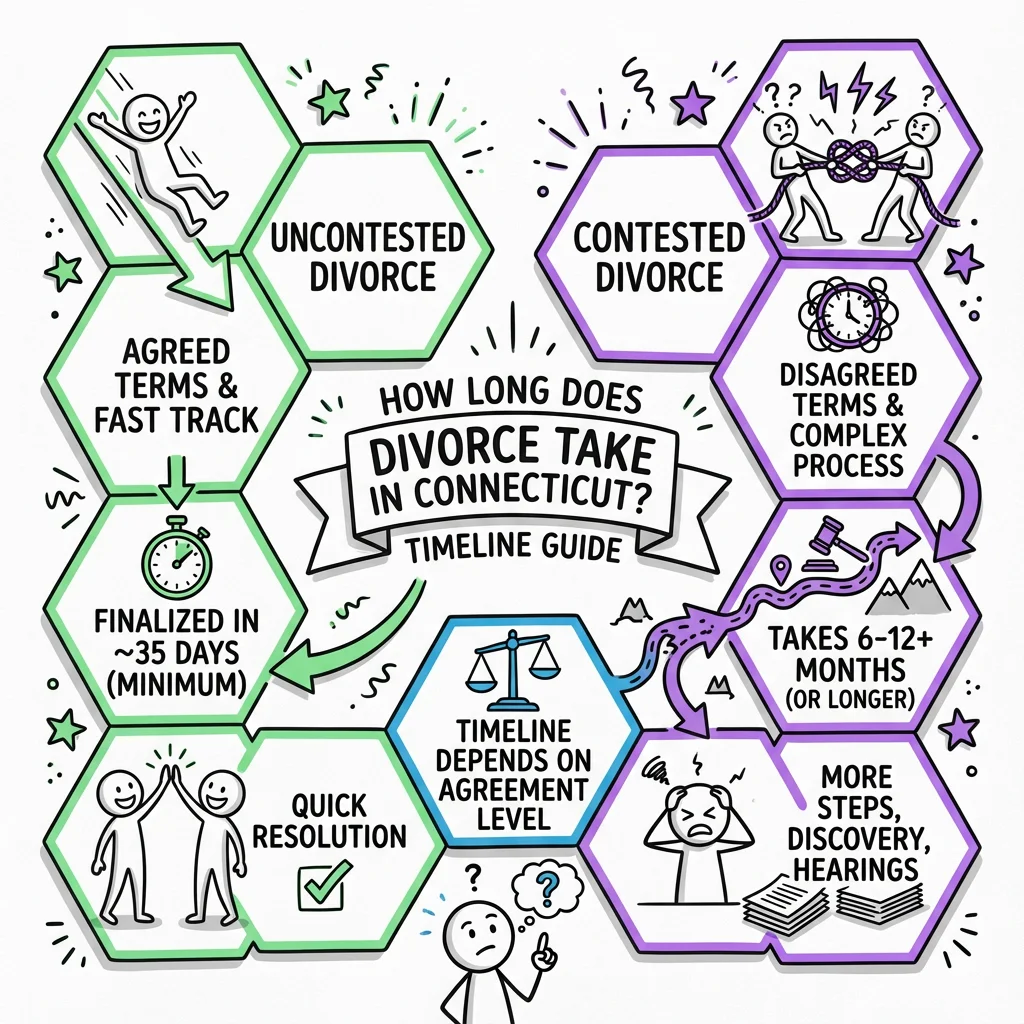
Connecticut Divorce Timeline Comparison
| Divorce Type | Typical Timeline | Key Requirements | Best For |
|---|---|---|---|
| Nonadversarial (Joint Petition) | 30-35 days | Complete agreement, joint filing, all documents ready | Couples who agree on everything |
| Uncontested (Traditional) | 3-4 months | Agreement on all terms, standard filing | Most amicable divorces |
| Contested (Moderate) | 6-9 months | Some disputes, willing to negotiate | Couples with limited disagreements |
| Contested (Complex) | 9-18+ months | Major disputes, significant assets, custody battles | High-conflict situations |
| With 6-Month Cooling Period | 6+ months additional | Court-ordered under C.G.S. § 46b-53 | When court believes reconciliation possible |
Steps to Speed Up Your Connecticut Divorce
-
Choose the right process from the start. If you and your spouse can agree on terms, pursue nonadversarial dissolution. Even if you have some disagreements, try mediation before defaulting to litigation—settling just one contested issue can save months.
-
Prepare financial documents immediately. Courts require detailed financial disclosure. Start gathering tax returns, bank statements, retirement account statements, pay stubs, and property records before you even file. Using Untangle's complete asset inventory helps you compile everything the court needs in the required format.
-
File complete, accurate paperwork. Incomplete filings get returned, requiring corrections and refiling that add weeks to your timeline. The Certificate of Compliance (JD-FM-175) confirms you've met all requirements—make sure you actually have before submitting it. To streamline this, tools like Untangle's electronic court filing can simplify the submission process, reducing errors and saving time.
-
Respond promptly to all requests. Whether from your spouse, their attorney, or the court, delays in responding ripple through your entire case. Set calendar reminders for deadlines and treat them as non-negotiable.
-
Complete required programs early. If you have minor children, Connecticut requires a parenting education program. Don't wait until the last minute—complete it as soon as possible so it's not a bottleneck.
-
Consider mediation for disputes. Even in contested divorces, mediation can resolve specific issues faster than waiting for a trial date. Many Connecticut courts offer family mediation services, and private mediators can often schedule sessions within weeks.
-
Stay organized throughout the process. Track all communications, filings, and deadlines in one place. Disorganization leads to missed deadlines and preventable delays. To help keep everything in order and on track, consider using a Personalized task dashboard like Untangle's, which breaks down your divorce into clear, manageable steps.
What Can Delay Your Divorce
Several factors commonly extend Connecticut divorce timelines beyond the typical ranges. Court backlogs vary by judicial district—some Connecticut courts have heavier caseloads than others, affecting how quickly you get hearing dates. You cannot control this, but you can control everything else.
One spouse refusing to participate creates significant delays. If the defendant doesn't respond to the divorce complaint, you can eventually proceed without them under Practice Book Rule § 25-51, but this requires additional procedural steps. If they engage but drag their feet on discovery or settlement discussions, you may need court intervention to compel cooperation.
Under C.G.S. § 46b-51, if only one spouse claims the marriage has broken down irretrievably and the other disputes it, the court may order a 90-day conciliation period. If requested by either party, proceedings can be stayed for up to six months under C.G.S. § 46b-53—adding substantial time even to otherwise straightforward cases.
Changing circumstances during the divorce process also cause delays. If one spouse's income changes significantly, receives an inheritance, or other major financial shifts occur, financial disclosures may need updating. Custody arrangements proposed early in the case may need revision as circumstances evolve.
When to Get Professional Help
While you can pursue a Connecticut divorce without an attorney, doing so successfully requires organization, attention to detail, and a cooperative spouse. If your divorce involves significant assets, business interests, complex custody arrangements, or any level of conflict, professional guidance typically saves time despite the initial investment.
Even in amicable situations, having a resource to ensure you're completing everything correctly prevents the delays that come from rejected filings or missing documents. Untangle's case management bridges the gap between going it completely alone and hiring full attorney representation—providing the structure and document preparation support that keeps your case moving efficiently toward resolution. When speed matters to you, getting it right the first time matters most.
Frequently Asked Questions
What is the fastest way to get divorced in Connecticut?
Connecticut's nonadversarial dissolution process is the fastest option, allowing couples who agree on all terms to finalize their divorce in just 30-35 days after filing a joint petition.
What's the difference between contested and uncontested divorce timelines in CT?
An uncontested divorce in Connecticut typically takes 3-4 months, while contested divorces involving disputes over property, custody, or support average 6-12 months or longer.
Does Connecticut require a separation period before filing for divorce?
No, Connecticut has no mandatory separation period before filing for divorce, which allows couples to begin the process immediately.
What delays a divorce case in Connecticut?
Disagreements over property division, alimony, or child custody are the main factors that delay Connecticut divorce cases, often requiring negotiation, mediation, or court intervention to resolve.
How does Connecticut's Pathways system affect my divorce timeline?
Connecticut's Pathways case management system assigns divorces to Track A, B, or C based on complexity, with simpler cases requiring minimal court time and complex cases requiring more involvement, directly impacting how long your divorce takes.
Legal Citations
- • Practice Book Rule § 25-50A - Case Management under Pathways View Source
- • C.G.S. § 46b-44a - Filing of joint petition for nonadversarial dissolution of marriage View Source
- • C.G.S. § 46b-44c - Disposition of nonadversarial dissolution of marriage View Source
- • C.G.S. § 46b-67 - Time frame for court to proceed in action for dissolution View Source
- • Practice Book Rule § 25-30 - Statements To Be Filed View Source
- • Practice Book Rule § 25-51 - When Motion for Default for Failure To Appear Does Not Apply View Source
- • C.G.S. § 46b-51 - Stipulation of parties and finding of irretrievable breakdown View Source