How Long Does a Contested Divorce Take in Connecticut? Timeline Guide
Learn how long contested divorces take in Connecticut. Understand the typical timeline of 1-3 years, factors that affect duration, and ways to move your case forward.
How Long Does a Contested Divorce Take in Connecticut?
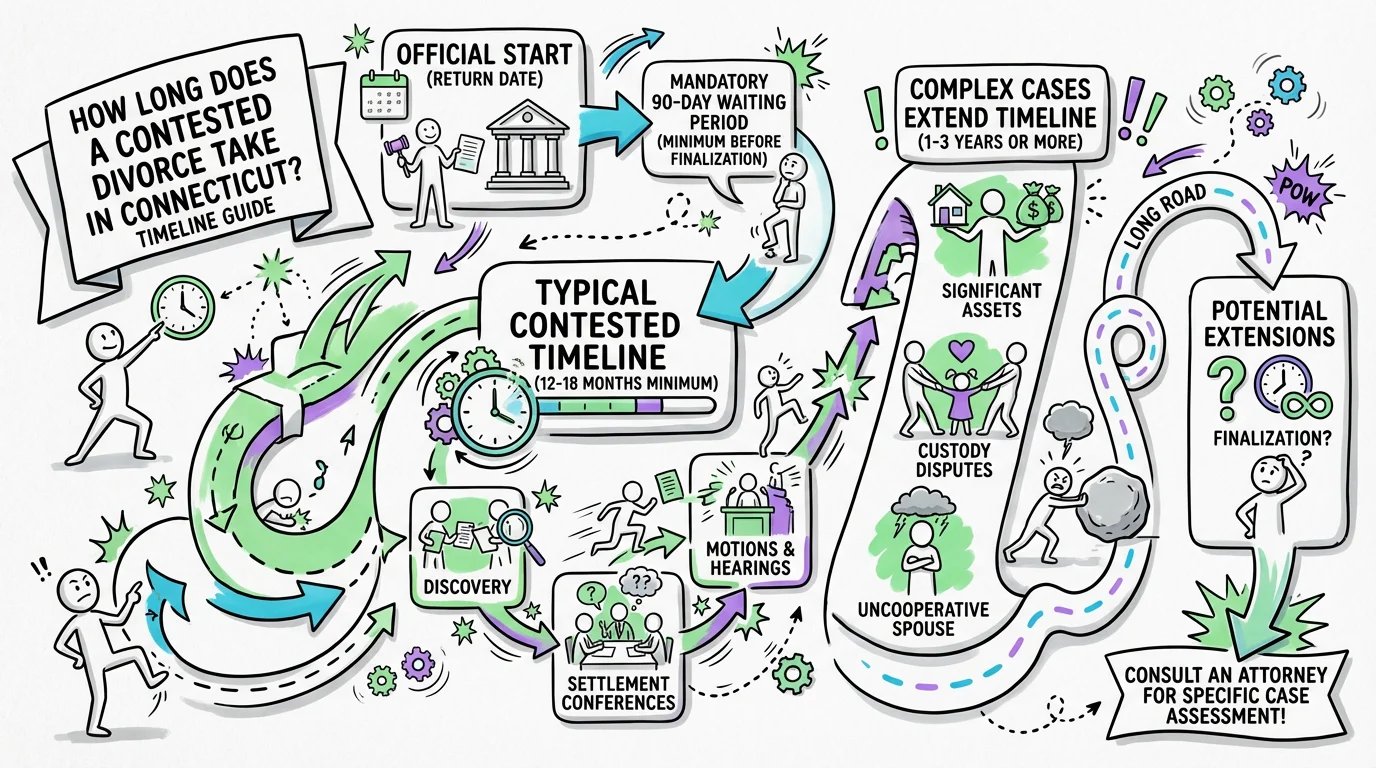
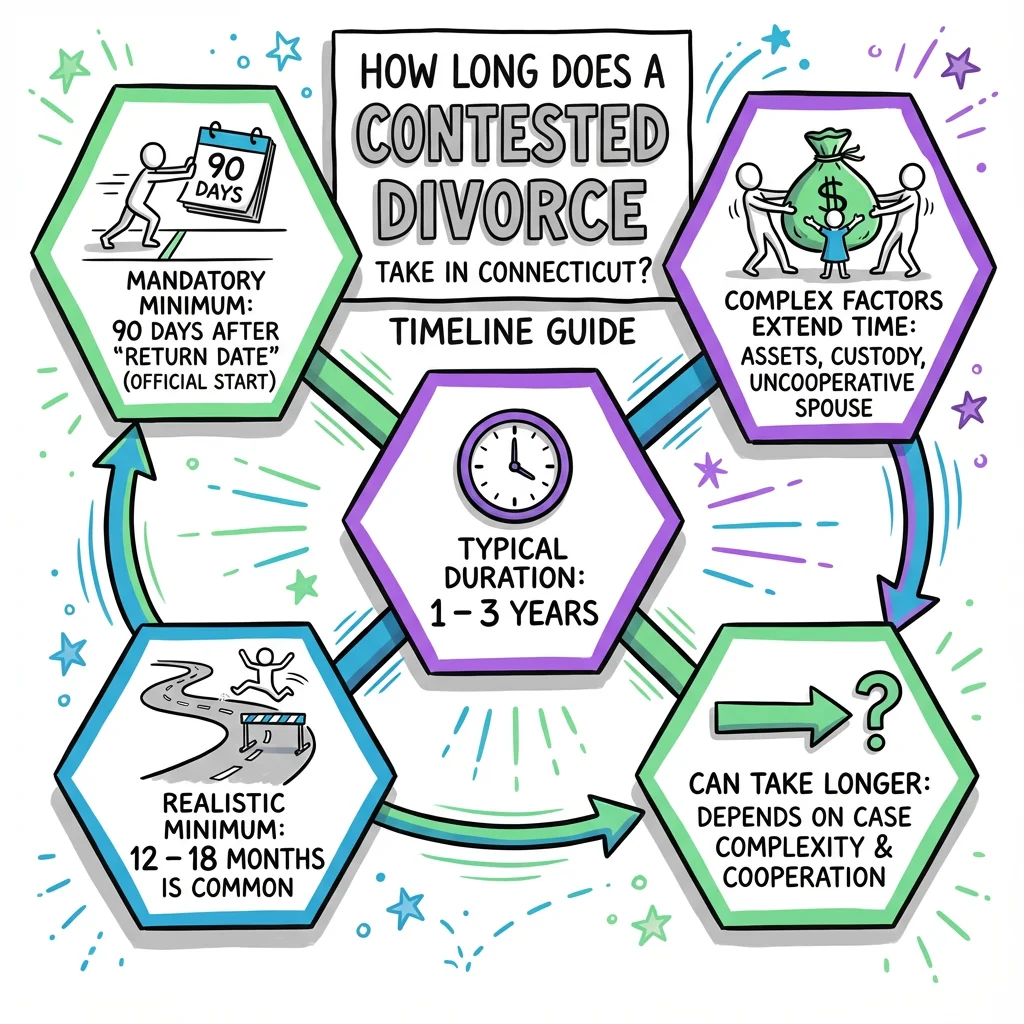
A contested divorce in Connecticut typically takes between one and three years to complete, though complex cases involving significant assets, custody disputes, or uncooperative spouses can extend even longer. Under C.G.S. § 46b-67, the court cannot finalize any divorce until at least 90 days after the return date (the official start of your case), but contested matters routinely take 12 to 18 months at minimum—and often much longer when litigation is required.
Understanding Contested vs. Uncontested Divorce Timelines
The difference in timeline between contested and uncontested divorces in Connecticut is dramatic. While an uncontested, nonadversarial dissolution can be finalized in as little as 35 days under C.G.S. § 46b-44c, a contested divorce has no maximum time limit. The court system provides minimum waiting periods but cannot force two disagreeing spouses to reach resolution quickly.
A divorce becomes "contested" when spouses cannot agree on one or more key issues: property division, alimony, child custody, child support, or parenting time. Even disagreement on a single issue—such as who keeps the family home or how retirement accounts should be divided—transforms your case from a simple administrative process into a potentially lengthy legal battle. Connecticut courts use a "Pathways" case management system under Practice Book § 25-50A to track and manage contested cases, but even with this structure, the adversarial nature of contested proceedings means multiple court appearances, extensive discovery, and potentially a trial.
The emotional and financial toll of extended litigation is substantial. Understanding the realistic timeline helps you plan accordingly, both for your family's stability and your financial resources. Tools like Untangle's task dashboard can help you identify which issues are most likely to become contested in your situation, potentially saving months of dispute over matters that could be resolved earlier.
The Connecticut Contested Divorce Timeline: Step by Step
Phase 1: Filing and Initial Pleadings (1-3 Months)
Your contested divorce begins with the filing of a complaint for dissolution of marriage and service of process using form JD-FM-003 (Summons Family Actions). The defendant then has a specific period to file an appearance and respond. Under Practice Book § 25-11, the pleadings follow a strict order: the plaintiff's complaint comes first, followed by the defendant's motions to dismiss or strike, then the defendant's answer and any cross-complaint, and finally the plaintiff's responses to those filings.
This initial phase sets the tone for your entire case. If your spouse contests the divorce by filing their own claims or disputing your allegations, the court recognizes that your matter requires more intensive management. Both parties must file sworn financial affidavits (using form JD-FM-006-long for those with gross annual income over $75,000) at least five business days before any hearing on financial matters, as required by Practice Book § 25-30. Tools like Untangle's document generation features can help you prepare these necessary court forms and pleadings accurately, ensuring your case starts on solid ground.
Phase 2: Resolution Plan Date and Track Assignment (30-60 Days from Return Date)
Under Connecticut's Pathways system outlined in Practice Book § 25-50A, your case will be assigned a Resolution Plan Date within 30-60 days of the return date. At this meeting, you and your spouse will meet with a family relations counselor who evaluates your case and recommends one of three tracks:
| Track | Description | Typical Duration | Court Involvement |
|---|---|---|---|
| Track A | Minimal court time needed; parties close to agreement | 3-6 months | Limited hearings |
| Track B | Moderate complexity; some contested issues | 6-12 months | Regular case management |
| Track C | Complex or highly contested; significant disputes | 12-36+ months | Extensive court involvement |
Most genuinely contested divorces land in Track B or Track C. The track assignment affects your scheduling order, discovery deadlines, and the court's expectations for your case. Understanding where your case falls helps you plan realistically.
Phase 3: Discovery (3-12 Months)
Discovery is often the longest phase of a contested divorce. This is when both parties exchange financial information, request documents, issue interrogatories (written questions), and potentially take depositions. In high-asset divorces or cases where one spouse suspects the other of hiding assets, discovery can become extraordinarily detailed and time-consuming.
Connecticut courts expect parties to cooperate with discovery requests. Practice Book § 25-50A allows courts to impose sanctions for non-compliance with scheduling orders, including discovery deadlines. However, even cooperative discovery takes time—financial institutions must respond to subpoenas, appraisers must value property, and forensic accountants may need to trace complex assets.
If your spouse is uncooperative or deliberately delays discovery, your timeline extends further. Courts can compel compliance, but motions to compel add weeks or months to your case. Being organized from the start—with complete financial records, property documentation, and clear timelines—can significantly reduce this phase.
Phase 4: Motions and Temporary Orders (Ongoing Throughout)
While your divorce is pending, either party can file motions for temporary ("pendente lite") orders addressing immediate needs: temporary custody arrangements, temporary support, exclusive use of the marital home, or attorney's fees. Under Practice Book § 25-34A, these motions are automatically scheduled for the next case date unless placed on a special motion docket.
Each motion requires preparation, a hearing, and a court decision—all of which add time. In highly contested cases, spouses may file numerous motions, each requiring response and court time. Some motions, like those involving custody evaluations or guardian ad litem appointments, can add months to your case while evaluations are completed.
Phase 5: Settlement Negotiations and Mediation (1-6 Months)
Connecticut encourages settlement at every stage. Under C.G.S. § 46b-53, either party can request conciliation services within 90 days of the return date, and many courts require mediation before trial. Settlement conferences with attorneys, mediator-assisted negotiations, and judicial pre-trial conferences all aim to resolve disputes without the expense and unpredictability of trial.
Many contested divorces settle during this phase—sometimes on the courthouse steps immediately before trial. Settlement can happen at any time, and the more prepared you are with clear documentation and realistic expectations, the more effectively you can negotiate. Untangle's AI-powered guidance help you understand what a fair settlement might look like based on Connecticut law and your specific circumstances.
Phase 6: Trial (1-5 Days, Plus Waiting Time)
If settlement fails, your case proceeds to trial. However, getting a trial date can take months due to court backlogs. Once scheduled, a contested divorce trial in Connecticut typically lasts one to five days, depending on complexity. Highly complex cases with extensive expert testimony, business valuations, or disputed custody issues may require even longer.
After trial, the judge issues a decision—sometimes immediately, sometimes weeks or months later for complex cases. Either party can then appeal, potentially adding another year or more to final resolution.
Factors That Extend Your Contested Divorce Timeline
The primary driver of divorce duration in Connecticut is case complexity. When assets are difficult to value or child custody is hotly disputed, the court requires more time to hear evidence, and attorneys require more time to gather it. This systemic reality often catches litigants off guard, as the administrative backlog of the court system compounds with the specific intricacies of a complex marital estate to create significant delays.
Furthermore, the cooperation level of both parties plays a critical role. A divorce that might otherwise be straightforward can drag on for years if one spouse refuses to comply with discovery requests or files frivolous motions. Understanding these variables helps manage expectations regarding the following specific factors that frequently push timelines beyond the three-year mark:
Complexity of Assets
- Business ownership requiring valuation
- Multiple real estate properties
- Stock options, RSUs, or deferred compensation
- Retirement accounts and pensions requiring QDRO preparation
- Hidden assets requiring forensic investigation
Child-Related Disputes
- Custody evaluations (add 3-6 months)
- Guardian ad litem appointments
- Relocation disputes
- Parental alienation allegations
- Special needs considerations
Spouse Behavior
- Deliberate delays and non-compliance
- Discovery disputes and motions to compel
- Frequent attorney changes
- Failure to appear at hearings
- Contempt proceedings (as seen in cases like Ill v. Manzo-III)
External Factors
- Court backlogs and scheduling delays
- Expert witness availability
- Attorney schedules
- COVID-related or other systemic delays
Try our free CT alimony calculator
Get an instant estimate based on Connecticut's statutory factors. No signup required.
How to Move Your Contested Divorce Forward Efficiently
While you cannot control the court schedule or your spouse's behavior, your own organizational strategy significantly impacts the pace of litigation. Proactive preparation prevents unnecessary delays during the discovery phase, which is often the biggest bottleneck in contested cases. By anticipating what the court and your attorney will need, you remove friction from the process and signal to the judge that you are a cooperative party interested in resolution.
Implementing a systematic approach to your divorce administration allows your legal team to focus on strategy rather than chasing documents. Consider these actionable steps to maintain momentum in your case:
-
Get organized immediately - Gather all financial documents, property records, and relevant communications before filing. The more prepared you are, the faster discovery proceeds.
-
Respond promptly to all requests - Meet every deadline. Courts notice parties who consistently comply, and your cooperation can influence judicial decisions.
-
Choose your battles wisely - Not every issue is worth fighting over. Focus your energy on matters that truly affect your future.
-
Consider early mediation - Even if you expect conflict, attempting mediation early can identify areas of agreement and narrow disputed issues.
-
Stay realistic about outcomes - Understanding what Connecticut courts typically award helps you evaluate settlement offers fairly. Rejecting reasonable offers extends your case unnecessarily.
-
Document everything - Keep records of all communications, agreements, and incidents. This evidence can prove crucial if issues escalate.
Using Untangle's automatic document generation helps ensure you're never scrambling to find critical paperwork when deadlines approach.
Cost Implications of Extended Timelines
The length of your contested divorce directly impacts cost:
| Timeline | Estimated Attorney Fees | Total Cost Range |
|---|---|---|
| 6-12 months | $15,000-$30,000 | $20,000-$50,000 |
| 12-24 months | $30,000-$75,000 | $50,000-$100,000+ |
| 24-36+ months | $75,000-$150,000+ | $100,000-$250,000+ |
These ranges vary significantly based on attorney rates, case complexity, and how aggressively your spouse litigates. Some cases settle early and cost less; others involve appeals and cost far more.
When Your Contested Divorce Requires Professional Help
While understanding the process helps you participate effectively, contested divorces in Connecticut almost always require experienced legal representation. You should consult with a family law attorney if:
- Your spouse has already hired an attorney
- Significant assets, businesses, or debts are involved
- Children are part of the equation
- You suspect hidden assets or financial manipulation
- Domestic violence is a factor
- Your spouse is being uncooperative or hostile
An experienced Connecticut divorce attorney understands local court practices, judges' tendencies, and efficient strategies for moving contested cases forward. They can also help you determine whether certain issues are worth contesting or whether compromise might serve your long-term interests better.
Preparing thoroughly before meeting with an attorney saves both time and money. Having your financial information organized, your goals clarified, and your questions ready allows you to use attorney time efficiently. For quick answers to your legal questions and help understanding complex terms before your consultation, Untangle's AI legal chat can be a valuable resource.
Frequently Asked Questions
What factors can delay a contested divorce in Connecticut?
Contested divorces in CT are commonly delayed by disputes over property division, child custody battles, complex asset valuation, uncooperative spouses, and scheduling conflicts with court calendars.
How can I speed up my contested divorce in CT?
You can potentially speed up a contested divorce by agreeing on as many issues as possible, responding promptly to discovery requests, considering mediation, and hiring an experienced Connecticut divorce attorney who can efficiently navigate the court system.
What is the minimum waiting period for a contested divorce in Connecticut?
Under C.G.S. § 46b-67, Connecticut requires a minimum 90-day waiting period after the return date before any divorce can be finalized, though contested cases routinely take 12 to 18 months or longer.
Why do some Connecticut divorce cases take 3 years or more?
The longest contested divorces in Connecticut typically involve high-value assets, business valuations, hidden assets, prolonged custody disputes, or spouses who refuse to cooperate or negotiate in good faith.
How much faster is an uncontested divorce than a contested divorce in CT?
An uncontested divorce in Connecticut can be finalized in as little as 35 days under C.G.S. § 46b-44c, compared to one to three years for most contested divorces.
Legal Citations
- • C.G.S. § 46b-67 View Source
- • C.G.S. § 46b-44c View Source
- • C.G.S. § 46b-53 View Source
- • Practice Book § 25-50A View Source
- • Practice Book § 25-11 View Source
- • Practice Book § 25-30 View Source
- • Practice Book § 25-34A View Source
- • Ill v. Manzo-III View Source
- • JD-FM-003 Summons Family Actions View Source
- • JD-FM-006-long Financial Affidavit View Source