How Fast Can Untangle Complete Your Connecticut Divorce? Timeline Guide
Learn how fast Untangle can complete your Connecticut divorce. Document prep takes 1-2 hours; legal minimums are 30-90 days depending on your case type.
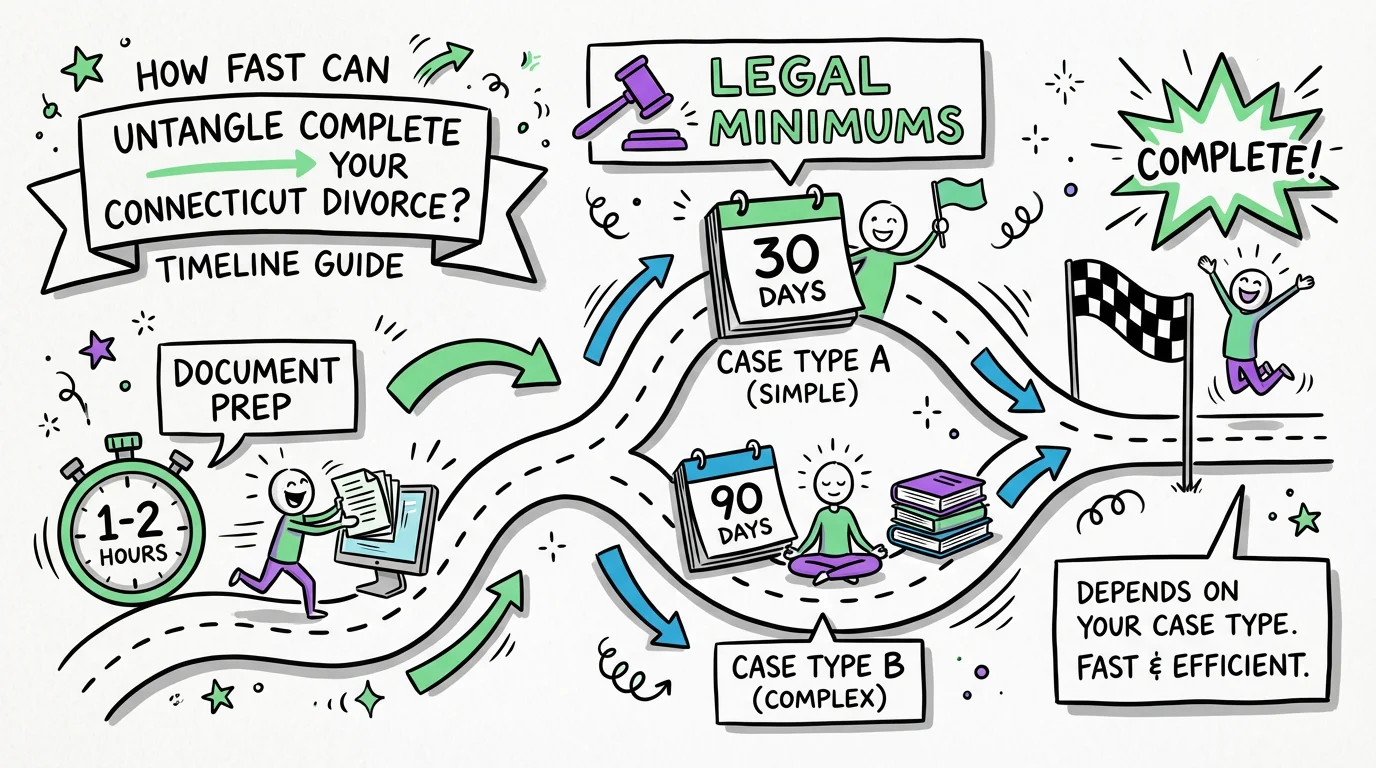
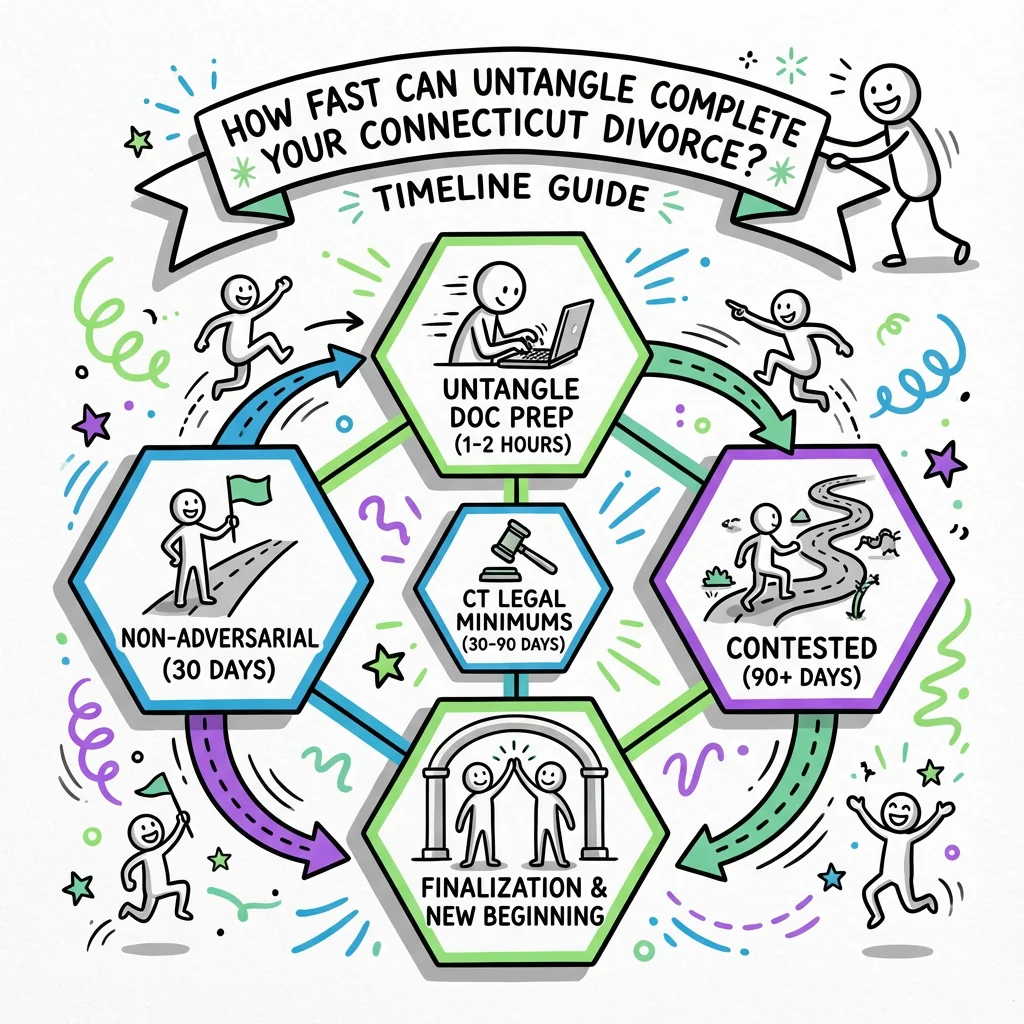
Using Untangle, you can complete your Connecticut divorce documents in as little as one to two hours—but the total timeline depends on Connecticut's mandatory waiting periods. The state requires a minimum 30-day waiting period for uncontested divorces filed jointly, and a 90-day waiting period for standard contested divorces. Untangle eliminates the document preparation bottleneck entirely, letting you focus on the legal timeline rather than paperwork delays.
Understanding Connecticut's Divorce Timeline Requirements
Connecticut law establishes specific minimum timeframes that no software, attorney, or service can bypass. For couples who qualify for a nonadversarial (uncontested) dissolution under C.G.S. § 46b-44a, the court assigns a disposition date no less than 30 days after filing the joint petition. This 30-day minimum represents the fastest possible legal path to finalizing a Connecticut divorce, assuming both parties agree on all terms and submit complete, accurate paperwork.
For contested divorces or cases filed by one spouse alone, C.G.S. § 46b-67 requires a longer waiting period. The court cannot proceed on the complaint until after the second day following the return date—typically about 90 days after filing. This extended timeline allows the responding spouse adequate opportunity to participate in the proceedings and ensures both parties have time to gather financial information and negotiate terms.
The critical insight for speed seekers is this: while you cannot shorten the legal waiting periods, you can eliminate delays caused by paperwork errors, incomplete filings, and back-and-forth document revisions. This is where Untangle's guided divorce process delivers significant time savings, ensuring your documents are court-ready from day one.
The Fastest Path: Connecticut's Nonadversarial Dissolution
Connecticut offers an expedited process called nonadversarial dissolution specifically designed for couples who agree on everything. Under C.G.S. § 46b-44c, these cases receive a disposition date just 30-35 days after filing. If neither party revokes the petition and the court finds your settlement agreement fair and equitable, the judge can enter your divorce decree without requiring either party to appear in person.
To qualify for this streamlined process, both spouses must attest under oath that specific conditions exist at the time of filing. These typically include agreement on all issues—property division, any spousal support, and if applicable, child custody, visitation, and support. You must file a complete settlement agreement along with your joint petition, and both parties must submit sworn financial affidavits.
Untangle's platform guides you through each qualification requirement, helping you determine within minutes whether you're eligible for Connecticut's fastest divorce track. Tools like Untangle's automatic document generation tool ensure you address every required element, reducing the risk that the court will flag your agreement for additional review under C.G.S. § 46b-44d—which could add another 30 days to your timeline.
What Slows Down Most Connecticut Divorces
Understanding common delay triggers helps you avoid them. The most frequent cause of divorce delays isn't the legal system—it's incomplete or incorrect paperwork. When courts identify errors in your financial affidavit, missing signatures on required forms, or gaps in your settlement agreement, they schedule additional hearings that can push your finalization date out by weeks or months.
Financial documentation requirements trip up many self-represented parties. Connecticut Practice Book Rule § 25-30 mandates sworn financial statements showing current income, expenses, assets, and liabilities. These must be filed at least five business days before any hearing and updated within 30 days of final judgment. Using the wrong form—the Short Form Financial Affidavit for incomes under $75,000, or the Long Form for higher earners—creates immediate processing delays.
The Pathways case management system, governed by Connecticut Practice Book Rule § 25-50A, assigns cases to tracks based on complexity. Track A cases (minimal court involvement) move fastest, typically completing within the minimum waiting periods. However, parties who appear disorganized or unprepared at initial conferences often get bumped to Track B or C, adding months to their timeline. To ensure you present as an organized, settlement-ready case from the start, tools like Untangle's personalized task dashboard can be invaluable.
Timeline Comparison: Your Divorce Options
| Divorce Approach | Document Prep Time | Minimum Legal Timeline | Typical Total Time |
|---|---|---|---|
| Untangle + Nonadversarial Filing | 1-2 hours | 30-35 days | 5-6 weeks |
| Untangle + Standard Uncontested | 2-4 hours | 90+ days | 3-4 months |
| DIY Without Assistance | 10-20+ hours | 30-90 days | 4-8 months |
| Traditional Attorney | Varies (multiple meetings) | 30-90 days | 4-12 months |
| Contested Divorce with Trial | N/A | No minimum | 12-24+ months |
The comparison table illustrates a key point: the legal minimum and actual completion time often differ dramatically. DIY filers frequently experience 2-3x the minimum timeline due to rejected forms, missed deadlines, and incomplete filings. Untangle compresses the gap between minimum possible and actual completion by eliminating paperwork errors.
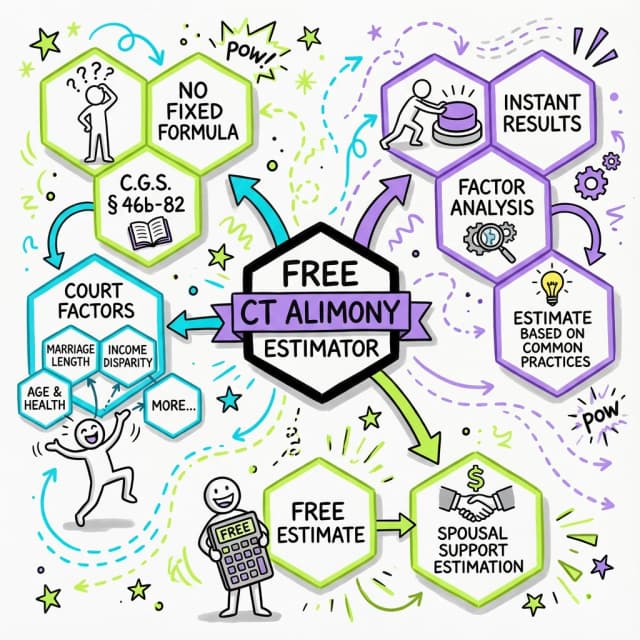
Try our free CT alimony calculator
Get an instant estimate based on Connecticut's statutory factors. No signup required.
Step-by-Step: Getting Divorced Quickly with Untangle
-
Complete the intake questionnaire (15-30 minutes). Untangle asks targeted questions about your marriage, assets, children, and goals to determine your eligibility for Connecticut's nonadversarial process and generate appropriate documents.
-
Build your settlement agreement (30-60 minutes). The guided builder walks you through property division, debt allocation, and if applicable, parenting plans and support calculations. Both spouses can collaborate on the platform.
-
Generate financial affidavits (15-30 minutes). Input your income, expenses, assets, and liabilities into Untangle's financial affidavit generation tool, which automatically populates the correct Connecticut Judicial Branch forms.
-
Review and notarize documents (varies). Your completed packet includes all required forms with clear instructions for notarization. For joint petitions, both parties must sign before a notary.
-
File with your local Superior Court (same day). Submit your documents to the judicial district where one spouse resides. Filing fees apply (currently around $360).
-
Wait for disposition date (30-90 days). For nonadversarial cases, the court assigns a date 30+ days out. Prepare any additional documentation the court requests.
-
Receive your divorce decree (disposition date). If everything is in order, the court enters your judgment. For most nonadversarial cases, no appearance is required.
Factors That Can Speed Up or Slow Down Your Case
Several variables affect whether you'll hit the minimum timeline or experience delays:
Factors that accelerate your divorce:
- Complete agreement between spouses on all issues
- No minor children (eliminates custody, support, and parenting education requirements)
- Simple asset structure with clear documentation
- Both parties actively cooperating and responsive
- Accurate, complete financial affidavits filed with the petition
- Using Connecticut's nonadversarial process when eligible
Factors that cause delays:
- Disagreement on any issue, even minor ones
- Complex assets like businesses, retirement accounts, or real estate
- One spouse avoiding service or refusing to participate
- Incomplete or inaccurate financial disclosures (as demonstrated in Lavy v. Lavy, where material omissions led to the judgment being reopened)
- Court finding settlement agreement potentially unfair under C.G.S. § 46b-44d
- Custody disputes requiring evaluation or investigation
The automatic orders that take effect upon filing (Connecticut Practice Book Rule § 25-5B) also impact timeline. These orders freeze assets and insurance policies. Violations can result in contempt proceedings that derail your progress, so understanding and following these restrictions is essential.
When DIY Speed Isn't Enough: Getting Professional Help
While Untangle enables rapid completion of divorce documents, some situations warrant attorney involvement. If your spouse contests any issue, hides assets, or becomes uncooperative after filing, the nonadversarial track closes. You'll need to navigate Connecticut's standard dissolution process, potentially including discovery, mediation, and trial preparation.
Complex financial situations—business ownership, stock options, multiple properties, or significant retirement assets—benefit from professional guidance. The case of Natarajan v. Natarajan illustrates how asset distribution disputes can complicate proceedings. An attorney can help you understand your rights and negotiate effectively, while Untangle's document tools still reduce the administrative burden.
Connecticut's Pathways system (Practice Book Rule § 25-50A) includes family relations counselors who help parties identify agreements and settlement likelihood. Even in Track B or C cases, having organized documentation from Untangle positions you for efficient case management. Your counselor can focus on substantive issues rather than sorting through disorganized paperwork.
For most amicable divorces without complex issues, Untangle's case management tools provide everything you need to complete the process in the shortest time Connecticut law allows. The combination of guided document preparation, settlement agreement building, and financial affidavit tools eliminates the friction that typically extends divorce timelines well beyond legal minimums.
Frequently Asked Questions
What is the minimum waiting period for a divorce in Connecticut?
Connecticut requires a minimum 30-day waiting period for uncontested (nonadversarial) divorces filed jointly, and a 90-day waiting period for standard contested divorces or cases filed by one spouse alone.
Can any service or attorney speed up Connecticut's mandatory divorce waiting periods?
No, Connecticut's legal waiting periods of 30 or 90 days cannot be bypassed by any software, attorney, or service—but you can eliminate delays caused by paperwork errors and incomplete filings.
How long does it take to complete divorce paperwork with Untangle?
Untangle allows you to complete all your Connecticut divorce documents in as little as one to two hours through its guided process.
What slows down the divorce process in CT?
Common delays include paperwork errors, incomplete filings, back-and-forth document revisions, and disagreements between spouses on terms like asset division or custody.
What is a nonadversarial dissolution in Connecticut?
A nonadversarial dissolution is Connecticut's expedited divorce process for couples who agree on all terms, requiring only a 30-day waiting period under C.G.S. § 46b-44a.
Legal Citations
- • Connecticut Practice Book Rule § 25-30 - Statements To Be Filed View Source
- • Connecticut Practice Book Rule § 25-50A - Case Management under Pathways View Source
- • Connecticut Practice Book Rule § 25-5B - Automatic Orders upon Filing of Joint Petition View Source
- • Lavy v. Lavy, 210 A.3d 98 View Source
- • Natarajan v. Natarajan, 107 Conn. App. 381 View Source