How Divorce Affects Children in Connecticut: A Parent's Guide to Protecting Your Kids
Learn how divorce affects children emotionally and legally in Connecticut. Understand custody, support, and parenting education requirements to protect your kids.
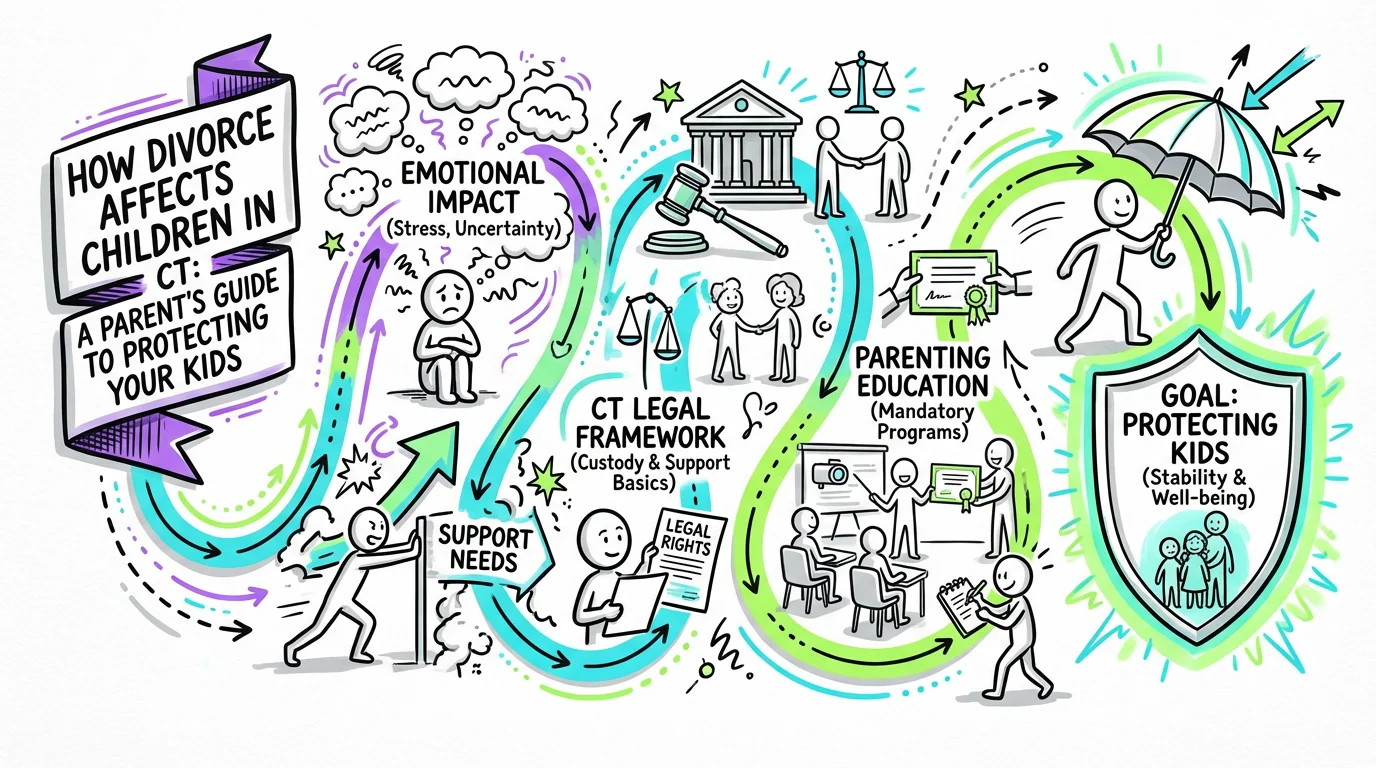
Divorce affects children by disrupting their emotional stability and daily routines, but the long-term impact is largely determined by how parents manage the transition. Connecticut law actively mitigates these risks through mandatory parenting education, custody laws focused on the "best interests of the child," and income-based child support formulas. While the restructuring of a family is challenging, children can thrive when parents minimize conflict, maintain consistent routines, and facilitate healthy relationships with both co-parents.
Understanding the Emotional Impact on Children
Children experience divorce differently depending on their age, temperament, and the level of parental conflict they witness. Younger children may struggle to understand why their family is changing and often blame themselves, while teenagers might experience anger, anxiety, or behavioral changes as they process the restructuring of their home life. Research consistently shows that children's long-term adjustment depends less on the divorce itself and more on how parents handle co-parenting, communication, and conflict resolution.
Connecticut's family court system acknowledges the profound impact divorce has on children by building protective measures into the legal process. The state's parenting education program, mandated under C.G.S. § 46b-69b, specifically addresses "the impact on children of the restructuring of families." This isn't just a formality—it's a recognition that parents need tools and education to help their children navigate this major life transition. The program covers communication strategies, how to reduce conflict exposure, and ways to support children's emotional needs during and after divorce.
One of the most important factors in children's adjustment is the quality of their relationships with both parents. Connecticut courts prioritize arrangements that allow children to maintain meaningful contact with each parent, understanding that children benefit from feeling loved and supported by both mom and dad—even when those parents no longer live together. Maintaining these bonds requires intentional effort from both parents to separate their marital issues from their parental responsibilities.
How Connecticut Law Protects Children During Divorce
Connecticut has established comprehensive legal protections specifically designed to safeguard children's interests throughout the divorce process. These protections begin automatically the moment a divorce complaint is served and continue through final orders and beyond.
Automatic Court Orders
Under Connecticut Practice Book Rule § 25-5, automatic orders take effect immediately when divorce proceedings begin. These orders specifically protect children by prohibiting either parent from permanently removing minor children from Connecticut without written consent of the other parent or a court order. This ensures that children maintain stability and that neither parent can unilaterally disrupt the child's relationships, schooling, or support systems during the emotionally charged divorce process.
The automatic orders also require parents living apart to "help the children continue their customary contacts" and maintain the children's well-being as a priority. These aren't suggestions—they're enforceable court orders that both parents must follow from day one. Violating these orders can result in serious consequences, including being held in contempt of court, which can negatively impact a parent's standing in future custody determinations.
Guardian ad Litem for Children
In cases where the court believes additional protection is needed, Connecticut allows for the appointment of a guardian ad Litem (GAL) or attorney for the minor children under C.G.S. § 46b-54. This independent advocate's sole responsibility is representing the child's best interests—not either parent's wishes. The court can appoint a GAL on its own motion, at either parent's request, or even at the request of a child "who is of sufficient age and capable of making an intelligent request."
Having a GAL can be particularly valuable in high-conflict divorces where children might otherwise get caught in the middle. The GAL investigates the family situation, speaks with the children, and makes recommendations to the court about what custody and visitation arrangements would truly serve the children's needs. Tools like Untangle's children's information management features can help parents prepare for GAL interviews by keeping important information about their children's needs, schedules, and activities organized and accessible.
Custody Arrangements: Keeping Children Connected to Both Parents
Connecticut law strongly favors arrangements that allow children to maintain meaningful relationships with both parents. Understanding how custody works can help you advocate for arrangements that truly serve your children's needs.
Types of Custody in Connecticut
Under C.G.S. § 46b-56a, Connecticut recognizes two components of custody: legal custody and physical custody. Legal custody refers to decision-making authority over major aspects of your child's life, including education, healthcare, religious upbringing, and extracurricular activities. Physical custody addresses where the child lives day-to-day.
Connecticut law establishes a presumption in favor of joint custody when both parents agree to it. Joint legal custody means both parents share decision-making responsibility, which research shows helps children feel that both parents remain actively involved in their lives. Joint physical custody means the child spends significant time living with each parent, though this doesn't necessarily mean a 50/50 split—the specific schedule depends on what works best for the child.
The court may award joint legal custody without awarding joint physical custody in situations where shared decision-making is appropriate but having the child split time equally between homes isn't practical or in the child's best interest. This flexibility allows Connecticut courts to craft arrangements that fit each family's unique circumstances while preserving the child's access to both parents.
The Best Interests Standard
Every custody decision in Connecticut must be guided by the child's best interests under C.G.S. § 46b-56. This isn't a vague concept—courts consider specific factors including:
- The child's temperament and developmental needs
- Each parent's ability to understand and meet those needs
- The child's relationships with parents, siblings, and other significant people
- The child's adjustment to home, school, and community
- The mental and physical health of all involved
- Each parent's willingness to encourage the child's relationship with the other parent
- Any history of domestic violence
These factors are considered holistically rather than as a checklist where one parent "wins" more points than the other. The judge's goal is to construct a living arrangement that offers the child the most stability, safety, and emotional support possible. For example, a parent who actively encourages the child's relationship with the other parent is often viewed more favorably than one who attempts to restrict access or disparage the co-parent.
Understanding these factors can help you focus on what truly matters when advocating for your children. Tools like Untangle's personalized task dashboard can help you organize your thoughts around each of these factors, ensuring you're ready to discuss your children's specific needs with your attorney or the court.
Parenting Plans: Creating Stability for Your Children
A well-crafted parenting plan is one of the most important tools for protecting your children during and after divorce. Connecticut requires parents seeking joint custody to file a parenting responsibility plan detailing how they'll share parental duties.
What Goes Into a Parenting Plan
Effective parenting plans address both the big picture and daily details that affect children's lives. Covering these bases early prevents ambiguity later:
| Category | Elements to Address |
|---|---|
| Physical Custody Schedule | Regular weekly schedule, weekends, overnights |
| Holiday & Vacation Time | Specific holidays, school breaks, summer vacation |
| Decision-Making | Education, healthcare, religious upbringing, activities |
| Communication | How parents share information, how children contact each parent |
| Transitions | Pick-up/drop-off locations, times, and procedures |
| Relocation | Notice requirements if either parent plans to move |
| Conflict Resolution | How parents will handle disagreements |
The more detailed and clear your parenting plan, the fewer opportunities for misunderstanding and conflict—which directly benefits your children. Children thrive on predictability, and knowing exactly when they'll be with each parent, where transitions happen, and what to expect reduces their anxiety significantly. A vague plan like "reasonable visitation" often leads to disputes, whereas a specific schedule provides a reliable framework for everyone involved.
Making Your Parenting Plan Work
Creating a parenting plan is just the beginning—making it work requires ongoing cooperation and flexibility. The best plans include mechanisms for addressing changes as children grow and circumstances evolve. Connecticut allows modification of custody orders when there's been a substantial change in circumstances, but having built-in flexibility can help parents avoid returning to court for every adjustment.
Tools like Untangle's parenting plan builder can help you track schedules, document important events, and maintain the kind of organized communication that makes parenting plans succeed. When both parents have clear records of agreements, schedules, and children's activities, there's less room for conflict and more energy available for actually parenting.
Try our free CT child support calculator
Calculate your estimated child support using Connecticut's official guidelines formula.
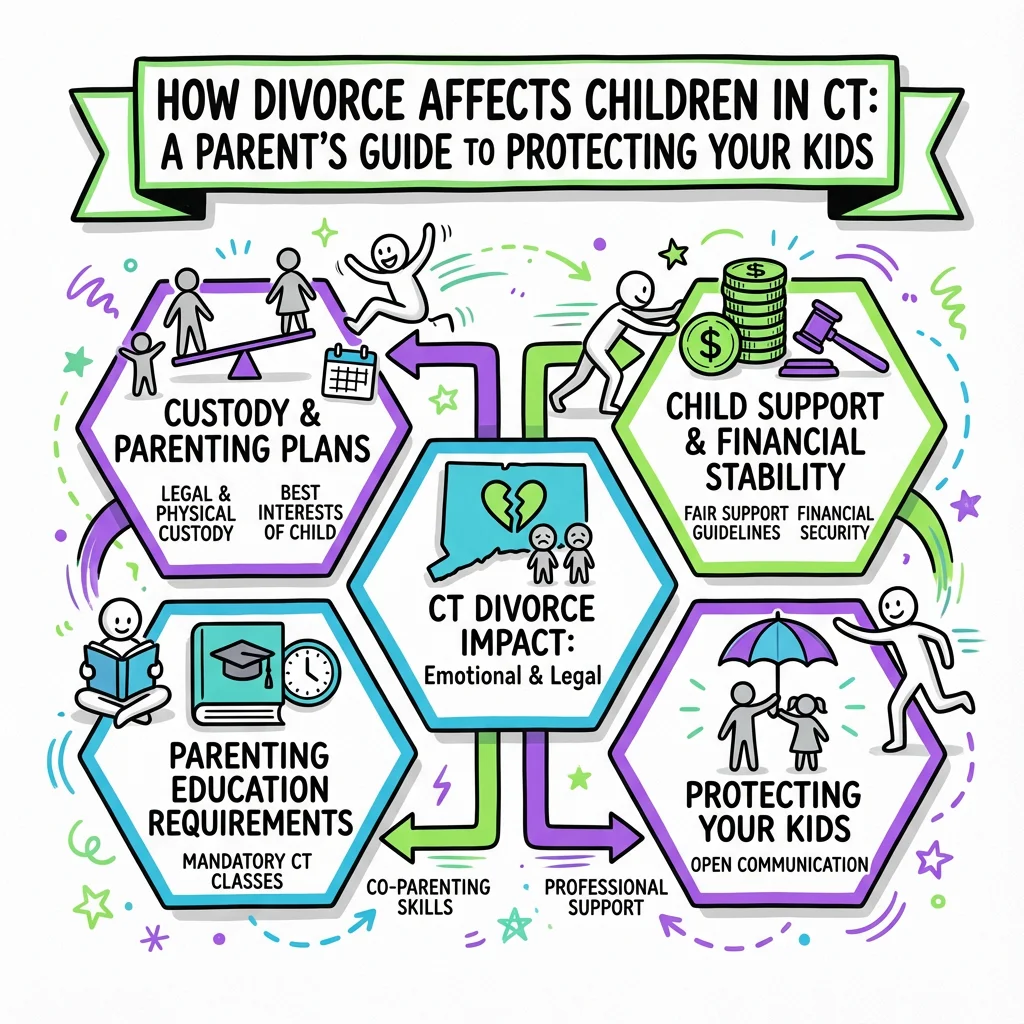
Mandatory Parenting Education: Connecticut's Investment in Children
Connecticut takes children's well-being so seriously that it requires divorcing parents to complete a parenting education program. Under C.G.S. § 46b-69b, the Judicial Department has established this program specifically to "educate persons...on the impact on children of the restructuring of families."
What the Program Covers
The parenting education program addresses topics directly relevant to helping children adjust:
- Understanding how children experience divorce at different ages
- Reducing the impact of parental conflict on children
- Effective co-parenting communication strategies
- Helping children maintain healthy relationships with both parents
- Recognizing when children need additional support
The program typically consists of two three-hour sessions or one six-hour session, totaling six hours of instruction. It is not therapy or counseling, but rather a curriculum-based class taught by mental health professionals. Participants must register within 60 days of the case return date, and the court generally will not grant a divorce judgment until both parents have filed their completion certificates.
This program isn't punishment—it's a resource designed to give you tools for protecting your children. Many parents find the program genuinely helpful, providing insights they hadn't considered and strategies they can implement immediately. The court takes completion seriously; failure to participate can result in delays in your case proceeding or even sanctions.
Financial Protection: Child Support in Connecticut
Children have a legal right to financial support from both parents, regardless of the custody arrangement. Connecticut's child support guidelines ensure that children receive adequate financial support while treating parents in similar circumstances consistently.
How Child Support Is Calculated
Connecticut uses the Income Shares Model for calculating child support. The fundamental principle, as stated in the guidelines' preamble, is that "the child should receive the same proportion of parental income as he or she would have received if the parents lived together." This recognizes that children shouldn't bear the financial burden of their parents' divorce.
The calculation considers both parents' gross income, the number of children, childcare expenses, healthcare costs, and the custody arrangement. The Connecticut Child Support Guidelines Worksheet (Form CCSG-001) walks through this calculation step by step.
| Factor | How It Affects Support |
|---|---|
| Combined parental income | Higher income = higher support obligation |
| Number of children | More children = higher total support |
| Custody arrangement | Shared physical custody may reduce support |
| Childcare costs | Added to basic support obligation |
| Health insurance premiums | Divided proportionally between parents |
Under C.G.S. § 46b-84, both parents maintain an obligation to support their minor children "according to their respective abilities." This means the calculation looks at what each parent can actually afford while ensuring children's needs are met. Deviations from the guideline amount are possible but require specific findings by the court justifying why the standard amount would be inequitable.
Using Support Calculations Effectively
Understanding how child support works helps you plan realistically for your children's future. Tools like Untangle's child support calculator can help you organize income information and understand how different scenarios might affect support calculations. Having accurate financial information ready makes the process smoother and helps ensure the final support order truly reflects your family's circumstances.
It is also crucial to document variable income sources such as bonuses, commissions, or overtime pay, as these are often included in the support calculation. Connecticut courts look at total earning capacity, so being transparent about all financial resources prevents future disputes and ensures the child support order is durable. Accurate data entry at the beginning protects your children from the instability of financial litigation later on.
Practical Steps to Protect Your Children During Divorce
Taking intentional steps to prioritize your children's well-being can make a significant difference in how they experience and adjust to divorce.
- Shield children from conflict - Never argue in front of your children or use them to communicate with your co-parent. Children who witness ongoing parental conflict experience significantly more adjustment problems.
- Maintain routines - Keep bedtimes, meal times, school activities, and other routines as consistent as possible. Predictability helps children feel secure during uncertain times.
- Encourage the other parent relationship - Speak positively (or at least neutrally) about your co-parent. Children who feel they must choose sides or hide their love for one parent suffer emotionally.
- Listen without leading - Let your children express their feelings without projecting your own emotions onto them. A child saying they miss the other parent isn't a rejection of you.
- Consider professional support - Therapists who specialize in children and divorce can provide invaluable support. Many children benefit from having a neutral person to talk to.
- Document appropriately - Keep records of schedules, agreements, and important events, but avoid turning documentation into a weapon. The goal is clarity and organization, not ammunition.
- Complete parenting education promptly - Don't view the mandatory program as an obstacle. Engage genuinely and apply what you learn.
When to Seek Professional Help
While many families navigate divorce without extensive professional intervention, certain situations call for additional support. If your children are showing significant behavioral changes, struggling academically, expressing persistent sadness or anxiety, or having difficulty with transitions between homes, consulting with a child therapist is wise. Early intervention can prevent temporary distress from becoming a long-term emotional struggle.
From a legal perspective, complex custody disputes—especially those involving allegations of abuse, substance abuse concerns, or parental alienation—require experienced legal representation. If you're concerned about your children's safety or your co-parent is not following court orders, don't wait to seek help. Connecticut courts take children's safety seriously and have mechanisms to address urgent concerns.
Tools like Untangle's AI legal guidance can help you understand when your situation requires professional assistance and what options are available. Being prepared with organized documentation and clear understanding of your concerns helps you use professional time effectively—whether that's a therapist, mediator, or attorney. Remember that seeking help isn't a sign of failure—it's a sign that you're taking your children's well-being seriously.
Frequently Asked Questions
What are the signs my child is struggling emotionally during a divorce?
Common signs include changes in sleep or appetite, withdrawal from friends or activities, declining grades, regression to younger behaviors (like bedwetting), increased anxiety, anger outbursts, or expressing guilt or self-blame about the divorce.
How do I tell my kids about divorce based on their age?
Younger children (under 5) need simple, reassuring explanations focusing on what will stay the same, school-age children (6-12) benefit from more detail about logistics and repeated reassurance it's not their fault, and teenagers can handle more context but still need emotional support and shouldn't be treated as confidants.
When should I consider therapy for my child during a Connecticut divorce?
Consider therapy if your child shows persistent emotional distress lasting more than a few weeks, significant behavioral changes, academic decline, or expresses thoughts of self-harm—and Connecticut courts can order counseling as part of custody arrangements if deemed in the child's best interest.
What are the long-term effects of divorce on children?
Research shows that while children of divorce may face slightly higher risks for anxiety, depression, and relationship difficulties, most children adjust well long-term, especially when parents minimize conflict, maintain consistent relationships, and provide emotional stability.
What co-parenting strategies help minimize the impact of divorce on kids in CT?
Effective strategies include keeping conflict away from children, maintaining consistent routines between households, communicating respectfully with your co-parent, never putting children in the middle, and attending Connecticut's mandatory parenting education program which teaches these specific skills.
Legal Citations
- • Connecticut Practice Book Rule § 25-5 - Automatic Orders View Source
- • Connecticut Judicial Branch - Family Matters View Source
- • Connecticut Child Support Guidelines Worksheet (Form CCSG-001) View Source