Free Connecticut Divorce Forms Online: Complete List and Filing Guide
Access free Connecticut divorce forms online including the Divorce Complaint, Financial Affidavit, and Summons. Download official CT court forms and learn how to file.
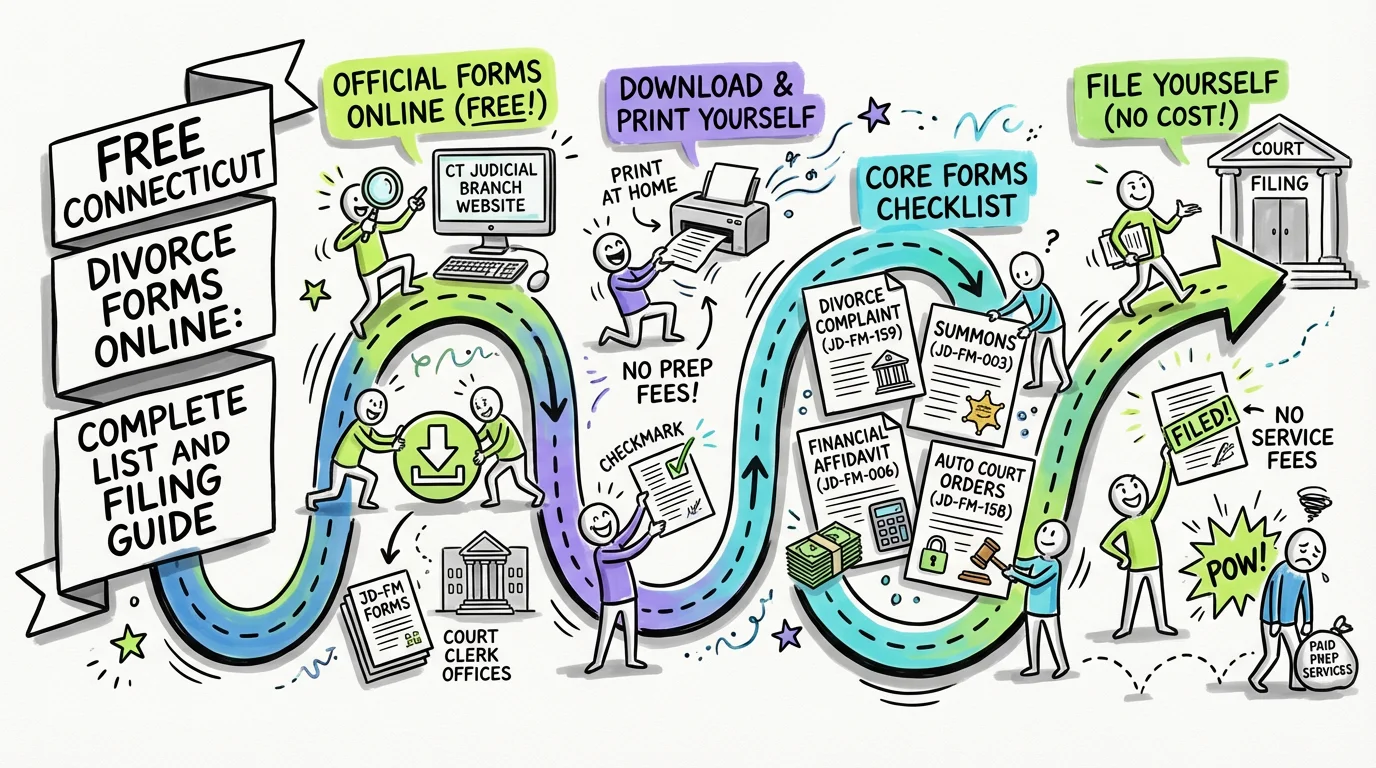
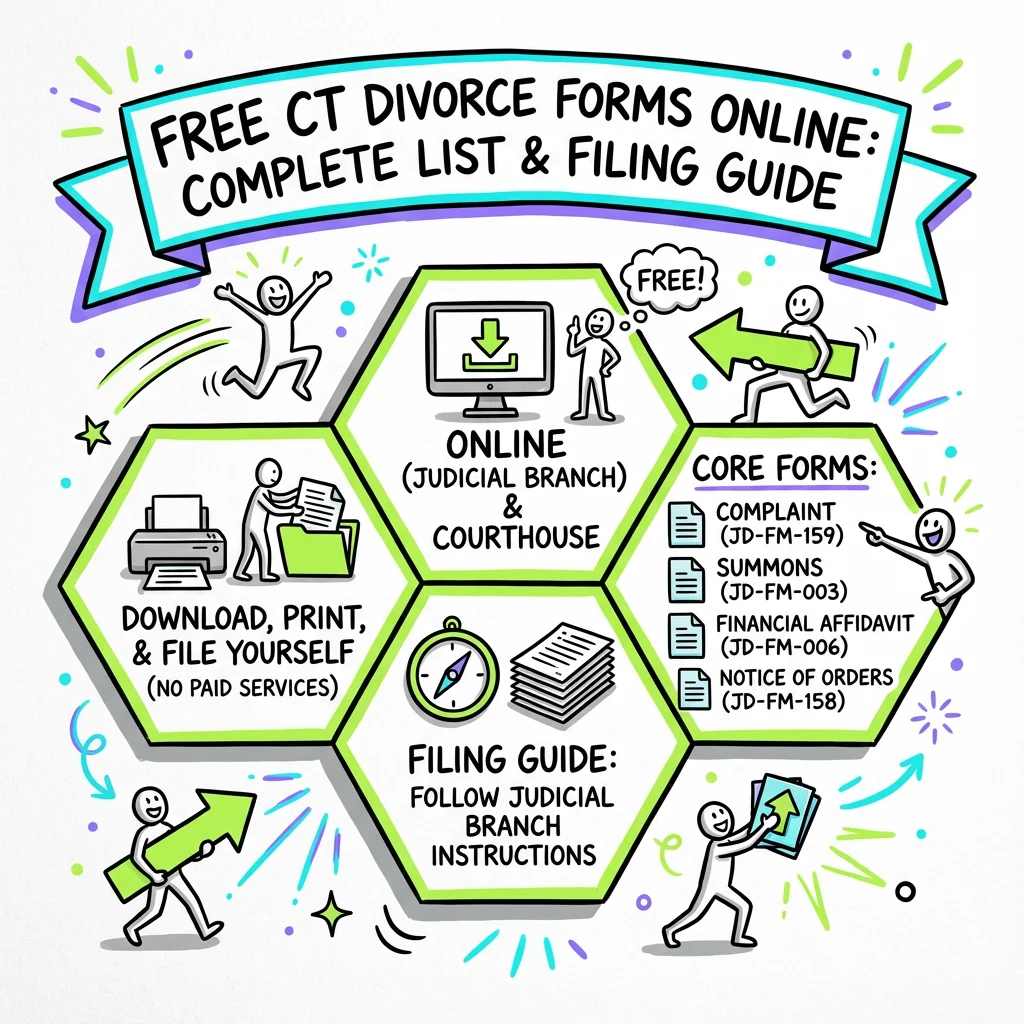
Connecticut provides all official divorce forms completely free through the Judicial Branch website and court clerk offices. You can download, print, and file these forms yourself without paying for document preparation services. The core forms you'll need include the Divorce Complaint (JD-FM-159), Summons for Family Actions (JD-FM-003), Financial Affidavit (JD-FM-006), and Notice of Automatic Court Orders (JD-FM-158)—all available at no cost.
Overview: Connecticut's Free Divorce Form System
The Connecticut Judicial Branch maintains a comprehensive library of family law forms designed for self-represented parties. These aren't stripped-down versions or "basic" templates—they're the exact same forms that attorneys use when filing divorce cases. The state has invested in making these documents accessible with plain-language instructions because they recognize that many people need to navigate divorce without legal representation.
What makes Connecticut's system particularly helpful is that forms come with detailed instructions explaining each section. The Judicial Branch regularly updates these documents to reflect changes in law and procedure, so you're always working with current versions. However, having the right forms is only part of the equation—knowing which forms you need and how to complete them correctly is where most DIY filers encounter challenges.
Tools like Untangle's document generation tools can help you understand which forms apply to your specific situation and guide you through completing them accurately, potentially saving you from costly filing errors or delays.
Essential Connecticut Divorce Forms (Free Downloads)
The Core Filing Documents
Every Connecticut divorce starts with the same foundational paperwork, regardless of whether you're filing contested or uncontested. Here's what you'll need:
| Form Number | Form Name | Purpose | When Required |
|---|---|---|---|
| JD-FM-159 | Divorce Complaint | Initiates the divorce action | Always required |
| JD-FM-003 | Summons - Family Actions | Notifies your spouse of the case | Always required |
| JD-FM-158 | Notice of Automatic Court Orders | Explains temporary restrictions | Always required |
| JD-FM-006 (Short or Long) | Financial Affidavit | Discloses income, expenses, assets | Always required |
| JD-FM-175 | Certificate of Compliance | Confirms you've met requirements | Required before judgment |
The Divorce Complaint form (JD-FM-159) is your starting point. This document tells the court basic information about your marriage, grounds for divorce, and what relief you're requesting (property division, custody, support, etc.). Connecticut allows no-fault divorce, meaning you can simply state that your marriage has irretrievably broken down without proving wrongdoing.
The Summons for Family Actions (JD-FM-003) must be served on your spouse along with the complaint. Under C.G.S. § 46b-45, the summons must include a blank appearance form so your spouse knows how to respond to the court.
Financial Disclosure Forms
Connecticut requires complete financial transparency in every divorce case. Under Practice Book Rule § 25-30, you must file a sworn financial statement at least five business days before any hearing involving alimony, support, or counsel fees—and you'll need to update it within 30 days before final judgment.
You'll use one of two versions:
- Short Form Financial Affidavit (JD-FM-006-Short): Use this when neither party earns more than $75,000 annually AND total assets are under $75,000
- Long Form Financial Affidavit (JD-FM-006-Long): Required for higher-income or higher-asset cases
These affidavits are sworn documents—you sign under oath that the information is accurate. Providing false information can result in serious legal consequences and may affect the final divorce judgment. Untangle's financial affidavit tools can help you gather and organize the documentation you'll need to complete these forms accurately.
Child-Related Forms
If you have minor children, additional forms become necessary to handle custody and support arrangements:
| Form | Purpose |
|---|---|
| CCSG-001 | Child Support Guidelines Worksheet |
| JD-FM-149 | Request for Relief - Parent Education Program |
The Child Support Guidelines Worksheet (CCSG-001) calculates support obligations based on Connecticut's mandatory statutory formula. This ensures that child support awards are consistent across the state, regardless of which judge hears the case. Both parents' gross and net incomes, healthcare premium costs, childcare expenses, and specific parenting time schedules all factor into the final calculation.
While the worksheet provides a rigid structure, the inputs can be complex to determine correctly. Variables such as self-employment income, bonuses, overtime, or shared custody arrangements often require careful interpretation of the guidelines. Errors here can lead to long-term financial discrepancies, so accuracy in these forms is paramount.
Understanding Automatic Court Orders
Once you file for divorce in Connecticut, automatic court orders take effect immediately under Practice Book Rule § 25-5. These orders apply to both spouses and prohibit certain actions during the divorce process:
Property and Financial Restrictions:
- Neither party can sell, transfer, or encumber assets (except for normal living expenses or attorney fees)
- Neither party can incur unreasonable debts
- Both parties must maintain existing insurance coverage
- Neither party can change beneficiaries on life insurance policies
If You Have Children:
- Neither parent can permanently remove children from Connecticut without written consent or court order
- A parent who vacates the family home must provide a mailing address within 48 hours
- Both parents must facilitate the children's relationship with the other parent
The Notice of Automatic Court Orders (JD-FM-158) must be served with your divorce complaint. Violating these orders can result in contempt of court charges, so understanding them thoroughly is essential.
Two Paths: Regular Divorce vs. Nonadversarial Dissolution
Connecticut offers two distinct divorce procedures, each with different forms and requirements:
Standard (Adversarial) Divorce
This is the traditional path where one spouse files a complaint and serves the other. It is the necessary route if you cannot locate your spouse, if there is a history of domestic violence, or if you anticipate disagreements regarding custody or assets. Under C.G.S. § 46b-67, the court cannot finalize your divorce until at least 90 days after the return date (when your spouse's response is due).
This waiting period constitutes a "cooling off" phase, allowing both parties time to negotiate terms or reconcile. Even if you and your spouse agree on everything initially, this path provides the legal structure to handle disputes should they arise later in the process. Unlike the nonadversarial method, the standard track allows for temporary hearings to resolve immediate issues like who stays in the home or temporary support payments.
Forms needed:
- JD-FM-159 (Divorce Complaint)
- JD-FM-003 (Summons)
- JD-FM-158 (Automatic Orders Notice)
- JD-FM-006 (Financial Affidavit)
Nonadversarial (Joint Petition) Dissolution
If you and your spouse agree on all issues, Connecticut's nonadversarial dissolution process under C.G.S. § 46b-44a offers a faster, simpler alternative. Both parties file together using a joint petition, and the court can enter a divorce decree as soon as 30 days after filing (per C.G.S. § 46b-44c).
Requirements for nonadversarial dissolution:
- Both parties must sign and notarize the joint petition
- You must attest under oath that you meet all eligibility requirements
- Complete agreement on all divorce terms (property, support, custody if applicable)
- Financial affidavits filed with the petition (Practice Book Rule § 25-5B)
The nonadversarial path can save significant time and money, but it requires complete cooperation. If either party files a notice of revocation before the disposition date, the case converts to a regular contested divorce.
Step-by-Step: Filing Your Connecticut Divorce Forms
-
Determine your filing path - Decide whether you'll file a standard complaint or joint nonadversarial petition based on your circumstances and level of agreement with your spouse.
-
Download the correct forms - Access all forms from the Connecticut Judicial Branch website or use the direct links provided above. Print clearly—courts may reject illegible documents.
-
Complete the Divorce Complaint or Joint Petition - Include your grounds for divorce (typically "irretrievable breakdown"), requested relief, and information about children if applicable.
-
Prepare your Financial Affidavit - Gather pay stubs, tax returns, bank statements, and debt documentation. Complete every section—courts take incomplete financial disclosures seriously.
-
Calculate child support (if applicable) - Use the CCSG-001 worksheet to determine support obligations under Connecticut guidelines.
-
File with the Superior Court - Submit your documents to the court clerk in the judicial district where you or your spouse lives. Pay the filing fee (fee waivers available for those who qualify).
-
Serve your spouse - For standard divorces, arrange proper service of the summons and complaint. A state marshal or other authorized person must deliver the documents.
-
Attend the case management conference - Under Practice Book Rule § 25-50A, you'll meet with a family relations counselor within 30-60 days to discuss your case path.
-
Complete required programs - If you have minor children, both parents must attend a court-approved parenting education program.
-
File the Certificate of Compliance (JD-FM-175) - Before your final hearing, confirm you've met all court requirements using this form.
Untangle's task dashboard can help you track your progress and ensure you don't miss critical deadlines. Managing all these steps, forms, and deadlines can be overwhelming. Untangle's organized workflow provides a clear, organized view of your divorce progress, helping you stay on track and ensure every requirement is met.
Try our free CT child support calculator
Calculate your estimated child support using Connecticut's official guidelines formula.
Common Mistakes That Delay DIY Divorces
Even with free forms, self-represented filers often encounter setbacks that extend their divorce timeline:
Incomplete Financial Affidavits: Courts require detailed financial information. Leaving sections blank or providing vague estimates can result in your documents being rejected or your hearing being continued.
Wrong Form Version: Connecticut periodically updates its forms. Using outdated versions can cause rejection at filing. Always download forms fresh from official sources.
Service of Process Errors: You cannot simply mail divorce papers to your spouse in a standard divorce. Connecticut requires formal service through a state marshal, constable, or other authorized person.
Missing the Return Date: The return date is a critical deadline. If your spouse doesn't file an appearance by this date in a contested case, you may need to file for a default judgment—which involves additional forms and procedures.
Forgetting Court Programs: If you have children, both parents must complete a parenting education program. Failure to do so will delay your final judgment.
Cost Comparison: DIY vs. Professional Help
| Approach | Typical Cost | Best For |
|---|---|---|
| Complete DIY (forms only) | $350-$500 (filing fees) | Simple, uncontested cases with no children |
| Online document preparation | $150-$500 + filing fees | Uncontested cases needing guidance |
| Limited scope attorney help | $500-$2,000 + filing fees | Specific questions or document review |
| Full attorney representation | $5,000-$15,000+ | Complex assets, custody disputes, conflict |
The forms themselves are free—your primary costs will be the court filing fee and service of process fees. However, mistakes in preparation or procedure can result in delays, rejected filings, or unfavorable outcomes that far exceed what you might have spent on professional guidance.
When Free Forms Aren't Enough
While Connecticut's free divorce forms make self-representation possible, certain situations warrant professional help:
- Complex property division: Retirement accounts, business interests, real estate, or significant assets require careful valuation and division
- Custody disputes: When parents can't agree on parenting arrangements, the legal and emotional stakes are high
- Domestic violence concerns: Safety planning and protective orders require specialized knowledge
- Spouse has an attorney: The power imbalance can be significant; at minimum, consult with an attorney about your rights
- Significant debt or bankruptcy considerations: How debts are allocated can have long-term financial consequences
- Alimony questions: Connecticut courts have broad discretion in awarding spousal support
Even if you plan to represent yourself, a one-time consultation with a Connecticut family law attorney can help you understand your rights and avoid costly mistakes. Many attorneys offer unbundled services where they'll review your completed forms or answer specific questions for a flat fee.
Getting Started with Your Connecticut Divorce
Free divorce forms put the legal process within reach for budget-conscious individuals willing to invest time in understanding Connecticut's requirements. The forms themselves are straightforward—the challenge lies in completing them correctly and navigating court procedures.
Start by honestly assessing your situation: Do you and your spouse agree on major issues? Do you have children? Are there significant assets or debts to divide? Your answers will determine which forms you need and whether the nonadversarial path is available to you.
Untangle's divorce tools can help you evaluate your options and understand what to expect at each stage of the process. Whether you ultimately handle everything yourself or decide to get professional help, understanding the forms and procedures puts you in control of your divorce journey.
Frequently Asked Questions
Where can I download official Connecticut divorce forms for free?
You can download all official Connecticut divorce forms for free from the Connecticut Judicial Branch website (jud.ct.gov) or pick up printed copies at any court clerk's office.
What forms do I need to file for divorce in Connecticut?
The essential forms include the Divorce Complaint (JD-FM-159), Summons for Family Actions (JD-FM-003), Financial Affidavit (JD-FM-006), and Notice of Automatic Court Orders (JD-FM-158).
Are free online divorce forms legitimate in Connecticut?
Yes, the free forms available through the Connecticut Judicial Branch website are the exact same official documents that attorneys use when filing divorce cases.
How do I fill out Connecticut divorce forms correctly?
Each Connecticut divorce form comes with detailed plain-language instructions from the Judicial Branch explaining how to complete each section, or you can use a divorce document assistant tool for guided help.
Is there a checklist of divorce paperwork needed in CT?
Connecticut requires core documents including the complaint, summons, financial affidavit, and automatic orders notice, with additional forms depending on whether you have children or property to divide.
Legal Citations
- • C.G.S. § 46b-45 - Service and Filing of Complaint View Source
- • C.G.S. § 46b-44a - Joint Petition for Nonadversarial Dissolution View Source
- • C.G.S. § 46b-44c - Disposition of Nonadversarial Dissolution View Source
- • C.G.S. § 46b-67 - Time Frame for Court to Proceed View Source
- • Practice Book Rule § 25-5 - Automatic Orders upon Service View Source
- • Practice Book Rule § 25-5B - Automatic Orders for Non-adversarial Divorce View Source
- • Practice Book Rule § 25-30 - Statements To Be Filed View Source
- • Practice Book Rule § 25-50A - Case Management under Pathways View Source
- • JD-FM-159 - Divorce Complaint Form View Source
- • JD-FM-003 - Summons Family Actions View Source
- • JD-FM-158 - Notice of Automatic Court Orders View Source
- • JD-FM-006-Short - Financial Affidavit Short Form View Source
- • JD-FM-006-Long - Financial Affidavit Long Form View Source
- • CCSG-001 - Child Support Guidelines Worksheet View Source
- • JD-FM-175 - Certificate of Compliance View Source
- • JD-FM-149 - Request for Relief from Judgment - Parent Education Program View Source