Fastest Online Divorce Services in Connecticut: Speed Comparison Guide
Compare the fastest online divorce options in Connecticut. Learn about nonadversarial dissolution, timelines, and which service gets you divorced quickest.
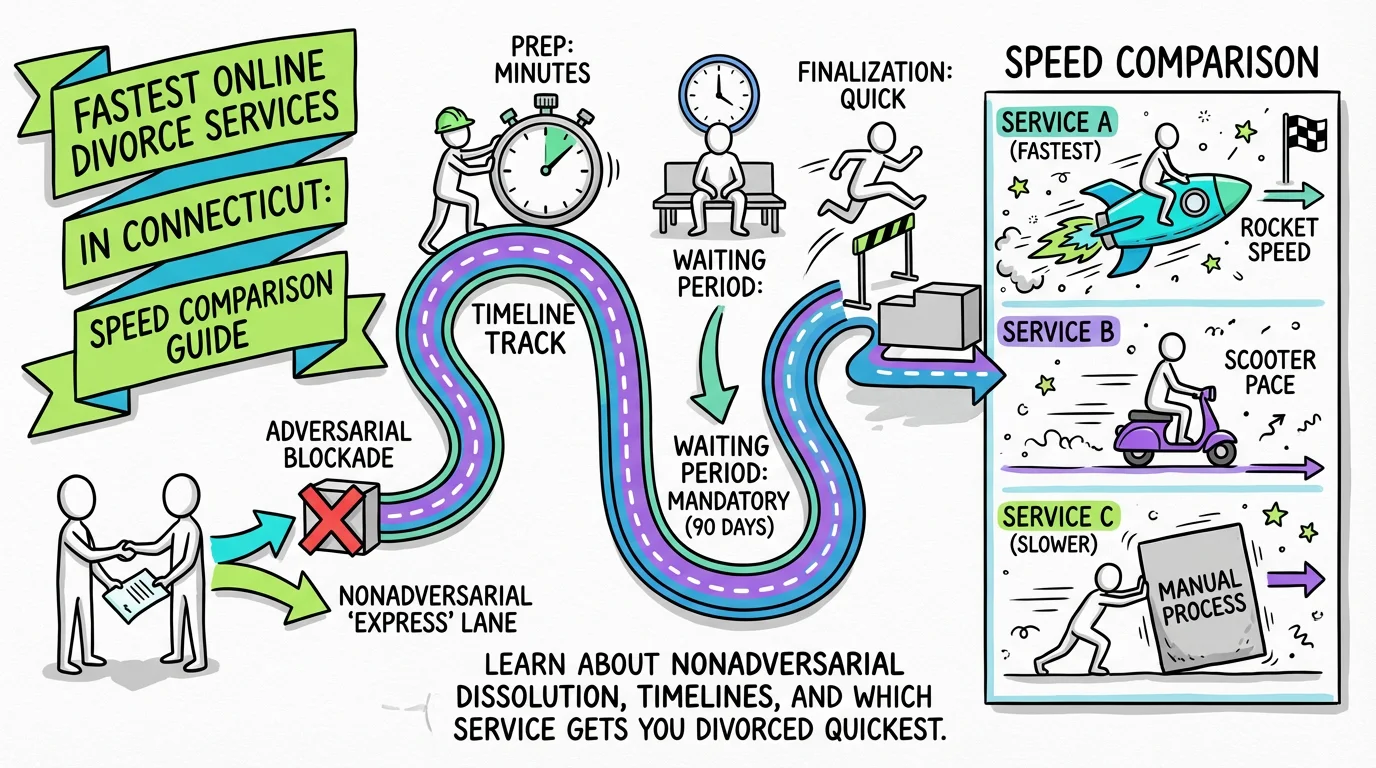
The fastest way to get divorced in Connecticut is through a nonadversarial dissolution, which can be finalized in as few as 30-35 days from filing—but only if you and your spouse fully agree on all terms. Online divorce services vary dramatically in how quickly they can get you to that filing point, with some completing document preparation in 24-48 hours while others take weeks. The key to speed isn't just which service you choose—it's whether your situation qualifies for Connecticut's expedited nonadversarial process and how quickly you can gather the required financial information.
Understanding Connecticut's Divorce Timeline Options
Connecticut offers two distinct divorce pathways with very different timelines. The traditional contested divorce process has a mandatory 90-day waiting period after the return date before the court can enter a judgment, meaning even the smoothest cases take at least three to four months. However, Connecticut's nonadversarial dissolution statute eliminates this waiting period entirely, allowing couples who agree on everything to receive their final decree just 30 days after filing their joint petition.
This nonadversarial process, established under C.G.S. § 46b-44a, requires both spouses to file together and attest under oath that they've agreed on all issues including property division, debt allocation, and if applicable, custody and support. The statute specifically states that the disposition date must be "not less than thirty days after the date on which the parties filed the joint petition." If the court reviews your settlement agreement and finds it fair and equitable, your divorce can be finalized on that disposition date or within five days after.
The catch? Most online divorce services are designed for the traditional process, not Connecticut's faster nonadversarial option. This means you could pay for document preparation only to discover you're locked into the slower timeline. Understanding which pathway you qualify for—and which services actually support the faster route—is essential for anyone prioritizing speed.
Online Divorce Service Speed Comparison
When evaluating online divorce services for Connecticut, speed depends on three factors: document preparation time, whether they support nonadversarial filing, and how much work you'll need to do yourself after receiving your paperwork. Here's how the main options compare:
| Service Type | Document Prep Time | Supports CT Nonadversarial | Total Time to Filing | Estimated Cost |
|---|---|---|---|---|
| Premium Online Services | 24-48 hours | Varies by provider | 2-7 days | $300-$500 |
| Standard Online Services | 3-7 days | Rarely | 1-2 weeks | $150-$300 |
| DIY Court Forms | Immediate download | Yes, if you know which forms | Same day possible | $0 (plus filing fees) |
| Guided Divorce Platforms | 1-3 days | Yes | 3-5 days | $200-$400 |
The fastest online services generate documents within 24-48 hours after you complete their questionnaire. However, speed at the document stage means nothing if those documents aren't correctly formatted for Connecticut courts or don't align with the nonadversarial process requirements. Connecticut requires specific forms including a notarized joint petition, sworn financial statements from both parties, and a comprehensive settlement agreement covering all marital issues.
Tools like Untangle's Financial affidavit generation can help you gather the required financial information quickly by organizing your assets, debts, and income in formats that translate directly to Connecticut's mandatory financial affidavit forms. Since completing accurate financial disclosures is often the biggest bottleneck in the divorce process, having your information pre-organized can shave days or even weeks off your timeline.
What Makes Connecticut's Nonadversarial Divorce So Fast
Connecticut's nonadversarial dissolution process is genuinely one of the fastest in the nation because it eliminates several time-consuming steps. Under C.G.S. § 46b-44c, the court can enter your divorce decree on the assigned disposition date—just 30 days after filing—if no notice of revocation has been filed and your settlement agreement passes judicial review. In many cases, you won't even need to appear in court.
The statute under C.G.S. § 46b-44d allows the court to review your settlement agreement on paper. If the judge determines your agreement is "fair and equitable," they can enter the decree without requiring either party to appear. This is a significant time-saver compared to traditional divorces, which require at least one court appearance and often multiple hearings. Only if the court cannot determine fairness from the paperwork alone will you be scheduled for an appearance within 30 days of the original disposition date.
To qualify for this expedited process, you must meet specific requirements at the time of filing: both parties must agree on all terms, at least one spouse must be a Connecticut resident, and neither party can be seeking alimony from the other (unless you've already agreed on alimony terms in your settlement). If you have minor children, you'll also need to include a complete parenting plan in your agreement. Any online service you choose should verify whether you qualify before processing your paperwork.
Critical Documents That Determine Your Speed
The biggest delay in online divorce isn't the service—it's you. Specifically, how quickly you can complete Connecticut's mandatory financial affidavit determines whether your 30-day timeline stays on track or gets extended. Practice Book Rule § 25-30 requires each party to file a sworn financial statement showing current income, expenses, assets, and liabilities. For nonadversarial dissolutions, these statements must be filed with your joint petition.
Connecticut offers two versions of the financial affidavit. The Short Form (JD-FM-006-Short) is available when neither party's net income exceeds $75,000 per year and total assets are less than $75,000. If you exceed either threshold, you'll need the Long Form, which requires significantly more detail. Completing these forms accurately requires gathering pay stubs, bank statements, retirement account balances, mortgage information, credit card statements, and tax returns.
This is where tools like Untangle's Complete asset inventory and Debt and liability tracking become invaluable for speed-seekers. Rather than scrambling to locate documents after you've already started the divorce process, you can use Untangle to compile and organize your financial picture in advance. The platform helps you categorize assets and debts, calculate net worth, and generate summaries that map directly to Connecticut's required disclosures. Couples who complete their financial inventory before starting the formal process consistently file faster than those who try to gather information reactively.

Try our free CT alimony calculator
Get an instant estimate based on Connecticut's statutory factors. No signup required.
Step-by-Step: The Fastest Path to Filing
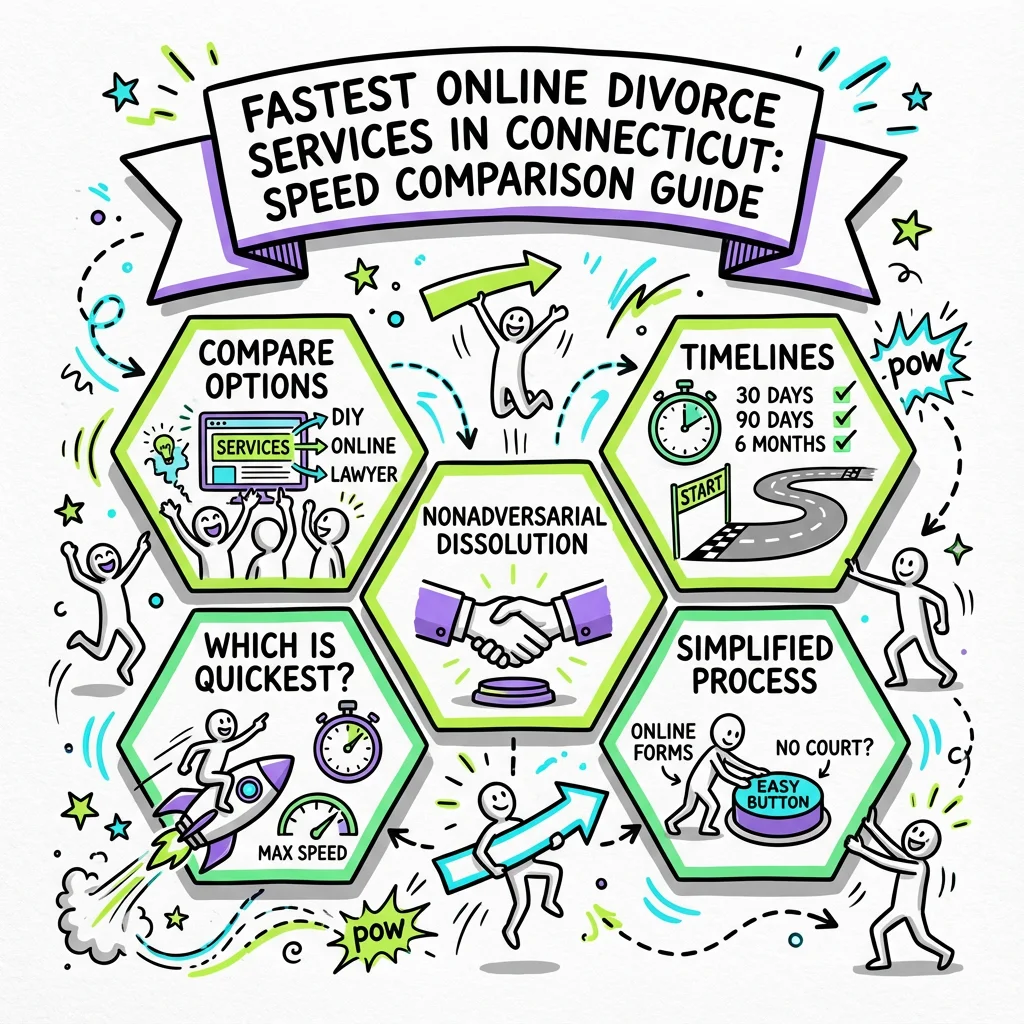
If speed is your priority, follow this optimized sequence to minimize delays:
-
Verify you qualify for nonadversarial dissolution - Confirm both spouses agree on all issues, at least one is a Connecticut resident, and you can meet the attestation requirements under C.G.S. § 46b-44a.
-
Complete your financial inventory first - Before touching any divorce paperwork, gather all financial documents and organize them by category. This is the step that delays most people.
-
Draft your settlement agreement - Your agreement must cover property division, debt allocation, and if applicable, custody, parenting time, and support. The more detailed and clear your agreement, the less likely the court will require an appearance.
-
Choose a service that supports nonadversarial filing - Not all online services prepare the joint petition format. Verify before paying that your service generates Connecticut-specific nonadversarial documents.
-
Complete both financial affidavits simultaneously - Both spouses need to complete their sworn statements. Coordinate to do this together rather than waiting for one to finish before the other starts.
-
Get documents notarized - The joint petition must be notarized. Many banks, UPS stores, and shipping centers offer notary services. Some online services now offer remote notarization options.
-
File with the correct judicial district - File in the district where either spouse resides. Incorrect filing location causes delays.
-
Wait for your disposition date - Per statute, this will be at least 30 days from filing. If your paperwork is complete and your agreement is fair, you may not need to do anything else.
To ensure you stay on track with all these steps and deadlines, especially when aiming for a fast-track divorce, tools like Untangle's Personalized task dashboard can help break down the entire process into clear, manageable tasks.
Hidden Speed Bumps to Avoid
Even with perfect preparation, certain issues can derail your fast-track divorce. Understanding these potential obstacles helps you avoid them:
Incomplete financial disclosures cause more delays than any other issue. If the court can't verify that both parties understand what they're agreeing to, they'll schedule a hearing. Double-check that every asset and debt is listed, even small accounts.
Vague settlement agreements trigger judicial review. Phrases like "we'll split things fairly" don't satisfy the court. Your agreement needs specific dollar amounts, specific property items, and clear timelines for any transfers or payments.
Missing signatures or notarization will get your petition rejected. The joint petition requires both parties' notarized signatures. Some couples file with only one signature notarized, causing an automatic rejection and restart of the timeline.
Revocation by either party stops everything. Under C.G.S. § 46b-44b, either spouse can revoke the joint petition at any time before the decree is entered simply by filing a notice with the court. If this happens, the case converts to a traditional dissolution action with the full 90-day waiting period.
Using Untangle's Automatic document generation can help you create a settlement agreement with the specificity courts require. The platform prompts you to address all required issues and helps ensure nothing is overlooked—avoiding the delays that come from incomplete agreements.
When Fast Isn't Possible: Understanding Your Alternatives
Some situations simply don't qualify for the fastest divorce pathway, and recognizing this early saves time in the long run. If you and your spouse disagree on any significant issue—property division, custody, support—you cannot use the nonadversarial process. You'll need to file a traditional dissolution action, which has a minimum 90-day waiting period under C.G.S. § 46b-67.
For traditional dissolutions, Connecticut uses a case management system called Pathways, outlined in Practice Book Rule § 25-50A. Within 30-60 days of your return date, you'll meet with a family relations counselor who evaluates your case complexity and assigns you to Track A (minimal court involvement), Track B (moderate complexity), or Track C (complex cases requiring significant judicial oversight). Track A cases can still resolve relatively quickly if you reach agreement during the process.
If you're not sure whether you and your spouse can agree on terms, Untangle's AI-assisted mediation tools let you share and negotiate settlement options before filing. This pre-filing negotiation can help you determine whether nonadversarial dissolution is realistic or whether you should prepare for a traditional timeline. Sometimes a few weeks of structured negotiation saves months of litigation.
When to Get Professional Help
While online divorce services and DIY approaches work well for straightforward cases, certain situations benefit from professional guidance even when speed is the priority. If you have significant assets, own a business together, have complex custody arrangements, or suspect your spouse may be hiding assets, the time saved by skipping professional review often costs more in the long run.
Consider consulting with a Connecticut family law attorney if your combined assets exceed $100,000, if either spouse has retirement accounts or pensions, if you own real estate beyond a primary residence, or if there's any history of domestic violence. Many attorneys offer unbundled services where they review your documents without handling the entire case—a middle ground that adds only a few days to your timeline while providing valuable protection. The goal isn't just a fast divorce; it's a fast divorce that protects your interests and doesn't require expensive modifications later.
Frequently Asked Questions
What is the fastest way to get divorced in Connecticut?
The fastest way to get divorced in Connecticut is through a nonadversarial dissolution, which can be finalized in as few as 30-35 days from filing if both spouses fully agree on all terms.
How long does an online divorce take in CT compared to hiring an attorney?
Online divorce services can prepare your documents in 24-48 hours, but the total timeline depends on whether you qualify for Connecticut's 30-day nonadversarial process or the standard 90-day contested divorce waiting period.
What is Connecticut's nonadversarial dissolution and how does it work?
Connecticut's nonadversarial dissolution under C.G.S. § 46b-44a allows couples who agree on all divorce terms to file a joint petition and receive their final decree in just 30 days, bypassing the traditional 90-day waiting period.
Do online divorce services work for Connecticut's expedited nonadversarial process?
Most online divorce services are designed for the traditional contested process, not Connecticut's faster nonadversarial dissolution, so you should verify the service supports this option before purchasing.
What do I need to qualify for a fast uncontested divorce in Connecticut?
To qualify for Connecticut's expedited nonadversarial dissolution, both spouses must file together and agree under oath on all issues including property division, debt allocation, custody, and support.
Legal Citations
- • C.G.S. § 46b-44a - Filing of joint petition for nonadversarial dissolution of marriage View Source
- • C.G.S. § 46b-44b - Revocation of joint petition for nonadversarial dissolution of marriage View Source
- • C.G.S. § 46b-44c - Disposition of nonadversarial dissolution of marriage View Source
- • C.G.S. § 46b-44d - Review of settlement agreement in nonadversarial dissolution View Source
- • C.G.S. § 46b-67 - Time frame for court to proceed in dissolution action View Source
- • Practice Book Rule § 25-30 - Statements To Be Filed View Source
- • Practice Book Rule § 25-50A - Case Management under Pathways View Source
- • JD-FM-006-Short - Financial Affidavit Short Form View Source