How Untangle Helps with Asset Division in Connecticut Divorce
Learn how Untangle simplifies asset division in Connecticut divorce, helping you organize finances, understand equitable distribution, and prepare for fair property settlements.

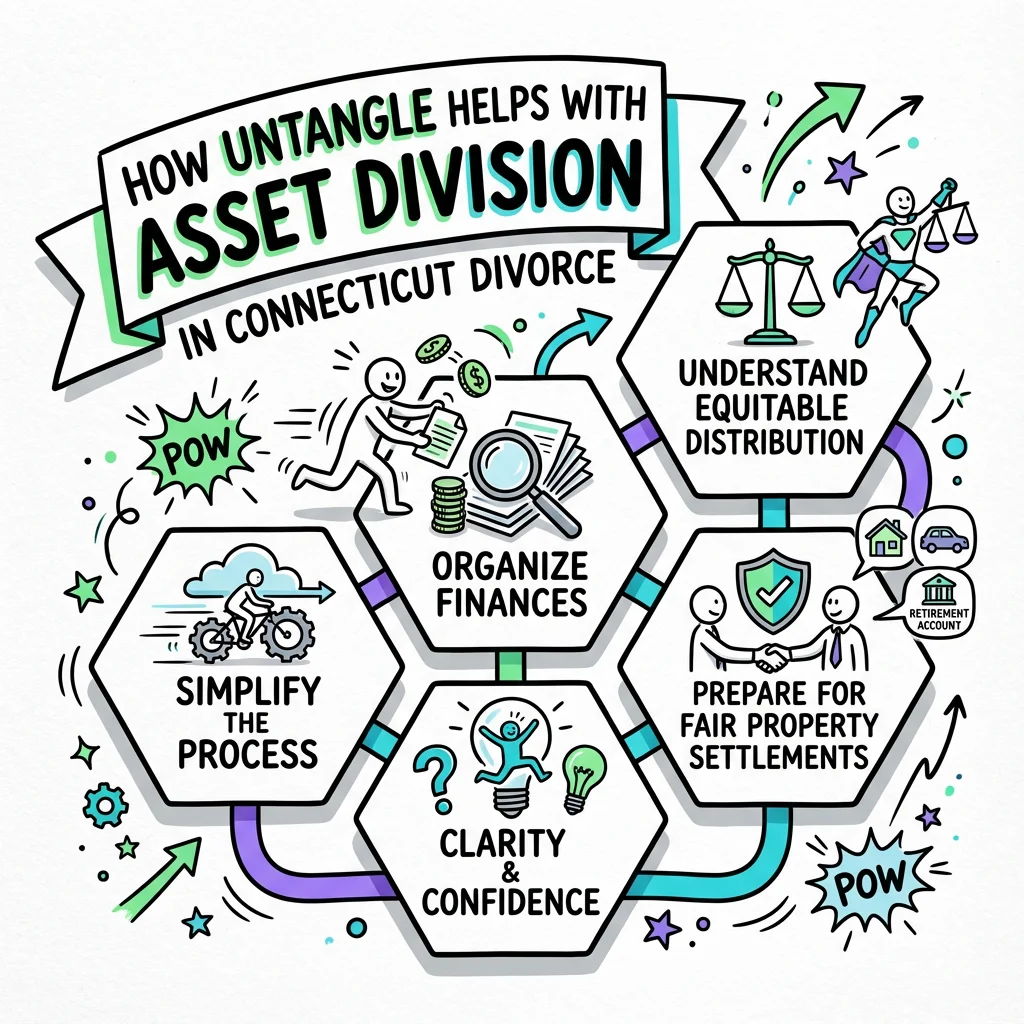
Yes, Untangle provides comprehensive support for asset division during Connecticut divorce proceedings. The platform helps you organize your complete financial picture, categorize marital versus separate property, understand Connecticut's equitable distribution framework, and prepare the documentation courts require under C.G.S. § 46b-81. Whether you're worried about getting a fair share of retirement accounts, real estate equity, or business interests, Untangle's tools guide you through each step of the property division process with clarity and confidence.
Understanding Asset Division in Connecticut
Connecticut follows an "equitable distribution" model for dividing marital property, which means the court aims for a fair—but not necessarily equal—division of assets. Under C.G.S. § 46b-81, the Superior Court has broad authority to "assign to either spouse all or any part of the estate of the other spouse" when dissolving a marriage. This includes the power to transfer title to real property, order sales, and divide retirement accounts, investments, and other assets accumulated during the marriage.
What makes Connecticut unique is that courts can consider both marital and separate property when making distribution decisions. This "all-property" approach means that even assets you brought into the marriage or inherited could potentially be subject to division, though the source of assets is one factor the court weighs. The statute directs judges to consider factors including the length of marriage, causes for dissolution, each spouse's age and health, occupation, employability, and the opportunity for future acquisition of capital assets.
For someone anxious about financial stability after divorce, understanding this framework is essential. The court's goal is fairness based on your specific circumstances—not a simple 50/50 split. This means thorough documentation of all assets, their values, and their origins becomes critical to achieving an equitable outcome. Tools like Untangle's complete asset inventory can help you build this complete picture systematically.
How Untangle Organizes Your Financial Picture
One of the biggest challenges in asset division is simply knowing what you have. Couples often accumulate accounts, properties, and investments over years or decades without maintaining a consolidated view. Untangle addresses this by providing a centralized platform where you can inventory every asset, from checking accounts to real estate to retirement funds.
The platform guides you through categorizing assets as marital or separate property—a distinction that matters significantly in Connecticut courts. While the "all-property" rule means everything could theoretically be divided, assets clearly traceable to pre-marital ownership or inheritance typically receive different treatment than jointly accumulated wealth. Untangle helps you document the provenance of each asset, which becomes valuable evidence if you need to argue for a particular distribution.
Beyond simple organization, Untangle helps you understand asset values and how they might be divided. The recent Connecticut case Marzaro v. Marzaro reinforced that even assets held in revocable trusts with both parties as cotrustees can be subject to equitable distribution under § 46b-81. This illustrates why comprehensive asset tracking matters—you need to account for property held in various legal structures, not just what's in your individual name.
Meeting Connecticut's Mandatory Disclosure Requirements
Connecticut Practice Book Rule § 25-32 requires extensive financial disclosure within 60 days of a request in any dissolution action. This mandatory disclosure includes federal and state tax returns for the past three years, all W-2s, 1099s, and K-1 forms, current pay stubs, and statements for every financial institution account for the past 24 months. The list continues with retirement account statements, life insurance policies, business valuations, and more.
This disclosure requirement exists because courts cannot make fair decisions without complete financial information. Under Rule § 25-30, each party must file a sworn financial statement showing current income, expenses, assets, and liabilities at least five business days before any hearing involving alimony or property division. Updated statements are required within 30 days before final judgment.
Tools like Untangle's smart bank statement analysis can help you compile these required disclosures systematically. Rather than scrambling to locate bank statements and tax returns, you can build your financial file progressively, ensuring nothing gets missed. The platform also helps you understand what each disclosure category means, reducing anxiety about whether you've provided everything the court needs.
Preparing Your Financial Affidavit
The Financial Affidavit is arguably the most important document in property division. Connecticut offers two versions: the Short Form (JD-FM-006) for cases where neither party's net income exceeds $75,000 annually and total assets are below $75,000, and the Long Form for higher-asset cases. This sworn statement becomes the foundation for court decisions about how to divide your marital estate.
Completing this form accurately requires knowing your complete financial situation—every account balance, every debt, every monthly expense. Errors or omissions can undermine your credibility with the court and potentially result in an unfair distribution. The process of gathering this information often reveals assets one spouse didn't know about or debts that weren't fully understood.
Untangle walks you through each section of the Financial Affidavit, helping ensure nothing gets overlooked. The platform prompts you to consider categories you might not think of independently—does your employer offer stock options? Do you have a pension with a current value? What about cryptocurrency or collectibles? By systematically covering all asset categories, Untangle's financial affidavit generation feature helps you present a complete and accurate financial picture.
What Assets Are Subject to Division?
Understanding which assets courts typically divide helps reduce anxiety about the process. Connecticut courts have broad discretion, but certain asset categories receive particular attention in most divorces.
| Asset Category | Common Division Approaches | Key Considerations |
|---|---|---|
| Marital Home | Sell and split proceeds, buyout, or deferred sale | Mortgage balance, market value, children's needs |
| Retirement Accounts | QDRO to divide 401(k)/pension, split IRAs | Tax implications, vesting schedules |
| Bank/Investment Accounts | Direct division based on values | Account ownership, source of funds |
| Business Interests | Buyout, ongoing percentage, or sale | Valuation complexity, liquidity concerns |
| Vehicles | One spouse keeps each, value offset | Loan balances, depreciation |
| Debts | Divided considering who benefited | Credit card debt, mortgages, loans |
The Ferri v. Powell-Ferri case demonstrates how Connecticut courts handle complex asset situations involving trusts and business interests. Courts examine not just legal ownership but practical control and benefit when determining what should be divided. Untangle helps you think through these nuances by organizing assets with relevant details about how they're titled, who contributed, and how they've been used.
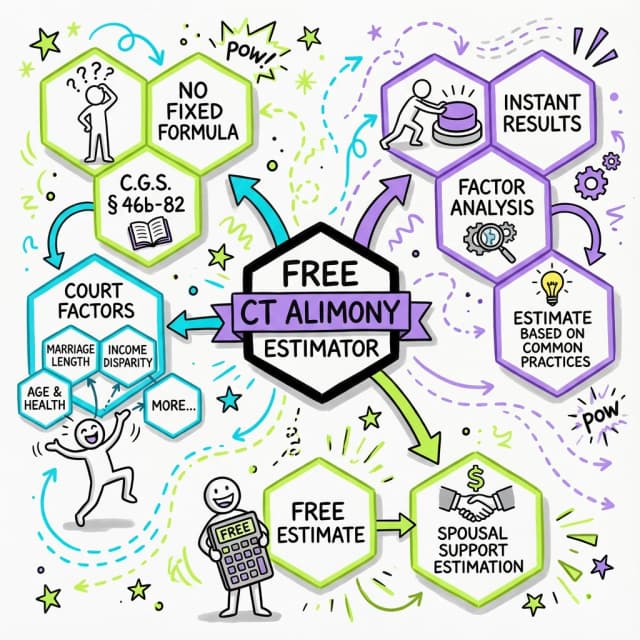
Try our free CT alimony calculator
Get an instant estimate based on Connecticut's statutory factors. No signup required.
Automatic Orders and Asset Protection
Once a divorce action begins, Connecticut's Automatic Orders (Practice Book Rule § 25-5) immediately restrict what either spouse can do with marital assets. These orders prohibit selling, transferring, encumbering, or disposing of property except for reasonable living expenses, existing business obligations, or with written consent of the other party or court approval.
These protective orders exist to prevent one spouse from hiding or dissipating assets before division occurs. Violating automatic orders can result in court sanctions and affect how the judge views your credibility. Understanding these restrictions is essential—you cannot empty bank accounts, transfer property to family members, or cancel insurance policies once divorce proceedings begin.
Untangle's AI legal guidance helps you understand exactly what actions are permitted and prohibited under automatic orders. The platform also helps you document the status of assets at the time of filing, creating a baseline that can be important if disputes arise about asset dissipation during the divorce process.
Steps to Prepare for Asset Division
Proper preparation significantly impacts how smoothly asset division proceeds. Following a systematic approach helps ensure you're ready for negotiations or court proceedings.
-
Inventory all assets and debts - List every account, property, and obligation you're aware of. Include retirement accounts, investment portfolios, real estate, vehicles, valuables, and business interests. Don't forget digital assets, reward points, or prepaid balances.
-
Gather supporting documentation - Collect statements for all accounts going back at least 24 months, as required by Connecticut disclosure rules. Obtain deeds, titles, loan documents, and tax returns. The more documentation you have, the stronger your position.
-
Determine asset values - Some values are straightforward (bank account balances), while others require appraisal (real estate, businesses, collectibles). Retirement accounts need current statements showing vested balances. Understanding values helps you evaluate proposed settlements.
-
Classify marital versus separate property - Document which assets you brought into the marriage, inherited, or received as gifts. While Connecticut's all-property rule means these could still be divided, their source matters in determining what's "equitable."
-
Identify your priorities - What assets matter most to your financial security and emotional wellbeing? The marital home might be important if you're keeping children stable, while retirement accounts might matter more for long-term security.
-
Calculate your post-divorce budget - Understanding what you'll need financially helps you evaluate whether proposed divisions are sustainable. Untangle's expense tracking with AI can help you project expenses in your new single-household reality.
When Professional Help Is Essential
While Untangle provides powerful tools for organizing your asset division preparation, certain situations require professional expertise. If your marital estate includes business interests requiring valuation, complex investment portfolios, pension plans needing Qualified Domestic Relations Orders (QDROs), or significant real estate holdings, working with attorneys, CPAs, or financial analysts becomes important.
Cases involving suspected hidden assets present particular challenges. Under C.G.S. § 46b-66, when parties submit a final agreement, the court must "inquire into the financial resources and actual needs of the parties" to ensure the settlement is fair. If you suspect your spouse hasn't disclosed everything, forensic accountants and discovery tools available through legal representation become necessary.
Untangle helps you identify when professional help is needed by highlighting complexity in your financial situation. The platform also helps you prepare for professional consultations by organizing your documents and questions in advance—making attorney time more efficient and cost-effective. For straightforward situations, Untangle's tools may be sufficient for preparation, while complex estates benefit from using the platform alongside professional guidance.
Reaching Fair Settlements
Most Connecticut divorces settle without trial, and C.G.S. § 46b-66 establishes the framework for court review of settlement agreements. The court must determine that any agreement regarding "alimony or the disposition of property" is fair and equitable before incorporating it into the divorce decree. Under C.G.S. § 46b-44d, if the court cannot determine whether a settlement agreement is fair, the matter gets docketed for further review.
This court oversight protects both parties, but it also means your settlement must be well-reasoned and documented. Judges want to see that both spouses understood what they were agreeing to and that the division makes sense given the circumstances. Having organized financial information and clear rationale for your proposed division strengthens your settlement's chances of approval.
Untangle's spouse financial comparison tool can help you model different division scenarios, understanding how various approaches affect your long-term financial position. This empowers you to negotiate from an informed position rather than accepting proposals you don't fully understand. When you can clearly see how a proposed division impacts your retirement security, housing stability, or cash flow needs, you make better decisions about what to accept, counter, or reject.
Frequently Asked Questions
What assets are subject to division in a Connecticut divorce?
Connecticut follows an "all-property" approach, meaning both marital and separate property—including assets brought into the marriage or inherited—can potentially be divided by the court under C.G.S. § 46b-81.
Does Connecticut split assets 50/50 in divorce?
No, Connecticut follows "equitable distribution," which means the court divides assets fairly based on factors like marriage length, each spouse's earning capacity, and health—but not necessarily equally.
How do I organize my financial documents for asset division in CT?
Untangle helps you categorize and organize all financial records, distinguish marital from separate property, and prepare the documentation Connecticut courts require for equitable distribution proceedings.
What factors do Connecticut courts consider when dividing property?
Under C.G.S. § 46b-81, courts consider factors including the length of marriage, causes for dissolution, each spouse's age, health, occupation, employability, and opportunity for future asset acquisition.
Can inherited property be divided in a Connecticut divorce?
Yes, because Connecticut uses an all-property approach, inherited assets can potentially be subject to division, though the source of the property is one factor the court considers when determining a fair distribution.
Legal Citations
- • C.G.S. § 46b-81 - Assignment of property and transfer of title View Source
- • C.G.S. § 46b-66 - Review of final agreement; incorporation into decree View Source
- • C.G.S. § 46b-66a - Order of court re conveyance of title to real property View Source
- • C.G.S. § 46b-44d - Review of settlement agreement in nonadversarial dissolution View Source
- • Connecticut Practice Book Rule § 25-32 - Mandatory Disclosure and Production View Source
- • Connecticut Practice Book Rule § 25-30 - Statements To Be Filed View Source
- • Connecticut Practice Book Rule § 25-5 - Automatic Orders upon Service of Complaint View Source
- • Marzaro v. Marzaro, 231 Conn. App. 85 View Source
- • Ferri v. Powell-Ferri, 213 Conn. App. 841 View Source
- • Financial Affidavit Short Form (JD-FM-006) View Source