Military Divorce in Connecticut: How Untangle Handles Your Unique Needs
Learn how Untangle supports military divorces in Connecticut, addressing USFSPA, deployment custody, military benefits division, and federal regulations unique to service members.
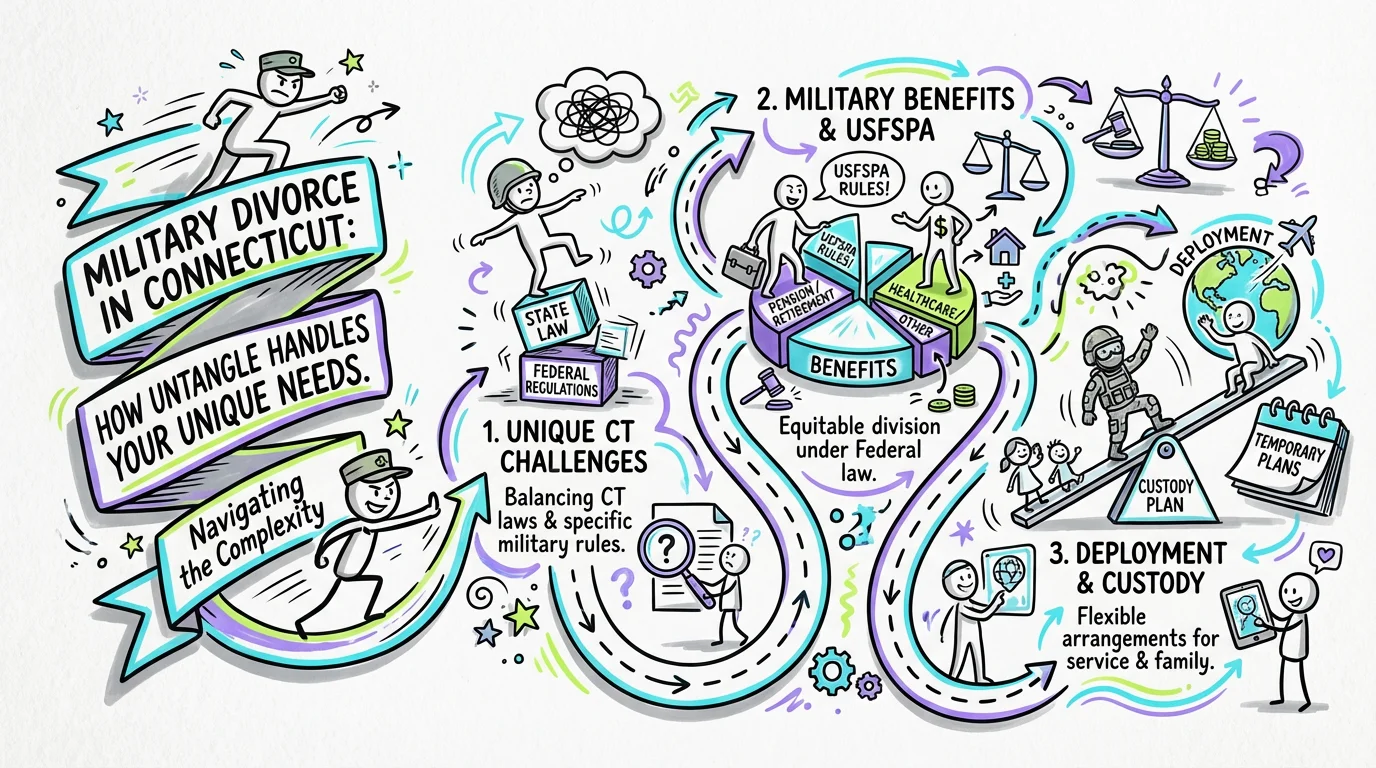
Yes, Untangle is specifically designed to handle military divorces in Connecticut, addressing the unique federal regulations, benefits considerations, and deployment-related custody issues that military families face. Our platform guides you through both Connecticut state divorce law and the federal requirements under the Uniformed Services Former Spouses' Protection Act (USFSPA), the Servicemembers Civil Relief Act (SCRA), and military-specific pension division rules that civilian divorce tools often overlook.
Why Military Divorces Require Specialized Support
Military divorces involve a complex intersection of state and federal law that most divorce resources aren't equipped to handle. While Connecticut courts follow standard dissolution procedures, military families must navigate additional layers including the 10/10/10 rule for direct pension payments, Survivor Benefit Plan (SBP) elections, TRICARE eligibility requirements, and the proper division of Thrift Savings Plan (TSP) accounts. Getting any of these wrong can cost you thousands of dollars in benefits you're entitled to receive.
Connecticut courts have jurisdiction over military divorces when residency requirements are met. Under C.G.S. § 46b-44, a divorce complaint may be filed once either party has established residence in the state—meaning if you're stationed elsewhere but your spouse lives in Connecticut, you may still file here. This flexibility is particularly important for military families who may have connections to multiple states.
The financial stakes in military divorce are significant. Connecticut courts have addressed the division of military education benefits, with recent cases like Wald v. Cortland-Wald examining whether G.I. Bill benefit transfers should be considered in property division. Understanding how Connecticut law treats these military-specific assets is essential for protecting your financial future.
How Untangle Addresses Military-Specific Issues
Military Pension Division and the 10/10/10 Rule
One of the most valuable assets in a military divorce is the service member's retirement pay. Under the USFSPA, Connecticut courts can treat military retirement as marital property subject to division. However, the method of division and payment depends on your specific circumstances.
The "10/10/10 rule" determines whether the Defense Finance and Accounting Service (DFAS) will make direct payments to the former spouse. To qualify, the marriage must have lasted at least 10 years, with at least 10 of those years overlapping with 10 years of creditable military service. If you don't meet this threshold, you're still entitled to your share—it just means the service member must make the payments directly rather than through DFAS.
Untangle's asset disclosure tools help you calculate your portion of military retirement using the "marital fraction" method, which divides the months of marriage during military service by the total months of creditable service. We also guide you through preparing the military pension division order (often called a "deemed" or direct payment order) that DFAS requires, ensuring the language meets federal specifications that Connecticut courts may not automatically include.
Deployment and Custody Considerations
Connecticut has specific protections for military parents facing deployment. Under C.G.S. § 46b-56e, courts can issue temporary custody or visitation orders when a parent receives deployment orders. This statute covers all branches including the Army, Navy, Marine Corps, Coast Guard, Air Force, Space Force, and reserve components including the Connecticut National Guard.
The law recognizes that deployment—defined as military service in compliance with orders to report for combat operations, contingency operations, peacekeeping operations, or similar assignments—shouldn't permanently alter custody arrangements. Courts can modify orders temporarily during deployment and address how the deploying parent can maintain contact with children through technology and leave time.
Untangle helps military families create detailed parenting plans that anticipate deployment scenarios. Our parenting plan tools include provisions for virtual visitation schedules, designated caregivers who can exercise time on behalf of the deployed parent, and automatic reinstatement clauses when deployment ends. This proactive planning helps avoid emergency court filings when orders come through.
Military Benefits and Healthcare Coverage
TRICARE eligibility for former spouses follows the "20/20/20" and "20/20/15" rules, which determine whether you can retain military healthcare coverage after divorce. Under the 20/20/20 rule, a former spouse qualifies for full TRICARE benefits if the marriage lasted at least 20 years, the service member performed at least 20 years of creditable service, and there was at least 20 years of overlap between the marriage and military service.
If you meet the 20/20/15 threshold (15 years of overlap instead of 20), you're entitled to one year of transitional TRICARE coverage. Understanding which category you fall into—or if you don't qualify at all—is crucial for planning your post-divorce healthcare needs.
Connecticut's child support guidelines specifically include "military personnel fringe benefit payments" as gross income under C.G.S. § 46b-215a-1(11)(A)(vii). This means Basic Allowance for Housing (BAH), Basic Allowance for Subsistence (BAS), and other military allowances must be considered when calculating support obligations. Untangle's child support calculator incorporates these military-specific income sources to provide accurate estimates.
Key Documents for Connecticut Military Divorce
| Document | Purpose | Military Considerations |
|---|---|---|
| Divorce Complaint (JD-FM-159) | Initiates dissolution | Include military status for SCRA compliance |
| Financial Affidavit | Discloses income/assets | Must include all military pay and allowances |
| Child Support Worksheet (CCSG-001) | Calculates support | Include BAH, BAS, and fringe benefits |
| Affidavit Concerning Children (JD-FM-164) | Documents custody information | Note any pending deployment orders |
| Military Pension Division Order | Divides retirement pay | Must meet DFAS language requirements |
| SBP Election Form | Survivor benefits | Deadline-sensitive; must be filed within 1 year |
Try our free CT child support calculator
Calculate your estimated child support using Connecticut's official guidelines formula.
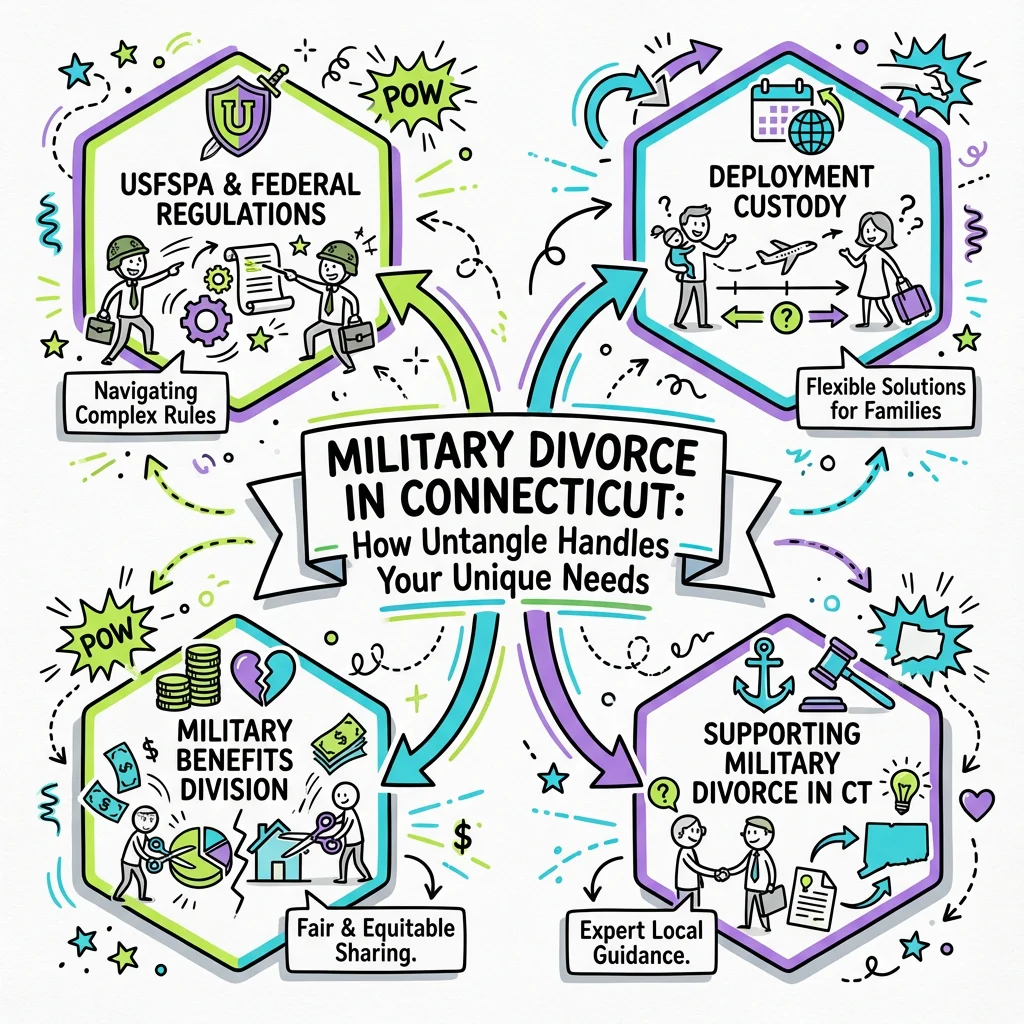
Steps to Complete Your Military Divorce in Connecticut
-
Verify jurisdiction and residency - Confirm that either you or your spouse meets Connecticut's residency requirements under C.G.S. § 46b-44. Military members may claim residency based on their home of record or current duty station state.
-
Gather military-specific financial documents - Collect Leave and Earnings Statements (LES), retirement point statements (for reservists), TSP account statements, and any records related to military benefits. These documents are essential for accurate property division. Tools like Untangle's Financial affidavit generation can help ensure all military pay and allowances, including BAH and BAS, are correctly disclosed on your official forms.
-
Determine benefit eligibility thresholds - Calculate your marriage overlap with military service to determine DFAS direct payment eligibility (10/10/10), TRICARE coverage (20/20/20 or 20/20/15), and commissary/exchange privileges.
-
File the appropriate complaint - Use the Summons Family Actions (JD-FM-003) and Divorce Complaint (JD-FM-159) if contested, or the Joint Petition (JD-FM-242) for an uncontested nonadversarial divorce. Include the Notice of Automatic Court Orders (JD-FM-158).
-
Comply with SCRA requirements - The Servicemembers Civil Relief Act provides active-duty members protection from default judgments. Proper service and, if necessary, a request for stay, must follow federal procedures.
-
Draft military-compliant orders - Ensure your final divorce decree includes pension division language that DFAS will accept, SBP election requirements, and any deployment-related custody provisions.
-
File with military finance offices - After the divorce is final, submit the certified court order to DFAS, your TSP, and any other relevant military agencies to implement the division.
Cost and Timeline Comparison
| Divorce Type | Typical Cost | Timeline | Complexity |
|---|---|---|---|
| Uncontested civilian | $500-$2,000 | 90 days minimum | Low |
| Uncontested military | $800-$3,000 | 90-120 days | Moderate |
| Contested civilian | $5,000-$25,000+ | 6-18 months | High |
| Contested military | $10,000-$40,000+ | 8-24 months | Very High |
The additional costs in military divorces typically come from specialized pension valuation, preparation of military-compliant orders, and coordination with federal agencies. Using Untangle's guided process can significantly reduce these costs by helping you organize documents, calculate divisions, and prepare draft agreements before involving attorneys.
When to Seek Additional Legal Help
While Untangle can guide you through most aspects of a military divorce, certain situations benefit from attorney involvement. If your spouse is a high-ranking officer with substantial retirement benefits, the pension division alone may justify hiring a military divorce specialist. Cases involving disability retirement pay (which has different division rules than regular retirement) also require careful legal analysis.
Connecticut courts have shown willingness to address complex military benefit issues. In Wald v. Cortland-Wald, the Appellate Court examined agreements involving the transfer of G.I. Bill benefits, demonstrating that these military-specific assets are subject to court scrutiny during dissolution. If you're dealing with education benefits, combat-related special compensation, or concurrent retirement and disability pay (CRDP), professional guidance helps ensure you receive your fair share.
For most military couples who can agree on major issues, Untangle provides the structure and military-specific guidance needed to complete your Connecticut divorce efficiently. Our platform helps you avoid common mistakes—like using pension division language that DFAS will reject, or missing the one-year deadline to request SBP coverage—that can cost military families significant benefits. By understanding both Connecticut law and federal military regulations, you can navigate this process with confidence.
Frequently Asked Questions
What is the 10/10/10 rule for military divorce in Connecticut?
The 10/10/10 rule requires at least 10 years of marriage overlapping with 10 years of military service for a former spouse to receive direct pension payments from the Defense Finance and Accounting Service (DFAS).
Can I file for divorce in Connecticut if my spouse is deployed overseas?
Yes, you can file for divorce in CT if you meet residency requirements, but the Servicemembers Civil Relief Act (SCRA) allows deployed service members to request a stay of proceedings until they can participate.
How does Untangle calculate military pension division in a Connecticut divorce?
Untangle guides you through military pension division using Connecticut's equitable distribution rules and federal USFSPA requirements, including the proper formulas for dividing retirement benefits earned during the marriage.
Does my ex-spouse keep TRICARE benefits after our military divorce in CT?
Your ex-spouse may retain TRICARE benefits under the 20/20/20 rule if you were married at least 20 years, with 20 years of creditable military service overlapping the marriage.
What makes military divorce apps different from regular divorce tools?
Military divorce apps like Untangle address federal requirements civilian tools overlook, including Survivor Benefit Plan elections, TSP division, G.I. Bill considerations, and compliance with the Uniformed Services Former Spouses' Protection Act.
Legal Citations
- • Wald v. Cortland-Wald, 226 Conn. App. 752 View Source
- • JD-FM-159 - Divorce Complaint (Dissolution of Marriage) View Source
- • JD-FM-006-Short - Financial Affidavit Short Form View Source
- • CCSG-001 - Worksheet for Child Support and Arrearage Guidelines View Source
- • JD-FM-164 - Affidavit Concerning Children View Source
- • JD-FM-003 - Summons Family Actions View Source
- • JD-FM-242 - Joint Petition - Nonadversarial Divorce View Source
- • JD-FM-158 - Notice of Automatic Court Orders View Source