Does Untangle Handle All Uncontested Divorce Paperwork in Connecticut?
Learn how Untangle helps you prepare all Connecticut uncontested divorce paperwork, from joint petitions to settlement agreements, for a smooth collaborative process.
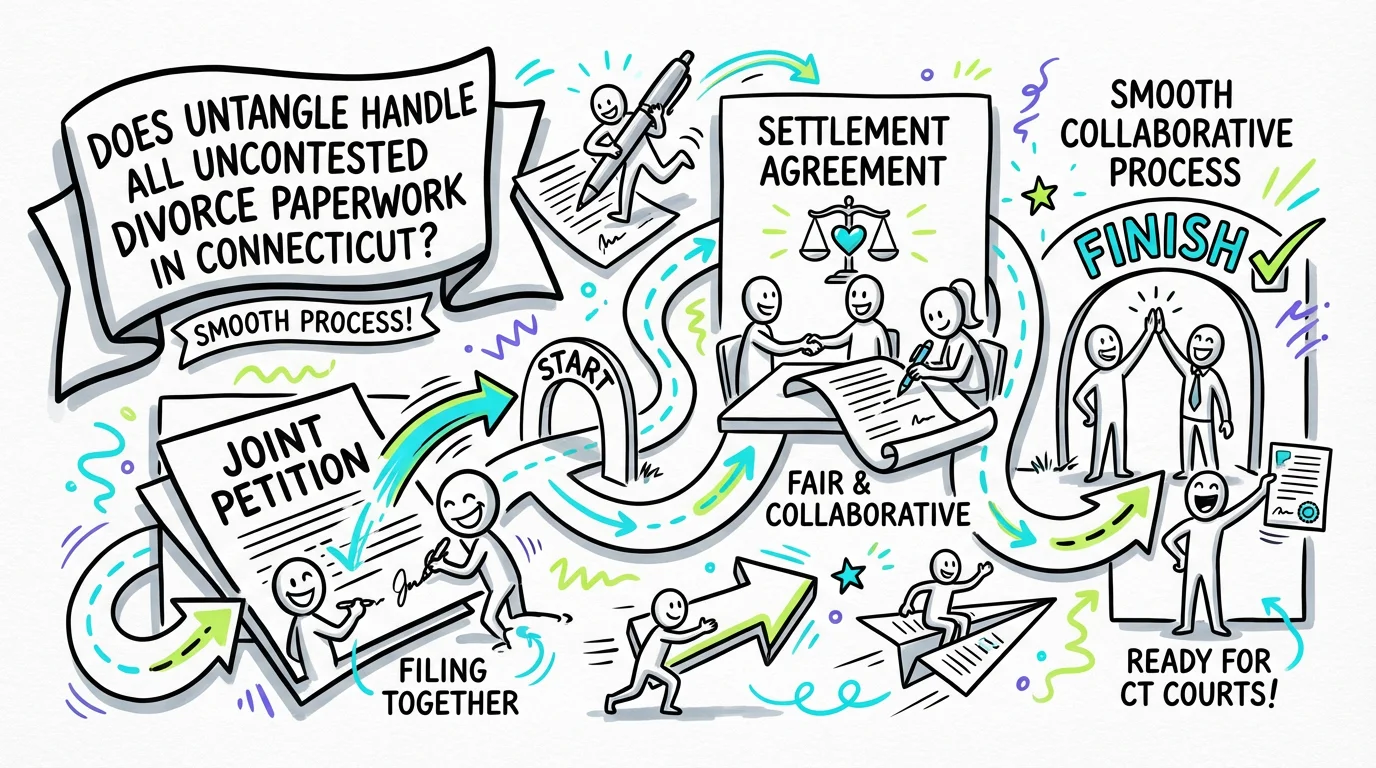
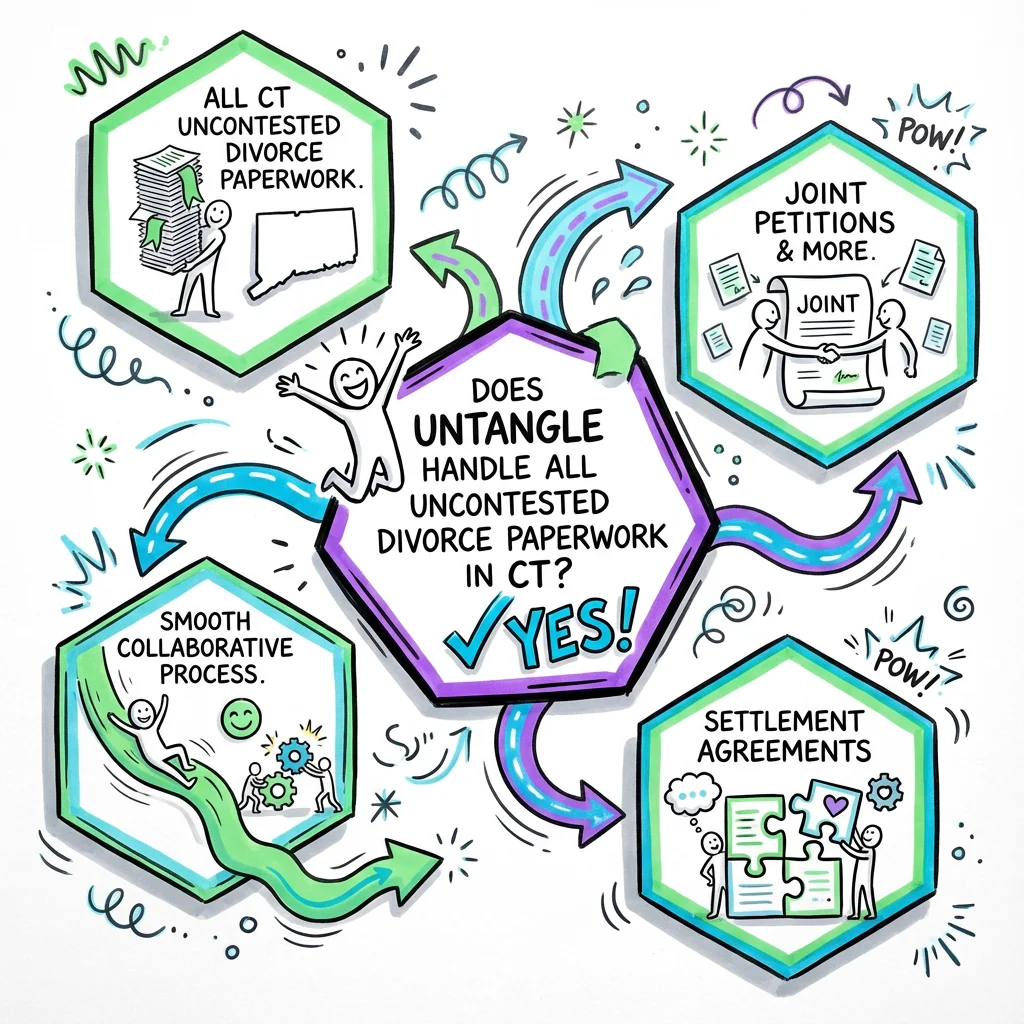
Yes, Untangle helps you prepare all the essential paperwork required for an uncontested divorce in Connecticut. When both spouses agree on the terms of their divorce, Untangle guides you through creating your joint petition, financial affidavits, settlement agreement, and other required court documents—everything you need to file for a nonadversarial dissolution under Connecticut law. While Untangle prepares your documents, you'll still need to file them with the court yourself and ensure they meet all legal requirements for your specific situation.
Understanding Connecticut's Uncontested Divorce Process
Connecticut offers a streamlined path for couples who agree on all aspects of their divorce, officially called a "nonadversarial dissolution of marriage." Under C.G.S. § 46b-44a, you and your spouse can file a joint petition rather than having one spouse serve papers on the other. This collaborative approach reflects your mutual decision to end the marriage amicably and typically results in a faster, less expensive process.
To qualify for Connecticut's nonadversarial dissolution, both parties must attest under oath that they meet specific conditions at the time of filing. The joint petition must be notarized and filed in the judicial district where either spouse resides. This process eliminates the adversarial dynamics of traditional divorce filings, where one party is the "plaintiff" and the other the "defendant."
The Connecticut courts assign uncontested cases a disposition date not less than thirty days after filing, as specified in C.G.S. § 46b-44c. If neither party files a notice of revocation before that date, and the court determines your settlement agreement is fair and equitable, a decree of dissolution can be entered without either spouse appearing in court. This efficiency is one of the greatest benefits of an amicable divorce—but it only works when your paperwork is complete and accurate from the start.
The Complete List of Required Documents
Connecticut uncontested divorces require several interconnected documents that must work together seamlessly. Missing or inconsistent information across forms is one of the most common reasons courts delay or reject filings. Here's what you'll need:
| Document | Purpose | Form Number |
|---|---|---|
| Joint Petition | Initiates the nonadversarial dissolution | JD-FM-159 (modified for joint filing) |
| Summons | Official notice document | JD-FM-003 |
| Financial Affidavit | Discloses income, assets, and expenses | JD-FM-006 (short form if income/assets under $75,000) |
| Notice of Automatic Court Orders | Acknowledges property/insurance restraints | JD-FM-158 |
| Settlement Agreement | Details all terms of your divorce | Custom document |
| Child Support Worksheet | Calculates support obligations | CCSG-001 (if children involved) |
| Certificate of Compliance | Confirms completion of requirements | JD-FM-175 |
Each spouse must complete their own financial affidavit, sworn under oath, disclosing their complete financial picture. Practice Book Rule § 25-5B requires these sworn financial statements to be filed with your joint petition. The automatic orders—covering property transfers, insurance policies, and other protections—take effect immediately upon filing because both parties file jointly.
Untangle's automatic document generation helps ensure consistency across all your forms. When you enter information once, it populates across related documents, reducing errors and saving you hours of redundant data entry.
Creating Your Settlement Agreement
The settlement agreement is the heart of your uncontested divorce. This document captures everything you and your spouse have agreed upon—property division, debt allocation, spousal support, and if you have children, custody arrangements, parenting time, and child support. Under C.G.S. § 46b-66, the court must review this agreement to confirm it addresses custody, care, education, visitation, maintenance, support, alimony, and property disposition.
Connecticut courts take their review responsibility seriously. The judge will inquire into both parties' financial resources and actual needs before approving your agreement. If you have minor children, the court also evaluates each parent's fitness for custody and visitation. An agreement that appears one-sided or doesn't adequately provide for children may be rejected or modified by the court.
Your settlement agreement must address every asset and debt acquired during the marriage, even if you're simply confirming that each spouse keeps what they currently have. Vague language like "we'll split everything fairly" won't suffice—courts require specificity. For couples with children, the agreement must include a detailed parenting plan covering legal custody, physical custody, holiday schedules, and decision-making authority for education, healthcare, and religious upbringing.
Untangle's platform walks you through each required element, ensuring you don't overlook critical provisions. The platform prompts you to address items couples commonly forget, like retirement account division, tax dependency exemptions, and responsibility for joint credit cards.
Financial Disclosure Requirements
Connecticut requires complete financial transparency from both spouses, regardless of whether your divorce is contested or uncontested. This isn't just a formality—it's a legal obligation that protects both parties and helps the court determine whether your agreement is fair.
If your gross weekly income is less than $75,000 annually and your total assets (excluding your home) are under $75,000, you can use the Short Form Financial Affidavit (JD-FM-006-short). This simplified version still requires disclosure of all income sources, assets, liabilities, and weekly expenses. Couples with higher incomes or more substantial assets must use the long-form affidavit with more detailed breakdowns.
The financial affidavit must be sworn and notarized—you're attesting under penalty of perjury that the information is accurate and complete. Intentionally hiding assets or misrepresenting income can result in the court setting aside your divorce decree, even years after it's finalized. This is why thorough, honest disclosure protects both parties.
Untangle's financial organization tools help you gather and categorize the information needed for your affidavit. By organizing bank statements, pay stubs, retirement account balances, and debt statements in one place, you can complete your financial disclosure accurately and confidently.
Try our free CT child support calculator
Calculate your estimated child support using Connecticut's official guidelines formula.
Child-Related Documents and Requirements
If you have minor children, your uncontested divorce requires additional documentation and court oversight. Connecticut law prioritizes children's wellbeing, so even amicable divorces involving kids receive extra scrutiny.
The Child Support and Arrearage Guidelines Worksheet (CCSG-001) calculates support obligations based on both parents' incomes and the parenting time arrangement. Connecticut uses an income shares model, meaning child support reflects what the child would have received if the family remained intact. Deviations from the guidelines are permitted but must be justified in writing and approved by the court.
Both parents must also complete a court-approved parenting education program before the divorce can be finalized. This requirement applies to all divorces involving minor children, contested or not. If circumstances prevent attendance, you can file a Request for Relief from the Parent Education Program requirement (JD-FM-149), though courts grant these exceptions sparingly.
Your parenting plan should anticipate future needs, not just current circumstances. Consider how holidays will rotate, what happens when children reach school age, how you'll handle extracurricular activities, and what communication methods you'll use for co-parenting decisions. A comprehensive plan now prevents conflicts later. Tools like Untangle's child support calculator and parenting plan builder can help you create these critical elements accurately.
Step-by-Step Filing Process
-
Gather all required documents - Complete your joint petition, financial affidavits (one from each spouse), settlement agreement, and any child-related forms. Ensure all documents requiring notarization are properly signed and stamped.
-
Review for consistency - Cross-check information across all documents. Names, addresses, dates, and financial figures should match exactly. Inconsistencies trigger court questions and delays.
-
File with the appropriate court - Submit your paperwork to the Superior Court in the judicial district where either spouse resides. Pay the required filing fee (currently around $350, though fee waivers are available for those who qualify). Once prepared, you can use available e-filing systems to submit your documents efficiently.
-
Wait for your disposition date - The court assigns a date at least 30 days after filing, per C.G.S. § 46b-44c. During this period, either party can file a notice of revocation if they change their mind.
-
Court review of settlement agreement - If the court finds your agreement fair and equitable, a dissolution decree may be entered on or within five days of the disposition date, potentially without requiring either party to appear.
-
Handle any court questions - Under C.G.S. § 46b-44d, if the court cannot determine whether your settlement is fair, you'll be scheduled to appear within 30 days. This is an opportunity to clarify terms, not a rejection.
-
Receive your final decree - Once approved, your divorce is final. Retain certified copies for updating identification, accounts, and property titles.
Costs and Timeline Comparison
| Factor | DIY with Untangle | Traditional Attorney |
|---|---|---|
| Document preparation | Guided platform | $1,500-$5,000+ |
| Filing fee | ~$350 | ~$350 |
| Timeline to filing | Days to weeks | Weeks to months |
| Minimum time to decree | 30+ days | 30+ days |
| Revisions and updates | Self-service | Hourly billing |
| Court appearance | Often waived | Often waived |
The nonadversarial process under C.G.S. § 46b-44a offers significant time savings compared to contested divorces, which can take six months to over a year. By arriving at the courthouse with a complete, well-organized filing, you maximize the chances of approval on your first disposition date.
While the filing fees are standard regardless of how you proceed, the difference in preparation costs is substantial. Traditional representation involves retainers and hourly rates for every document revision and email, whereas self-preparation platforms offer a predictable, lower cost for the same required paperwork.
When to Seek Additional Help
Even amicable divorces can benefit from professional guidance in certain situations. If you own a business together, have complex retirement accounts like pensions or stock options, own real estate in multiple states, or have significant debt that needs careful allocation, consulting with an attorney for document review may be worthwhile.
If your spouse has historically controlled the finances and you're uncertain whether you have complete information, a family law attorney can help ensure you're not unknowingly agreeing to unfair terms. Similarly, if domestic violence has been part of your relationship—even if things seem calm now—professional guidance helps protect your interests.
Untangle's AI consultation can help you identify when professional help makes sense and assist you in understanding your options. Many couples successfully complete their uncontested divorce using Untangle's document preparation and only consult an attorney for a final review, combining the cost savings of self-preparation with the reassurance of professional oversight.
Frequently Asked Questions
What forms are needed for an uncontested divorce in Connecticut?
Connecticut uncontested divorce requires a joint petition, financial affidavits, a settlement agreement, and other court-required documents, all of which Untangle helps you prepare.
How long does an uncontested divorce take in Connecticut?
Connecticut courts assign a disposition date at least 30 days after filing, and if no revocation is filed and the agreement is fair, a divorce decree can be entered without a court appearance.
Do I need to go to court for an uncontested divorce in CT?
No, if neither spouse files a notice of revocation and the court finds your settlement agreement fair and equitable, a decree can be entered without either spouse appearing in court.
Does Untangle file my divorce paperwork with the court?
No, while Untangle prepares all your required divorce documents, you are responsible for filing them with the Connecticut court yourself.
What is the difference between contested and uncontested divorce in Connecticut?
An uncontested divorce, called a nonadversarial dissolution in Connecticut, means both spouses agree on all terms and file jointly, while a contested divorce involves disagreements that require court resolution.
Legal Citations
- • C.G.S. § 46b-44a View Source
- • C.G.S. § 46b-44c View Source
- • C.G.S. § 46b-66 View Source
- • C.G.S. § 46b-44d View Source