Does Untangle Create Custody Agreements? How to Build a Parenting Plan in Connecticut
Learn how Untangle helps Connecticut parents create comprehensive custody agreements and parenting plans that meet court requirements and protect children's best interests.
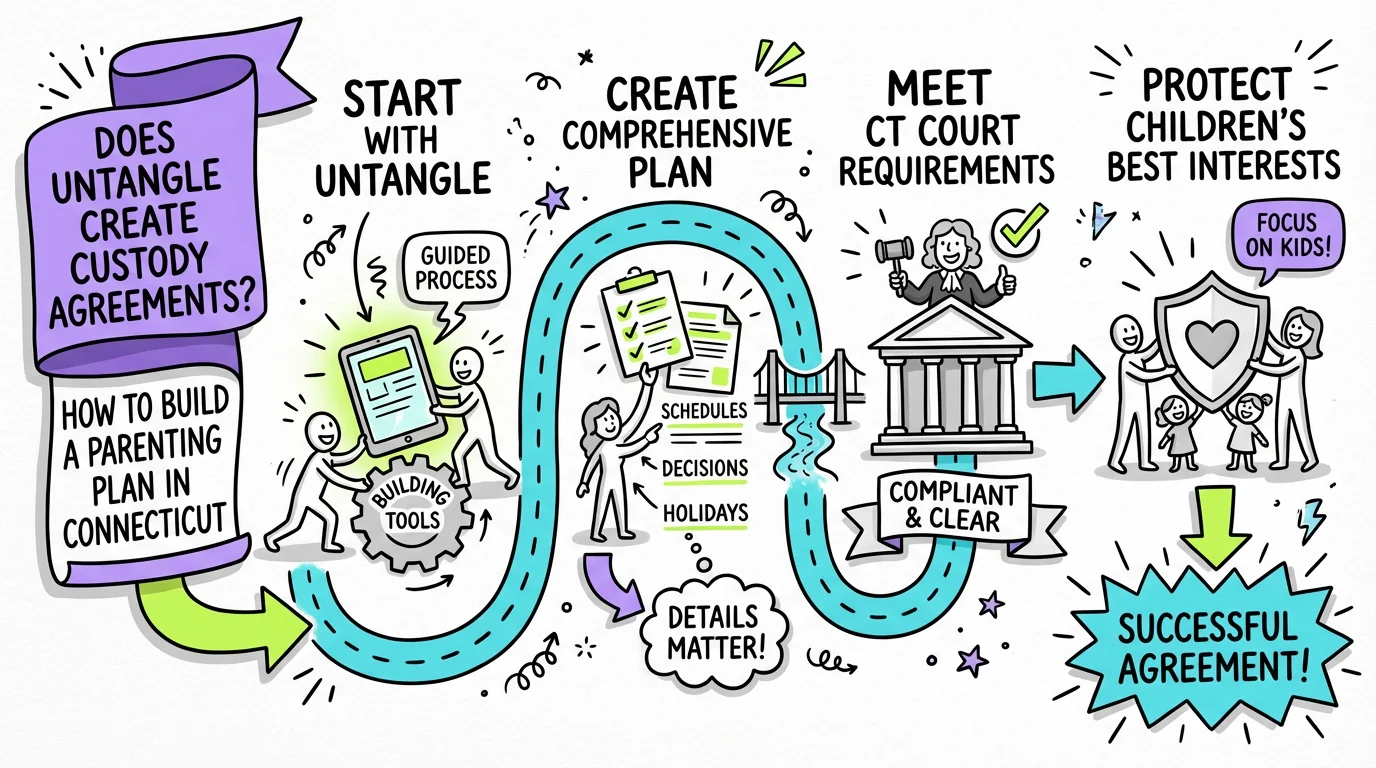
Yes, Untangle helps Connecticut parents create comprehensive custody agreements (also called parenting plans) that address all the elements required by state law. The platform guides you through building a detailed parenting responsibility plan that covers legal custody, physical custody schedules, decision-making authority, and all the practical details courts need to see. While Untangle creates the framework and language for your agreement, the final document must be reviewed and approved by a Connecticut Superior Court judge to become legally enforceable.
Understanding Custody Agreements in Connecticut
In Connecticut, custody arrangements are governed by C.G.S. § 46b-56, which authorizes courts to make orders regarding "custody, care, education, visitation and support of children." The statute establishes that all custody decisions must prioritize the child's best interests—a standard that considers factors like each parent's relationship with the child, the child's developmental needs, and the stability of proposed living arrangements.
Connecticut law recognizes two distinct types of custody that your agreement must address. Under C.G.S. § 46b-56a, "joint custody" means both parents share legal custody and decision-making authority, while physical custody determines where children actually live. The court can award joint legal custody without requiring joint physical custody, giving parents flexibility to create arrangements that work for their family's unique circumstances. Understanding this distinction is crucial because your parenting plan needs to clearly specify both components.
When parents submit a custody agreement to the court, C.G.S. § 46b-66 requires the judge to review the agreement and "inquire into the financial resources and actual needs of the parties and their respective fitness to have physical custody." This means your agreement must be thorough enough to demonstrate you've considered all aspects of your children's welfare. A well-drafted agreement created using Untangle's Parenting plan builder significantly increases the likelihood of court approval because it addresses the specific elements judges look for.
What a Connecticut Parenting Plan Must Include
Required Elements Under State Law
Connecticut's parental responsibility plan requirements, outlined in C.G.S. § 46b-56a, mandate specific components that every custody agreement must address. Your plan needs to:
- Designate legal custody: Clarify who makes major decisions about education, healthcare, and religious upbringing.
- Establish a physical custody schedule: Define exactly when the children are with each parent.
- Create mechanisms for resolving disputes: Outline how parents will handle disagreements without immediately returning to court.
Courts won't approve vague or incomplete agreements, so specificity is essential. The physical custody schedule forms the backbone of your parenting plan. This includes the regular weekly schedule, holiday rotations, summer vacation arrangements, and special occasions like birthdays and school breaks.
Tools like Untangle's Parenting plan builder can help you visualize different custody arrangements and calculate actual parenting time percentages, ensuring both parents understand exactly how the schedule works in practice. The platform prompts you to address scenarios that parents often overlook, like three-day weekends, teacher workdays, and what happens when holidays fall on different days each year.
Beyond scheduling, your agreement should address practical logistics: transportation arrangements for exchanges, communication protocols between households, how parents will share information about school and medical appointments, and rules about introducing children to new partners. Courts appreciate detailed agreements because they reduce future conflicts and modification requests. Practice Book Rule § 25-57 requires an affidavit concerning children that verifies no other custody proceedings exist—tools like Untangle's Automatic document generation help ensure you have all required paperwork ready.
Decision-Making Authority
One of the most important—and often contentious—aspects of custody agreements involves decision-making authority for major life choices. Legal custody determines who has the right to make decisions about:
- Education: Public vs. private school, special education services, tutoring.
- Healthcare: Medical treatments, therapy, medications.
- Religious upbringing: Faith practices and participation.
- Extracurricular activities: Sports, arts, and other programs.
Your agreement should specify whether these decisions are made jointly or whether one parent has final authority in certain areas. Many Connecticut parents choose joint legal custody, which requires ongoing cooperation and communication.
If you're concerned about your co-parent's decision-making regarding specific issues—perhaps due to different views on medical care or educational philosophy—your agreement can include provisions that give one parent tie-breaking authority in designated areas while maintaining joint decision-making elsewhere. This nuanced approach often works better than all-or-nothing legal custody arrangements.
Tools like Untangle's AI-assisted mediation can help parents work through decision-making disagreements by presenting common solutions other Connecticut families have used. The platform encourages you to think through scenarios before they become conflicts: What happens if parents disagree about whether a child should repeat a grade? How will decisions about braces or therapy be made? Addressing these questions in your original agreement prevents costly modification proceedings later.
How Untangle Helps You Build Your Custody Agreement
Step-by-Step Guidance Through Complex Decisions
Creating a custody agreement involves dozens of interconnected decisions, and missing important elements can lead to court rejection or future disputes. Untangle's guided process walks you through each component systematically, ensuring you address everything from major custody provisions to small but important details like who keeps the children's passports or how extracurricular scheduling conflicts are resolved.
The platform presents custody options in plain language, explaining the legal implications of each choice. For example, when you're deciding between different physical custody schedules, Untangle shows you how a 2-2-3 rotation differs from alternating weeks, including the number of transitions children experience and how each schedule affects school-night routines. This information helps you make decisions based on your children's actual needs rather than arbitrary preferences.
As you build your agreement, Untangle tracks what you've completed and what still needs attention. This comprehensive checklist approach mirrors what family law attorneys use when drafting custody agreements, ensuring your final document covers all the bases Connecticut courts require under C.G.S. § 46b-56 and related statutes.
Creating Schedules That Work for Your Children
The parenting time schedule is often the most complex part of any custody agreement because it must account for regular weeks, holidays, school breaks, and special circumstances. Untangle's visual scheduling tools let you build and preview different arrangements, seeing exactly how a proposed schedule plays out over months and years. You can experiment with different approaches before committing, which is especially valuable when parents live in different school districts or have demanding work schedules.
Connecticut courts pay close attention to whether proposed schedules provide children with "continuing contact with both parents," as required by C.G.S. § 46b-56a. Your schedule should demonstrate meaningful time with each parent while minimizing disruption to children's routines. Untangle helps you balance these priorities by showing transition frequency, calculating overnight percentages, and flagging potential problems like extremely long stretches without seeing one parent.
For protective parents concerned about children's safety and stability, detailed scheduling provisions provide crucial documentation of expectations. Your agreement can specify exact exchange times and locations, require certain conditions be met before overnight visits, and establish protocols for schedule changes. The more specific your agreement, the easier it is to identify and address violations if they occur.
The Court Approval Process for Custody Agreements
What Judges Look For
When you submit your custody agreement to a Connecticut Superior Court, the judge reviews it to ensure it serves your children's best interests. Under C.G.S. § 46b-66, the court must "inquire into the financial resources and actual needs of the parties and their respective fitness to have physical custody." This doesn't mean judges automatically reject agreements parents create themselves—it means your agreement must demonstrate thoughtful consideration of children's welfare.
Judges look for balanced arrangements that allow children to maintain relationships with both parents whenever safely possible. They scrutinize agreements that seem to exclude one parent without clear justification, as well as agreements that appear to prioritize parental convenience over children's needs. Your agreement should show that you've considered factors like children's school schedules, established relationships with extended family, and any special needs or circumstances.
Practice Book Rule § 25-30 requires sworn financial statements filed at least five business days before any hearing involving support, and these documents help judges evaluate whether your proposed arrangement is financially sustainable. Tools like Untangle's Financial affidavit generation help you prepare accurate financial disclosures that support your custody agreement.
Getting Your Agreement Approved
The path from drafted agreement to court-approved parenting plan involves several steps:
- Sign the Agreement: Both parents must sign the document, indicating their voluntary consent to the terms.
- File Required Documents: You must file the agreement along with the Affidavit Concerning Children (addressing requirements under Practice Book Rule § 25-57) and the Notice of Automatic Court Orders (Form JD-FM-158).
- Court Review: The judge reviews the agreement to ensure it meets legal standards and serves the children's interests.
Most uncontested custody agreements in Connecticut are approved without extensive hearings, particularly when the agreement is comprehensive and clearly serves children's interests. Judges may ask questions to confirm both parents understand the terms and agree voluntarily. If the judge has concerns about specific provisions, you may need to revise and resubmit your agreement.
If parents can't reach agreement on custody terms, the court will make custody decisions for them based on the best interests standard in C.G.S. § 46b-56. This process is more expensive, time-consuming, and stressful than negotiating your own agreement—another reason why tools like Untangle's AI-assisted mediation provide significant value for families working through custody disputes.
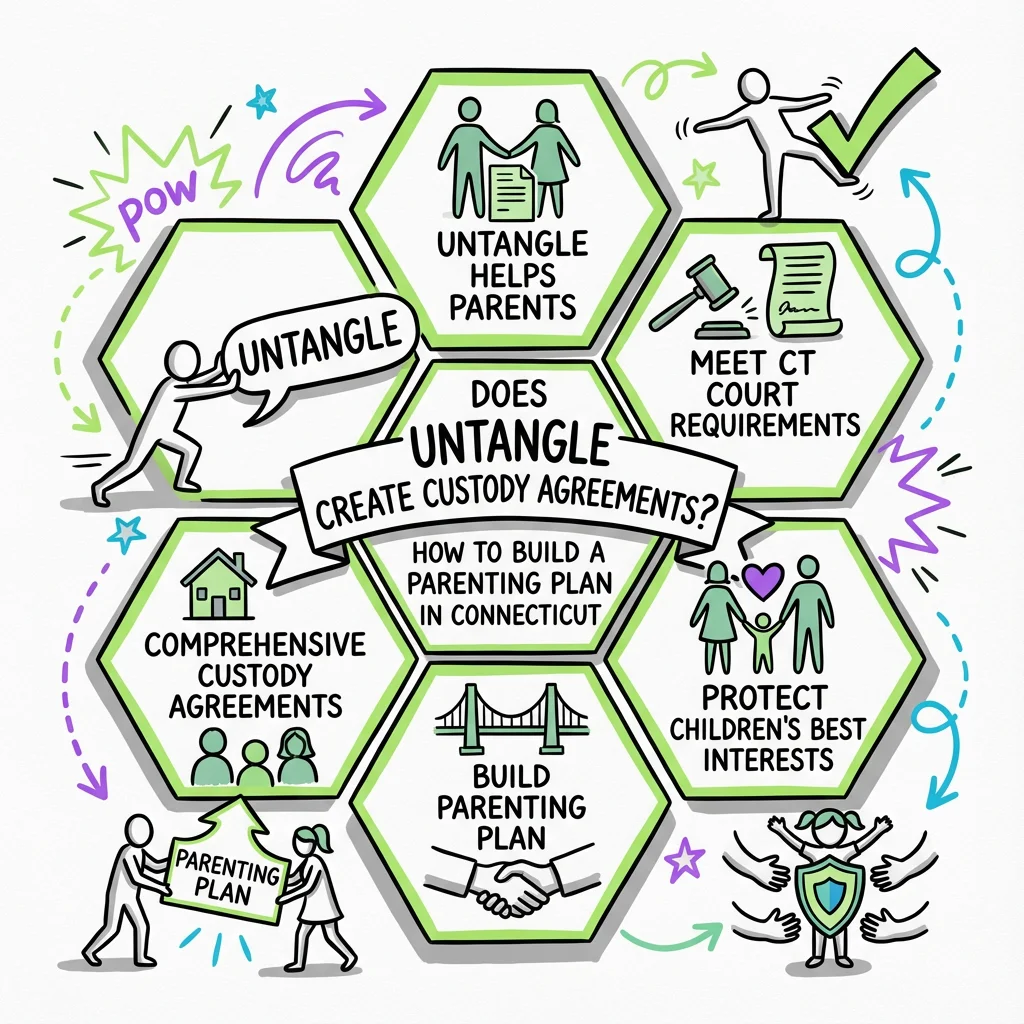
Protecting Your Children During and After Divorce
Automatic Protections Under Connecticut Law
Once you file for divorce or custody, automatic court orders immediately protect your children. Practice Book Rule § 25-5 establishes strict prohibitions and mandates:
- Neither parent can permanently remove children from Connecticut without written consent or court order.
- Parents who vacate the family home must provide a mailing address within 48 hours.
- Both parents must facilitate the children's continuing contact with the other parent.
These automatic orders remain in effect throughout your case and provide important safeguards during what can be an uncertain and emotionally volatile time. Understanding these protections helps you recognize if your co-parent violates them, which can be relevant to custody decisions. Form JD-FM-158 (Notice of Automatic Court Orders) details these provisions and must be served with your divorce paperwork.
Building in Safeguards for the Future
A well-crafted custody agreement anticipates future challenges and includes mechanisms to address them. Consider including provisions for how schedule changes are requested and approved, what happens if one parent wants to relocate, and how disputes will be resolved before returning to court. Some parents include requirements for co-parenting counseling or mediation before litigation, which can save thousands of dollars in legal fees while preserving the co-parenting relationship.
If you have specific concerns about your children's safety or wellbeing—perhaps related to a co-parent's substance use, mental health, or parenting capabilities—your agreement can include appropriate safeguards. These might range from requiring supervised exchanges in public locations to more significant provisions like mandatory drug testing or supervised visitation. Untangle's agreement drafting tools help you incorporate protective provisions in legally appropriate language.
Comparison: DIY, Untangle, and Attorney-Drafted Agreements
Choosing how to draft your custody agreement is a significant decision that impacts both your budget and your peace of mind. While some parents attempt to use free online templates, these often fail to account for Connecticut-specific requirements like the automatic orders or specific affidavit language. On the other end of the spectrum, hiring attorneys to draft the entire agreement ensures legal compliance but can cost thousands of dollars, even for amicable cases.
Untangle bridges this gap by providing a platform specifically designed for Connecticut family law. It offers the customization and legal guidance missing from generic forms without the high hourly rates of full legal representation. The table below outlines the key differences between these approaches to help you decide which path fits your family's needs.
| Factor | DIY Template | Untangle | Attorney-Drafted |
|---|---|---|---|
| Cost | $0-50 | Affordable subscription | $2,000-10,000+ |
| Customization | Limited | Highly customizable | Fully customized |
| Legal Guidance | None | Built-in explanations | Personalized advice |
| CT Law Compliance | Uncertain | Designed for CT requirements | Attorney ensures compliance |
| Time Required | Varies widely | Guided process saves time | Depends on attorney availability |
| Court Acceptance | Risk of rejection | Addresses required elements | High acceptance rate |
| Ongoing Support | None | Platform updates and tools | Hourly fees for changes |
When to Seek Additional Help
While Untangle empowers parents to create comprehensive custody agreements, some situations benefit from additional professional support. If domestic violence has occurred, if there are concerns about child abuse or neglect, or if one parent has serious mental health or substance abuse issues, consulting with a family law attorney provides crucial protection. Courts can appoint counsel or a guardian ad litem for children under C.G.S. § 46b-54 when circumstances warrant, and understanding when to request this protection matters.
Complex custody situations—like cases involving children with significant special needs, parents living in different states, or disputes about paternity—often require legal expertise beyond what any self-help tool can provide. High-conflict situations where parents cannot communicate effectively may need professional mediation or court intervention. If additional professional support is needed, consider reaching out to Connecticut family law attorneys and mediators who can supplement your self-prepared work.
For most Connecticut parents navigating divorce with a genuine desire to co-parent effectively, Untangle provides the structure and guidance needed to create custody agreements that protect children and satisfy court requirements. The combination of legal information, practical tools, and step-by-step guidance helps families reach resolutions that work—without the adversarial approach and high costs that often characterize traditional divorce proceedings.
Frequently Asked Questions
Is an Untangle custody agreement legally binding in Connecticut?
An Untangle-created custody agreement becomes legally binding only after it's reviewed and approved by a Connecticut Superior Court judge, as required by C.G.S. § 46b-66.
What does Untangle include in a Connecticut parenting plan?
Untangle guides you through creating a comprehensive parenting plan that covers legal custody, physical custody schedules, decision-making authority, and all practical details required by Connecticut law under C.G.S. § 46b-56.
How do I generate a parenting plan using Untangle?
Untangle walks you through a guided process to build your parenting plan step-by-step, helping you address each element Connecticut courts require while creating the framework and language for your agreement.
Does Connecticut require both legal and physical custody in a parenting plan?
Yes, Connecticut law under C.G.S. § 46b-56a requires your parenting plan to specify both legal custody (decision-making authority) and physical custody (where children live), though parents can have joint legal custody without joint physical custody.
What happens after I create a custody agreement with Untangle in CT?
After creating your custody agreement with Untangle, you must submit it to a Connecticut Superior Court where a judge will review it, inquire into your fitness and resources, and approve it before it becomes enforceable.
Legal Citations
- • Connecticut Practice Book Rule § 25-5 - Automatic Orders upon Service of Complaint View Source
- • Connecticut Practice Book Rule § 25-30 - Statements To Be Filed View Source
- • Connecticut Practice Book Rule § 25-57 - Affidavit Concerning Children View Source
- • Form JD-FM-158 - Notice of Automatic Court Orders View Source