Free Divorce Paperwork Help in Connecticut: Complete DIY Guide
Get free help with Connecticut divorce paperwork. Learn about official court forms, self-help resources, and step-by-step guidance for filing your own divorce in CT.
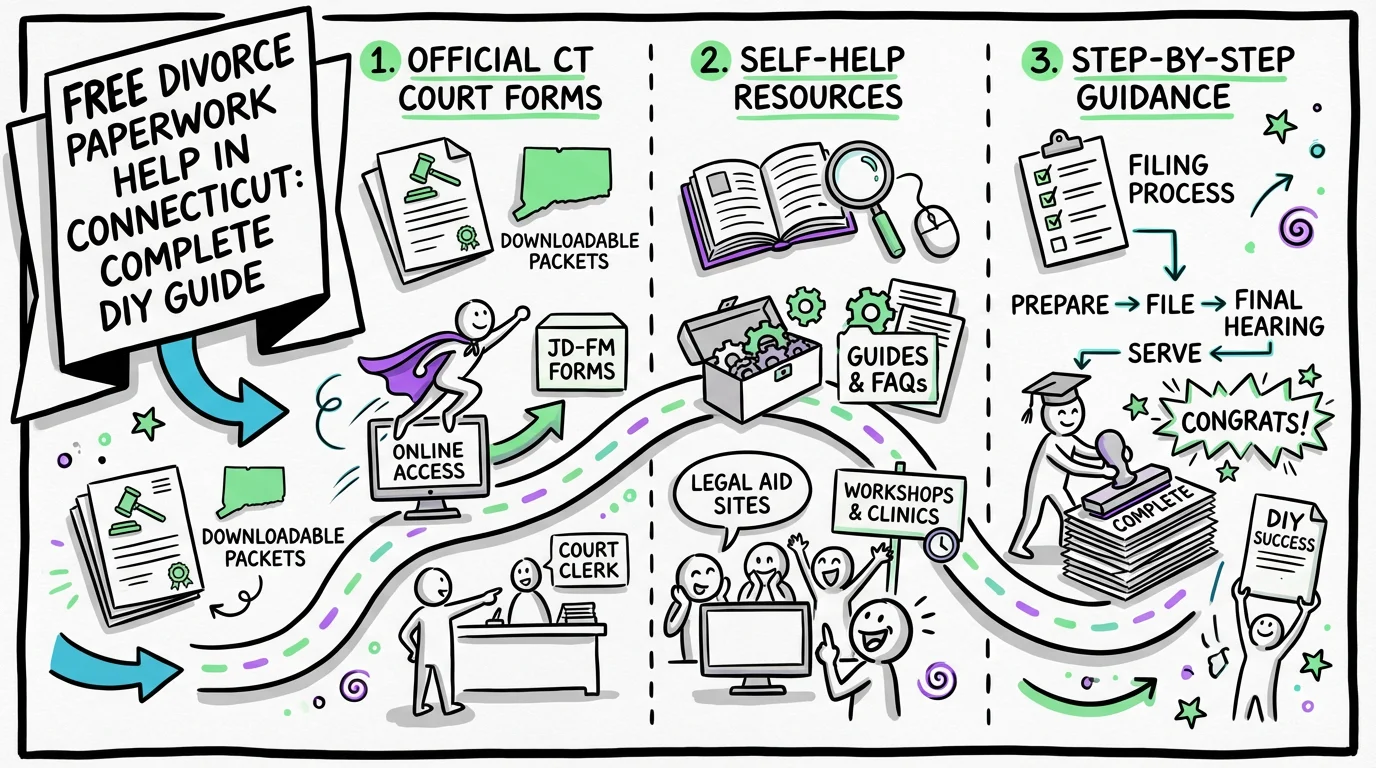
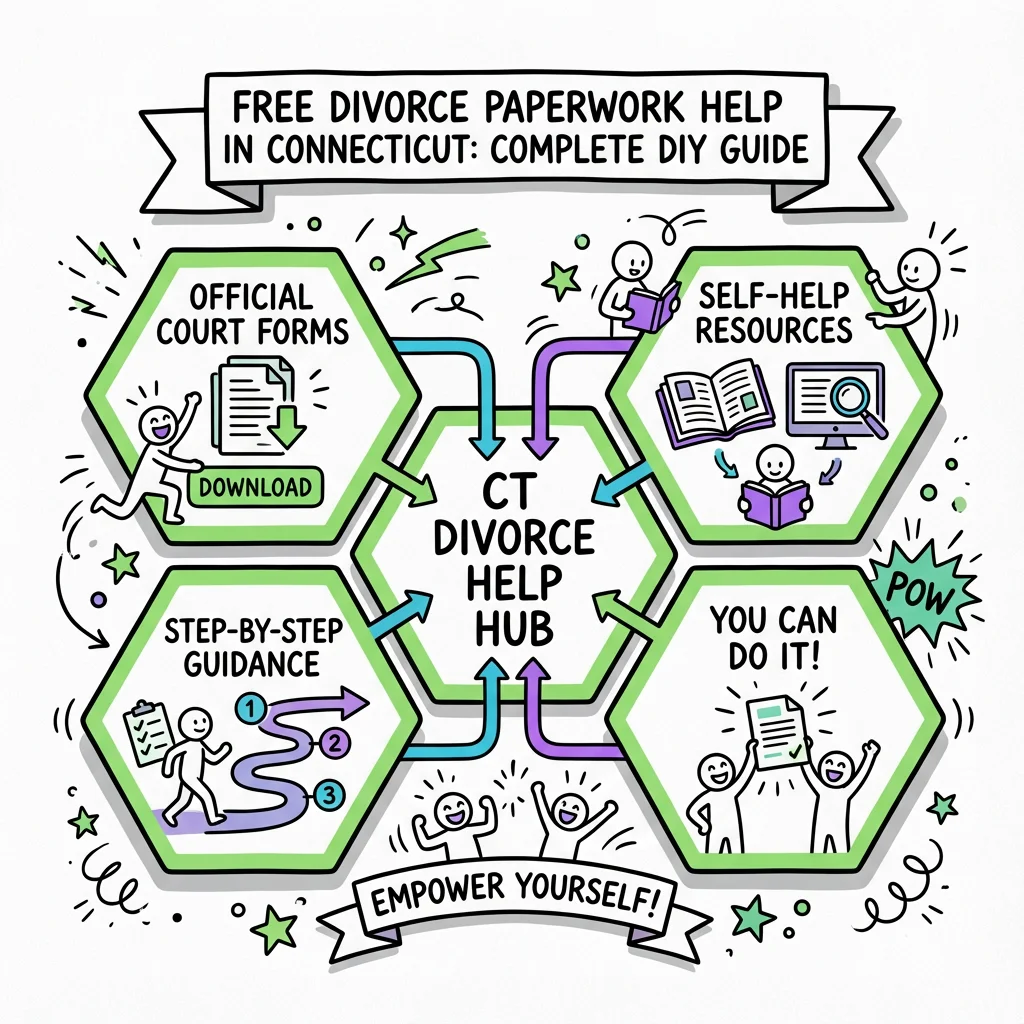
Connecticut offers several free resources to help you complete divorce paperwork without hiring an attorney. The Connecticut Judicial Branch provides all required forms at no cost through their website and court service centers, along with plain-language instructions designed for self-represented parties. For most uncontested divorces, you can successfully file the paperwork yourself using these free resources—potentially saving thousands of dollars in legal fees.
Understanding Your Free Options in Connecticut
Connecticut has made significant efforts to make divorce accessible to people who cannot afford or choose not to hire attorneys. The state court system provides every form you need to file for divorce, along with instructions written in plain language to help you understand what's required. Court service centers located in each judicial district offer free assistance with paperwork, and law libraries throughout the state provide additional support.
The key to successfully completing your own divorce paperwork is understanding which forms you need and when to file them. Connecticut distinguishes between contested and uncontested (nonadversarial) divorces, and each path requires different paperwork. If you and your spouse agree on all major issues—property division, child custody, and support—you may qualify for a simplified nonadversarial dissolution under C.G.S. § 46b-44a, which requires less paperwork and typically moves faster through the court system.
Tools like Untangle's automatic document generation can help you determine which divorce path is right for your situation by asking you questions about your circumstances and generating the appropriate forms based on your answers. This can save considerable time compared to sorting through court forms yourself and trying to figure out which ones apply to your case.
Essential Connecticut Divorce Forms (All Free)
Every Connecticut divorce requires specific forms filed in a particular order. Understanding this paperwork is crucial for DIY filers who want to avoid costly delays or rejections.
Starting Your Case
For a standard divorce where you file first and serve your spouse, you'll need the Summons (JD-FM-003), which officially notifies your spouse of the divorce action and their requirement to respond. You'll also need the Divorce Complaint or Dissolution of Marriage form (JD-FM-159), where you state the grounds for divorce and what relief you're seeking. Connecticut also requires the Notice of Automatic Court Orders (JD-FM-158), which informs both parties of restrictions that go into effect immediately upon filing—things like not hiding assets, not canceling insurance, and not removing children from the state.
For couples who agree on everything and want to file together, C.G.S. § 46b-44a allows a joint petition for nonadversarial dissolution. This simpler process requires both spouses to sign a notarized joint petition attesting that they meet certain conditions, including having reached a full agreement on all issues. The court must then assign a disposition date at least 30 days after filing under C.G.S. § 46b-44c, giving either party time to change their mind.
Financial Documentation Requirements
Connecticut takes financial disclosure seriously. Practice Book Rule § 25-30 requires sworn financial statements from both parties before any hearing on alimony, support, or counsel fees. The Financial Affidavit Short Form (JD-FM-006-short) is used when neither party's net income exceeds $75,000 per year and total assets are less than $75,000. If your income or assets exceed these thresholds, you'll need the long-form financial affidavit instead.
These financial affidavits must be completed accurately and honestly—they're sworn statements, meaning you're signing under oath. Misrepresenting your finances can have serious legal consequences. The forms require detailed information about your income from all sources, monthly expenses, assets (including real estate, vehicles, bank accounts, and retirement accounts), and liabilities (debts you owe). To simplify this critical step and help ensure your disclosures are accurate and complete, consider using Untangle's financial affidavit generation feature.
If you have children, you'll also need to complete the Worksheet for Child Support and Arrearage Guidelines (CCSG-001). Connecticut's child support guidelines include a worksheet designed with a "plain language approach" to make calculations more user-friendly, as noted in Preamble (f) of the guidelines. Untangle's child support calculator can help you run these numbers before completing the official worksheet, so you understand what to expect.
Where to Get Free Help with Your Paperwork
Connecticut offers multiple free resources specifically designed to help self-represented divorce filers. Knowing where to find help can make the difference between a smooth filing and a frustrating experience.
Court Service Centers
Each judicial district in Connecticut has a Court Service Center where staff can provide free assistance with divorce paperwork. They cannot give legal advice—meaning they can't tell you what to do in your specific situation—but they can help you understand which forms to use, how to fill them out correctly, and where to file them. They can also review your completed forms for obvious errors before you file.
Court Service Center staff are familiar with the most common mistakes self-represented filers make and can help you avoid them. Simple errors like using the wrong form, filing in the wrong location, or forgetting to sign where required can delay your case by weeks. Taking advantage of this free resource before filing can save you significant time and frustration.
Law Libraries and Self-Help Resources
Connecticut law libraries, located in courthouses throughout the state, offer free access to legal resources, forms, and sometimes staff who can point you in the right direction. The Connecticut Judicial Branch website provides downloadable forms, instructions, and guides for self-represented parties going through divorce.
The Office of the Chief Court Administrator is required by C.G.S. § 46b-87a to prepare forms with "instructions in plain language" for various family court matters. This mandate reflects Connecticut's commitment to making the court system accessible to people representing themselves.
Step-by-Step Process for Filing DIY Divorce Paperwork
Navigating the specific sequence of a Connecticut divorce can be daunting. A tool like Untangle's personalized task dashboard can break down the entire process into clear, manageable steps, helping you track your progress and ensure you don't miss anything important.
Filing for divorce in Connecticut follows a specific sequence. Missing a step or filing things out of order can cause delays or require you to start over.
-
Determine your divorce type - Decide whether you're filing a standard contested divorce, an uncontested divorce where your spouse will agree, or a joint nonadversarial petition if you've already reached a complete agreement together.
-
Gather financial information - Before completing any forms, collect documentation of all income, expenses, assets, and debts for both spouses. This includes pay stubs, tax returns, bank statements, retirement account statements, mortgage documents, and credit card statements.
-
Complete the required forms - Fill out all necessary forms completely and accurately. For standard divorces, this includes the Summons, Complaint, Notice of Automatic Court Orders, and Financial Affidavit at minimum.
-
File with the court - Submit your completed forms to the clerk's office in the judicial district where you or your spouse resides, as required by C.G.S. § 46b-45. There is a filing fee, though fee waivers are available for those who qualify based on income.
-
Serve your spouse - In standard divorces, you must have your spouse formally served with the divorce papers. Connecticut allows service by a state marshal or, if your spouse agrees, they can sign an Acceptance of Service form waiving formal service under C.G.S. § 46b-45.
-
Attend the case management conference - Under Practice Book Rule § 25-50A, the court will schedule a Resolution Plan Date 30-60 days from the return date, where you'll meet with a family relations counselor to discuss settlement prospects and get assigned to a case track.
-
Complete any required programs - If you have minor children, Connecticut requires completion of a Parent Education Program. Form JD-FM-149 is used to request relief if you cannot complete this requirement.
-
Finalize your agreement and judgment - Once all issues are resolved, file your final agreement and the Certificate of Compliance (JD-FM-175) for the court to enter a final judgment.
Using Untangle's case management tools can streamline this process significantly by guiding you through each step and generating the forms you need based on your specific situation.
Try our free CT child support calculator
Calculate your estimated child support using Connecticut's official guidelines formula.
Cost Comparison: DIY vs. Attorney-Assisted Divorce
Understanding the true costs of each approach helps you make an informed decision about handling your own paperwork.
| Approach | Typical Cost | Best For | Time Investment |
|---|---|---|---|
| Full DIY with free resources | $350-$500 (filing fees only) | Simple, uncontested cases with no children and minimal assets | 20-40 hours |
| DIY with online tools | $500-$800 (fees + software) | Uncontested cases needing more guidance | 10-20 hours |
| Limited scope attorney help | $1,000-$3,000 | Review of DIY paperwork, specific questions | 5-10 hours |
| Full attorney representation | $5,000-$15,000+ | Contested cases, complex assets, custody disputes | Minimal personal time |
The Connecticut Child Support Guidelines note in Preamble (c)(3) that one purpose of standardized guidelines is "promoting settlements" and improving efficiency. This reflects the state's recognition that clear rules help parties resolve matters without extensive litigation—good news for DIY filers.
Understanding Automatic Court Orders
One critical aspect of Connecticut divorce paperwork that catches many DIY filers off guard is the automatic court orders that take effect immediately when a divorce case begins. These aren't optional guidelines—they're enforceable court orders that both parties must follow.
Under Practice Book Rule § 25-5, automatic orders apply to both parties as soon as the divorce action begins. These include prohibitions on removing minor children from Connecticut without written consent, requirements to maintain health insurance coverage, restrictions on selling or transferring assets, and obligations to continue paying usual household expenses. Violations can result in contempt of court charges.
For nonadversarial divorces filed jointly, Practice Book Rule § 25-5B specifies that automatic orders become effective immediately upon filing. Since both parties file together, there's no gap between filing and service—the orders apply instantly to both spouses. Understanding these orders is essential because violating them, even accidentally, can seriously harm your case.
Timeline Expectations for DIY Divorce in Connecticut
Connecticut law establishes minimum waiting periods that affect how quickly your divorce can be finalized, regardless of whether you use an attorney.
For nonadversarial dissolutions under C.G.S. § 46b-44c, the court must assign a disposition date "not less than thirty days" after filing the joint petition. This is the earliest your divorce can be finalized if you file jointly and everything goes smoothly.
For standard divorces, C.G.S. § 46b-67 provides that the court may proceed on the complaint "following the second day after which a complaint for dissolution or legal separation is made returnable." However, the return date is typically set about 6 weeks after filing to allow time for service and response. If proceedings are stayed for reconciliation efforts under C.G.S. § 46b-53, there's a six-month waiting period.
DIY filers should realistically expect even simple uncontested divorces to take 3-6 months from filing to final judgment. Complex cases or those with disagreements can take a year or longer. Practice Book Rule § 25-51 clarifies that if your spouse doesn't appear, you don't need to file a motion for default—you can proceed to judgment under the pathways system, which can sometimes speed things up.
When DIY Might Not Be Enough
While many Connecticut divorces can be successfully completed without an attorney, certain situations call for professional help—even if just for limited consultation.
Consider seeking attorney assistance if your divorce involves significant assets or debts, business ownership or valuation questions, pension or retirement account division, real estate in multiple states, allegations of hidden assets, custody disputes, domestic violence concerns, or if your spouse has hired an attorney. The power imbalance when one party has legal representation and the other doesn't can lead to unfair outcomes.
Even if you're committed to DIY, many Connecticut attorneys offer unbundled or limited-scope services. You might pay a flat fee to have an attorney review your completed paperwork before filing, or consult for an hour to get answers to specific questions. This middle-ground approach can provide peace of mind without the cost of full representation.
Untangle's AI-assisted mediation can help you and your spouse work through agreements on property division, custody, and support before you ever step into a courthouse—potentially resolving issues that might otherwise require attorney involvement.
Frequently Asked Questions
What are the income requirements to qualify for free legal aid divorce help in Connecticut?
Connecticut Legal Services typically requires your household income to be at or below 125% of the federal poverty guidelines, though some programs may have different thresholds based on available funding and case type.
Where can I find a court self-help center for divorce forms in CT?
Connecticut has Court Service Centers located in each judicial district that provide free assistance with divorce paperwork, form selection, and general procedural questions for self-represented parties.
Are there pro bono divorce lawyers available in Connecticut?
Yes, Connecticut has pro bono programs through organizations like Statewide Legal Services and local bar associations that connect qualifying individuals with volunteer attorneys who provide free divorce representation.
Can I get my divorce documents reviewed for free in Connecticut?
Yes, Connecticut Court Service Centers can review your completed divorce forms for obvious errors and completeness, and some legal aid organizations offer free document review clinics for eligible applicants.
How do I know if I qualify for free divorce help versus needing to pay an attorney in CT?
Your eligibility for free divorce assistance in Connecticut depends on your income level, case complexity, and whether your divorce is contested or uncontested, with most free services prioritizing low-income individuals with straightforward cases.
Legal Citations
- • Summons (JD-FM-003) View Source
- • Divorce Complaint or Dissolution of Marriage form (JD-FM-159) View Source
- • Notice of Automatic Court Orders (JD-FM-158) View Source
- • Financial Affidavit Short Form (JD-FM-006-short) View Source
- • Form JD-FM-149 View Source
- • Certificate of Compliance (JD-FM-175) View Source