Divorce Financial Tools for Business Owners in Connecticut | Essential Strategies
Connecticut business owners facing divorce need specialized financial tools for valuation, income analysis, and asset protection. Learn essential strategies and legal requirements.
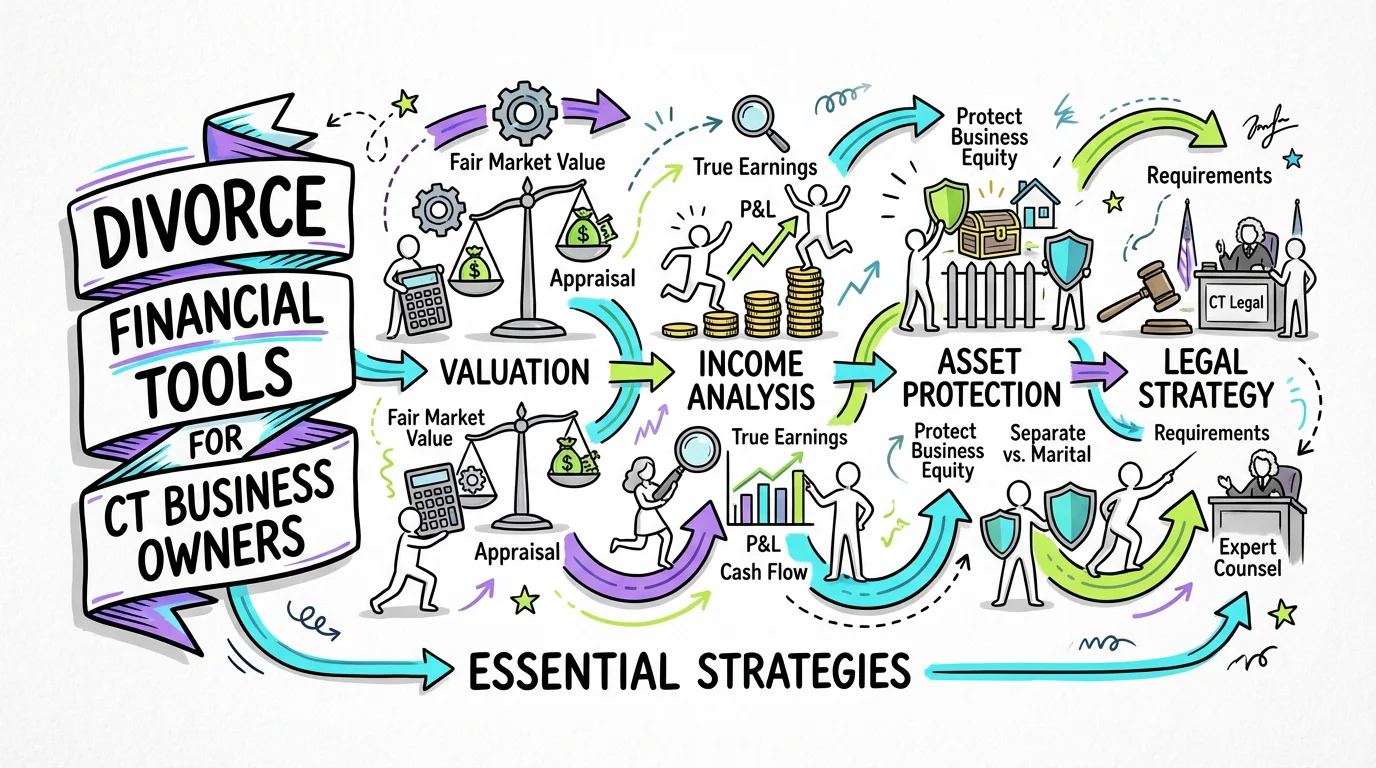
Connecticut business owners navigating divorce need specialized financial tools including business valuation software, forensic accounting analysis, cash flow modeling, and comprehensive financial disclosure systems. These tools help accurately value closely held businesses, identify true owner income (including non-cash benefits), project future earnings, and ensure compliance with Connecticut's mandatory disclosure requirements under Practice Book Rule § 25-32. Without proper financial analysis tools, business owners risk either overpaying in settlements or having courts impute income they don't actually earn. To mitigate these risks and ensure comprehensive disclosure, tools like Untangle's financial affidavit generation can streamline the process, helping you compile the necessary data accurately.
Why Business Owners Face Unique Divorce Challenges in Connecticut
Connecticut follows an equitable distribution model under C.G.S. § 46b-81, meaning courts can assign "all or any part of the estate of the other spouse" during divorce proceedings. For business owners, this creates significant complexity because the business itself—whether wholly or partially owned—becomes a marital asset subject to division. Unlike liquid assets with clear market values, closely held businesses require sophisticated analysis to determine their worth.
The stakes are particularly high because Connecticut courts have broad discretion in property division. In Oudheusden v. Oudheusden, the Connecticut Supreme Court addressed a case where a business owner's gross annual income of $550,000 was derived from two closely held businesses. The court examined how business value should factor into both property division and alimony calculations—highlighting the need for careful analysis to avoid "double counting" business assets. When business income funds alimony while business equity gets divided as property, improper calculations can result in the business owner effectively paying twice for the same asset.
Business owners must also contend with Connecticut's automatic orders under Practice Book Rule § 25-5, which restrict financial transactions once divorce proceedings begin. These orders prohibit selling, transferring, or encumbering assets without written consent or court approval—meaning business owners cannot restructure or sell business interests during litigation without navigating additional legal hurdles. Understanding these constraints early allows for strategic planning before filing.
Essential Financial Disclosure Requirements for Business Owners
Connecticut mandates comprehensive financial disclosure that goes far beyond personal bank statements. Under Practice Book Rule § 25-32, business owners must automatically exchange extensive documentation within 60 days of a request, including federal and state tax returns for the last three years, all K-1 forms for closely held entities, statements for all financial institution accounts for the past 24 months, and documentation of any interest in a pension, profit-sharing plan, or retirement account.
For business owners specifically, the disclosure requirements capture corporate and partnership documents, business tax returns, and ownership interests in any entity. The Financial Affidavit Long Form (JD-FM-006) requires detailed reporting of business income, ownership percentages, and valuations. This sworn statement must be filed at least five business days before any hearing on financial matters, with updated versions required within 30 days before final judgment.
Tools like Untangle's automatic document generation can help business owners compile and organize the extensive documentation required for disclosure. The platform allows you to upload financial documents, track what's been exchanged, and ensure nothing falls through the cracks during the mandatory disclosure process. Given that discovery disputes can lead to court-appointed special masters under Practice Book Rule § 25-32B—adding cost and complexity—staying organized from the start is essential.
Business Valuation Approaches and Tools
The Three Primary Valuation Methods
Business valuation typically employs three approaches, and Connecticut courts may consider all three depending on the business type. The income approach values the business based on its ability to generate future economic benefits, often using discounted cash flow analysis. The market approach compares the business to similar companies that have recently sold. The asset approach calculates net asset value by subtracting liabilities from the fair market value of all assets. Most closely held businesses in divorce proceedings rely primarily on the income approach, as comparable sales data rarely exists for private companies.
Specialized valuation software helps forensic accountants perform these analyses, but business owners should understand what goes into the calculations. Key adjustments include normalizing owner compensation (comparing what the owner takes to market-rate salaries for similar roles), identifying personal expenses run through the business, and adjusting for one-time or non-recurring expenses that don't reflect ongoing operations. These "add-backs" can significantly increase the apparent value and income of the business.
Connecticut courts recognize that business valuation involves judgment calls. The court may appoint its own expert witness under Practice Book Rule § 25-33 to provide independent analysis, particularly in high-conflict cases where spouses present vastly different valuations. When courts appoint experts, their compensation is allocated between the parties as the court orders—making it worthwhile to reach agreement on valuation methodology early if possible.
Key Valuation Adjustments Business Owners Should Track
| Adjustment Type | What It Captures | Impact on Valuation |
|---|---|---|
| Owner Compensation Normalization | Difference between actual and market-rate salary | Increases business income if owner underpaid |
| Personal Expenses | Car payments, travel, meals run through business | Increases owner's imputed income |
| Non-Recurring Items | One-time legal fees, equipment purchases | May decrease business value |
| Related-Party Transactions | Below-market rent from owner-owned property | May increase business income |
| Depreciation Add-Back | Non-cash expense that reduces taxable income | Increases cash flow for valuation |
Income Analysis Tools for Business Owners
Understanding Gross Income Under Connecticut Guidelines
Connecticut's Child Support Guidelines define gross income broadly to include not just salary and wages but also profit sharing, deferred compensation, and income from self-employment. Under Section 46b-215a-1(11)(A), gross income encompasses "average weekly earned and unearned income from all sources before deductions." For business owners, this means courts look beyond the salary you pay yourself to examine the total economic benefit you receive from the business.
This comprehensive income definition creates challenges for business owners whose tax returns may show modest income while the business provides substantial non-cash benefits. Courts routinely impute income based on personal expenses paid by the business, vehicle allowances, health insurance premiums, retirement contributions, and other perks. Forensic accountants use specialized software to analyze business and personal financial records together, reconstructing the owner's true economic position.
For cases involving combined net weekly income exceeding $4,000 (approximately $208,000 annually), Connecticut Guidelines Section 46b-215a-2c(a)(2) requires case-by-case determination of child support. This threshold is particularly relevant for business owners, who often have fluctuating incomes. Courts may also enter supplemental orders for percentage-based payments from bonuses or other variable compensation under Section 46b-215a-2c(c)(1)(B), creating ongoing obligations tied to business performance.
Cash Flow Analysis and Lifestyle Reconstruction
Beyond formal income calculations, courts often examine lifestyle evidence to verify reported income. If a family's expenditures exceed reported income, courts may conclude additional resources exist. Cash flow analysis tools track spending patterns, identify funding sources, and reconcile bank accounts with reported income. Untangle's expense tracking with AI helps business owners document their actual living expenses accurately, providing evidence to support their income claims.
Lifestyle reconstruction works in both directions. If you've been living modestly despite owning a successful business, documenting your actual expenses helps counter arguments that you're hiding income. Conversely, if your spouse has been spending lavishly, tracking those expenditures helps establish the marital standard of living—a key factor in Connecticut alimony determinations under C.G.S. § 46b-82.
Asset Protection Strategies and Limitations
What You Can and Cannot Do Under Automatic Orders
Once divorce proceedings begin, Connecticut's automatic orders significantly limit a business owner's options. Practice Book Rule § 25-5 prohibits transferring, encumbering, concealing, or disposing of any property except in the usual course of business or for customary living expenses. This means you cannot restructure ownership, take on new debt secured by business assets, or distribute extraordinary dividends without court permission or written consent from your spouse.
However, "usual course of business" operations continue normally. You can pay ordinary business expenses, compensate employees (including yourself) at established rates, and make routine business decisions. The key is avoiding transactions that would diminish the marital estate or change the character of assets. If you need to make an extraordinary business decision during litigation—such as acquiring a competitor or taking on significant new debt—you'll need either a stipulated agreement or a court order.
Pre-divorce planning offers more flexibility, though Connecticut courts can still scrutinize transactions that occur close to separation. Legitimate business planning, such as buy-sell agreements, proper corporate structures, and documented compensation practices, generally withstands scrutiny if implemented well before marital difficulties arise. If you're concerned about protecting business interests, consulting with both a family law attorney and business planning professional before any marital separation provides the most options.
The Role of Prejudgment Remedies
Connecticut provides prejudgment remedies under C.G.S. § 46b-80 to secure financial interests during divorce proceedings. These remedies—borrowed from general civil litigation—allow either spouse to protect against dissipation of assets. For business owners, this means a spouse could potentially seek attachment of business interests, garnishment of business income, or appointment of a receiver in extreme cases.
Understanding these remedies helps business owners prepare defensively. Maintaining transparent financial records, avoiding unusual transactions, and documenting legitimate business needs for any significant decisions provides protection against claims of dissipation. Tools like Untangle's case details management allow you to maintain organized records of business transactions that demonstrate good faith management of marital assets.

Try our free CT alimony calculator
Get an instant estimate based on Connecticut's statutory factors. No signup required.

Alimony Considerations for Business Owners
How Business Income Affects Support Calculations
Connecticut alimony law under C.G.S. § 46b-82 requires courts to consider the causes for dissolution of the marriage, the length of the marriage, each party's age, health, and occupation, and crucially, the "amount and sources of income" of each party. For business owners, income analysis often becomes the central battleground, as the income figure drives both alimony calculations and lifestyle analysis.
In Oudheusden v. Oudheusden, the Appellate Court addressed claims that the trial court "double counted" a marital asset when business value was divided as property while business income also supported substantial alimony. This case illustrates the interconnection between business valuation and support calculations—if the business is valued based on its income-producing capacity, and that same income funds alimony, adjustments may be necessary to avoid compensating the non-owner spouse twice for the same economic value.
Business owners should also understand that Connecticut allows courts to order security for alimony payments and to require life insurance to protect support obligations. For business owners whose income depends on their continued involvement in the business, these security provisions create additional obligations beyond the base support amount. Planning for these requirements early—including determining what security might be available without disrupting business operations—helps avoid last-minute scrambling.
Modification Considerations and Future Planning
Under C.G.S. § 46b-86, alimony orders may be modified upon showing a "substantial change in circumstances" unless the decree precludes modification. For business owners, this creates both opportunity and risk. If business performance declines substantially, modification may be available. However, if performance improves, your former spouse might seek increased support.
Strategic planning during divorce negotiations can address modification concerns. Some business owners prefer non-modifiable alimony (as in Oudheusden) to achieve certainty, accepting a potentially higher amount in exchange for predictability. Others prefer modifiable orders that can adjust to business performance. Working with financial advisors to model different scenarios helps determine which approach better protects your interests given your specific business situation.
Step-by-Step Process for Business Owner Divorce Preparation
-
Gather comprehensive business documentation before filing or being served. Collect three years of business and personal tax returns, all K-1s, corporate minutes, shareholder agreements, buy-sell agreements, and financial statements. Having these organized before automatic orders take effect gives you time to understand your position.
-
Engage a forensic accountant experienced with business valuation. Your regular CPA may not have divorce experience, and valuation requires specialized skills. Interview candidates about their experience testifying in Connecticut family court and their approach to common business valuation issues.
-
Document your actual income and lifestyle accurately. Use Untangle's income source tracking and expense tracking with AI to record income sources, business distributions, and personal expenses. Accurate documentation supports your position on income and counters lifestyle-based arguments.
-
Review and understand automatic orders. Once proceedings begin, restrictions apply. Knowing what you can and cannot do prevents inadvertent violations that could damage your credibility with the court.
-
Analyze tax implications of different settlement structures. Property division, alimony, and child support have different tax treatments. Modeling after-tax outcomes may reveal settlement structures that work better for both parties.
-
Prepare for discovery comprehensively. Missing the 60-day disclosure deadline or providing incomplete information creates litigation risk and potential sanctions. Use checklists and tracking tools to ensure complete compliance.
-
Consider business continuity planning. If your spouse will receive a share of business equity, how will that be structured? Buyout over time? Insurance-funded lump sum? Continued ownership? Each option has implications for business operations.
Cost and Timeline Considerations
| Service | Typical Cost Range | Timeline |
|---|---|---|
| Forensic Accounting/Business Valuation | $15,000 - $75,000+ | 2-4 months |
| Financial Affidavit Preparation | $500 - $2,000 | 1-2 weeks |
| Discovery Compliance | $2,500 - $10,000 | 60 days (mandatory) |
| Court-Appointed Expert | $10,000 - $50,000 | 3-6 months |
| Lifestyle Analysis | $5,000 - $25,000 | 1-3 months |
| Complete High-Asset Divorce (Attorney Fees) | $50,000 - $250,000+ | 12-24 months |
These costs vary significantly based on business complexity, level of conflict, and whether experts must testify at trial. Cases that settle through negotiation or mediation typically cost substantially less than fully litigated matters.
When Professional Help Is Essential
While tools like Untangle can help you organize documents, track finances, and understand your situation, business owner divorces almost always require professional guidance. The intersection of business valuation, tax planning, support calculations, and property division creates complexity that DIY approaches cannot adequately address. Even amicable divorces involving significant business interests benefit from expert review of settlement terms.
You should engage professionals immediately if your business has significant value (generally over $500,000), if business income is your primary source of support for alimony and child support calculations, if your spouse disputes your reported income or business value, if the business was started or grew substantially during the marriage, or if multiple entities or complex ownership structures exist. Early professional involvement typically reduces total costs by preventing mistakes that create litigation later. Connecticut courts have broad discretion in property division and support—having experts who can effectively present your position often determines outcomes more than the underlying facts alone.
Frequently Asked Questions
How is a business valued during a divorce in Connecticut?
Connecticut courts typically use one or more of three methods to value a business in divorce: the income approach (based on future earnings), the market approach (comparing to similar business sales), and the asset approach (based on net asset value), with the specific method depending on the business type and industry.
Can my spouse take half my business in a CT divorce?
Under Connecticut's equitable distribution law (C.G.S. § 46b-81), courts can assign any portion of business ownership to either spouse, though equitable doesn't always mean 50/50—the court considers factors like each spouse's contribution, the length of the marriage, and whether the business was started before or during the marriage.
What is double counting in business owner divorces?
Double counting occurs when a business owner's income is used to calculate alimony while the same business equity is also divided as marital property, effectively making the owner pay twice for the same asset—a critical issue Connecticut courts addressed in Oudheusden v. Oudheusden.
Should I buy out my spouse's interest in my business during divorce?
Buying out your spouse's business interest is often preferable to forced co-ownership or liquidation, allowing you to maintain full control and operations, though you'll need accurate valuation and may need to offset the buyout with other marital assets or structured payments.
What financial documents do business owners need to disclose in a Connecticut divorce?
Connecticut's Practice Book Rule § 25-32 requires comprehensive financial disclosure including business tax returns, profit and loss statements, balance sheets, accounts receivable, and documentation of owner benefits like personal expenses paid through the business.
Legal Citations
- • Practice Book Rule § 25-5 - Automatic Orders upon Service View Source
- • Practice Book Rule § 25-32 - Mandatory Disclosure and Production View Source
- • Practice Book Rule § 25-32B - Discovery Special Master View Source
- • Practice Book Rule § 25-33 - Judicial Appointment of Expert Witnesses View Source
- • Oudheusden v. Oudheusden, 338 Conn. 761 View Source
- • Oudheusden v. Oudheusden, 209 A.3d 1282 View Source
- • Financial Affidavit Long Form (JD-FM-006) View Source