Is a Divorce Financial Advisor Worth It in Connecticut? Expert Analysis
Discover whether hiring a divorce financial advisor is worth the cost in Connecticut. Learn how CDFAs help protect assets, analyze settlements, and ensure fair outcomes.
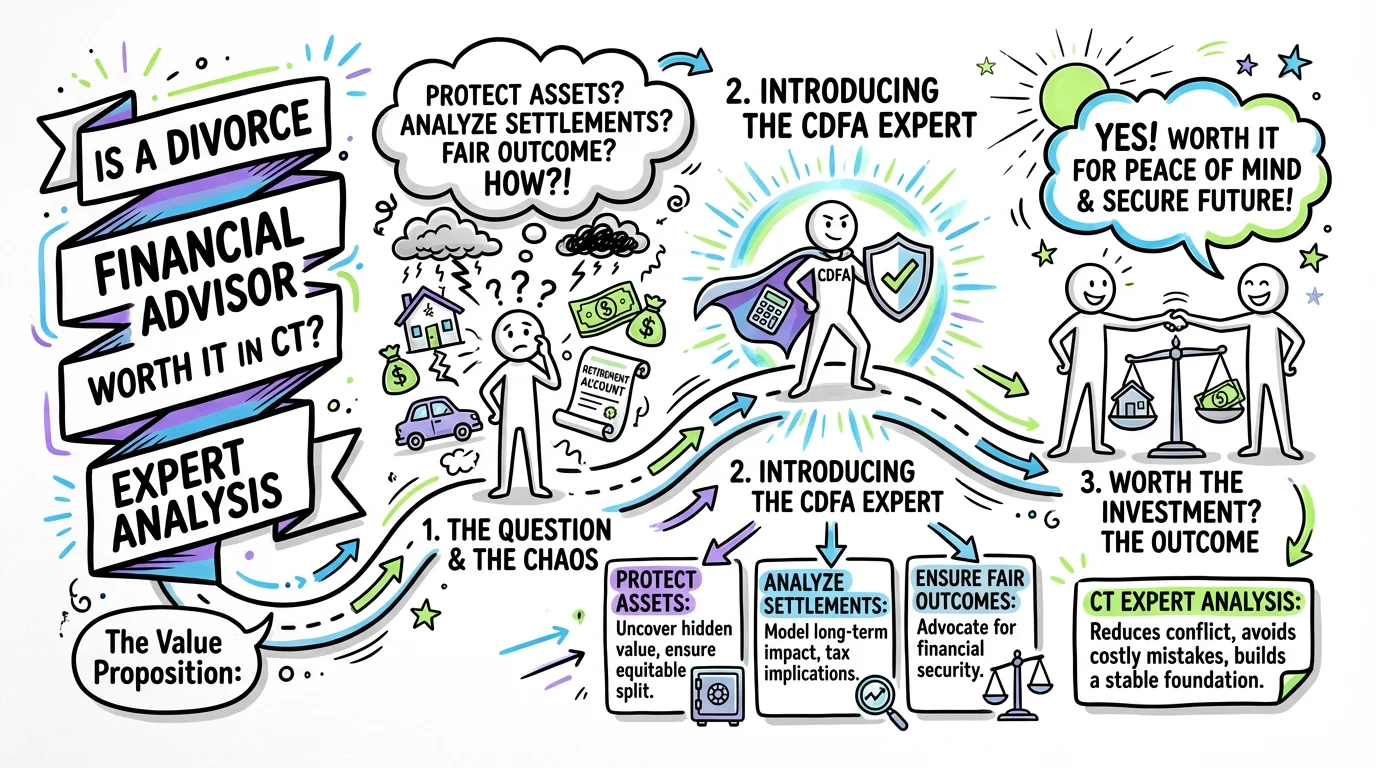
For most Connecticut divorces involving significant assets, complex finances, or retirement accounts, a divorce financial advisor is absolutely worth the investment. A Certified Divorce Financial Analyst (CDFA) typically costs $1,500 to $5,000 for a complete case analysis, but can save you tens of thousands of dollars by identifying hidden assets, projecting long-term tax consequences, and ensuring your settlement actually meets your future financial needs. If your combined marital estate exceeds $200,000, you own a business, have pensions or stock options, or you're the lower-earning spouse who hasn't managed household finances, the expertise of a financial professional can be the difference between a fair settlement and years of financial struggle.
What Does a Divorce Financial Advisor Actually Do?
A divorce financial advisor—particularly one with CDFA certification—specializes in the unique financial complexities of marital dissolution. Unlike a general financial planner, they understand how Connecticut's equitable distribution laws under C.G.S. § 46b-81 affect property division and can translate legal requirements into concrete financial projections.
Their core services include comprehensive asset identification and valuation, tax impact analysis for different settlement scenarios, cash flow projections for post-divorce budgets, and pension/retirement account division strategies. They work alongside your attorney to ensure settlement proposals are financially viable long-term, not just acceptable on paper today. Many people discover only after signing their settlement agreement that the house they fought to keep costs more than they can afford, or that the retirement account they accepted is worth far less after taxes than the one they gave up.
Connecticut courts require detailed financial disclosure through sworn financial affidavits, as outlined in Practice Book Rule § 25-30. A CDFA can help you accurately complete these forms and, more importantly, analyze your spouse's disclosures for inconsistencies or undervalued assets. The mandatory disclosure requirements under Rule § 25-32—which include three years of tax returns, 24 months of financial statements, and business documents—generate mountains of financial data that most people aren't equipped to interpret effectively. Tools like Untangle's smart bank statement analysis can significantly simplify the process of reviewing and categorizing transactions from these extensive records.
When Is a Divorce Financial Advisor Most Valuable?
High-Asset or Complex Financial Situations
If your marital estate includes business ownership, stock options, restricted stock units, multiple retirement accounts, or real estate investments, a financial advisor becomes essential rather than optional. Connecticut courts consider the "contribution of each of the parties in the acquisition, preservation or appreciation in value of their respective estates" under C.G.S. § 46b-81, which means accurately valuing these assets directly impacts your settlement.
Business valuations alone can vary by hundreds of thousands of dollars depending on the methodology used. A CDFA understands the difference between book value, fair market value, and liquidation value—and knows which approach benefits your position. They can also identify whether your spouse's reported business income matches lifestyle expenses, a common red flag for hidden income that appears in cases like Britto v. Britto, where the court scrutinized the husband's claimed annual income against the evidence.
Similarly, dividing retirement accounts requires understanding Qualified Domestic Relations Orders (QDROs), tax consequences of different distribution methods, and the true present value of future pension payments. Taking $200,000 from a taxable brokerage account is not financially equivalent to receiving $200,000 from a 401(k), yet many settlements treat them as equal.
Long-Term Marriages with Income Disparities
Connecticut's alimony statute (C.G.S. § 46b-82) considers factors including length of marriage, causes of divorce, age and health of the parties, occupation, earning capacity, and the time necessary for a spouse to acquire education or training for appropriate employment. A CDFA can project how different alimony scenarios—duration, amount, and type—affect your long-term financial independence.
For the spouse who has been out of the workforce or earned significantly less during the marriage, this analysis is critical. You need to understand not just whether you can pay this month's bills, but whether you'll be financially stable in 10 or 20 years. A financial advisor can model different scenarios: What if you receive more alimony but less property? What if you keep the house versus receiving its equity value in cash? What if alimony is unallocated versus separate from child support?
These projections help you negotiate from an informed position rather than accepting terms that seem reasonable now but create financial hardship later. Tools like Untangle's alimony calculator can help you organize different scenarios, though complex situations often benefit from professional financial modeling.
How to Evaluate the Cost-Benefit Analysis
| Situation | Estimated CDFA Cost | Potential Savings/Value | Worth It? |
|---|---|---|---|
| Simple divorce, minimal assets | $500-$1,500 | Limited; straightforward division | Usually No |
| Combined assets $200K-$500K | $1,500-$3,000 | $5,000-$25,000 in better outcomes | Usually Yes |
| Combined assets $500K-$1M+ | $3,000-$5,000 | $25,000-$100,000+ in tax savings, asset protection | Strongly Yes |
| Business ownership involved | $3,000-$7,500 | Often $50,000+ in valuation disputes | Essential |
| Pension/complex retirement | $2,000-$4,000 | $10,000-$50,000 in proper division | Strongly Yes |
| Spouse controls finances | $1,500-$3,500 | Peace of mind + fair settlement | Usually Yes |
The break-even calculation is straightforward: if a $3,000 investment in a CDFA helps you negotiate even 1% more of a $500,000 estate, you've gained $5,000 minus their fee. In practice, their value often exceeds this because they identify opportunities and risks you wouldn't recognize on your own.
However, if your divorce involves primarily known, liquid assets with relatively equal incomes and a short marriage, the cost may not be justified. Couples using Untangle's financial affidavit generation to catalog assets and liabilities may find they can handle straightforward situations without additional professional help.
Finding the Right Divorce Financial Advisor in Connecticut
Credentials and Qualifications to Look For
The gold standard credential is the Certified Divorce Financial Analyst (CDFA) designation, offered by the Institute for Divorce Financial Analysts. This certification requires specific training in divorce-related financial planning, tax issues, and asset valuation. Beyond this credential, look for professionals who also hold CFP (Certified Financial Planner) or CPA designations, as these indicate broader financial expertise.
Interview potential advisors about their experience specifically with Connecticut divorces. Understanding how courts in Hartford versus Stamford handle certain issues, or having working relationships with local family law attorneys, adds practical value. Ask how many divorce cases they've handled, what percentage of their practice focuses on divorce financial analysis, and whether they've ever testified as an expert witness.
Under Practice Book Rule § 25-33, Connecticut courts can appoint expert witnesses to provide objective analysis in financial disputes. While most CDFAs work as consultants for one party, understanding the court's option to appoint neutral experts helps you appreciate what an objective analysis looks like.
Red Flags to Avoid
Be cautious of financial professionals who promise specific outcomes, push particular investment products during your divorce process, or seem unfamiliar with Connecticut's equitable distribution framework. A good CDFA provides analysis and options—they don't guarantee results or make legal recommendations outside their expertise.
Also avoid advisors who can't explain their findings in plain language. If you don't understand their analysis, you can't make informed decisions about your settlement. The goal is empowerment through knowledge, not dependence on another professional.
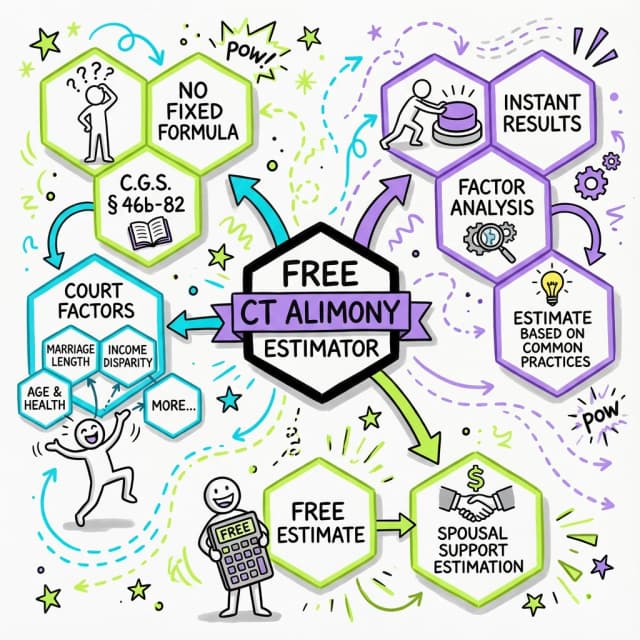
Try our free CT alimony calculator
Get an instant estimate based on Connecticut's statutory factors. No signup required.

Working with Your Divorce Team
A divorce financial advisor works best as part of a coordinated team including your attorney and, in some cases, a tax professional or accountant. They don't replace your lawyer—they complement legal advice with financial expertise that most attorneys don't possess.
The ideal workflow involves the CDFA analyzing financial disclosures (those mandatory documents required under Rule § 25-32), creating settlement scenarios, and presenting options to you and your attorney. Your attorney then uses this analysis in negotiations or court proceedings. This collaboration ensures financial realities inform legal strategy.
Sharing relevant documents efficiently matters here. Using Untangle's asset inventory feature to collect and categorize financial records saves time and money—you're not paying professional rates for document hunting. When you meet with your CDFA, having three years of tax returns, recent pay stubs, account statements, and benefit summaries organized and accessible allows them to focus on analysis rather than paperwork.
Steps to Decide Whether You Need a Divorce Financial Advisor
-
Inventory your marital estate. List all assets (homes, retirement accounts, investments, businesses) and debts. If the total exceeds $200,000 or includes hard-to-value assets, professional help becomes more valuable.
-
Assess your financial knowledge. Have you been actively involved in managing household finances? Do you understand your spouse's income, benefits, and retirement accounts? If you're playing catch-up, a CDFA accelerates your learning curve.
-
Identify complexity factors. Business ownership, multiple properties, stock options, pensions, or significant tax considerations all favor professional analysis.
-
Consider the emotional factor. If financial anxiety is preventing you from negotiating effectively or understanding settlement proposals, a CDFA provides clarity and confidence.
-
Get a consultation. Many CDFAs offer initial consultations for $150-$300 where they can assess your situation and estimate the value they'd provide. This investment helps you make an informed decision.
-
Coordinate with your attorney. Discuss whether your lawyer recommends financial expertise for your specific situation and whether they have CDFA professionals they trust.
Throughout this process, organizing your financial information using Untangle's asset inventory and debt tracking tools helps you understand your own situation better and makes any professional consultation more productive.
When Professional Financial Advice Isn't Enough
While a CDFA provides invaluable financial analysis, some situations require additional specialists. Forensic accountants may be necessary if you suspect hidden income or assets. Business valuation experts with specific industry knowledge may be needed for complex business appraisals. Pension valuation specialists can provide precise calculations for defined benefit plans.
A good CDFA recognizes the limits of their expertise and will recommend additional professionals when appropriate. They also understand that Connecticut courts, as demonstrated in cases like McTiernan v. McTiernan, take seriously the accurate disclosure of income and assets—so thorough financial investigation isn't just about fairness, it's about compliance with court expectations.
When to Get Help
If you're losing sleep over financial uncertainty in your divorce, that anxiety is itself a sign that professional guidance would help. The cost of a CDFA is finite and knowable; the cost of a poorly structured settlement can compound for decades through inadequate retirement savings, unexpected tax bills, or an unaffordable lifestyle.
Start by getting organized. Gather the financial documents required for your sworn financial affidavit and mandatory disclosures. Use this process to understand your own financial picture—what do you own, what do you owe, what does your income and expense situation look like? Once you have this foundation, you'll be better positioned to evaluate whether a divorce financial advisor's expertise matches your specific needs. For many Connecticut residents facing the division of significant assets, the answer is clearly yes.
Frequently Asked Questions
How much does a Certified Divorce Financial Analyst (CDFA) cost in Connecticut?
A CDFA in Connecticut typically costs between $1,500 and $5,000 for a complete case analysis, though complex cases involving businesses or multiple retirement accounts may cost more.
When should I hire a divorce financial advisor during my CT divorce?
You should hire a divorce financial advisor early in the process—ideally before negotiations begin—so they can analyze assets, identify tax implications, and help shape settlement proposals rather than just react to them.
What's the difference between a divorce financial advisor and a regular accountant?
A divorce financial advisor (especially a CDFA) specializes in marital dissolution, understanding Connecticut's equitable distribution laws and long-term settlement projections, while a regular accountant focuses on tax preparation and general bookkeeping without divorce-specific expertise.
What questions should I ask before hiring a divorce financial advisor in Connecticut?
Ask about their CDFA certification, experience with Connecticut equitable distribution cases, how they coordinate with divorce attorneys, their fee structure, and whether they can provide long-term cash flow projections for your post-divorce life.
Do I need a divorce financial advisor if my spouse handled all our finances?
Yes, if you're the lower-earning spouse who hasn't managed household finances, a divorce financial advisor is especially valuable for identifying all marital assets, understanding your true financial picture, and ensuring your settlement supports your long-term needs.
Legal Citations
- • Practice Book Rule § 25-30 - Statements To Be Filed View Source
- • Practice Book Rule § 25-32 - Mandatory Disclosure and Production View Source
- • Practice Book Rule § 25-33 - Judicial Appointment of Expert Witnesses View Source
- • Britto v. Britto, 141 A.3d 907 View Source
- • McTiernan v. McTiernan, 138 A.3d 935 View Source