Divorce Counseling vs Therapy in Connecticut: Understanding Your Mental Health Support Options
Learn the key differences between divorce counseling and therapy in Connecticut. Discover which type of mental health support is right for your situation.
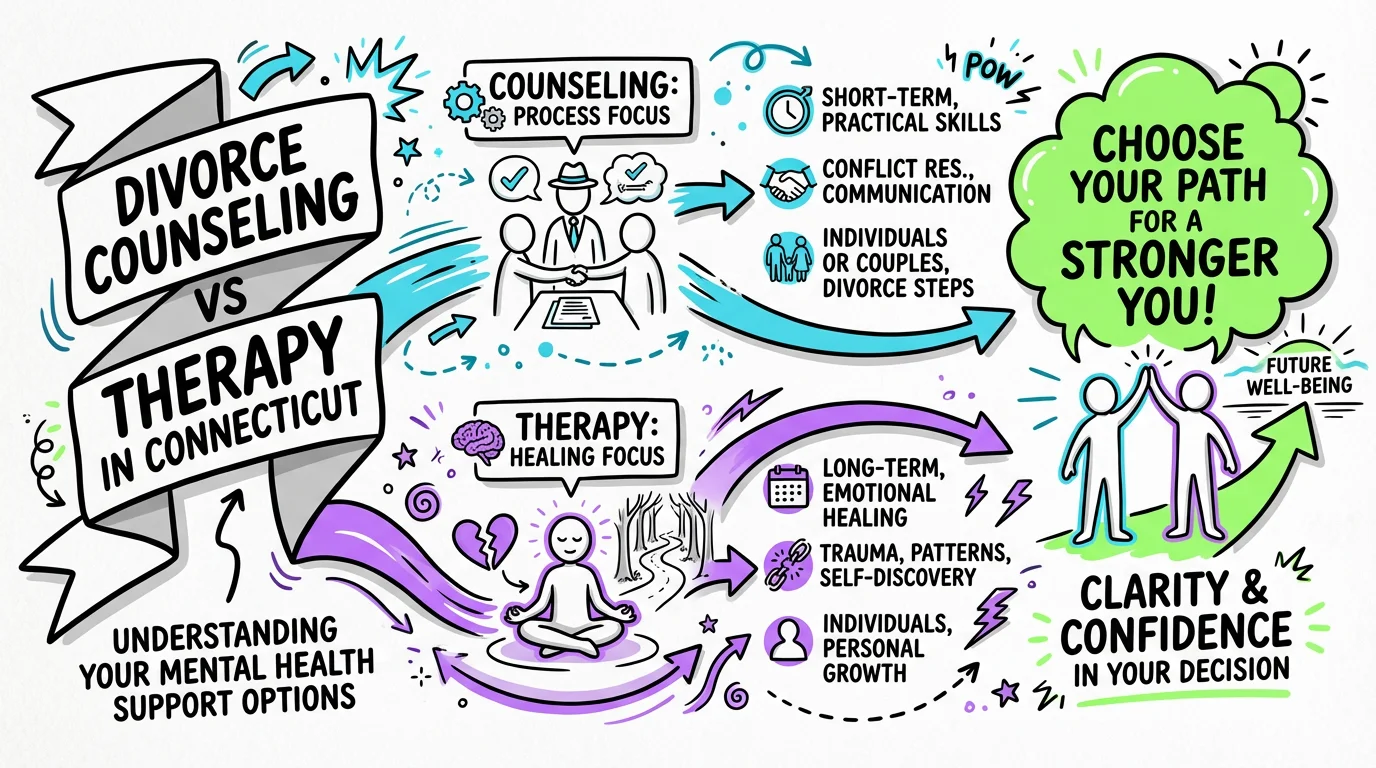
The primary difference between divorce counseling and therapy in Connecticut is their scope and duration: divorce counseling is short-term and practical, focusing on navigating the specific logistics of the legal process and co-parenting, while therapy is long-term and addresses deep-seated emotional trauma, patterns, and mental health. Understanding this distinction is essential for selecting the right support system, as many individuals require both practical guidance for the legal dissolution and therapeutic support for personal healing.
Understanding the Core Differences
The distinction between divorce counseling and therapy can feel confusing when you're already overwhelmed by the emotional weight of ending a marriage. At its core, divorce counseling is solution-focused and present-oriented. A divorce counselor helps you develop specific skills to handle immediate challenges: negotiating with your spouse, managing stress during proceedings, explaining the situation to your children, and rebuilding your identity post-divorce. Sessions typically center on practical strategies you can implement right away.
Therapy—sometimes called psychotherapy or mental health counseling—takes a broader, deeper approach. A therapist helps you understand the underlying patterns, unresolved emotions, and personal history that may have contributed to your marriage's difficulties or that are now surfacing during divorce. This might include exploring childhood experiences, attachment styles, depression, anxiety, or grief. Therapy often continues long after the divorce is finalized because it addresses fundamental aspects of your emotional wellbeing.
Many Connecticut residents find that their needs evolve throughout the divorce process. What starts as a need for practical guidance on communicating with a difficult spouse might reveal deeper issues around self-worth or past relationship trauma. Being open to both types of support—and understanding when each is most helpful—can significantly improve your divorce experience and long-term healing.
Types of Counseling and Therapy Available During Divorce
Individual Divorce Counseling
Individual divorce counseling provides one-on-one support focused entirely on your experience. Your counselor becomes a dedicated ally who helps you process decisions, prepare for difficult conversations, and develop coping strategies specific to your situation. This is particularly valuable when you're feeling isolated or when friends and family, though well-meaning, don't fully understand the complexity of what you're facing.
In Connecticut, many divorce counselors are licensed clinical social workers (LCSWs), licensed professional counselors (LPCs), or licensed marriage and family therapists (LMFTs) who specialize in divorce-related issues. They understand the state's legal landscape and can help you prepare emotionally for mediation sessions or negotiations. Tools like Untangle's personalized task dashboard can complement individual counseling by helping you track the practical aspects of your divorce while your counselor addresses the emotional components.
Couples Counseling (Discernment or Divorce Counseling)
Not all couples counseling aims to save the marriage. Discernment counseling helps couples who are uncertain about whether to divorce explore their options with clarity. Divorce counseling for couples—sometimes called "conscious uncoupling" or "collaborative divorce counseling"—helps those who have decided to separate do so with respect and minimal damage. This aligns with the spirit of Connecticut's conciliation procedures under C.G.S. § 46b-53, which emphasizes resolving disputes amicably.
This type of counseling can be transformative for Connecticut couples who want to pursue uncontested divorce or mediation but struggle to communicate productively. A skilled divorce counselor can facilitate conversations about co-parenting plans, property division, and other sensitive topics in a neutral setting. To help formalize these agreements, Untangle's parenting plan builder can provide a structured framework to outline custody, visitation, and decision-making details, ensuring clarity and reducing future conflicts.
Family Therapy
When children are involved, family therapy addresses how divorce affects the entire family system. A family therapist works with various combinations of family members—sometimes parents together, sometimes parent and child, sometimes the whole family—to improve communication, process grief, and establish new family dynamics.
Connecticut courts may sometimes recommend or order family therapy, particularly in contested custody cases. Even without court involvement, family therapy can help children process their feelings in a safe environment while teaching parents how to support their children through the transition. This becomes especially important during major adjustments like establishing two households or introducing new partners.
Support Groups and Group Therapy
While not the same as individual counseling or therapy, divorce support groups offer something uniquely valuable: community. Knowing you're not alone in your experience can be profoundly healing. Many Connecticut communities, religious organizations, and mental health centers offer divorce support groups where you can share experiences, learn from others further along in their journey, and build connections with people who truly understand.
Group therapy is more structured than support groups and is led by a licensed therapist. These sessions provide the community aspect of support groups while incorporating therapeutic techniques and professional guidance. The combination of peer support and professional facilitation can be particularly effective for processing shame, rebuilding confidence, and learning new relationship skills.
Comparing Divorce Counseling and Therapy
Deciding between divorce counseling and therapy often comes down to understanding the specific role each plays in your recovery and legal journey. While there is overlap, understanding the primary focuses and logistical differences can help you prioritize your time and resources. The following comparison highlights the distinct approaches of each professional support option.
| Aspect | Divorce Counseling | Therapy |
|---|---|---|
| Primary Focus | Navigating the divorce process | Deeper emotional healing and personal growth |
| Duration | Typically 3-6 months | Months to years, as needed |
| Session Frequency | Weekly or as needed around key events | Weekly, ongoing |
| Goals | Practical skills, decision-making, co-parenting | Understanding patterns, healing trauma, managing mental health |
| Best For | Immediate divorce-related challenges | Underlying issues, anxiety, depression, past trauma |
| Approach | Solution-focused, present-oriented | Exploratory, may examine past experiences |
| Cost in CT | $100-$200 per session | $100-$250 per session |
When to Choose Divorce Counseling
Divorce counseling is particularly helpful when you're facing immediate, practical challenges related to your divorce proceedings. In Connecticut, the state mandates a parenting education program for all divorces involving children under C.G.S. § 46b-69b, which is a form of brief, mandatory divorce counseling. Beyond this requirement, voluntary divorce counseling can provide targeted support for specific hurdles.
Consider divorce counseling if you're experiencing any of the following situations:
- You need help developing a co-parenting communication strategy
- You're preparing for mediation or collaborative divorce and want to participate effectively
- You're struggling to make decisions about settlement options
- You want support adjusting to single life and new routines
- You need strategies for telling your children about the divorce
- You're dealing with a high-conflict spouse and need coping techniques
The structured, goal-oriented nature of divorce counseling pairs well with practical planning tools. For instance, if you're struggling to make decisions about settlement options or understand the legal nuances of your case, Untangle's AI legal guidance can provide instant answers based on Connecticut law, complementing your counselor's emotional support. To organize the financial aspects of your divorce, Untangle's financial affidavit generation can help you compile necessary documents and calculations while your counselor helps you develop the emotional resilience to handle difficult conversations.
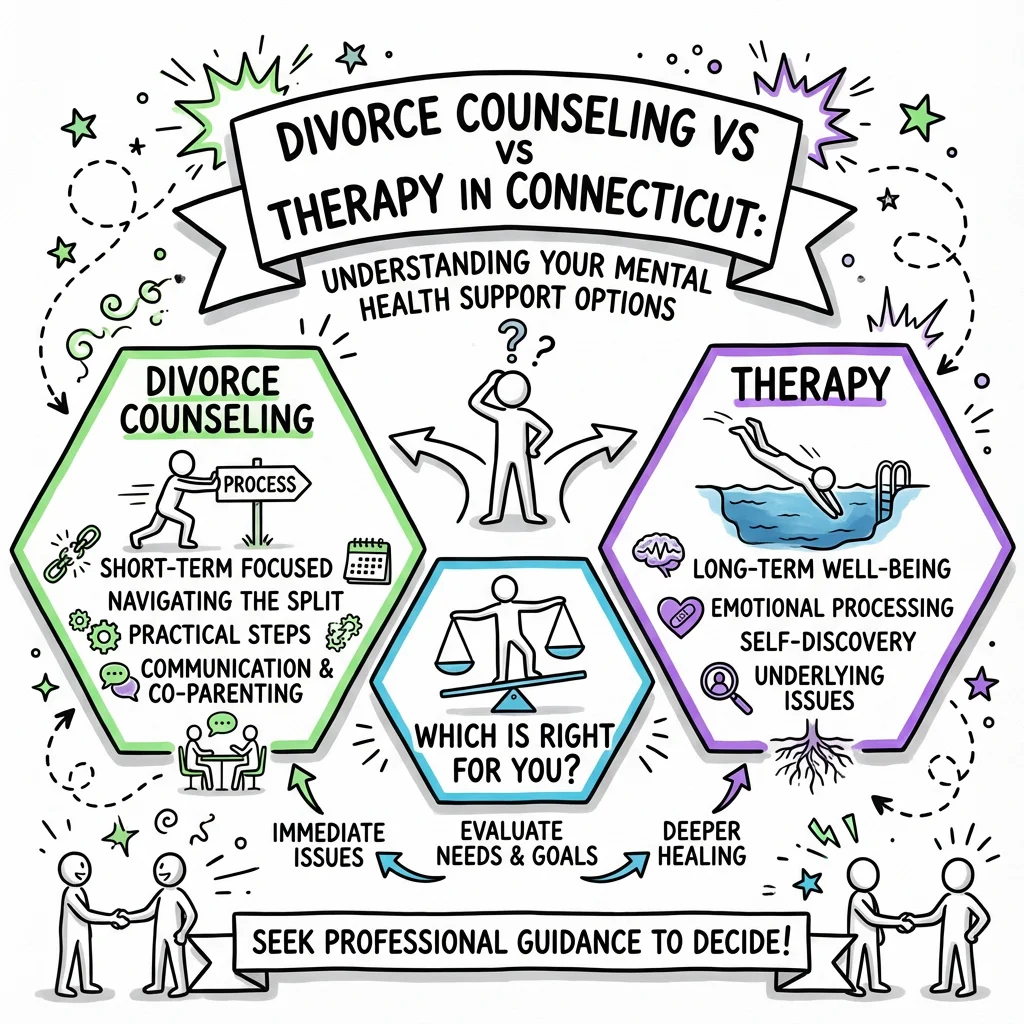
When to Choose Therapy
Therapy is the better choice when your struggles extend beyond the immediate divorce situation or when you're experiencing symptoms that significantly impact your daily functioning. If you're dealing with depression, anxiety, trauma responses, or finding that the divorce has triggered unresolved issues from your past, a therapist can provide the deeper, more comprehensive support you need.
Seek therapy if you're experiencing:
- Persistent depression, anxiety, or panic attacks
- Difficulty functioning at work or in daily activities
- Trauma responses or PTSD symptoms
- Patterns of unhealthy relationships you want to understand
- Substance use concerns
- Suicidal thoughts or self-harm (seek immediate help)
- Childhood trauma that's resurfacing during divorce
- Intense anger or rage that feels out of control
Therapy can also be valuable for personal growth even without acute symptoms. Many people use the divorce transition as an opportunity to better understand themselves, develop healthier relationship patterns, and build a stronger foundation for their post-divorce life. This investment in self-understanding often leads to better outcomes in future relationships and improved overall wellbeing.
Finding the Right Professional in Connecticut
Credentials and Specializations
In Connecticut, mental health professionals must be licensed by the Department of Public Health. When seeking support for divorce, look for professionals with specific experience in divorce, family transitions, or relationship issues. Common credentials include:
- LCSW (Licensed Clinical Social Worker)
- LPC (Licensed Professional Counselor)
- LMFT (Licensed Marriage and Family Therapist)
- PsyD or PhD (Psychologist)
- Psychiatrist (MD, can prescribe medication)
Beyond credentials, consider whether the professional's approach resonates with you. Some therapists are more directive and solution-focused, while others take a more exploratory approach. Many offer free initial consultations—use these to assess whether you feel comfortable and understood.
Insurance and Cost Considerations
Many Connecticut health insurance plans cover mental health services, though coverage varies significantly. Check whether your plan requires pre-authorization, limits the number of sessions, or restricts you to in-network providers. Some counselors and therapists offer sliding scale fees based on income, and community mental health centers often provide services at reduced rates.
The investment in mental health support during divorce often pays dividends beyond emotional wellbeing. When you're thinking clearly and managing stress effectively, you make better decisions about settlements, custody arrangements, and your future.
Creating Your Support System
Combining Resources Effectively
The most effective approach often combines multiple types of support. You might work with a divorce counselor during active proceedings while also participating in a support group for community connection. Or you might see a therapist for deeper work while using divorce-specific resources to handle practical planning.
Consider creating a support ecosystem that includes:
- Professional support - Counselor, therapist, or both based on your needs
- Community support - Support groups, trusted friends, faith community
- Practical tools - Resources like Untangle's case management tools for organizing documents, understanding the process, and tracking deadlines
- Self-care practices - Exercise, meditation, journaling, or other wellness activities
- Legal guidance - Attorney or mediator for legal aspects of your divorce
Adjusting as Your Needs Change
Your support needs will evolve throughout the divorce process. In the early stages, you might need more intensive support—frequent counseling sessions, regular support group attendance, and constant access to practical resources. As you move through the process and develop coping skills, you might scale back to occasional check-ins.
Pay attention to transition points that might require additional support: filing papers, serving your spouse, mediation sessions, court appearances, finalizing the decree, and major post-divorce milestones like your first holidays apart or when one spouse begins dating. Building in extra support around these moments can help you navigate them with greater resilience.
When to Seek Additional Help
While divorce counseling and therapy are invaluable resources, some situations require immediate or specialized intervention. If you're experiencing domestic violence, contact the Connecticut Coalition Against Domestic Violence or refer to C.G.S. § 46b-38b regarding family violence protections. If you're having thoughts of suicide or self-harm, reach out to the 988 Suicide and Crisis Lifeline by calling or texting 988.
If you're struggling with substance use during your divorce, specialized addiction counseling may be more appropriate than general divorce counseling. If your spouse is exhibiting signs of personality disorders that are making the divorce process extremely difficult, a therapist experienced in high-conflict divorces can provide specialized guidance.
Remember that seeking help is a sign of strength, not weakness. The willingness to invest in your mental health during one of life's most difficult transitions sets the stage for healing, growth, and a healthier future. Whether you choose divorce counseling, therapy, or both, you're taking an important step toward caring for yourself during a challenging time.
Frequently Asked Questions
What does a divorce counselor do differently than a regular therapist?
A divorce counselor focuses on short-term, practical skills like communication with your spouse, co-parenting strategies, and navigating the divorce process, while a therapist addresses deeper emotional issues, past trauma, and long-term personal growth.
Is divorce counseling or therapy covered by insurance in Connecticut?
Many Connecticut health insurance plans cover therapy sessions with licensed mental health providers, but coverage for divorce-specific counseling varies by plan, so check with your insurer about mental health benefits and any required referrals.
When should I start seeing a therapist during my Connecticut divorce?
You can begin therapy at any point—before filing, during proceedings, or after finalization—but many experts recommend starting early to develop coping strategies before stress peaks during negotiations or court appearances.
Can I use both divorce counseling and therapy at the same time?
Yes, many Connecticut residents benefit from using both simultaneously, with divorce counseling addressing immediate practical challenges and therapy providing deeper emotional support and processing.
How do I find a therapist in Connecticut who specializes in divorce?
Search online directories like Psychology Today filtered by location and specialty, ask your attorney or mediator for referrals, or contact your insurance provider for a list of in-network therapists experienced in divorce-related issues.
Legal Citations
- • C.G.S. § 46b-53 View Source
- • C.G.S. § 46b-69b View Source
- • C.G.S. § 46b-38b View Source