Divorce Budget Calculator Comparison: Choosing the Right Financial Planning Tool in Connecticut
Compare divorce budget calculators for Connecticut divorces. Learn which financial planning tools help you estimate costs, track assets, and prepare for court requirements.
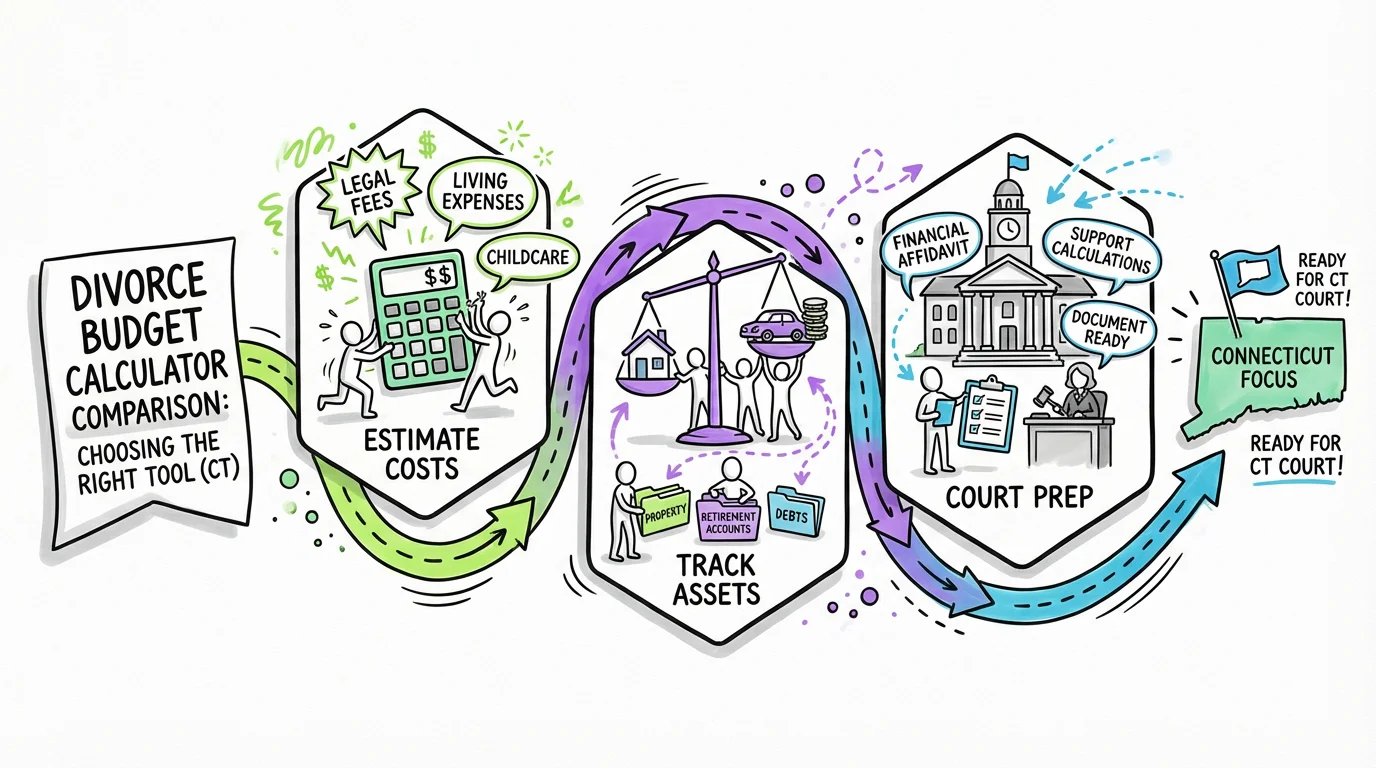
The best divorce budget calculator for your situation depends on your specific financial complexity and needs. For most Connecticut divorces, you'll want a tool that helps you organize assets, estimate costs, and project post-divorce finances—all areas where your financial picture must align with Connecticut's equitable distribution requirements under C.G.S. § 46b-81. While basic spreadsheets can work for simple situations, dedicated divorce budget calculators like Untangle's financial planning tools provide Connecticut-specific guidance that accounts for state filing fees, typical attorney costs, and the mandatory financial disclosure requirements you'll need to satisfy.
Why Divorce Budget Planning Matters in Connecticut
Financial anxiety during divorce is completely normal—you're essentially splitting one household into two while navigating legal costs, potential alimony obligations, and an uncertain future. Connecticut courts require comprehensive financial disclosure through sworn financial statements (Practice Book § 25-30), which means you'll need to understand every aspect of your finances anyway. A good budget calculator helps you get ahead of this requirement while reducing the overwhelming feeling that comes with financial uncertainty.
Connecticut operates under equitable distribution principles, meaning the court divides marital property fairly but not necessarily equally. Under C.G.S. § 46b-81, judges consider factors including the length of marriage, causes of dissolution, each spouse's age and health, occupation, employability, and estate. Understanding these factors helps you anticipate potential outcomes—and a proper budget calculator should help you model different scenarios based on these Connecticut-specific considerations.
The mandatory disclosure rules under Practice Book § 25-32 require exchanging extensive financial documentation within 60 days, including three years of tax returns, bank statements for the past 24 months, and retirement account statements. Starting your budget planning early with the right calculator means you'll already have this information organized when deadlines hit, reducing both stress and potential legal costs from scrambling to gather documents at the last minute. Tools like Untangle's smart bank statement analysis can read transactions, categorize them, and calculate monthly averages, taking the headache out of this crucial step.
Types of Divorce Budget Calculators Available
Basic Spreadsheet Templates
Free spreadsheet templates offer a starting point for tracking income, expenses, and assets. These typically include columns for listing bank accounts, property values, debts, and monthly expenses. The advantage is simplicity and cost—you can find free templates online and customize them to your needs.
However, basic spreadsheets lack Connecticut-specific calculations and don't account for the nuanced factors courts consider. They won't help you estimate child support using Connecticut's official guidelines. While tools like Untangle's child support calculator can help you quickly estimate obligations based on state guidelines, basic spreadsheets often require manual entry of complex formulas. For a straightforward divorce with minimal assets, these might suffice, but they leave significant gaps for anyone with real property, retirement accounts, or children.
Dedicated Divorce Financial Planning Software
Specialized divorce budget calculators go beyond simple tracking to help you model outcomes, estimate support obligations, and plan for post-divorce financial stability. The best options integrate state-specific requirements—critical in Connecticut where courts follow detailed statutory guidelines for both property division and support calculations.
Dedicated tools are designed specifically for divorce financial planning, helping you organize the information required for Connecticut's Financial Affidavit forms while projecting different settlement scenarios. This type of software typically costs more than free spreadsheets but can save money overall by reducing the hours an attorney or financial advisor spends organizing your data. For Connecticut divorces, look for calculators that understand the distinction between marital and separate property, can model alimony under C.G.S. § 46b-82 factors, and help you complete required court forms accurately.
Professional Financial Analysis Tools
Certified Divorce Financial Analysts (CDFAs) use professional-grade software to perform detailed analyses, including tax implications of different settlement options, long-term projections for retirement, and present-value calculations for comparing settlement offers. These tools are powerful but typically require professional guidance to use effectively.
For high-asset divorces or situations involving business ownership, complex investments, or significant retirement accounts, professional analysis may be worth the investment. Connecticut's equitable distribution framework gives judges broad discretion, and understanding the true financial impact of different outcomes requires sophisticated modeling that basic calculators can't provide.
Key Features to Compare in Divorce Budget Calculators
| Feature | Basic Spreadsheet | Dedicated Software | Professional Analysis |
|---|---|---|---|
| Cost | Free | $50-$200 | $1,500-$5,000+ |
| CT-Specific Calculations | No | Some/Yes | Yes |
| Child Support Estimates | Manual | Automated | Detailed |
| Alimony Modeling | No | Basic | Comprehensive |
| Asset/Debt Tracking | Basic | Detailed | Forensic-level |
| Post-Divorce Budgeting | Limited | Yes | Long-term projections |
| Court Form Integration | No | Often | Yes |
| Tax Impact Analysis | No | Limited | Detailed |
| Professional Support | No | Varies | Included |
When evaluating calculators, prioritize features that address your specific anxieties. If child support is your primary concern, ensure the tool uses Connecticut's official guidelines. If you're worried about maintaining your lifestyle post-divorce, look for robust monthly budget projections that account for single-income realities.
Connecticut requires using either the Short Form Financial Affidavit (for cases where neither party's net income exceeds $75,000 and total assets are under $75,000) or the Long Form version for more complex situations. A guided process helps you determine which form applies and ensures you're gathering the right information from the start—reducing the risk of delays or rejected filings that add to your costs.
Estimating Your Total Divorce Costs in Connecticut
Understanding the full financial picture of divorce helps reduce anxiety about the unknown. While every case differs, here are typical cost ranges for Connecticut divorces:
| Cost Category | Uncontested/Simple | Contested/Moderate | High-Conflict/Complex |
|---|---|---|---|
| Court Filing Fees | $350-$400 | $350-$400 | $350-$400 |
| Attorney Fees | $1,500-$3,500 | $10,000-$25,000 | $25,000-$100,000+ |
| Mediation | $1,000-$3,000 | $3,000-$7,000 | May not apply |
| Financial Experts | Usually unnecessary | $2,000-$5,000 | $5,000-$20,000+ |
| Parent Education | $125 | $125 | $125 |
| Total Estimate | $3,000-$7,000 | $15,000-$40,000 | $30,000-$125,000+ |
These estimates assume moderate complexity in the Hartford/New Haven/Fairfield County areas. Your actual costs depend heavily on whether you and your spouse can reach agreements on major issues. Connecticut's Pathways case management system (Practice Book § 25-50A) assigns cases to tracks based on complexity—Track A for simpler cases requiring minimal court time, Track B for moderate complexity, and Track C for complex disputes. The earlier you understand your finances and potential settlement range, the better positioned you are to resolve matters in a lower-cost track.
A good divorce budget calculator helps you understand these costs upfront and track actual spending against your budget. Tools like Untangle's expense tracking with AI let you monitor where money is going so you can make informed decisions about when to negotiate versus when to litigate—often the most impactful financial choice in the entire process.
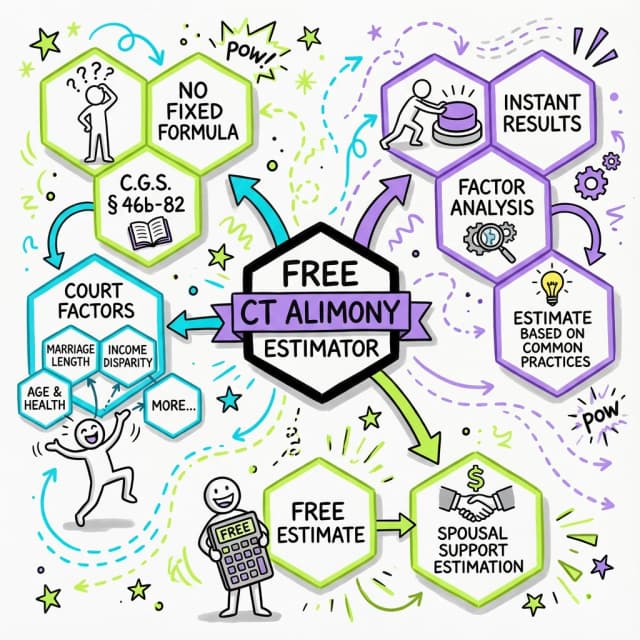
Try our free CT alimony calculator
Get an instant estimate based on Connecticut's statutory factors. No signup required.

How to Use a Divorce Budget Calculator Effectively
- Gather all financial documents first. Before entering any numbers, collect bank statements, tax returns, pay stubs, retirement account statements, mortgage documents, and credit card statements. Connecticut's mandatory disclosure rules require 24 months of bank statements and three years of tax returns, so start there.
- List all assets with current values. Include real property (with current market value, not purchase price), vehicles, retirement accounts, investment accounts, business interests, and personal property of significant value. Note which items you believe are marital versus separate property—though Connecticut courts make the final determination. Tools like Untangle's complete asset inventory can guide you through listing all your property and accounts, ensuring nothing is overlooked in your disclosures.
- Document all debts completely. Mortgages, car loans, student loans, credit cards, personal loans, and any other obligations. Include whose name is on each debt and current balances. Many people underestimate debt in divorce planning, leading to budget surprises later.
- Calculate accurate monthly expenses. Use actual spending, not estimates. Review bank and credit card statements for the past several months to capture irregular expenses like annual insurance premiums, car maintenance, and medical costs. Build separate budgets for your current household and your projected post-divorce household.
- Model multiple scenarios. What if you keep the house? What if you sell it? What if alimony is higher or lower than expected? A good calculator lets you compare these scenarios side-by-side. Under C.G.S. § 46b-82, Connecticut courts consider numerous factors when setting alimony, including length of marriage, causes of dissolution, age and health of parties, and station in life—modeling different outcomes helps you negotiate from an informed position.
- Update regularly throughout the process. Your financial situation may change during divorce proceedings, and new information emerges as discovery progresses. Courts can award temporary support under C.G.S. § 46b-83, which affects your budget during the case. Keep your calculator current to maintain an accurate picture.
Comparing Popular Divorce Budget Calculator Options
For Simple Connecticut Divorces (Under $75,000 Income/Assets)
If your situation qualifies for the Short Form Financial Affidavit, a basic calculator may suffice. Look for free options that help you:
- Track income and expenses in categories matching the court form
- List assets and debts clearly
- Calculate net worth
- Project a post-divorce budget
Even for simpler cases, consider whether a more robust tool's time savings justifies the cost. Spending $100 on software that saves you five hours of organizing paperwork—time you might otherwise pay an attorney $300/hour to handle—represents significant savings.
For Moderate Complexity Divorces
Most Connecticut divorces involve some complexity—whether children, real estate, retirement accounts, or simply accumulated assets and debts over years of marriage. For these situations, dedicated divorce budget software provides meaningful advantages:
- Automated child support calculations using Connecticut guidelines
- Alimony estimation based on statutory factors
- Property division modeling with different allocation scenarios
- Integration with required court forms
- Post-divorce budget projections
Untangle offers these features with Connecticut-specific guidance, helping you understand not just what the numbers are but what they mean for your case. The platform walks you through the exact information Connecticut courts require, reducing the risk of omissions or errors that could affect your settlement.
For High-Asset or Complex Divorces
When significant assets, business ownership, or contentious issues are involved, consider professional financial analysis alongside any calculator you use. Cases like Grabe v. Hokin demonstrate how complex financial issues—including prenuptial agreements and substantial separate property—require careful analysis. A budget calculator helps you organize and track information, but complex situations often require expert interpretation.
For these cases, your budget should include professional fees for CDFAs, business valuators, or forensic accountants. The investment often pays for itself through better settlement outcomes, but only if you choose professionals familiar with Connecticut family law and the equitable distribution framework.
When to Get Professional Help with Divorce Finances
While budget calculators help you organize and understand your finances, certain situations call for professional guidance beyond what any calculator can provide. Consider consulting a financial professional if:
- Your marital estate exceeds $500,000 in total value
- Either spouse owns a business or professional practice
- Retirement accounts represent a significant portion of marital assets
- You suspect hidden assets or financial dishonesty
- Tax implications of the settlement are unclear
- You're uncertain how to value complex assets like stock options or deferred compensation
Connecticut courts have broad discretion under the equitable distribution statute, as demonstrated in cases like Zhou v. Zhang, where the Supreme Court addressed how courts should approach complex property division questions. Understanding how judges in your local court typically exercise this discretion can meaningfully impact your settlement strategy—information that requires local legal expertise rather than just calculator outputs.
A divorce budget calculator is a tool for empowerment, not a replacement for professional advice when stakes are high. Untangle's AI consultation can help you determine when self-help tools are sufficient and when professional consultation makes financial sense for your specific situation. The goal is always reducing your anxiety through better information while making smart investments in expert help where it genuinely adds value.
Frequently Asked Questions
What expenses should I include in my Connecticut divorce budget?
Your CT divorce budget should include court filing fees, attorney costs, mediator fees, financial advisor costs, mandatory financial disclosure preparation, and post-divorce living expenses like separate housing, utilities, and insurance.
Are free divorce budget calculators as good as paid tools?
Free divorce calculators handle basic expense tracking, but paid tools typically offer more comprehensive features like Connecticut-specific cost estimates, scenario modeling for equitable distribution outcomes, and integration with mandatory financial disclosure requirements.
How much does a divorce typically cost in Connecticut?
Connecticut divorce costs range from a few hundred dollars for uncontested DIY divorces to $15,000-$50,000+ for contested cases, depending on attorney fees, complexity of asset division, and whether litigation is required.
What is the best divorce financial planning app for CT residents?
The best divorce financial planning app depends on your situation's complexity, but look for tools that account for Connecticut's equitable distribution laws, state filing fees, and the sworn financial statement requirements under Practice Book § 25-30.
When should I start budgeting for my Connecticut divorce?
Start budgeting as early as possible—ideally before filing—so you can gather financial records, estimate costs, and prepare for Connecticut's mandatory financial disclosure requirements that courts require in every divorce case.
Legal Citations
- • Practice Book § 25-30 - Statements To Be Filed View Source
- • Practice Book § 25-32 - Mandatory Disclosure and Production View Source
- • Practice Book § 25-50A - Case Management under Pathways View Source
- • Financial Affidavit Short Form (JD-FM-006-Short) View Source
- • Grabe v. Hokin, 341 Conn. 360 View Source
- • Zhou v. Zhang, 334 Conn. 601 View Source