Contested Divorce in Connecticut: Lawyer vs. Mediator - Which Do You Need?
When your spouse won't cooperate in a CT divorce, learn whether you need a divorce lawyer or mediator. Compare costs, timelines, and strategies for contested cases.
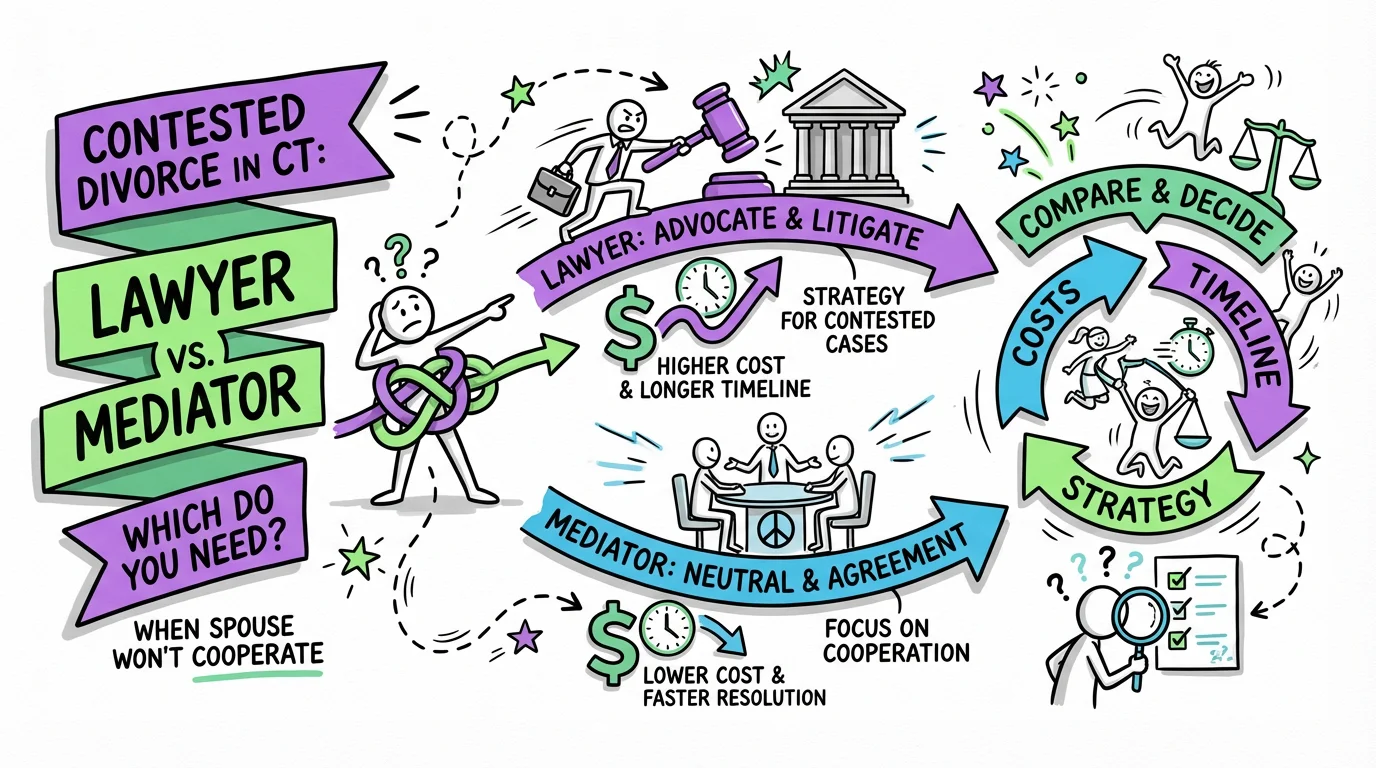
When your spouse refuses to cooperate in a Connecticut divorce, you almost certainly need a divorce lawyer rather than a mediator. Mediation requires both parties to participate voluntarily and negotiate in good faith—something an uncooperative spouse simply won't do. A skilled divorce attorney can file motions, enforce court orders, conduct discovery to uncover hidden assets, and advocate aggressively for your interests when settlement isn't possible. While mediation works beautifully for amicable divorces, a contested case with an adversarial spouse demands legal representation that can protect you through litigation.
Understanding Your Options in a CT Contested Divorce
Connecticut offers multiple paths to divorce, but the right choice depends entirely on your spouse's willingness to cooperate. The state's family courts recognize two primary dissolution approaches: uncontested (or "nonadversarial") divorce where both parties agree on all terms, and contested divorce where disagreements require judicial intervention. Under C.G.S. § 46b-40, the court can grant dissolution upon finding that the marriage has "broken down irretrievably"—but how you reach that final judgment varies dramatically based on your circumstances.
When you're dealing with a spouse who won't communicate, hides financial information, or actively undermines the process, mediation becomes functionally impossible. Connecticut's mediation program under C.G.S. § 46b-53a is designed to help willing parties address "property, financial, child custody and visitation issues." The key word is "willing." A mediator has no power to compel your spouse to show up, disclose assets, or negotiate fairly. They're a neutral facilitator, not your advocate.
The reality of contested divorce in Connecticut is that the court system expects conflict. Practice Book Rule § 25-50A establishes the "Pathways" case management system, which categorizes cases into Track A (minimal court time needed), Track B (moderate complexity), or Track C (complex cases requiring significant judicial resources). If your spouse is fighting you at every turn, expect your case to land in Track B or C—and prepare accordingly with proper legal representation.
Why Mediation Fails When Your Spouse Won't Cooperate
Mediation is built on a foundation of mutual respect and shared goals. Both parties must want to reach an agreement more than they want to "win." When one spouse is determined to make the process difficult—whether out of anger, spite, financial motivation, or a desire for control—mediation becomes a one-sided exercise in frustration.
Consider what happens in a typical mediation session: both parties sit down with a neutral third party who helps facilitate discussion. The mediator cannot force either party to disclose information, make concessions, or even attend sessions. Under C.G.S. § 46b-53a, communications made during mediation are privileged and confidential—which means if your spouse lies or withholds information during mediation, you can't even use that against them later. An uncooperative spouse can weaponize the mediation process by dragging it out, making unreasonable demands, or simply refusing to engage meaningfully.
More critically, mediators cannot issue orders. They can't freeze bank accounts when your spouse is draining them. They can't compel production of financial documents. They can't hold anyone in contempt for violating agreements. In contested situations, you need someone with the authority to take action—and that means working within the court system with a lawyer who knows how to leverage it.
Tools like Untangle's expense tracking can help you document financial information independently, which becomes crucial when your spouse isn't forthcoming. Having organized records ready for your attorney accelerates the discovery process and strengthens your position.
What a Contested Divorce Lawyer Does for You
A Connecticut divorce attorney in a contested case serves as your strategic advocate, courtroom representative, and legal shield. Unlike a mediator who must remain neutral, your lawyer's sole obligation is to protect your interests and pursue the best possible outcome for you.
Filing and Responding to Motions
From the moment divorce papers are served under C.G.S. § 46b-45, your attorney can file motions to protect your interests. This includes motions for temporary custody, exclusive possession of the marital home, temporary alimony (pendente lite support), and restraining orders if necessary. When your spouse files motions against you, your lawyer responds strategically and advocates on your behalf at hearings. Practice Book Rule § 25-5 establishes automatic orders that take effect once the divorce action begins—prohibiting either party from hiding assets, taking on excessive debt, or removing children from Connecticut without consent. Your attorney ensures these protections are enforced.
Discovery and Financial Investigation
Perhaps the most critical advantage of having a lawyer in a contested divorce is the ability to conduct formal discovery. If your spouse is hiding assets or income, your attorney can subpoena bank records, employment records, business financials, and other documents. They can depose your spouse under oath, forcing them to answer questions truthfully or face perjury charges. Connecticut courts require both parties to file Financial Affidavits (Form JD-FM-006), and your lawyer can pursue contempt charges if your spouse submits false or incomplete information.
Courtroom Advocacy
When negotiations fail and your case goes to trial, your lawyer presents evidence, examines witnesses, and argues your position before the judge. They understand how Connecticut judges typically rule on contested issues like custody under C.G.S. § 46b-56, which requires the court to consider the "best interests of the child." They know which arguments resonate and which fall flat. This courtroom experience is irreplaceable when facing an adversarial spouse.
Cost Comparison: Lawyer vs. Mediator in Connecticut
Understanding the financial implications helps you make an informed decision. While mediation is generally less expensive in cooperative situations, the cost calculus changes dramatically in contested cases.
| Factor | Divorce Mediator | Divorce Lawyer |
|---|---|---|
| Hourly Rate | $150-$400/hour | $250-$500+/hour |
| Typical Total Cost (Uncontested) | $2,000-$7,000 | $5,000-$15,000 |
| Typical Total Cost (Contested) | Often fails, requiring lawyer anyway | $15,000-$50,000+ |
| Authority to Issue Orders | None | Files motions; court issues orders |
| Can Compel Cooperation | No | Yes, through discovery and court enforcement |
| Advocacy for Your Interests | Neutral (neither side) | Exclusively represents you |
| Effective When Spouse Won't Cooperate | Rarely | Yes |
The hidden cost of attempting mediation with an uncooperative spouse is wasted time and money. Many people spend thousands on mediation sessions that go nowhere, then must hire a lawyer anyway and essentially start over. Under C.G.S. § 46b-62, Connecticut courts can order one spouse to pay the other's attorney fees based on their "respective financial abilities"—something to discuss with your attorney if your spouse has greater financial resources.
Using Untangle's financial affidavit generation before meeting with attorneys can significantly reduce your legal costs. Lawyers bill by the hour, and presenting them with organized financial information rather than boxes of unsorted documents saves substantial money.

Try our free CT alimony calculator
Get an instant estimate based on Connecticut's statutory factors. No signup required.
When Mediation Might Still Help (Even in Contested Cases)
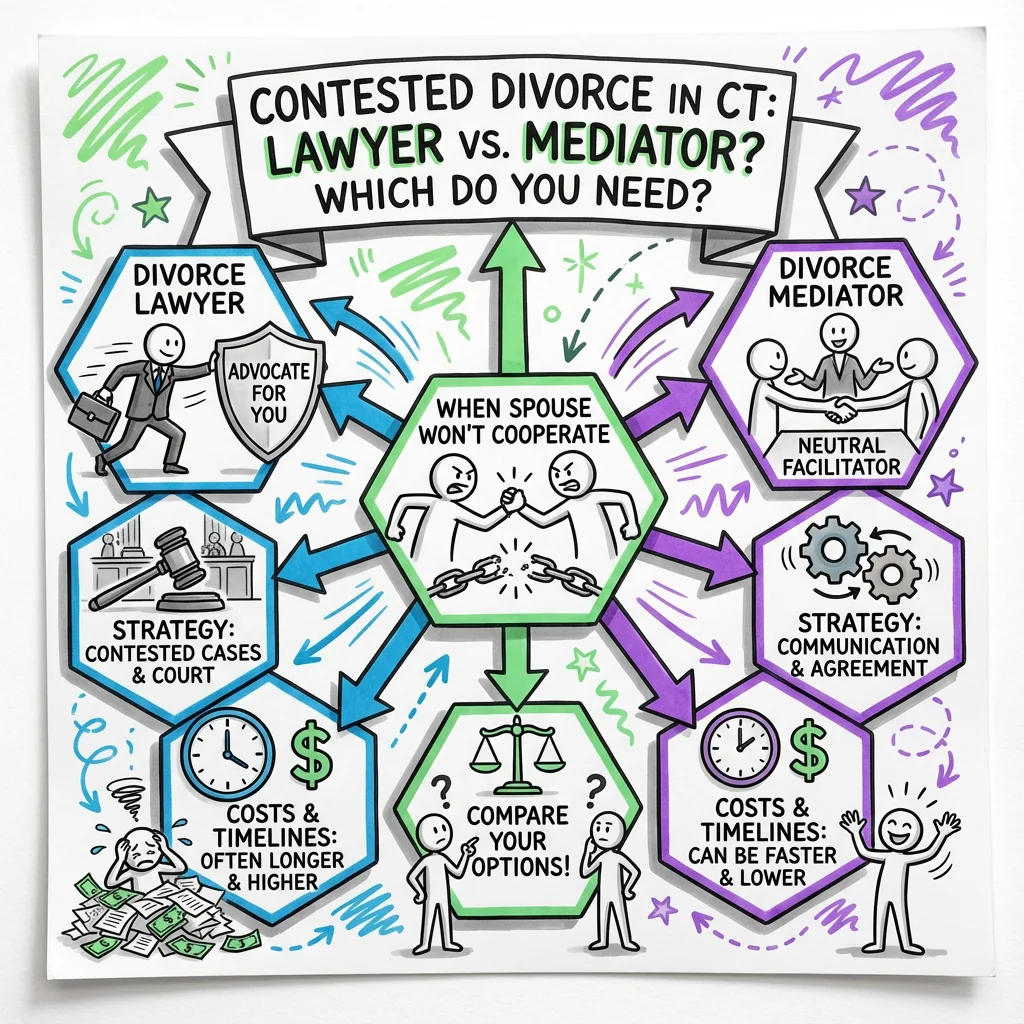
While full mediation is unlikely to work with an uncooperative spouse, there are scenarios where mediation-style approaches can still play a role in your contested divorce.
Court-Ordered Mediation
Connecticut judges often order parties to attempt mediation before trial, particularly on custody issues. Under Practice Book Rule § 25-50A, parties meet with a family relations counselor early in the case to identify areas of potential agreement. Even hostile spouses sometimes behave differently when ordered by a court to participate. Your lawyer prepares you for these sessions and helps you navigate them strategically.
Partial Mediation
You might agree on some issues (perhaps the parenting schedule) while fighting over others (like property division). Using mediation to resolve agreed-upon issues can narrow the scope of litigation and reduce costs. Your attorney guides you on which issues to attempt settling and which require courtroom resolution.
Post-Litigation Modifications
After your divorce is final, future disputes about custody modifications or support changes might be suitable for mediation—especially if time has cooled emotions. The adversarial posture during divorce doesn't necessarily continue forever.
The Connecticut Contested Divorce Process: What to Expect
Understanding the timeline and procedural steps helps you prepare mentally and practically for the road ahead.
Step-by-Step Process
-
Filing the Complaint - Your attorney files the Divorce Complaint (Form JD-FM-159) with the Superior Court in your judicial district, as required by C.G.S. § 46b-45. This officially starts the case.
-
Service of Process - Your spouse is formally served with the Summons (Form JD-FM-003), Complaint, and Notice of Automatic Orders (Form JD-FM-158). The 90-day waiting period begins.
-
Automatic Orders Take Effect - Under Practice Book Rule § 25-5, both parties are immediately prohibited from hiding assets, dissipating marital funds, changing insurance policies, or removing children from Connecticut without consent.
-
Spouse's Response - Your spouse has 30 days to file an Answer or Answer with Cross Complaint under Practice Book Rule § 25-9. An uncooperative spouse might ignore this deadline, which your attorney can use strategically.
-
Case Management Conference - You'll be assigned a "Pathway" track. Complex contested cases typically land in Track B or Track C, with corresponding timelines and court involvement.
-
Discovery Phase - Both sides exchange financial information, and your attorney can issue subpoenas, interrogatories, and deposition notices to gather evidence your spouse isn't providing voluntarily.
-
Temporary Orders Hearing - If needed, the court establishes temporary arrangements for custody, support, and use of marital assets while the case proceeds.
-
Negotiation and Settlement Attempts - Most cases settle before trial. Your lawyer negotiates from a position of strength, backed by evidence gathered during discovery.
-
Trial - If settlement fails, the judge hears evidence and decides all disputed issues. This can take one day or several weeks depending on complexity.
-
Final Judgment - The court enters the Dissolution Judgment, which becomes the binding legal document governing your post-divorce obligations and rights.
Throughout this process, Untangle's case management tools help you keep track of court filings, deadlines, and correspondence—essential when managing a complex contested case.
Protecting Yourself When Your Spouse Plays Dirty
An uncooperative spouse often escalates beyond mere disagreement into actively harmful behavior. Knowing your legal protections is essential.
Violations of Automatic Orders
If your spouse violates automatic court orders—draining bank accounts, hiding assets, making large purchases, or taking children out of state—your attorney can file a Motion for Contempt under Practice Book Rule § 25-27. The motion must state the specific order violated, the acts constituting contempt, and the relief you're requesting. Contempt findings can result in fines, jail time, and orders requiring your spouse to pay your attorney fees.
Hidden Assets and Income
Connecticut requires full financial disclosure. If you suspect your spouse is hiding income or assets, your lawyer can hire forensic accountants, subpoena business records, and depose your spouse under oath. Judges take financial dishonesty extremely seriously, and spouses caught hiding assets often face severe penalties in the final property division. Before your lawyer even begins formal discovery, tools like Untangle's smart bank statement analysis can help you identify suspicious transactions or undisclosed accounts, providing a crucial head start.
Custody Interference
If your spouse is interfering with your relationship with your children, documenting every incident is critical. Under C.G.S. § 46b-56, custody decisions must serve the children's best interests—and courts recognize that parents who obstruct the other parent's relationship are not acting in those best interests.
When to Get Professional Help
If your spouse has already demonstrated unwillingness to cooperate—ignoring your communications, threatening litigation, hiding financial information, or manipulating the children—consult with a Connecticut divorce attorney immediately. Don't waste time and money attempting mediation that will almost certainly fail.
The best time to hire a lawyer is before you file (or immediately after being served), when strategic decisions can position you advantageously for the entire case. Many attorneys offer initial consultations where you can discuss your situation and get a realistic assessment of your options. Ask about their experience with high-conflict cases, their approach to aggressive opposing parties, and their fee structure.
Untangle's AI legal guidance and financial affidavit generation tools can help you prepare for that first attorney meeting by organizing your financial picture, documenting your situation, and identifying the key issues in your case. Walking into a lawyer's office with clear, organized information demonstrates you're serious and saves significant attorney time—and your money.
Remember: in a contested divorce, you're not just ending a marriage—you're protecting your financial future, your relationship with your children, and your ability to move forward. Having the right professional in your corner makes all the difference.
Frequently Asked Questions
When is mediation not appropriate for a Connecticut divorce?
Mediation is not appropriate when one spouse refuses to participate voluntarily, hides assets, has a history of domestic abuse, or won't negotiate in good faith—since mediators cannot compel cooperation or protect your interests.
How much does a divorce lawyer cost compared to a mediator in CT?
Connecticut divorce mediation typically costs $3,000-$7,000 total for both parties, while a contested divorce with lawyers can range from $15,000-$50,000+ per spouse depending on complexity and litigation length.
Can I hire both a mediator and a lawyer for my Connecticut divorce?
Yes, many Connecticut couples use a mediator to negotiate terms while each spouse also retains a "review attorney" to provide independent legal advice and review the final agreement before signing.
What are the main advantages of divorce mediation over litigation in CT?
Divorce mediation in Connecticut is typically faster, less expensive, more private, and gives couples greater control over outcomes—but only works when both spouses are willing to cooperate and negotiate honestly.
How do I know if I need a divorce lawyer or mediator in Connecticut?
Choose a mediator if you and your spouse communicate reasonably well and agree on most issues; hire a divorce lawyer if your spouse is uncooperative, dishonest about finances, or the case involves domestic violence or complex assets.
Legal Citations
- • C.G.S. § 46b-40 View Source
- • C.G.S. § 46b-53a View Source
- • C.G.S. § 46b-45 View Source
- • C.G.S. § 46b-56 View Source
- • C.G.S. § 46b-62 View Source
- • Practice Book Rule § 25-50A View Source
- • Practice Book Rule § 25-5 View Source
- • Practice Book Rule § 25-9 View Source
- • Practice Book Rule § 25-27 View Source