Connecticut Joint Custody: A Complete Guide for Protective Parents
Learn how Connecticut joint custody works, including legal vs. physical custody, parenting plans, and how courts determine the best interests of your child.
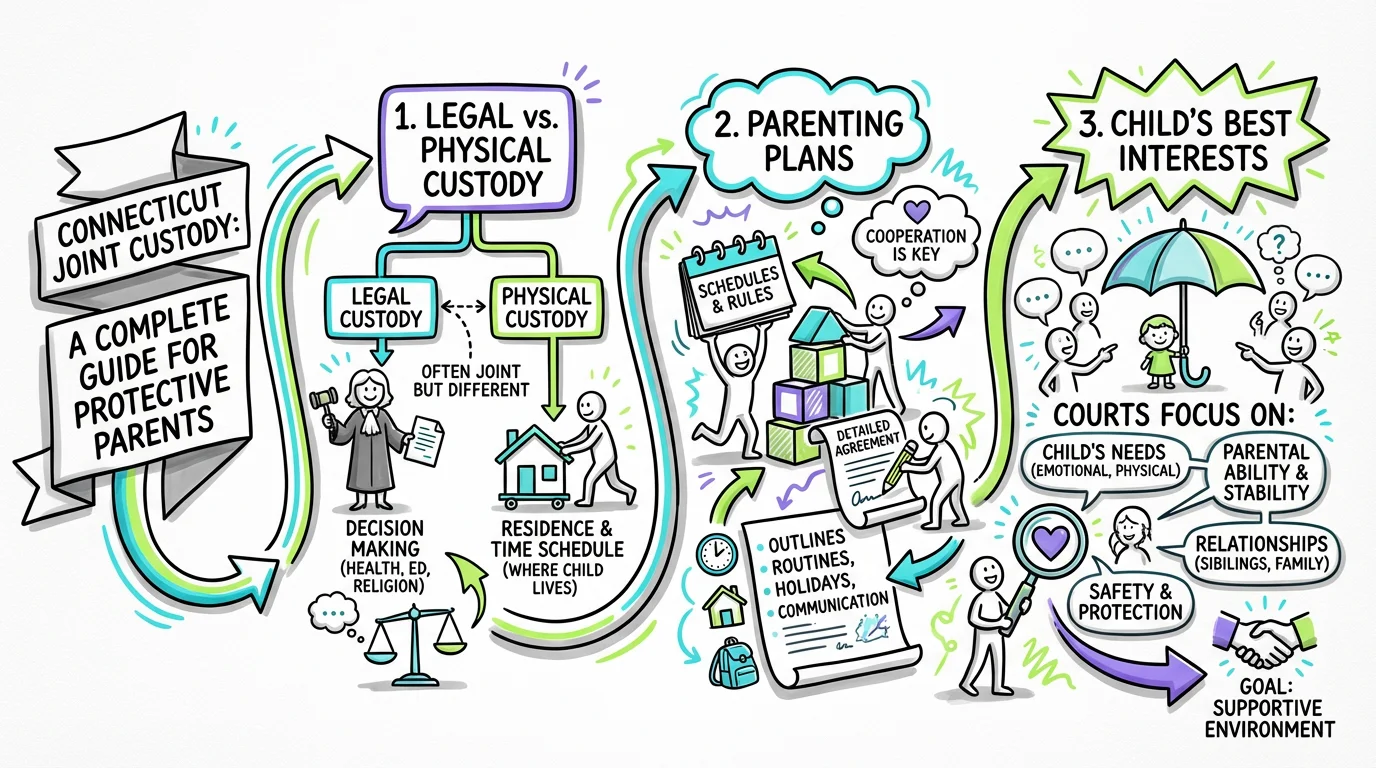
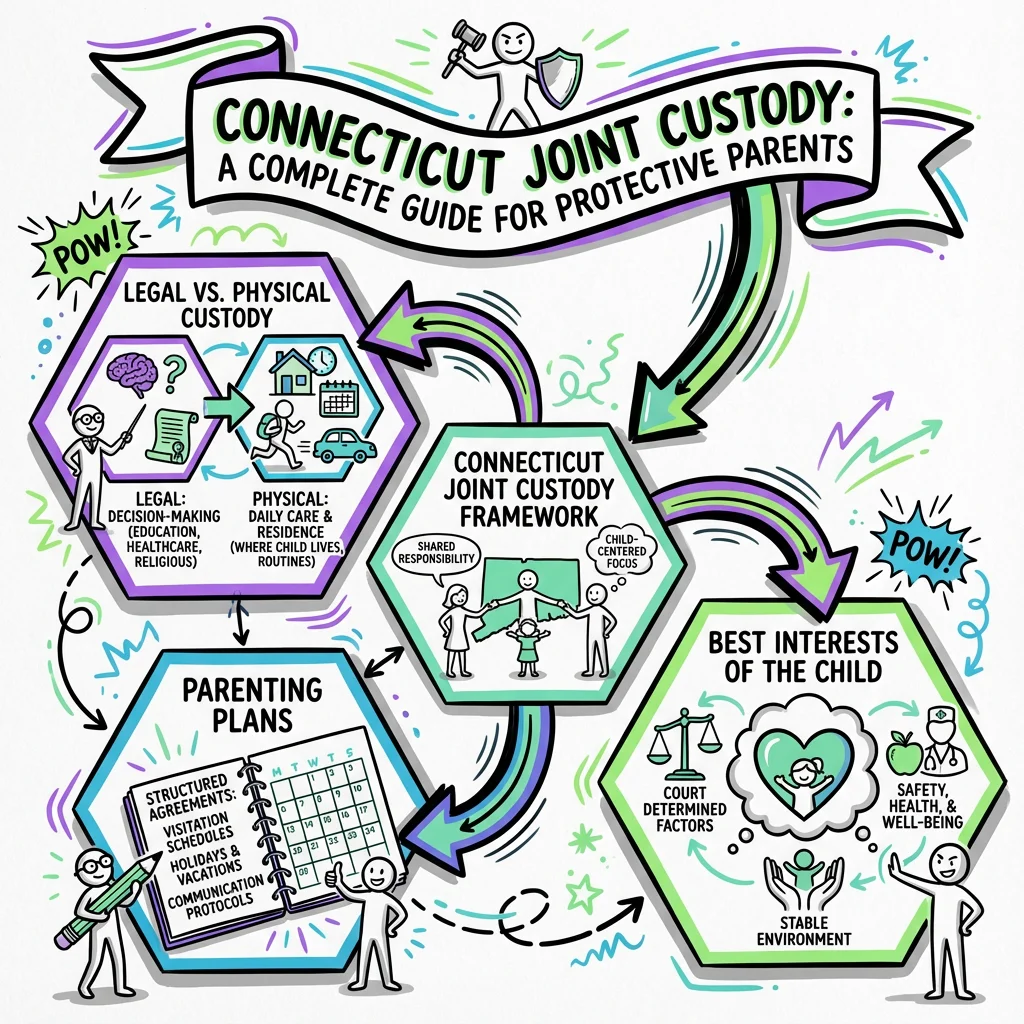
Connecticut law defines joint custody as an arrangement where both parents share legal custody of their minor child, participate in joint decision-making, and share physical custody in a way that ensures the child maintains continuing contact with both parents. Under C.G.S. § 46b-56a, courts can award joint legal custody even without joint physical custody when parents agree to that arrangement. This means you might share decision-making authority about your child's education, healthcare, and religious upbringing while your child primarily resides with one parent.
Understanding Joint Custody in Connecticut
When Connecticut courts consider custody arrangements, they start from a fundamental principle: the best interests of the child come first. This isn't just a phrase—it's the legal standard that guides every custody decision in the state. For parents who are primarily concerned about protecting their children during divorce, understanding exactly how Connecticut defines and implements joint custody is essential.
Joint custody in Connecticut has two distinct components that courts consider separately. Legal custody refers to decision-making authority—who gets to make important choices about your child's education, medical care, extracurricular activities, and religious upbringing. Physical custody, on the other hand, determines where your child actually lives and how parenting time is divided between households. These two types of custody can be arranged independently, giving courts flexibility to craft arrangements that truly serve each child's unique needs.
The Connecticut legislature has created a framework that recognizes both parents typically play vital roles in their children's lives. However, this doesn't mean joint custody is automatic or guaranteed. Courts evaluate each family's circumstances individually, and protective parents should understand that raising legitimate safety concerns about a child's wellbeing is not only appropriate but encouraged by the legal system.
Legal Custody vs. Physical Custody in Connecticut
Joint Legal Custody
Joint legal custody means both parents participate in major decisions affecting their child's life. This includes choices about schooling (public vs. private, which district), medical treatment (non-emergency procedures, therapy, medications), religious education, and significant extracurricular commitments. Under Connecticut law, parents with joint legal custody must communicate and cooperate on these decisions, even when they no longer live together.
For protective parents, joint legal custody can feel complicated when you have concerns about the other parent's judgment. Connecticut courts recognize this tension and can structure joint legal custody with specific provisions. For example, the court might grant final decision-making authority to one parent in certain areas (like medical decisions) while still requiring the other parent be consulted. This nuanced approach allows courts to protect children while still acknowledging both parents' roles.
When joint legal custody is awarded, both parents maintain equal access to their child's school records, medical information, and other important documents. Connecticut law specifically protects this access under C.G.S. § 46b-56, which ensures noncustodial parents can obtain records of their minor children. Tools like Untangle's Children's information management features can help you keep track of important communications and decisions, such as school records and medical information, which becomes crucial when co-parenting under a joint legal custody arrangement.
Joint Physical Custody and Shared Parenting Time
Joint physical custody in Connecticut means your child's residence is shared between both parents' homes. According to the Connecticut Child Support Guidelines, "shared physical custody" specifically refers to arrangements where the child has "substantially equal time and contact with both parents." However, the guidelines clarify that exactly equal sharing isn't required—what matters is that both parents have meaningful, ongoing presence in the child's daily life.
Physical custody arrangements vary widely based on each family's circumstances. Some parents alternate weeks, while others divide time differently based on work schedules, the child's school location, or developmental needs. Connecticut courts look at practical factors like the distance between parents' homes, each parent's work schedule, the child's age and preferences (for older children), and any special needs the child may have.
For parents concerned about their child's safety or wellbeing during time with the other parent, Connecticut law provides mechanisms for protection. Courts can order supervised visitation, restrict overnight stays, or impose other conditions when circumstances warrant. The key is presenting specific, documented concerns rather than general objections to the other parent.
How Connecticut Courts Determine Joint Custody
The Best Interests Standard
Every custody decision in Connecticut is governed by the "best interests of the child" standard outlined in C.G.S. § 46b-56. This isn't a checklist that courts mechanically follow—it's a holistic evaluation of what arrangement will best support your child's physical, emotional, and developmental needs. Courts consider factors including each parent's ability to meet the child's needs, the stability of each parent's home environment, and the child's existing relationships with siblings, extended family, and their community.
Connecticut courts also examine each parent's willingness and ability to facilitate a relationship between the child and the other parent. This is particularly important in joint custody cases. A parent who consistently undermines the child's relationship with the other parent, makes false allegations, or refuses to communicate may find courts less inclined to award them primary physical custody. Conversely, a parent who demonstrates genuine cooperation while still advocating for legitimate safety concerns often gains credibility with the court.
The court may also consider a child's preferences, particularly for older children who can articulate their wishes. Under C.G.S. § 46b-54, the court can appoint a guardian ad litem to represent the child's interests or counsel to advocate for the child's expressed preferences. This appointment helps ensure children's voices are heard while protecting them from being caught in the middle of parental disputes.
The Role of Family Relations and Custody Evaluations
Connecticut's Family Relations Unit plays a significant role in contested custody cases. Under Practice Book Rule § 25-61, the court can request that Family Relations assist with custody matters, including performing evaluations. These evaluators interview both parents, may interview the children, observe parent-child interactions, and sometimes visit each parent's home.
For protective parents, the custody evaluation process is an opportunity to present documented concerns in a professional setting. Evaluators are trained to assess factors like domestic violence history, substance abuse issues, mental health concerns, and parenting capabilities. If you have legitimate concerns about your child's safety with the other parent, the evaluation process allows these concerns to be professionally assessed.
Preparing for a custody evaluation requires organization and clarity. Having a clear record of your involvement in your child's life, any incidents that concern you, and evidence of your child's needs can help evaluators understand your family's situation. Untangle's Case details management tools can help you organize this information systematically, ensuring you can present your concerns clearly and thoroughly for evaluators.
Creating a Parenting Plan in Connecticut
Required Elements of a Parental Responsibility Plan
When parents seek joint custody in Connecticut, the court requires a detailed parenting plan—officially called a "parental responsibility plan" under C.G.S. § 46b-56a. This plan must address how parents will share decision-making, how physical time will be divided, and how parents will communicate about the child's needs. A well-crafted parenting plan reduces future conflict by anticipating common disagreements and establishing clear protocols.
Your parenting plan should include a detailed residential schedule specifying where your child will be on regular weeks, holidays, school breaks, and special occasions like birthdays. It should also outline how parents will make major decisions together, including what happens if they disagree. Many plans include provisions for a tie-breaker mechanism, such as mediation or giving one parent final authority in specific areas.
For protective parents, the parenting plan is also where you can build in safeguards. If you have concerns about the other parent's substance use, for example, the plan might include provisions about alcohol consumption during parenting time. If communication has been difficult, the plan might require all communication go through a co-parenting app or email. These provisions, once incorporated into a court order, become enforceable.
Practical Scheduling Considerations
| Arrangement Type | Description | Typical Time Split | Best Suited For |
|---|---|---|---|
| Week-on/Week-off | Child alternates full weeks with each parent | 50/50 | Parents living close together, older children |
| 5-2-2-5 Schedule | Child spends 5 days with one parent, then 2, then 2, then 5 with the other | 50/50 | Parents wanting more frequent contact |
| Every Other Weekend Plus | Primary residence with one parent, other parent has alternating weekends and one weekday | 70/30 to 80/20 | Younger children, parents living farther apart |
| 2-2-3 Schedule | Alternating two days, two days, three days | 50/50 | Parents wanting consistent mid-week contact |
When negotiating a parenting schedule, consider your child's age, temperament, and specific needs. Very young children often do better with more frequent transitions but shorter time away from their primary attachment figure. School-age children may prefer longer stretches that allow them to settle into routines at each home. Teenagers typically want more input into scheduling and may resist rigid arrangements that conflict with their social lives.
Untangle's parenting plan builder can help you visualize different custody arrangements and understand how they'll work in practice. Seeing the actual calendar can reveal potential problems—like realizing a proposed schedule means your child would miss every Tuesday soccer practice at one parent's house.
Try our free CT child support calculator
Calculate your estimated child support using Connecticut's official guidelines formula.
Automatic Orders and Protections During Divorce
Understanding Connecticut's Automatic Orders
From the moment a divorce case is filed in Connecticut, automatic orders take effect that protect both children and property. Under Practice Book Rule § 25-5, these orders apply to both parties immediately and remain in force until the court modifies them. For parents concerned about their children's safety, these automatic orders provide important protections.
Most critically for custody matters, the automatic orders prohibit either parent from permanently removing the children from Connecticut without the other parent's written consent or a court order. This prevents one parent from unilaterally relocating with the children during the divorce process. The orders also require that if a parent vacates the family residence, they must provide a mailing address within 48 hours.
The automatic orders also establish that parents living apart must "help the children have contact with both parents." This doesn't mean you must agree to any arrangement the other parent proposes—it means both parents have an obligation to facilitate the relationship rather than obstruct it. If you have legitimate concerns about the children's contact with the other parent, the appropriate path is seeking court-ordered protections, not unilateral restrictions.
When Additional Protections Are Needed
If you believe your child is at risk during time with the other parent, Connecticut law provides several protective mechanisms beyond the automatic orders. You can file an emergency motion requesting supervised visitation if there's evidence of abuse, substance abuse, or other immediate dangers. Courts take these motions seriously and will act quickly when children's safety is at stake.
For situations involving domestic violence, Connecticut courts can issue protective orders that restrict contact and establish safe exchange protocols for custody transfers. The court may also appoint a guardian ad litem under C.G.S. § 46b-54 to independently investigate and report on the children's needs and any safety concerns. This professional perspective can be particularly valuable when parents have very different accounts of family dynamics.
Documenting your concerns carefully and objectively is essential. Courts distinguish between legitimate safety concerns backed by specific incidents and general complaints that appear motivated by animosity toward the other parent. Keep records of concerning incidents, including dates, what happened, any witnesses, and any impact on your child. Untangle's Case details management features can help you maintain organized, timestamped records of concerning incidents that will be credible to the court.
Steps to Establish Joint Custody in Connecticut
-
File the appropriate paperwork: If you're divorcing, file a Dissolution of Marriage complaint (form JD-FM-159). If you're not married to the other parent, file an Application for Custody under C.G.S. § 46b-61 in the judicial district where either parent resides.
-
Complete required supporting documents: You'll need an Affidavit Concerning Children as required by Practice Book Rule § 25-57, a Financial Affidavit (form JD-FM-006), and potentially other documents depending on your situation.
-
Understand the automatic orders: Review the Notice of Automatic Court Orders (form JD-FM-158) carefully. These restrictions on removing children from the state and other provisions take effect immediately upon service.
-
Attend required parent education: Connecticut requires divorcing parents with minor children to attend a court-approved parent education program. This focuses on helping children cope with divorce and establishing effective co-parenting. Tools like Untangle's parent education tracking features can help you manage and stay on top of these required programs and deadlines.
-
Participate in mediation if ordered: Many Connecticut courts refer custody disputes to the Family Relations Unit for mediation before trial. Come prepared with a proposed parenting plan and supporting documentation.
-
Develop your parenting plan: Draft a detailed proposal addressing legal custody, physical custody schedules, holiday arrangements, and decision-making protocols. The more specific your plan, the fewer disputes you'll face later.
-
Attend court hearings: If you and the other parent cannot reach agreement, the court will schedule hearings to determine custody. Come prepared to explain why your proposed arrangement serves your child's best interests.
Modifying Joint Custody Orders
Joint custody arrangements established by the court aren't necessarily permanent. Under Practice Book Rule § 25-26, either parent can request modification of custody orders when circumstances have substantially changed since the original order. This might include a parent relocating, a significant change in a child's needs, or new concerns about a child's safety.
To modify custody, you must demonstrate both that circumstances have changed substantially and that modification would serve the child's best interests. Courts won't modify custody simply because one parent is unhappy with the current arrangement or because the child occasionally complains. However, documented evidence of problems—such as the other parent consistently failing to follow the parenting plan, substance abuse issues developing, or the child experiencing genuine distress—can support a modification request.
For protective parents, the modification process provides an ongoing mechanism to address emerging concerns. If you agreed to an arrangement that's proving problematic for your child, or if the other parent's circumstances have changed in ways that affect your child's wellbeing, you have legal options. Consulting with a family law attorney can help you understand whether your situation meets the threshold for modification.
When to Seek Professional Help
While many Connecticut parents successfully negotiate joint custody arrangements without extensive legal battles, some situations require professional assistance. If there's any history of domestic violence, child abuse, substance abuse, or mental health issues that affect parenting, working with an experienced family law attorney is essential. These cases involve nuanced legal protections and evidentiary requirements that are difficult to navigate alone.
Even in less contentious situations, consulting with an attorney can help you understand your rights and avoid common mistakes. Many protective parents inadvertently harm their custody position by making unilateral decisions (like restricting the other parent's access without court approval) that courts view unfavorably. An attorney can help you take appropriate protective steps while maintaining your credibility with the court.
Consider also working with a child therapist who can provide professional observations about your child's adjustment and needs. Their input can be valuable in both negotiations and court proceedings, providing objective evidence about what arrangement best serves your child.
Frequently Asked Questions
What is the difference between joint legal custody and joint physical custody in Connecticut?
Joint legal custody in Connecticut means both parents share decision-making authority over education, healthcare, and religious upbringing, while joint physical custody determines where the child lives and how parenting time is divided between households.
How do I file for joint custody in Connecticut?
To file for joint custody in Connecticut, you must submit a custody petition to the Superior Court in your judicial district, either as part of a divorce filing or as a separate custody action if unmarried.
What factors do Connecticut courts consider when deciding joint custody?
Connecticut courts use the "best interests of the child" standard under C.G.S. § 46b-56, evaluating factors such as each parent's involvement, the child's needs, parental cooperation ability, and any history of domestic violence or safety concerns.
Can a father get joint custody in Connecticut?
Yes, fathers have equal rights to seek joint custody in Connecticut, as the law does not favor either parent based on gender and courts evaluate custody based solely on the child's best interests.
Can I relocate with my child if I have joint custody in Connecticut?
Connecticut requires parents with joint custody to provide written notice and often obtain court approval before relocating with a child, especially if the move would significantly impact the other parent's custody time.
Legal Citations
- • C.G.S. § 46b-56a View Source
- • C.G.S. § 46b-56 View Source
- • C.G.S. § 46b-54 View Source
- • C.G.S. § 46b-61 View Source
- • Practice Book Rule § 25-5 View Source
- • Practice Book Rule § 25-26 View Source
- • Practice Book Rule § 25-57 View Source
- • Practice Book Rule § 25-61 View Source
- • JD-FM-159 View Source
- • JD-FM-158 View Source
- • JD-FM-006 View Source