Connecticut Contested Divorce: What to Expect When Your Spouse Won't Cooperate
Learn how contested divorces work in Connecticut when your spouse won't cooperate. Understand the process, timeline, costs, and what to expect in CT family court.
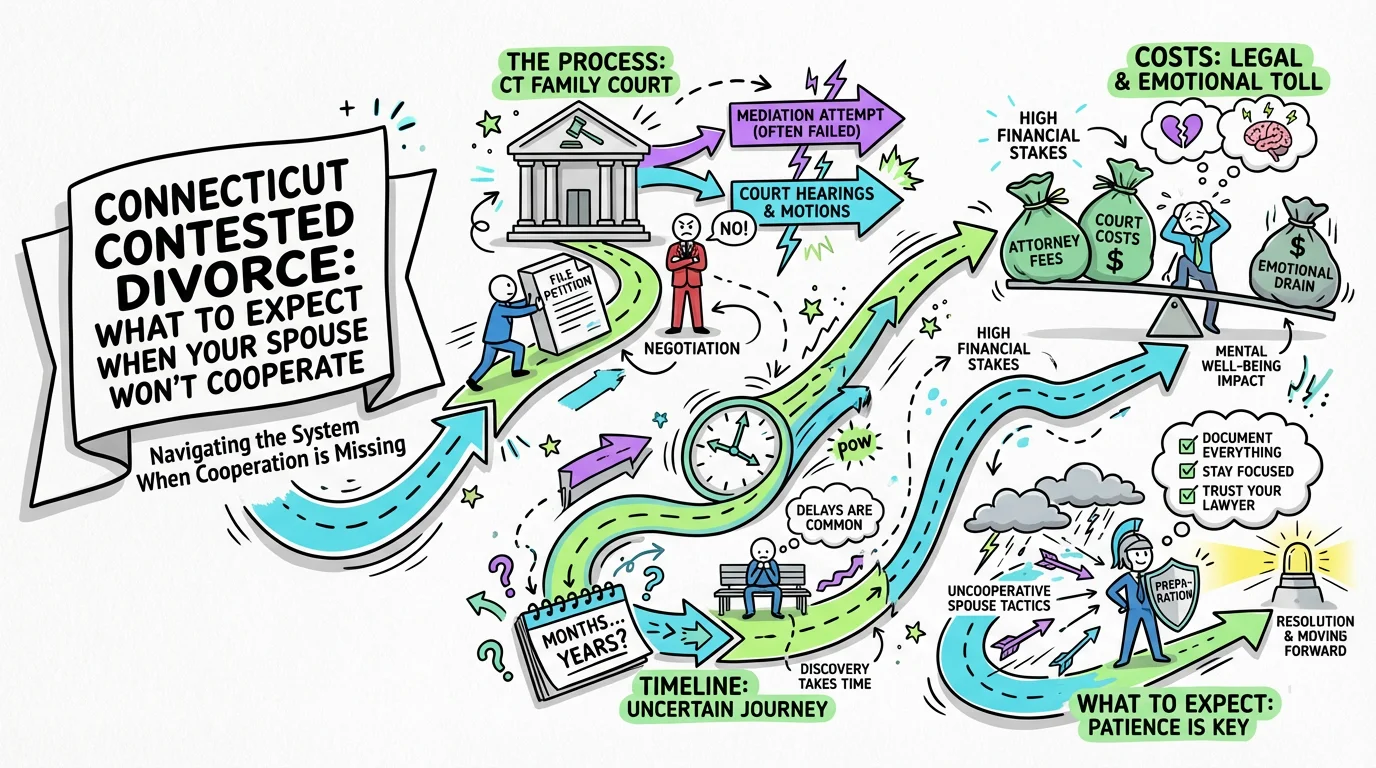
A contested divorce in Connecticut occurs when spouses cannot agree on one or more key issues—such as property division, alimony, child custody, or child support—and need the court to decide for them. Unlike an uncontested divorce where both parties reach a full agreement, a contested case requires litigation, evidence presentation, and ultimately a judge's decision on disputed matters. Under Connecticut law (C.G.S. § 46b-67), the court cannot proceed on a dissolution complaint until at least ninety days after the return date, giving both parties time to prepare their cases and attempt settlement before trial.
Understanding Contested Divorce in Connecticut
When your spouse refuses to cooperate or actively disputes your divorce terms, you're facing what family courts call a "contested" matter. This doesn't mean your divorce is impossible—it simply means the resolution path runs through the Connecticut Superior Court's family division rather than through mutual agreement. Connecticut is a "no-fault" divorce state, meaning you don't need to prove your spouse did something wrong. Under C.G.S. § 46b-40, you only need to establish that "the marriage has broken down irretrievably"—and your spouse cannot block the divorce simply by refusing to participate.
The contested divorce process in CT is designed to protect both parties' rights while ensuring fair outcomes for any children involved. Even if your spouse ignores the proceedings entirely, the court will still hear your case and issue orders. However, if your spouse actively contests the divorce by filing an Answer and Cross Complaint (as permitted under Practice Book Rule § 25-9), you should prepare for a longer, more complex process that may require multiple court appearances, discovery exchanges, and potentially a full trial.
Many divorces start as contested but eventually settle before trial. Connecticut courts strongly encourage settlement through mediation and pretrial negotiations. However, having a clear understanding of the contested process empowers you to make informed decisions about when to negotiate and when to stand firm on issues that matter most to you.
How the Contested Divorce Process Works
Filing and Service Requirements
A contested divorce begins the same way as any Connecticut divorce: by filing a complaint for dissolution of marriage in the Superior Court for the judicial district where either spouse resides. Under C.G.S. § 46b-45, you must serve your spouse with the complaint along with a blank appearance form, giving them formal notice of the proceedings. This service can be accomplished by a state marshal or through certified mail if your spouse waives formal service. To streamline the preparation of these and other necessary court forms, consider using Untangle's automatic document generation.
Once service is complete, automatic orders take effect immediately under Practice Book Rule § 25-5. These orders prohibit both parties from hiding assets, removing children from Connecticut, canceling insurance policies, or making major financial changes without court permission. These protections apply regardless of whether your spouse cooperates, providing crucial stability during the divorce process.
Your spouse has a specific timeframe to respond to your complaint. They can file an Answer admitting or denying your allegations, or file an Answer with a Cross Complaint that asserts their own grounds for divorce and specifies the relief they're seeking. If your spouse fails to respond at all, you can proceed with a default judgment—though the court will still require you to prove your case.
Mandatory Disclosure and Discovery
In contested cases, both parties must exchange extensive financial information. Practice Book Rule § 25-32 requires automatic disclosure within 60 days of a request, including three years of tax returns, bank statements for all accounts over the past 24 months, retirement account statements, and documentation for any closely held businesses. This mandatory disclosure ensures neither party can hide assets or misrepresent their financial situation.
Beyond automatic disclosure, contested divorces often involve formal discovery—depositions, interrogatories, and requests for production of documents. If you suspect your spouse is hiding assets or income, discovery tools allow you to compel disclosure under penalty of perjury. The court takes financial dishonesty seriously, and judges have broad discretion to sanction parties who fail to comply with discovery obligations.
Tools like Untangle's complete asset inventory can help you track and organize the financial documents you'll need during discovery. Having your financial records well-organized from the start makes the disclosure process smoother and helps your attorney identify any discrepancies in your spouse's filings.
Financial Affidavits and Court Filings
Practice Book Rule § 25-30 requires each party to file sworn financial statements at least five business days before any hearing involving alimony, support, or counsel fees. These detailed affidavits must show current income, expenses, assets, and liabilities in the Judicial Branch's required format. Updated statements must be filed within 30 days before any final judgment.
The Financial Affidavit form (JD-FM-006) is a critical document in contested cases. Judges rely heavily on these sworn statements when making decisions about property division, alimony, and child support. Any inconsistencies between your financial affidavit and your disclosed documents can damage your credibility and affect the court's decisions.
Key Issues in Contested Connecticut Divorces
Property Division Disputes
Connecticut follows the principle of "equitable distribution" rather than automatic 50/50 splits. Under C.G.S. § 46b-81, the court may assign "all or any part of the estate of the other spouse" based on numerous factors, including the length of the marriage, the causes for the dissolution, each spouse's age, health, occupation, employability, and contributions to the marriage (including homemaking). The court can also consider each party's future earning capacity and needs.
In the Walker v. Walker case, Connecticut's Appellate Court emphasized that trial courts must consider each statutory factor when distributing marital property. A spouse who claims the court ignored required factors faces an uphill battle on appeal if the court stated it considered all relevant factors. This means your contested divorce must present evidence addressing each statutory criterion to give the court a complete picture.
Property disputes often center on complex assets like businesses, stock options, pensions, or real estate. The court has broad authority to "pass title to real property to either party or to a third person or may order the sale of such real property" as needed to fairly divide the marital estate. If your spouse is fighting over specific assets, be prepared to provide valuations and argue why a particular distribution serves equity.
Alimony Battles
Alimony (spousal support) is frequently contested because it involves ongoing financial obligations that can last for years. Under C.G.S. § 46b-82, the court considers factors including the length of the marriage, the causes for dissolution, each spouse's age, health, station, occupation, amount and sources of income, employability, and the needs and means of each party. Connecticut courts also consider any premarital or post-marital agreement regarding alimony.
One of the most contentious aspects of alimony is duration. Longer marriages often result in longer alimony awards, and lifetime alimony remains possible in Connecticut for marriages of significant duration, particularly when one spouse sacrificed career advancement for the family. If you anticipate a fight over alimony, Untangle's alimony calculator can help you understand likely outcomes based on Connecticut guidelines and case law.
Child Custody and Support Conflicts
When children are involved, custody disputes can become the most emotionally charged aspect of a contested divorce. Connecticut uses the "best interests of the child" standard, considering factors like each parent's relationship with the children, the children's adjustment to home and school, and each parent's willingness to facilitate the other's relationship with the children.
Connecticut follows the Income Shares Model for child support, as outlined in the Child Support Guidelines. This model presumes children should receive the same proportion of parental income they would have received if the parents lived together. To estimate potential child support obligations or receipts, use Untangle's child support calculator based on Connecticut's guidelines. When parents' combined net weekly income exceeds $4,000, courts determine support on a case-by-case basis considering statutory criteria.
The Child Support Guidelines Worksheet (CCSG-001) is required in any case involving minor children. Deviation from the presumptive support amount requires specific findings that the calculated amount "would be inequitable or inappropriate" under the circumstances. If you're contesting child support calculations, you'll need to present evidence supporting one of the recognized deviation criteria.

Try our free CT alimony calculator
Get an instant estimate based on Connecticut's statutory factors. No signup required.
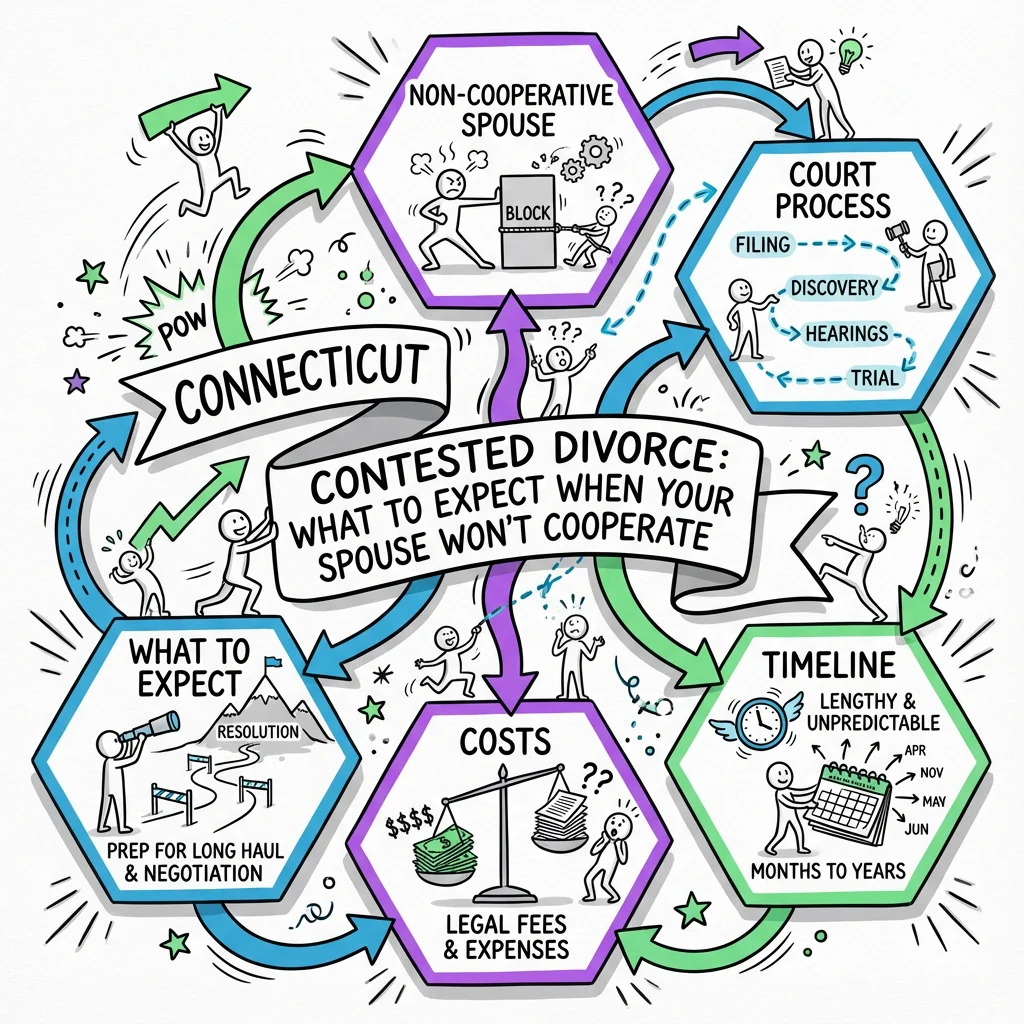
Timeline and Costs of Contested Divorce
| Factor | Uncontested Divorce | Contested Divorce |
|---|---|---|
| Minimum Duration | 90 days after return date | 12-24+ months |
| Court Appearances | 1-2 (may be waived) | Multiple hearings + trial |
| Attorney Fees | $1,500-$5,000 | $15,000-$100,000+ |
| Discovery | Minimal | Extensive |
| Expert Witnesses | Rarely needed | Often required |
| Emotional Toll | Lower | Significantly higher |
The timeline for a contested divorce depends heavily on the complexity of your issues and your spouse's level of opposition. Under C.G.S. § 46b-67, the court cannot enter a judgment until at least 90 days after the return date—but contested cases rarely resolve that quickly. Most contested divorces in Connecticut take 12 to 24 months, and complex cases involving business valuations or significant custody disputes can extend even longer.
Costs escalate quickly in contested matters. Every hearing, motion, and discovery dispute generates attorney fees. Expert witnesses—custody evaluators, forensic accountants, business appraisers—add thousands of dollars.
Steps to Navigate Your Contested Divorce
-
Gather and organize all financial documents before filing. Bank statements, tax returns, pay stubs, retirement account statements, property deeds, and vehicle titles should all be accessible. Complete documentation strengthens your position and speeds up mandatory disclosure.
-
File your complaint and serve your spouse properly. Use Form JD-FM-159 (Dissolution of Marriage Complaint) and Form JD-FM-003 (Summons). Proper service ensures your spouse cannot later claim they weren't notified.
-
Review and comply with automatic orders immediately. Practice Book Rule § 25-5 automatic orders take effect upon service and prohibit asset dissipation, child removal from CT, and insurance cancellation. Violating these orders damages your credibility with the court.
-
Complete mandatory disclosure within 60 days of your spouse's request. Organize documents by category and maintain copies of everything you provide.
-
File your financial affidavit using the court-required format at least five business days before any hearing on support or fees. Update this document within 30 days of any final hearing.
-
Attend all court dates and case management conferences. Judges notice who appears prepared and cooperative versus who creates obstacles. Your conduct throughout the process influences judicial perception.
-
Explore settlement opportunities even while preparing for trial. Mediation or four-way settlement conferences often resolve cases more favorably than leaving decisions to a judge who has limited time to understand your family's unique circumstances.
-
Prepare thoroughly for trial if settlement fails. This means organizing exhibits, preparing witness lists, and being ready to testify about every claim in your complaint and every item in your financial affidavit.
When to Get Professional Help
While Connecticut permits self-representation, contested divorces involve complex procedural rules and high stakes that usually warrant professional assistance. Consider hiring an attorney if your spouse has retained one, if significant assets are at stake, if you're fighting for custody, or if your spouse is being dishonest about finances. The power imbalance of one represented party against one self-represented party can significantly affect outcomes.
Even if you handle much of the process yourself, consulting with an attorney for strategic advice at critical junctures—like before depositions or settlement conferences—can be invaluable. Family law attorneys understand local judges' tendencies, realistic settlement ranges, and procedural requirements that can trip up self-represented parties. If cost is a concern, some attorneys offer limited-scope representation, handling only specific aspects of your case while you manage the rest with tools like Untangle's personalized task dashboard.
Remember that contested doesn't mean permanent conflict. Many cases that begin contentiously resolve through negotiation once both parties understand the likely outcomes. Courts generally favor settlement because it gives families more control over their futures and produces agreements parties are more likely to follow. Even in battle mode, keep your mind open to resolution—your ultimate goal is a fair outcome that allows you to move forward with your life.
Frequently Asked Questions
What are the filing requirements for a contested divorce in Connecticut?
To file a contested divorce in Connecticut, you must file a Summons and Complaint for Dissolution of Marriage with the Superior Court, serve your spouse properly, and meet the state's residency requirement of living in CT for at least 12 months before filing.
How long does a contested divorce take in Connecticut?
A contested divorce in Connecticut typically takes 6 months to over a year, as the court cannot proceed until at least 90 days after the return date under C.G.S. § 46b-67, and complex cases requiring trial take significantly longer.
What happens at a contested divorce hearing in CT?
At a contested divorce hearing in Connecticut, both parties present evidence and testimony on disputed issues like property division, custody, and support, and a judge makes binding decisions on matters the spouses cannot resolve themselves.
Do I need a lawyer for a contested divorce in Connecticut?
While not legally required, hiring an experienced Connecticut family law attorney is strongly recommended for contested divorces due to complex court procedures, discovery requirements, and the need to protect your rights regarding assets and custody.
Can my spouse block a contested divorce in Connecticut?
No, your spouse cannot block a divorce in Connecticut because it is a no-fault state—under C.G.S. § 46b-40, you only need to prove the marriage has irretrievably broken down, and the court will proceed even if your spouse refuses to participate.
Legal Citations
- • C.G.S. § 46b-67 View Source
- • C.G.S. § 46b-40 View Source
- • Practice Book Rule § 25-9 View Source
- • C.G.S. § 46b-45 View Source
- • Practice Book Rule § 25-5 View Source
- • Practice Book Rule § 25-32 View Source
- • Practice Book Rule § 25-30 View Source
- • C.G.S. § 46b-81 View Source
- • C.G.S. § 46b-82 View Source