Connecticut Child Custody Agreement Template: A Parent's Guide to Protecting Your Children
Learn how to create a comprehensive Connecticut child custody agreement that protects your children's wellbeing. Includes required elements, parenting plans, and legal guidelines.
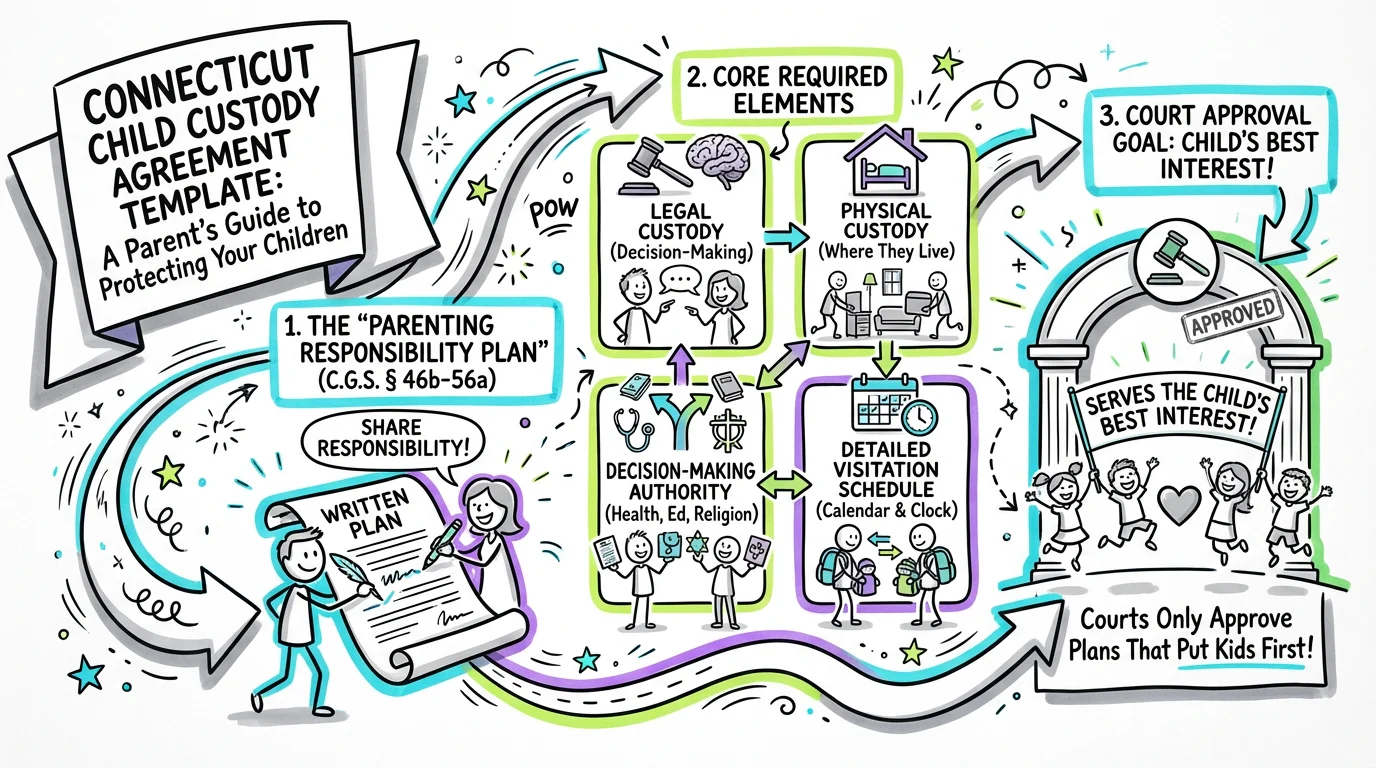
A Connecticut child custody agreement (officially called a "parenting responsibility plan") must include specific provisions about legal custody, physical custody, decision-making authority, and a detailed visitation schedule. Under C.G.S. § 46b-56a, Connecticut courts require parents to submit a written plan that addresses how both parents will share responsibility for raising their children—and the court will only approve agreements that serve the child's best interests.
Creating a custody agreement that truly protects your children requires more than filling in blanks on a template. Connecticut law sets clear standards that every parenting plan must meet, and the court has final authority to modify or reject any agreement that doesn't adequately address your children's needs. This guide walks you through every element your custody agreement must contain, with practical guidance on how to structure provisions that prioritize your children's stability and wellbeing.
Understanding Connecticut Custody Agreements
What Connecticut Law Requires
Connecticut distinguishes between two types of custody that your agreement must address separately. Legal custody refers to decision-making authority over major aspects of your child's life—education, healthcare, religious upbringing, and extracurricular activities. Physical custody determines where your child lives and the day-to-day parenting schedule. Under C.G.S. § 46b-56a, the court may award joint legal custody without awarding joint physical custody, which is actually the most common arrangement in Connecticut.
The court presumes that some form of joint custody arrangement serves children's best interests, but this presumption can be overcome by evidence showing otherwise. When reviewing your proposed agreement, the judge will examine whether it genuinely facilitates "continuing contact with both parents" as required by statute. If your agreement appears designed to minimize the other parent's involvement without legitimate justification, the court may reject it or impose modifications.
The "Best Interests" Standard
Every custody decision in Connecticut—whether made by agreement or court order—must satisfy the "best interests of the child" standard outlined in C.G.S. § 46b-56. This isn't just legal language; it's the lens through which every provision in your agreement will be evaluated. The statute lists specific factors the court considers, including:
- The child's developmental needs
- The parents' ability to meet those needs
- Each parent's willingness to encourage a relationship with the other parent
- The stability of each proposed living arrangement
Understanding these factors helps you draft provisions that will survive court scrutiny. For example, if you propose that you have sole decision-making authority over education, you'll need to explain why this serves your child's interests—not just your preferences. Tools like Automatic document generation can help you review your draft agreement against Connecticut's legal requirements before you submit it to the court.
Essential Elements of a Connecticut Parenting Plan
Legal Custody Provisions
Your agreement must specify exactly how major decisions about your children will be made. Connecticut recognizes three approaches: sole legal custody (one parent makes all major decisions), joint legal custody (both parents share decision-making), or a hybrid approach (dividing authority by category). For most families, joint legal custody with clear protocols for resolving disagreements works best—and aligns with Connecticut's statutory presumption favoring joint arrangements.
When drafting legal custody provisions, get specific. Rather than stating "parents will share medical decisions," specify: "Both parents must consent to non-emergency medical procedures, elective surgeries, and medication changes. Either parent may authorize routine care and emergency treatment, with notification to the other parent within 24 hours." This level of detail prevents future conflicts and demonstrates to the court that you've thoughtfully considered your children's needs.
Consider including a dispute resolution mechanism for when parents disagree. Many Connecticut parenting plans include a "tie-breaker" provision—perhaps designating one parent as the final decision-maker for education and the other for healthcare, or requiring mediation before either parent can seek court intervention. The court generally favors agreements that keep parents out of litigation.
Physical Custody and Parenting Time Schedules
The physical custody section of your agreement should leave nothing to chance. Connecticut courts expect detailed schedules covering: regular weekly parenting time, holiday and school vacation schedules, summer arrangements, transportation logistics, and procedures for schedule changes. Vague language like "reasonable visitation" invites conflict and may prompt the court to impose its own detailed order.
| Schedule Component | What to Include |
|---|---|
| Regular Schedule | Specific days/times for each parent, pickup/dropoff locations |
| Holidays | Exact dates, rotation pattern (odd/even years), pickup times |
| School Breaks | Winter, spring, summer vacation divisions |
| Special Days | Birthdays, Mother's/Father's Day, religious holidays |
| Transportation | Who drives, meeting location, handling of delays |
| Communication | Phone/video call schedule when child is with other parent |
The level of detail required in these schedules can be overwhelming to manage. To simplify the process and ensure all crucial details about your children's routines, medical needs, and schedules are centrally organized and accessible to both parents, consider using Untangle's children info tracker.
Your schedule should account for your children's ages and developmental needs. What works for a teenager won't work for a toddler. Young children often benefit from more frequent transitions to maintain bonds with both parents, while older children may prefer longer blocks of time. Be honest with yourself about what schedule genuinely serves your children versus what feels fair to you as a parent.
Geographic Restrictions and Relocation
Connecticut's automatic court orders (Practice Book § 25-5) prohibit either parent from permanently removing children from the state without written consent or court approval. Your agreement should address this directly and establish procedures for any future relocation requests. Consider including: advance notice requirements (typically 60-90 days), the specific information that must be provided (new address, reason for move, proposed revised schedule), and a process for attempting to reach agreement before involving the court.
Relocation provisions protect your children's stability while acknowledging that circumstances change. Courts have upheld agreements requiring the relocating parent to bear additional transportation costs or to fly children for visits. Whatever you agree to now, understand that Connecticut courts retain authority to modify custody arrangements if a proposed relocation would significantly impact the children.
Creating Provisions That Protect Your Children
Health and Safety Protections
If you have concerns about your children's safety with the other parent, your agreement can include specific protective provisions—but they must be reasonable and evidence-based. Connecticut courts take safety seriously, and provisions addressing substance abuse, mental health, or domestic violence can be appropriate when supported by documented concerns.
Protective provisions might include:
- Supervised visitation during a transition period
- Drug or alcohol testing requirements
- Prohibitions on overnight guests of romantic partners
- Requirements that certain individuals not be present during parenting time
Under C.G.S. § 46b-56, courts can order "access to records of the minor child by the noncustodial parent" and may order therapy, counseling, or substance abuse screening when warranted.
However, be cautious about including restrictions that appear punitive rather than protective. Courts can appoint a guardian ad litem under C.G.S. § 46b-54 to independently investigate and represent your children's interests—and that investigation will reveal whether your concerns are genuine or whether you're attempting to weaponize the custody process. Focus on specific, documented concerns and proportionate responses.
Education and Healthcare Decision-Making
Education provisions should address:
- School selection (public, private, homeschool)
- Special education services and tutoring needs
- Involvement in school activities
- Access to school records and conferences
If your children have special needs, include provisions for IEP meetings and therapy services. Both parents typically have equal rights to school records and attendance at events regardless of custody arrangement.
Healthcare provisions require similar specificity. Address:
- Selection of pediatricians and specialists
- Handling of non-emergency medical decisions
- Mental health treatment
- Dental and vision care
- Health insurance coverage
Don't forget prescription medications—specify how information about medications will be shared and ensure both parents can access pharmacy records. Using a tool like Untangle's parenting plan builder can help ensure you've addressed all necessary categories without overlooking important details.
The Court Review Process
What Happens After You Submit Your Agreement
Once you've drafted your parenting plan, it becomes part of your separation agreement submitted to the court under C.G.S. § 46b-66. The court doesn't simply rubber-stamp your agreement—the judge must "inquire into the financial resources and actual needs of the parties and their respective fitness to have physical custody of or rights of visitation" with your children. This inquiry ensures that your agreement genuinely serves your children's interests.
Before any custody order can be entered, you must file an Affidavit Concerning Children as required by Practice Book § 25-57. This affidavit confirms compliance with the UCCJEA (Uniform Child Custody Jurisdiction and Enforcement Act) and verifies that no other custody proceedings exist. It's a technical requirement, but failure to file properly can delay your case.
Connecticut also requires both parents to complete a parenting education program under C.G.S. § 46b-69b. This court-designed course educates parents on "the impact on children of the restructuring of families" and is mandatory before your divorce can be finalized. Don't view this as a bureaucratic hurdle—the program provides valuable information about helping children adjust to their new family structure.
Working with Family Relations
Connecticut's Family Relations unit (Practice Book § 25-61) plays a significant role in custody cases. Upon court request, Family Relations counselors can assist with custody evaluations, mediation, and case management. If you and your co-parent disagree on custody arrangements, you'll likely be referred to Family Relations for a custody study before the court makes a decision.
Family Relations evaluators interview both parents, may speak with your children (depending on age), and often contact teachers, therapists, and other individuals involved in your children's lives. Their report carries significant weight with judges. If you're concerned about your children's wellbeing with the other parent, document your concerns carefully and share them during this evaluation—but be factual, not inflammatory.
Step-by-Step Guide to Creating Your Agreement
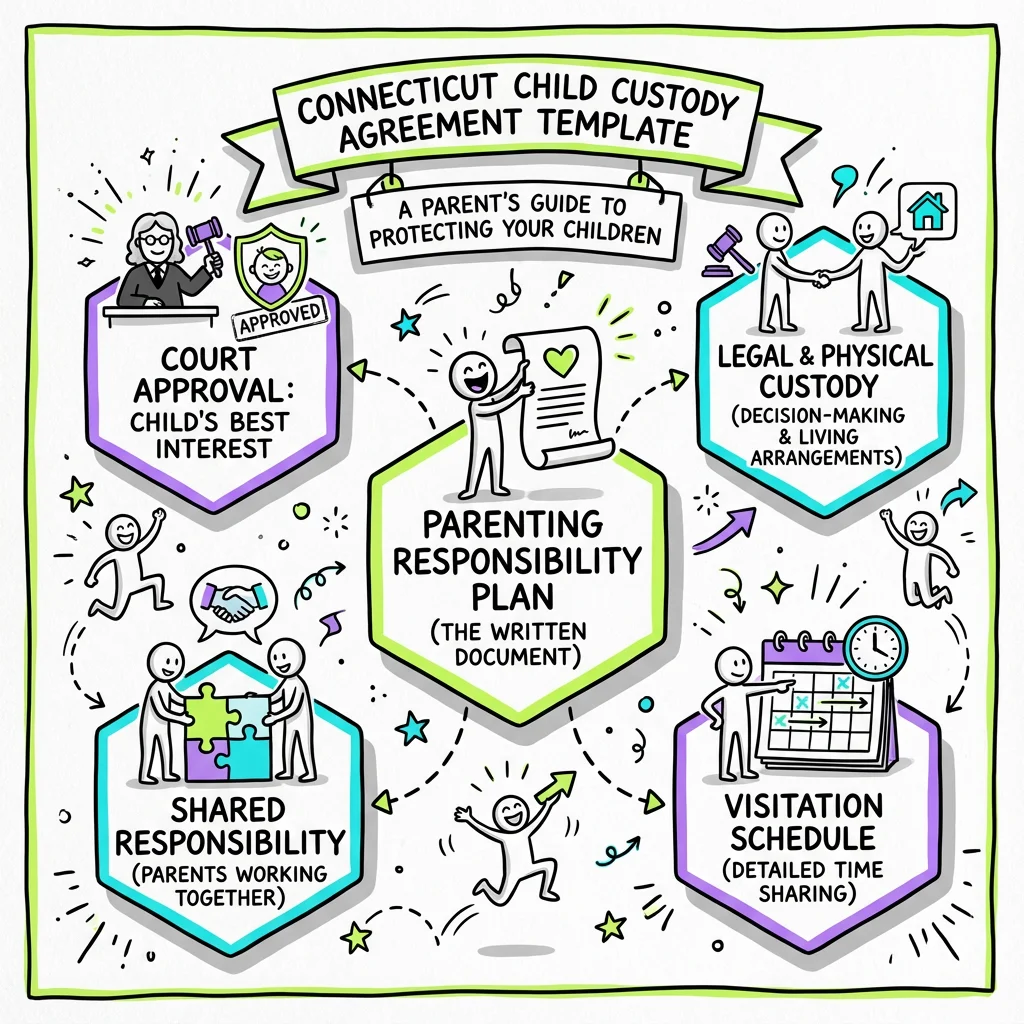
Creating a comprehensive custody agreement requires careful thought and organization. Follow this process to ensure you cover all essential elements:
-
Gather information about your children's current schedules - Document school hours, extracurricular activities, medical appointments, and existing routines that should be preserved.
-
Research Connecticut's legal requirements - Understand what C.G.S. § 46b-56a requires in a parenting responsibility plan and ensure your agreement addresses each element.
-
Draft your proposed parenting time schedule - Create a detailed calendar covering regular time, holidays, and vacations. Be specific about times, not just days.
-
Address decision-making authority - Determine how you'll handle legal custody—joint, sole, or divided by category—and include dispute resolution procedures.
-
Include protective provisions if needed - Document any safety concerns and propose reasonable, proportionate protective measures.
-
Review against best interests factors - Compare your draft against the factors in C.G.S. § 46b-56 to ensure it will withstand court scrutiny.
-
Have your agreement reviewed - Use Untangle's document generation tools to identify gaps or potential issues before submitting to the court.
-
File required documents - Submit your agreement along with the Affidavit Concerning Children and any other required forms.
Common Mistakes to Avoid
Agreements That Courts Reject
Courts regularly reject custody agreements that are too vague, obviously one-sided, or fail to address children's practical needs. An agreement stating that one parent has "primary custody" without defining what that means will be sent back for clarification. Similarly, agreements that give one parent virtually no meaningful time with the children—without documented safety concerns—may be modified by the court.
Another common mistake is failing to anticipate future conflicts. Your children will grow and their needs will change. Good agreements include provisions for handling schedule modifications as children age, procedures for addressing new extracurricular activities, and mechanisms for resolving disputes without returning to court. The goal is creating a durable agreement that serves your family for years.
Focusing on Winning Instead of Children
It's natural to approach divorce with a competitive mindset, but custody agreements aren't about winning—they're about creating the best possible arrangement for your children. Courts can tell when an agreement reflects genuine concern for children versus when it's designed to punish an ex-spouse. Judges in cases like N. R. v. M. P. carefully scrutinize whether custody arrangements actually serve children's interests or primarily serve parental interests.
Ask yourself honestly: does this provision help my children, or does it just feel satisfying to me? If you're including restrictions on the other parent, can you articulate exactly how those restrictions protect your children? This self-reflection will help you create a stronger agreement and present better in court if disputes arise.
When to Get Professional Help
Signs You Need an Attorney
While many Connecticut parents successfully negotiate custody agreements without attorneys, some situations require professional legal help. Consider consulting a family law attorney if: there are allegations of abuse or neglect, one parent has substance abuse or mental health issues affecting the children, you're dealing with complex relocation issues, your co-parent is represented by an attorney, or you simply can't reach agreement on fundamental issues.
Connecticut courts can appoint a guardian ad litem under C.G.S. § 46b-54 when they determine it's in the children's best interests. If your case involves significant conflict or safety concerns, requesting (or expecting) a GAL appointment may be appropriate. The GAL conducts an independent investigation and makes recommendations to the court—which can be invaluable when parents have fundamentally different views of what's best for the children.
Even if you don't need full legal representation, having an attorney review your draft agreement before submission can catch issues you might have missed. The cost of a document review is far less than the cost of returning to court later to fix problems with an inadequate agreement.
Using Technology to Support Your Process
Creating a custody agreement involves managing significant amounts of information—schedules, documents, communications, and legal requirements. Untangle's comprehensive platform helps parents organize this information, understand Connecticut's legal requirements, and create agreements that will withstand court review. The platform's guided process ensures you address every required element while keeping your focus where it belongs: on your children's wellbeing.
Whatever tools you use, remember that your custody agreement will shape your children's daily lives for years to come. Take the time to get it right. Your children deserve a thoughtful, comprehensive plan that provides stability and protects their relationships with both parents.
Frequently Asked Questions
Can I create a child custody agreement in Connecticut without going to court?
Yes, Connecticut parents can create a custody agreement outside of court, but it must be submitted to and approved by a judge to become legally enforceable under C.G.S. § 46b-56a.
What is a 50/50 custody schedule in Connecticut?
A 50/50 custody schedule in Connecticut divides physical custody equally between both parents, typically using alternating weeks, a 2-2-3 rotation, or a 3-4-4-3 pattern to ensure each parent has equal parenting time.
How do I create a holiday custody schedule in Connecticut?
A Connecticut holiday custody schedule should specify which parent has the child on each major holiday, typically alternating years or splitting the day, and this schedule overrides the regular parenting plan.
What must be included in a Connecticut parenting plan?
A Connecticut parenting plan must include provisions for legal custody, physical custody, decision-making authority, a detailed visitation schedule, holiday arrangements, and how parents will handle future disputes.
Where can I get a free child custody agreement template in Connecticut?
Free Connecticut custody agreement templates are available through the Connecticut Judicial Branch website, but consulting with a family law attorney is recommended to ensure the agreement meets all legal requirements and protects your children's interests.
Legal Citations
- • C.G.S. § 46b-56 View Source
- • C.G.S. § 46b-56a View Source
- • C.G.S. § 46b-66 View Source
- • C.G.S. § 46b-54 View Source
- • C.G.S. § 46b-69b View Source
- • Practice Book § 25-5 View Source
- • Practice Book § 25-57 View Source
- • Practice Book § 25-61 View Source
- • N. R. v. M. P., 227 Conn. App. 698 View Source