Cheapest Way to Get an Uncontested Divorce in Connecticut
Learn the most affordable ways to get an uncontested divorce in Connecticut, including joint petition options, filing fees, and DIY strategies to minimize costs.
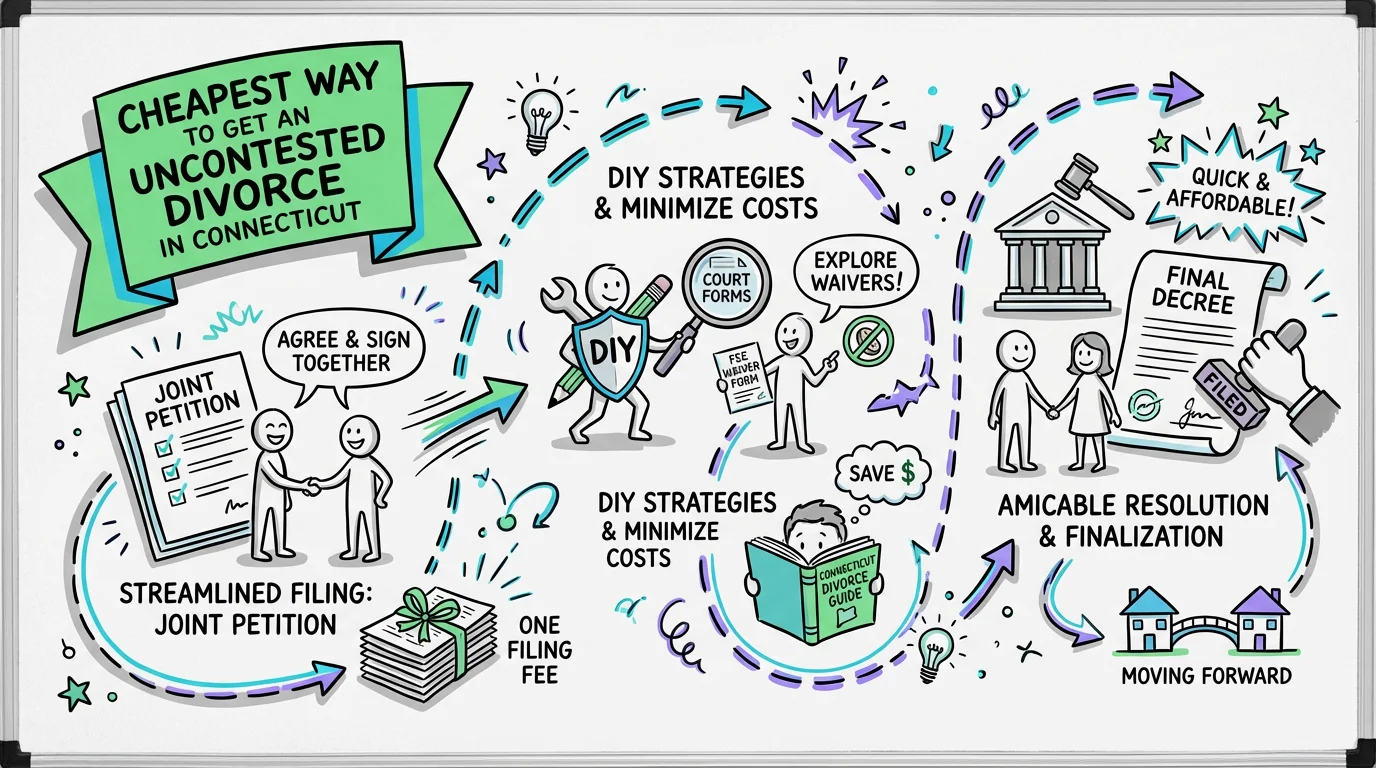
The cheapest way to get an uncontested divorce in Connecticut is to file a joint petition for nonadversarial dissolution of marriage, which allows both spouses to submit paperwork together without serving each other, eliminating process server fees and streamlining the entire process. When you and your spouse agree on all terms—property division, alimony, child custody, and support—you can complete your divorce for as little as the court filing fee (approximately $360) plus minimal document preparation costs. This approach can save thousands of dollars compared to a contested divorce, which often costs $15,000 to $30,000 or more in attorney fees alone.
Understanding Connecticut's Nonadversarial Divorce Option
Connecticut specifically created the nonadversarial dissolution process under C.G.S. § 46b-44a for couples who have reached agreement and want an efficient path to divorce. Unlike a traditional divorce where one spouse files a complaint and "serves" the other, a joint petition means both parties file together as co-petitioners. This eliminates the adversarial dynamic from day one and signals to the court that you're ready to move forward cooperatively.
To qualify for this streamlined process, both spouses must attest under oath that certain conditions exist at the time of filing. You'll need to have reached agreement on all major issues, including how you'll divide property, whether either spouse will receive alimony, and if you have children, the custody arrangement and child support amount. The joint petition must be notarized, and both parties sign acknowledging they understand the automatic court orders that take effect upon filing.
The beauty of this process is its speed and simplicity. Under C.G.S. § 46b-44c, the court assigns a disposition date no less than 30 days after filing. If neither party files a notice of revocation before that date, the court can enter your divorce decree on or within five days of the disposition date. Compare this to a contested divorce, which can drag on for a year or more, and you'll see why the nonadversarial route saves both money and emotional energy.
Breaking Down the True Costs of an Uncontested Divorce
Understanding exactly where your money goes helps you identify opportunities to save. The core costs of any Connecticut divorce include court filing fees, document preparation, and potentially professional assistance with specific aspects of your agreement.
| Cost Category | DIY Approach | Limited Legal Help | Full Attorney |
|---|---|---|---|
| Filing Fee | ~$360 | ~$360 | ~$360 |
| Document Preparation | $0-$200 | $500-$1,500 | Included |
| Attorney Review | $0 | $300-$800 | Included |
| Mediation (if needed) | $0 | $500-$2,000 | Varies |
| Process Server | $0 (joint petition) | $0 (joint petition) | $0 (joint petition) |
| Total Estimated | $360-$560 | $1,160-$4,660 | $3,000-$8,000+ |
The filing fee is unavoidable, but nearly every other cost is within your control. If you're comfortable preparing documents yourself and have straightforward finances, you can complete your divorce for under $600. However, if you have retirement accounts to divide, a business, or complex custody arrangements, investing in limited legal help often pays for itself by preventing costly mistakes.
Tools like Untangle's automatic document generation can help you generate the required forms accurately, reducing the risk of rejected filings that would cost additional time and money. Getting your paperwork right the first time is one of the best ways to keep costs down.
Essential Forms and Documents You'll Need
Connecticut requires specific forms for every divorce, and missing or incorrectly completed documents will delay your case. Gathering and completing these accurately is essential for a low-cost uncontested divorce.
Required Financial Disclosures
Every divorce in Connecticut requires sworn financial statements from both parties. Under Practice Book Rule § 25-30, you must file these at least five business days before any hearing on support, alimony, or fees. If your individual gross income is under $75,000 and your total assets are less than $75,000, you can use the Short Form Financial Affidavit (JD-FM-006-Short). Couples with higher incomes or more substantial assets must use the long form.
These financial affidavits require you to disclose your current income, monthly expenses, assets, and liabilities. Be thorough and honest—the court relies on this information to ensure your agreement is fair, and any attempt to hide assets can result in your agreement being rejected or, worse, set aside after the divorce is final. Untangle's Financial affidavit generation can simplify this complex task, guiding you through each section to ensure accuracy and completeness.
Core Filing Documents
For a joint petition nonadversarial divorce, you'll need:
- Joint Petition for Nonadversarial Dissolution (notarized, signed by both parties)
- Financial Affidavits from both spouses
- Separation Agreement (also called a marital settlement agreement)
- Notice of Automatic Court Orders (JD-FM-158)
- Certificate of Compliance (JD-FM-175)
If you have minor children, you'll also need the Child Support Guidelines Worksheet (CCSG-001) and potentially additional custody-related documents. Both parents must also complete Connecticut's mandatory parent education program—this is non-negotiable and costs approximately $125 per parent.
Using Untangle's automatic document generation ensures you don't miss any required documents and helps you understand what information goes where. The platform walks you through each form systematically, which is especially helpful if legal paperwork feels overwhelming.
Step-by-Step Process for the Cheapest Divorce
Following a clear process helps you avoid missteps that could increase costs or delay your divorce. Here's how to navigate an uncontested divorce in Connecticut while keeping expenses minimal:
-
Confirm you meet residency requirements. At least one spouse must have lived in Connecticut for 12 months before filing, or you must have been married in Connecticut and one spouse returned to live here with the intention of staying permanently.
-
Reach full agreement with your spouse. Before you file anything, you and your spouse need to agree on every issue: property division, debt allocation, alimony (if any), and if applicable, child custody, visitation schedules, and child support. Document these agreements in writing.
-
Gather financial information. Collect tax returns, pay stubs, bank statements, retirement account statements, mortgage documents, and any other records showing your assets, debts, income, and expenses. You'll need this to complete your financial affidavits accurately.
-
Complete all required forms. Fill out your joint petition, financial affidavits, and separation agreement. Make sure everything is consistent—if your separation agreement says one spouse keeps the house, your financial affidavit should reflect that same arrangement.
-
Have your joint petition notarized. Both spouses must sign the joint petition in front of a notary public. Many banks offer free notary services to account holders.
-
File with the Superior Court. Submit your completed documents to the Superior Court in the judicial district where either spouse lives. Pay the filing fee (check current amounts at the courthouse or online).
-
Attend your disposition date. The court will assign a date at least 30 days out. In some cases, you may not even need to appear if your paperwork is complete and the judge has no questions.
-
Receive your divorce decree. If everything is in order and neither party has filed a revocation, the court enters your decree on or within five days of your disposition date.
Throughout this process, Untangle's personalized task dashboard can serve as your roadmap, helping you track what you've completed and what still needs attention. This is particularly valuable when you're managing the process without an attorney.
Try our free CT child support calculator
Calculate your estimated child support using Connecticut's official guidelines formula.
Strategies to Minimize Costs Further
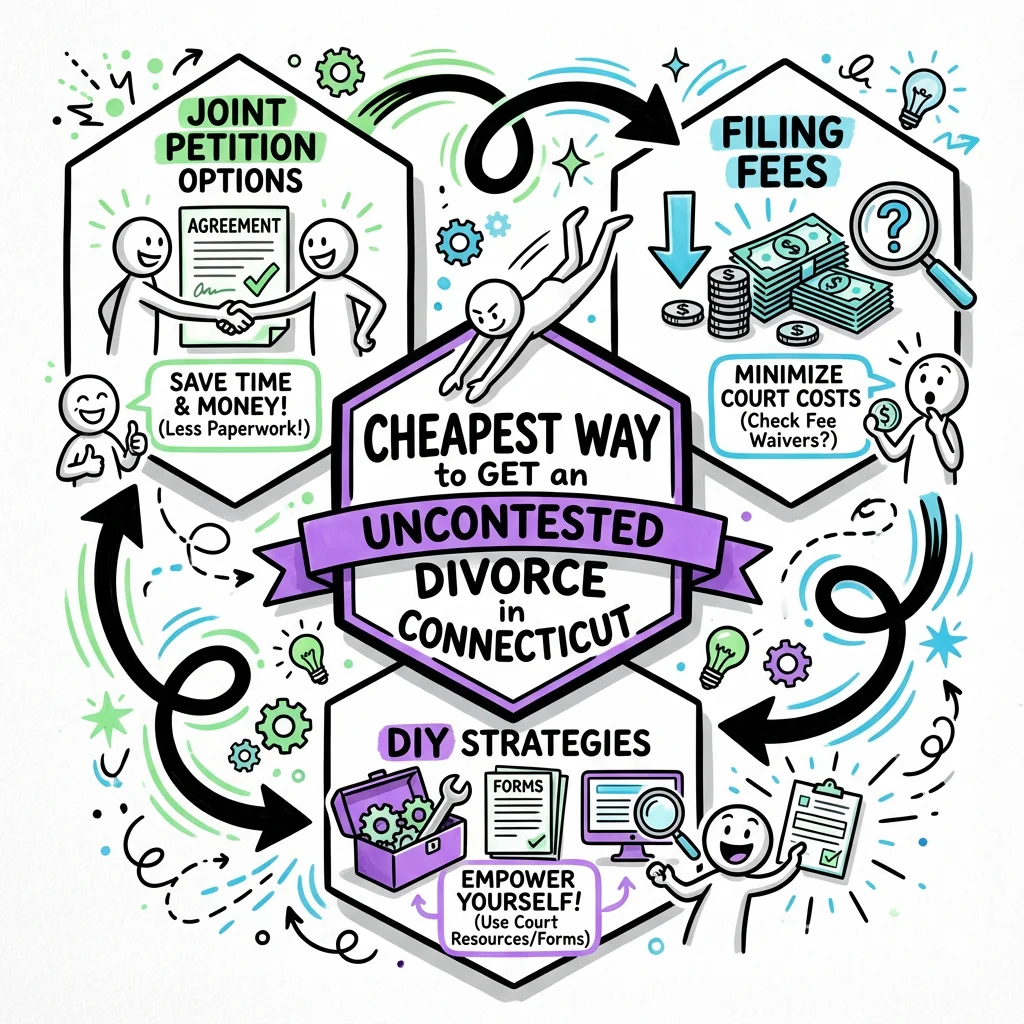
Beyond choosing the nonadversarial route, several strategies can help you squeeze every dollar of savings from your uncontested divorce.
Handle Your Own Mediation Conversations
If you and your spouse have one or two sticking points, try resolving them through direct conversation before hiring a mediator. Sometimes writing out your positions and exchanging them via email helps you find common ground without the hourly cost of a professional mediator. Reserve paid mediation for truly stubborn disagreements that you can't resolve on your own.
Use Court Self-Help Resources
Connecticut's Judicial Branch offers free resources for self-represented parties, including instructions for completing forms, information about what to expect at hearings, and assistance understanding court procedures. Take advantage of these resources before paying for private help.
Consider Unbundled Legal Services
If you want some professional guidance but can't afford full representation, look for attorneys who offer "unbundled" or "limited scope" services. You might pay an attorney for two hours to review your separation agreement and financial affidavits, ensuring they're legally sound, while handling all other aspects yourself. This approach typically costs $400-$800 rather than thousands for full representation.
Get Your Agreement Right the First Time
The most expensive "cheap divorce" is one where you have to go back to court later because your agreement was unclear or didn't address something important. Take time to think through scenarios: What happens if one of you wants to relocate with the children? How will you handle medical expenses that insurance doesn't cover? Who claims the children as dependents on taxes? Addressing these questions now prevents expensive modification proceedings later.
What the Court Looks for in Your Agreement
Under C.G.S. § 46b-66, even in uncontested cases, the court must review your separation agreement before approving it. The judge will examine whether the agreement is fair and equitable, considering each party's financial resources and needs. If you have children, the court scrutinizes custody arrangements and support calculations to ensure they serve the children's best interests.
Your separation agreement should be comprehensive and specific. Vague language like "we'll split everything fairly" won't satisfy the court—you need to specify exactly who gets what. List each major asset and debt by name, indicate who receives or assumes responsibility for each, and explain any offsets or equalizing payments.
For couples with children, the court expects to see a detailed parenting plan covering physical and legal custody, a specific visitation schedule (including holidays and vacations), decision-making authority for education and healthcare, and how you'll handle disputes. Your child support calculation should follow Connecticut's Child Support Guidelines, using the official worksheet (CCSG-001) to show your math. To ensure your child support calculations are accurate and meet court guidelines, utilize Untangle's child support calculator to work through the official worksheet.
The court's review protects both parties from agreements made under pressure or without full information. If something seems off—for example, one spouse waives all assets while assuming all debts—the judge may ask questions or even require you to consult with an attorney before proceeding.
When DIY Might Not Be Enough
While the cheapest approach is handling everything yourself, some situations genuinely require professional help, and spending money upfront can save you much more down the road.
Consider hiring an attorney if:
- You or your spouse owns a business or professional practice
- You have significant retirement accounts that need QDRO orders to divide
- There's a large disparity in income or earning potential between spouses
- You suspect your spouse may be hiding assets
- Domestic violence has been part of your relationship
- You're uncertain about giving up certain rights
Consider mediation if:
- You agree on most issues but are stuck on one or two
- Communication between you and your spouse is difficult
- You want a neutral third party to help you think through options
- One spouse is more assertive and the other fears being pressured
Even in these situations, you can still pursue an uncontested divorce—you just might need some professional assistance to get your agreement finalized. The goal is reaching a comprehensive settlement you can both live with, whether you do that entirely on your own or with some help along the way.
Untangle's AI legal guidance bridges the gap between pure DIY and full legal representation, giving you the structure and guidance to handle straightforward aspects yourself while flagging issues that might benefit from professional review. This hybrid approach keeps costs controlled while ensuring you don't miss important considerations.
Protecting Yourself During the Process
Even when divorcing amicably, it's important to protect your interests throughout the process. The automatic court orders that take effect when you file (detailed in Practice Book Rule § 25-5B) prohibit either spouse from selling, transferring, or encumbering assets, canceling insurance policies, or incurring unreasonable debts. These orders protect both parties during the divorce process and carry contempt-of-court penalties for violations.
Document everything. Keep copies of all financial records, communications about your agreement, and any changes you discuss. If something goes wrong later—even in the friendliest divorces, circumstances can change—you'll want a clear record of what was agreed and when.
Finally, resist the urge to finalize your divorce too quickly just to save money. The 30-day minimum waiting period under C.G.S. § 46b-44c exists partly to give you time to reconsider. Use this period to read through your agreement one more time, make sure you haven't overlooked anything, and confirm you're comfortable with every provision. A few extra weeks of thoughtfulness costs nothing and can prevent expensive regrets.
Frequently Asked Questions
Can I file for divorce in Connecticut without a lawyer?
Yes, you can file for divorce in Connecticut without a lawyer (called filing "pro se") by completing the required court forms yourself, though it's recommended only for uncontested cases where both spouses agree on all terms.
How do I qualify for a divorce filing fee waiver in Connecticut?
You may qualify for a fee waiver in Connecticut if your income falls below 125% of the federal poverty guidelines or you receive public assistance such as SNAP, HUSKY, or state-administered general assistance.
Where can I get free divorce forms in Connecticut?
Free Connecticut divorce forms are available online through the Connecticut Judicial Branch website (jud.ct.gov), which provides all necessary forms for both contested and uncontested dissolutions.
How much does an uncontested divorce cost in Connecticut?
An uncontested divorce in Connecticut can cost as little as $360 (the court filing fee) if you file jointly without attorneys, compared to $15,000 to $30,000 or more for a contested divorce.
Does Connecticut offer legal aid for divorce cases?
Yes, Connecticut offers free legal assistance for low-income residents through organizations like Statewide Legal Services and Connecticut Legal Services, which can help with divorce paperwork and court proceedings.
Legal Citations
- • C.G.S. § 46b-44a View Source
- • C.G.S. § 46b-44c View Source
- • Practice Book Rule § 25-30 View Source
- • C.G.S. § 46b-66 View Source
- • Practice Book Rule § 25-5B View Source