Cheapest Online Divorce Services in Connecticut: Compare Your Options
Compare affordable online divorce options in Connecticut. Learn about DIY filing, online services, and how to minimize costs while meeting CT legal requirements.
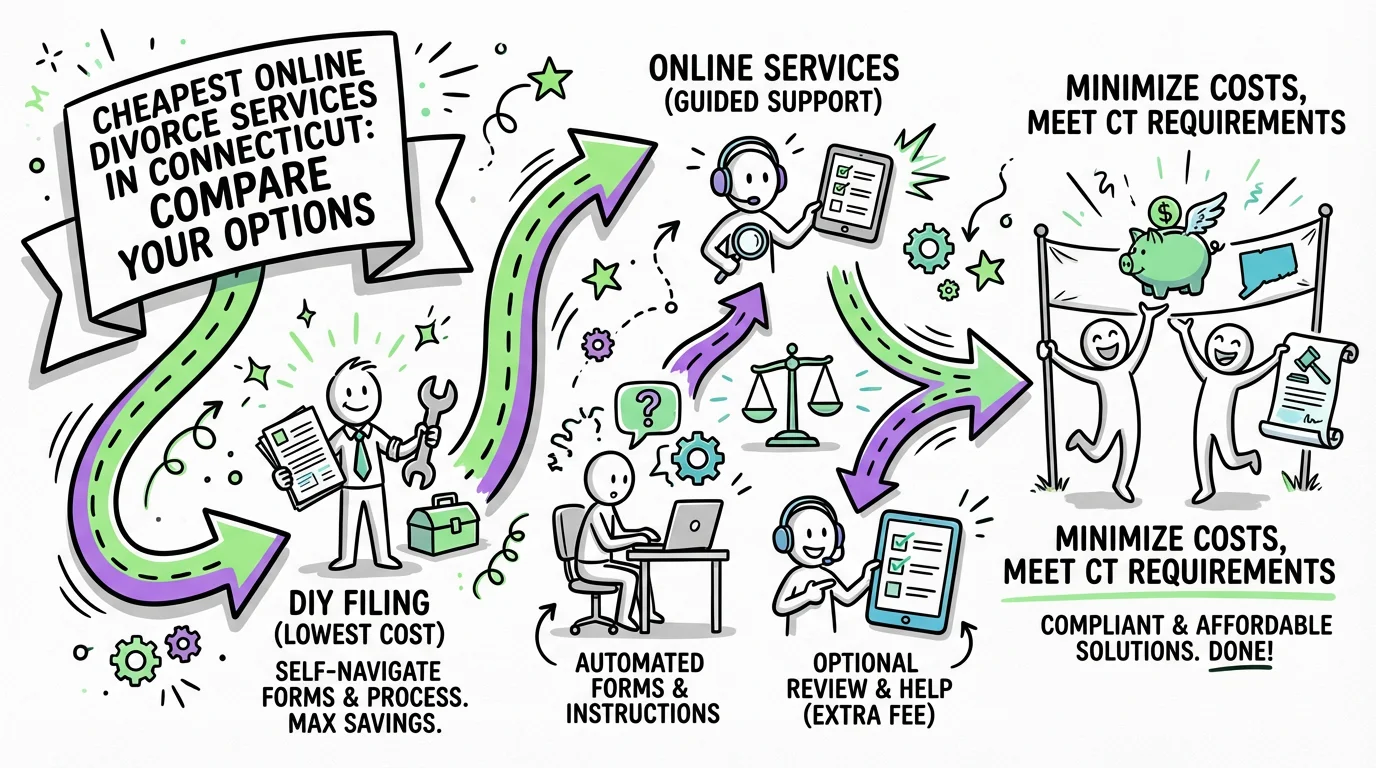
The cheapest way to get divorced in Connecticut is to file directly with the court yourself, which costs only the $360 court filing fee. Online divorce services typically charge $150 to $500 on top of filing fees to help you prepare paperwork, while attorney-assisted divorces can run $3,000 to $15,000 or more. If you and your spouse agree on all terms and have a straightforward situation, doing it yourself—with the right guidance—can save you thousands while still meeting Connecticut's legal requirements.
Understanding Your Options for an Affordable Connecticut Divorce
Connecticut offers a streamlined "nonadversarial" dissolution process specifically designed for couples who agree on everything. Under C.G.S. § 46b-44a, you and your spouse can file a joint petition that moves through the court system faster and with less complexity than a contested divorce. This pathway eliminates the need for formal service of process, reduces court appearances, and can result in a final decree in as little as 30 days after filing.
The key to keeping costs low isn't necessarily which online service you use—it's whether your divorce qualifies for this simplified process. To file nonadversarially, both parties must agree on all issues including property division, debt allocation, and if applicable, child custody and support. You'll both need to attest under oath that these conditions exist at the time of filing. If you meet these criteria, you have several affordable pathways to choose from.
What many people don't realize is that the Connecticut Judicial Branch provides all the necessary forms for free on their website. The challenge isn't accessing the paperwork—it's understanding how to complete it correctly and ensuring your settlement agreement will pass the court's "fair and equitable" review under C.G.S. § 46b-44d. This is where online tools and services add value, helping you avoid costly mistakes that could delay your divorce or require attorney intervention.
Comparing Online Divorce Options in Connecticut
| Option | Typical Cost | What You Get | Best For |
|---|---|---|---|
| DIY Filing (court forms only) | $360 (filing fee only) | Access to free court forms, no guidance | Very simple cases, legally savvy filers |
| Basic Online Services | $150-$300 + filing fees | Form preparation, general instructions | Uncontested divorces without children |
| Comprehensive Online Services | $300-$500 + filing fees | Forms, settlement agreement drafting, support | Divorces with children or moderate assets |
| Untangle | Included with platform | CT-specific forms, asset analysis, agreement builder | Budget-conscious couples wanting guidance |
| Limited-Scope Attorney | $500-$1,500 + filing fees | Document review, legal advice on specific issues | Complex assets or custody concerns |
The differences between services often come down to how much guidance and customization they provide. Basic services may give you generic forms that don't account for Connecticut's specific requirements, while comprehensive platforms offer state-specific document preparation and help you think through issues you might otherwise miss.
What Connecticut Courts Actually Require
Before choosing any online service, understand exactly what you'll need to file. Connecticut Practice Book Rule § 25-30 requires sworn financial statements from both parties, and Rule § 25-32 mandates specific financial disclosures including three years of tax returns, pay stubs, and account statements. Missing or incomplete documents can delay your case or result in the court rejecting your filing.
For a nonadversarial dissolution, you'll need to submit:
- Joint Petition for Nonadversarial Dissolution - The main filing document signed by both spouses
- Settlement Agreement - Your written agreement covering all terms of the divorce
- Financial Affidavits (JD-FM-006) - Sworn statements of income, expenses, assets, and liabilities from both parties
- Notice of Automatic Court Orders (JD-FM-158) - Acknowledgment of restrictions that take effect upon filing
- Certificate of Compliance (JD-FM-175) - Confirming you've met disclosure requirements
- Child Support Guidelines Worksheet (CCSG-001) - Required if you have minor children
The court will review your settlement agreement to ensure it's "fair and equitable" before entering your divorce decree. Under C.G.S. § 46b-44d, if the judge can't make this determination from your paperwork alone, they'll schedule a hearing—which adds time and potentially costs if you need to take time off work.
How to Evaluate Online Divorce Services
Not all online divorce services are created equal, and the cheapest option isn't always the best value. When comparing services, consider these factors beyond just the sticker price:
Connecticut-Specific Forms: Generic divorce services often use one-size-fits-all templates that may not comply with Connecticut court requirements. Look for services that provide the exact forms Connecticut courts expect, properly formatted and with all required elements.
Settlement Agreement Quality: Your separation agreement is the most important document in your divorce—it governs everything from property division to spousal support. Some services provide only basic templates, while others guide you through comprehensive agreements that address contingencies and protect your interests. Tools like Untangle's document generation walk you through Connecticut-specific considerations to help ensure your agreement addresses all necessary issues.
Financial Analysis Tools: Dividing assets fairly requires understanding what you actually have. Look for services that help you organize and analyze your financial picture, not just fill in blanks. Untangle's asset inventory tools can help you identify marital property, understand tax implications, and ensure nothing falls through the cracks.
Support and Guidance: When you hit a confusing legal term or aren't sure how to handle a specific situation, what resources does the service provide? FAQ pages are helpful, but real-time guidance as you complete your documents is more valuable.
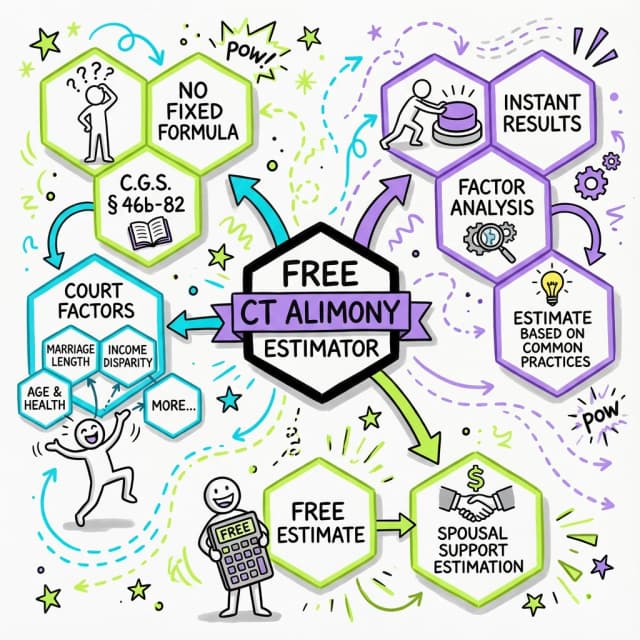
Try our free CT alimony calculator
Get an instant estimate based on Connecticut's statutory factors. No signup required.
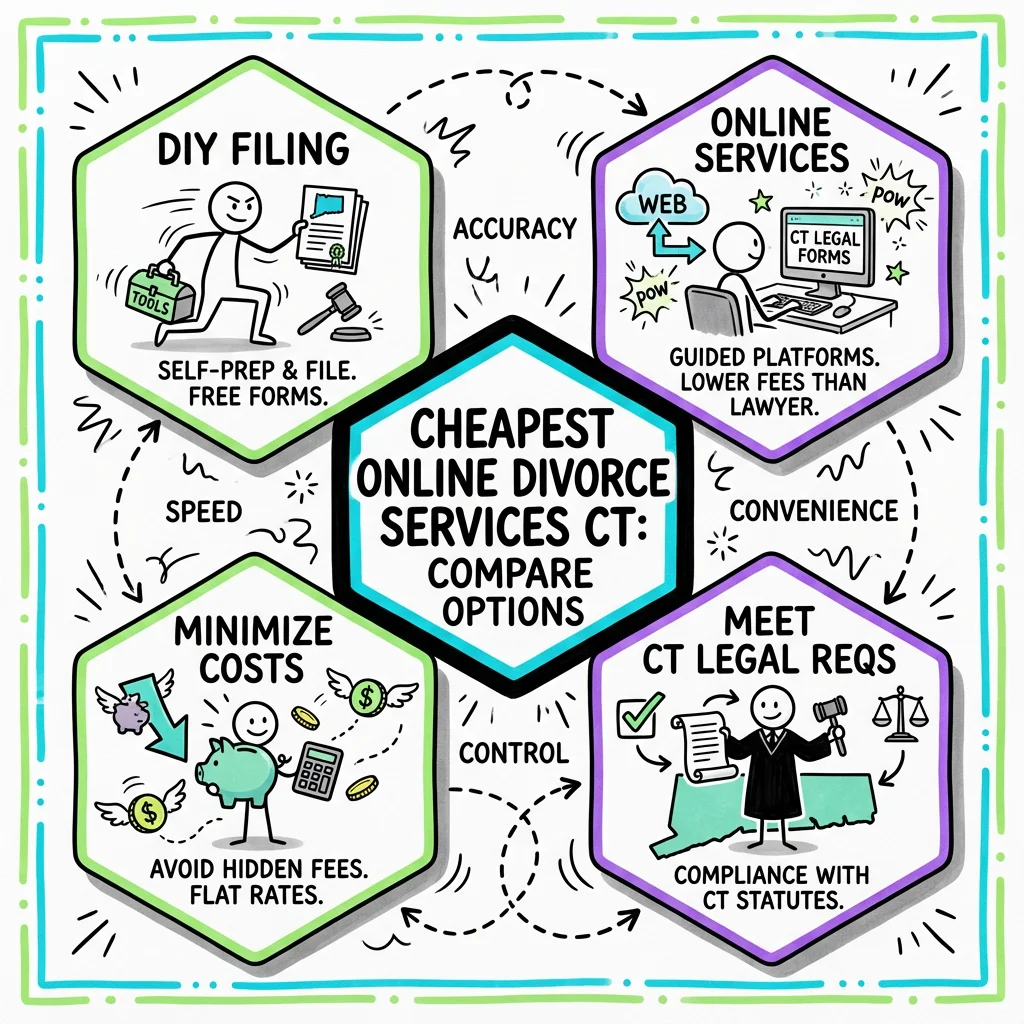
The True Cost of DIY Divorce: What Could Go Wrong
While filing yourself is the cheapest approach, it's worth understanding the potential hidden costs of mistakes. A rejected filing means you'll need to refile and potentially pay additional fees. An incomplete settlement agreement might require you to return to court later to resolve issues—and post-judgment modifications can cost more than getting it right the first time.
Common DIY mistakes that cost money down the road include:
- Forgetting to address retirement accounts: QDROs (qualified domestic relations orders) are often needed to divide 401(k)s and pensions. If your agreement doesn't properly address these, you may need to hire an attorney later.
- Overlooking debt responsibility: Your agreement needs to specify who pays joint debts. Creditors aren't bound by your divorce decree, so improper handling can leave you liable for your ex's unpaid bills.
- Vague custody language: Terms like "reasonable visitation" invite future conflict. Specific schedules prevent expensive disputes.
- Missing tax implications: Who claims the children as dependents? How do you handle the marital home's capital gains exclusion? These details matter.
This is where a comprehensive online tool pays for itself. Untangle's personalized task dashboard prompts you to address these issues before they become expensive problems, helping you create a thorough agreement without paying attorney rates.
Step-by-Step Process for Filing Your Connecticut Divorce Online
Once you've chosen your approach, here's what the process looks like:
-
Gather your financial documents - Collect three years of tax returns, recent pay stubs, bank statements, retirement account statements, and mortgage/loan documents. Connecticut's mandatory disclosure rules require these regardless of how you file.
-
Complete your financial affidavits - Both spouses must submit sworn financial statements. If neither spouse earns more than $75,000 annually and total assets are under $75,000, you can use the short form (JD-FM-006-Short).
-
Draft your settlement agreement - This is the heart of your divorce. Cover property division, debt allocation, and if applicable, custody, visitation, child support, and alimony. Be specific—vague terms cause problems later.
-
Prepare the joint petition and supporting forms - Your online service or platform should help you complete the joint petition for nonadversarial dissolution and all required accompanying documents.
-
File with the Superior Court - Submit your complete packet to the judicial district where either spouse resides. Pay the $360 filing fee.
-
Wait for your disposition date - Under C.G.S. § 46b-44c, the court will assign a date at least 30 days after filing. If everything is in order and neither party revokes, the court can enter your divorce decree on or within 5 days of that date.
-
Complete any required programs - If you have minor children, Connecticut requires completion of a parenting education program.
When DIY Isn't Enough: Recognizing Your Limits
Being budget-conscious is smart, but recognizing when you need professional help is smarter. Consider consulting with an attorney if any of these apply to your situation:
- Significant retirement assets - Dividing pensions and 401(k)s correctly requires understanding complex tax rules and QDRO requirements
- Business ownership - Valuing and dividing business interests is rarely straightforward
- Real estate complications - Multiple properties, underwater mortgages, or rental properties add complexity
- Spousal support concerns - If alimony might be warranted, understanding Connecticut's factors for determining amount and duration is important
- High conflict - If you can't communicate civilly with your spouse, the nonadversarial process may not work
- Domestic violence history - Safety concerns require professional guidance
Even if you use an online service for most of your divorce, many Connecticut attorneys offer "unbundled" or limited-scope services where they review your documents or advise on specific issues without representing you for the entire case. This hybrid approach can provide professional peace of mind at a fraction of full representation costs.
Making the Right Choice for Your Situation
The cheapest online divorce service is the one that helps you get it right the first time without paying for features you don't need. For truly simple cases—short marriages, no children, minimal assets, complete agreement—basic form preparation may be sufficient. For most Connecticut divorces, however, investing in comprehensive guidance through a platform like Untangle provides better value than the cheapest bare-bones option.
Whatever you choose, remember that your divorce decree and settlement agreement will govern your post-divorce life for years to come. Spending a few hundred dollars more upfront on proper preparation can save thousands in future legal fees and countless hours of stress. Your future self will thank you for taking the time to do this right.
Frequently Asked Questions
Are cheap online divorce services legitimate in Connecticut?
Yes, legitimate online divorce services in Connecticut are legal document preparation services that help you complete court-required paperwork, but they cannot provide legal advice and you remain responsible for filing with the court yourself.
What is included in online divorce packages for CT?
Online divorce packages typically include completed court forms, a customized settlement agreement, filing instructions, and customer support, though you'll still need to pay the $360 Connecticut court filing fee separately.
Can I get divorced in Connecticut without an attorney?
Yes, Connecticut allows you to file for divorce without an attorney using the state's nonadversarial dissolution process under C.G.S. § 46b-44a, as long as you and your spouse agree on all terms including property division and custody.
How much does a DIY divorce cost in Connecticut?
A DIY divorce in Connecticut costs a minimum of $360 for the court filing fee, plus $150 to $500 if you use an online document preparation service, compared to $3,000 to $15,000 or more for an attorney-assisted divorce.
How long does an uncontested online divorce take in Connecticut?
An uncontested divorce in Connecticut can be finalized in as little as 30 days after filing if you use the nonadversarial dissolution process and all paperwork is completed correctly.
Legal Citations
- • C.G.S. § 46b-44a View Source
- • C.G.S. § 46b-44d View Source
- • Connecticut Practice Book Rule § 25-30 View Source
- • Connecticut Practice Book Rule § 25-32 View Source
- • C.G.S. § 46b-44c View Source