Divorce Without Lawyers in Connecticut: Complete Guide to Self-Representation
Learn how to get divorced without lawyers in Connecticut. Discover the nonadversarial dissolution process, required forms, and when self-representation works best.
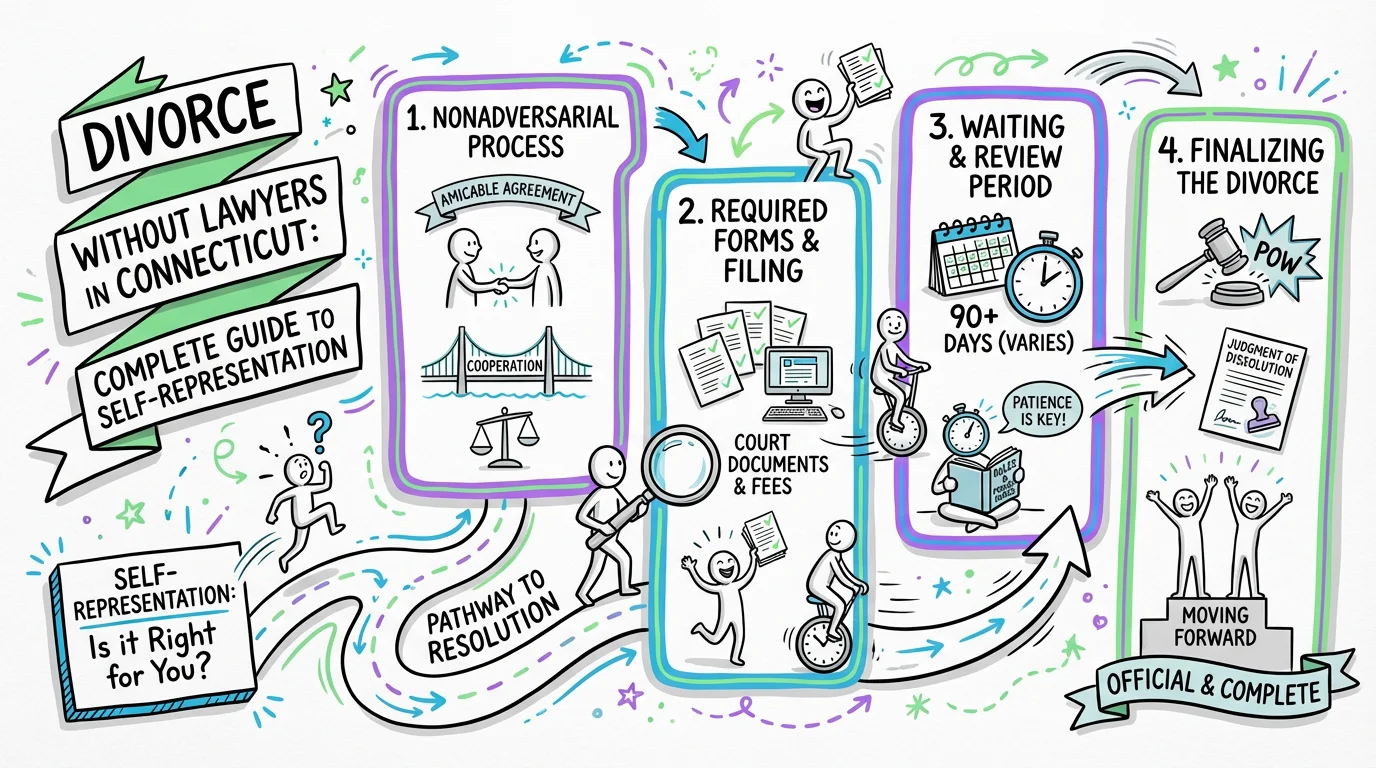
Yes, you can absolutely get divorced without lawyers in Connecticut. The state specifically provides a streamlined "nonadversarial dissolution" process designed for couples who agree on all terms of their divorce. Under C.G.S. § 46b-44a, spouses can file a joint petition together, submit their settlement agreement, and potentially finalize their divorce without ever appearing in court—all without attorney representation.
Understanding Connecticut's Nonadversarial Divorce Option
Connecticut recognizes that not every divorce requires expensive legal battles. When both spouses agree that the marriage has broken down irretrievably and can reach consensus on property division, support, and (if applicable) child custody, the nonadversarial dissolution pathway offers a faster, more affordable alternative to traditional contested divorce.
This process exists because Connecticut courts want to reduce conflict and streamline proceedings when couples can work together cooperatively. The nonadversarial option reflects a practical reality: when two adults agree on how to end their marriage fairly, they shouldn't need attorneys to negotiate on their behalf. The court's primary concern becomes ensuring the agreement is fair and equitable—not resolving disputes between opposing parties.
Self-representation (called "pro se" in legal terms) is a constitutional right in Connecticut, and family courts are accustomed to working with unrepresented parties. The Connecticut Judicial Branch provides standardized forms and resources specifically designed for people navigating divorce without legal counsel. While the process requires careful attention to detail, thousands of Connecticut couples successfully complete their divorces each year without hiring attorneys.
Requirements for Filing Without Attorneys in CT
To qualify for Connecticut's nonadversarial dissolution process, you and your spouse must meet specific criteria at the time of filing. Both parties must attest under oath that these conditions exist:
Eligibility Checklist:
- At least one spouse must reside in Connecticut
- Both parties agree the marriage has broken down irretrievably
- You've reached agreement on all issues (property, debt, support, custody if applicable)
- Neither party is under duress or coercion
- Both spouses are willing to sign a joint petition
The joint petition must be notarized and include attestations from both parties confirming these conditions. Unlike a traditional divorce where one spouse files against the other, the nonadversarial process treats you as co-petitioners working toward a shared goal. This collaborative framing sets the tone for the entire proceeding.
If you have minor children, additional requirements apply. Both parents must complete a court-approved parenting education program, and your agreement must address custody, visitation, and child support in accordance with Connecticut's child support guidelines. Tools like Untangle's child support calculator can help you determine appropriate support amounts based on Connecticut's official guidelines before you file.
The Step-by-Step Nonadversarial Divorce Process
1. Prepare Your Financial Documentation
Before filing anything, gather comprehensive financial information. Connecticut Practice Book Rule § 25-30 requires both parties to file sworn financial statements showing current income, expenses, assets, and liabilities. Use the Short Form Financial Affidavit (JD-FM-006-Short) if neither party's net income exceeds $75,000 per year and total assets are less than $75,000.
This financial disclosure isn't optional—it's how the court verifies your settlement agreement is fair. Be thorough and honest. Incomplete or inaccurate financial statements can delay your case or, worse, result in agreements being challenged later. Untangle's task dashboard can help you compile and organize this information systematically.
2. Draft Your Settlement Agreement
Your settlement agreement is the heart of your nonadversarial divorce. This legally binding document must address every aspect of separating your lives: who gets the house, how you'll divide retirement accounts, whether either spouse will pay alimony, and if you have children, detailed custody and support arrangements.
Under C.G.S. § 46b-66, the court will review your agreement to ensure it addresses the financial resources and actual needs of both parties. For couples with children, the court also considers each parent's fitness for custody and visitation rights. Your agreement should be specific enough that neither party has to guess about their rights or obligations.
3. File Your Joint Petition
File your notarized joint petition in the judicial district where either spouse resides. Along with the petition, you'll submit:
- Your complete settlement agreement
- Sworn financial affidavits from both parties
- Notice of Automatic Court Orders (JD-FM-158)
- Filing fee (check current Connecticut Judicial Branch fee schedule)
Per Practice Book Rule § 25-5B, automatic orders become effective immediately upon filing your joint petition. These orders prevent either party from hiding assets, canceling insurance, or taking other actions that could harm the other spouse during the divorce process.
4. Wait for Your Disposition Date
Under C.G.S. § 46b-44c, the court assigns a disposition date at least 30 days after you file. This waiting period serves two purposes: it gives either party time to reconsider (you can file a notice of revocation under C.G.S. § 46b-44b if circumstances change), and it allows the court time to review your agreement.
During this period, the court examines your settlement agreement. If the judge determines it's fair and equitable, they may enter your divorce decree on the disposition date—or within five days after—without requiring you to appear in court. This is the streamlined outcome the nonadversarial process is designed to achieve.
5. Court Appearance (If Required)
Per C.G.S. § 46b-44d, if the court cannot determine whether your agreement is fair and equitable from the paperwork alone, your case will be scheduled for a hearing within 30 days. Both parties must appear and be prepared to answer questions about your agreement.
This isn't necessarily a problem—it simply means the judge wants clarification or wants to ensure both parties understand what they're agreeing to. Come prepared to explain your reasoning for key decisions, particularly around property division and any spousal support arrangements.
Comparing DIY vs. Attorney-Assisted Divorce in Connecticut
| Factor | DIY Nonadversarial | Attorney-Assisted |
|---|---|---|
| Typical Cost | $350-$500 (filing fees + copies) | $3,000-$15,000+ per party |
| Timeline | 30-90 days | 3-12+ months |
| Best For | Amicable couples, simple assets | Complex finances, disputes |
| Court Appearances | Often none required | Multiple hearings typical |
| Agreement Drafting | You handle it | Attorney prepares |
| Risk Level | Low (if truly amicable) | Lower (professional guidance) |
| Flexibility | High—your schedule | Depends on attorney availability |
The cost difference is substantial. Connecticut attorneys typically charge $250-$450 per hour for divorce work, and even "simple" divorces can quickly accumulate 10-30+ hours of attorney time per side. When both parties agree and assets are straightforward, that expense may not provide proportional value.
However, the DIY approach requires you to educate yourself on Connecticut divorce law and handle all paperwork correctly. Tools like Untangle's document generation features can bridge this gap by walking you through the process step-by-step, helping you create court-ready documents without the full cost of attorney representation.
What Makes a Good Candidate for Divorce Without Lawyers
Self-representation works best when certain conditions exist. Consider your situation honestly before deciding to proceed without legal counsel.
Ideal Candidates for DIY Divorce:
- Both spouses genuinely agree on all major issues
- You can communicate respectfully with your spouse
- Your financial situation is relatively straightforward
- Neither party owns a business or has complex investments
- You don't have significant retirement assets requiring QDROs
- Any children's custody arrangements are mutually agreed upon
- Neither spouse has significantly more legal knowledge or bargaining power
Potential Red Flags:
- One spouse controlled all finances during the marriage
- There's a history of domestic violence or coercion
- Significant assets are difficult to value (businesses, stock options, pensions)
- One spouse is pressuring the other to "just sign"
- You're unsure whether the proposed division is fair
- Complex tax implications exist
The nonadversarial process assumes relatively equal bargaining power. If one spouse has significantly more financial sophistication or is pressuring quick decisions, the "fairness" review by the court may not catch subtle inequities. In these situations, at least consulting with an attorney—even if you don't hire one for full representation—provides valuable protection.
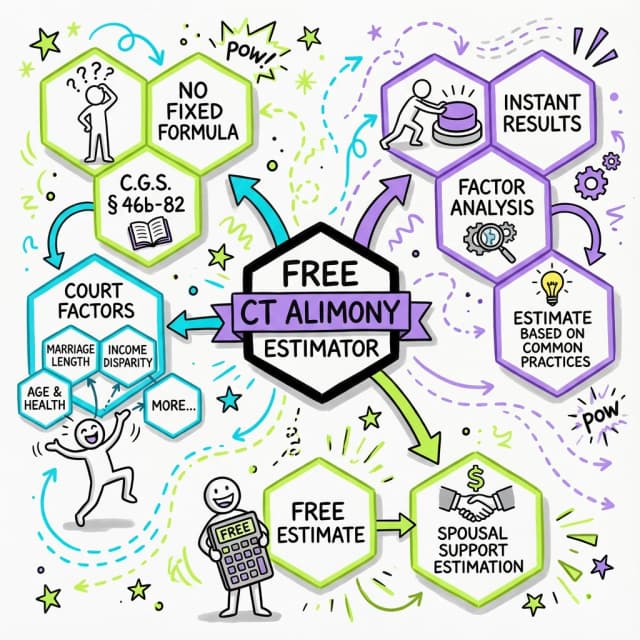
Try our free CT alimony calculator
Get an instant estimate based on Connecticut's statutory factors. No signup required.
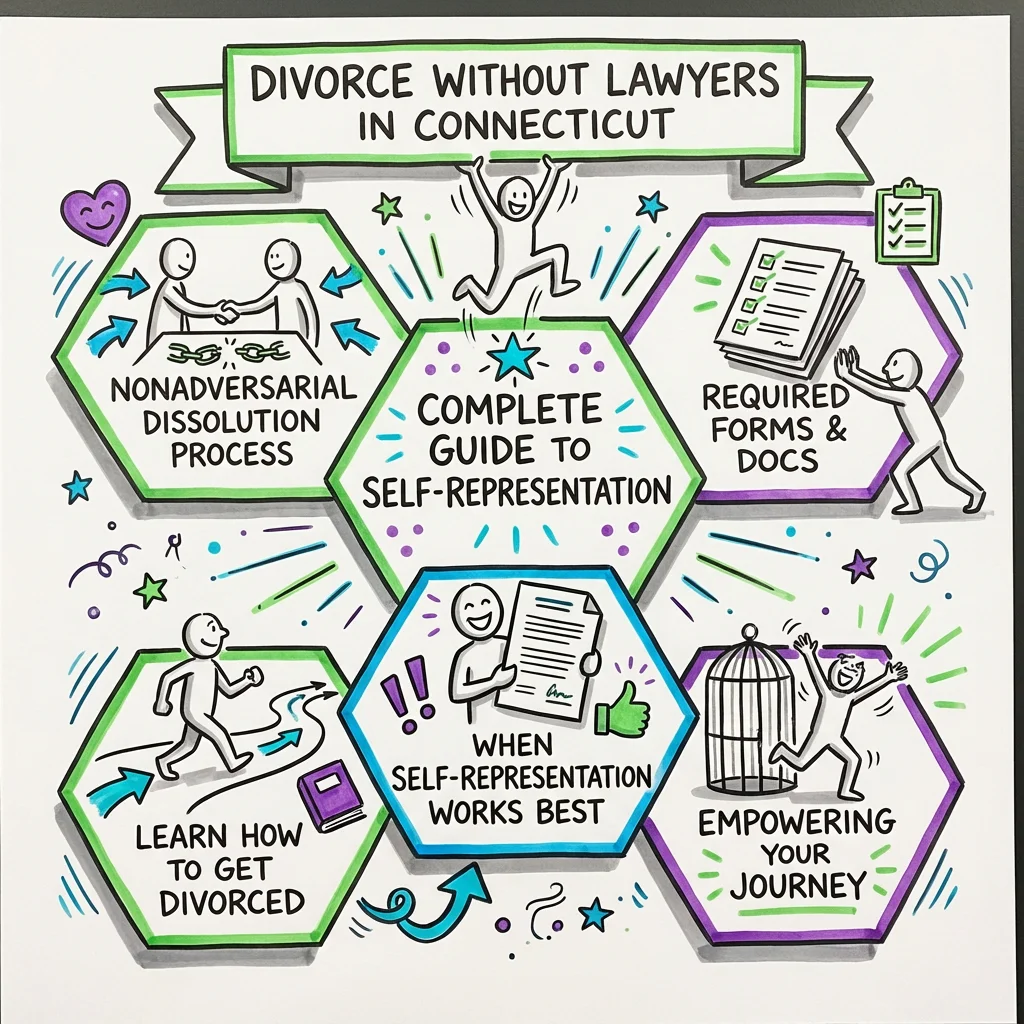
Essential Forms for Connecticut DIY Divorce
Connecticut standardizes its divorce forms, which helps self-represented parties navigate the process. Here are the key documents you'll need:
| Form | Purpose | When to File |
|---|---|---|
| Joint Petition for Nonadversarial Dissolution | Initiates your case | At filing |
| JD-FM-006-Short | Financial disclosure (if qualifying) | With petition |
| Settlement Agreement | Details all terms of divorce | With petition |
| JD-FM-158 | Automatic court orders notice | With petition |
| CCSG-001 | Child support worksheet | If children involved |
| JD-FM-175 | Certificate of compliance | Before final hearing |
Getting these forms right matters. Errors or omissions can delay your case or, worse, result in an agreement that doesn't actually protect your interests. Untangle's document preparation tools help ensure you complete each form correctly and don't miss required information. Once your forms are prepared, Untangle's e-file submission tools can simplify getting your documents filed with the court, ensuring timely and accurate delivery.
Understanding Automatic Court Orders
Even in an amicable divorce, Connecticut imposes automatic restraining orders the moment you file. Under Practice Book Rule § 25-5B, these orders mirror the standard automatic orders in § 25-5 and become effective immediately for both parties.
Key Restrictions Include:
- Neither party may sell, transfer, or hide marital assets
- Neither party may cancel or modify insurance policies
- Neither party may incur unreasonable debts
- If children are involved, neither parent may permanently remove them from Connecticut
These orders carry serious consequences. Violation can result in contempt of court charges. The orders remain in effect until your divorce is finalized or the court modifies them. Even though you're cooperating with your spouse, respect these boundaries throughout the process.
When to Reconsider Going Without a Lawyer
While self-representation saves money, certain situations warrant professional legal help. Consider consulting an attorney if:
-
You don't fully understand the proposed agreement. If your spouse drafted the settlement and you're unclear about implications, get independent advice before signing.
-
Retirement accounts are involved. Dividing 401(k)s, pensions, or IRAs often requires Qualified Domestic Relations Orders (QDROs)—specialized legal documents that must meet federal requirements.
-
Real estate has complex equity situations. If you're underwater on your mortgage, have investment properties, or one spouse wants to keep the home while buying out the other, professional guidance prevents costly mistakes.
-
Spousal support seems appropriate. Connecticut courts consider multiple factors in awarding alimony. Understanding whether you should be receiving (or paying) support requires knowledge of how courts apply these factors.
-
Something feels "off." Trust your instincts. If you feel pressured, confused, or like the agreement favors your spouse unfairly, pause and seek advice.
Even if you ultimately proceed without full attorney representation, a one-time consultation (typically $150-$300) can provide peace of mind that you're not missing something important. Some Connecticut attorneys offer "unbundled" services—reviewing your agreement or answering specific questions without handling your entire case.
Making Your DIY Divorce Successful
Success in self-representation requires organization, communication, and realistic expectations. Here's how to set yourself up for the smoothest possible process:
Communicate Clearly With Your Spouse: Establish how you'll discuss divorce-related decisions. Some couples prefer email for a written record; others find in-person conversations more productive. Whatever works for you, keep discussions focused and respectful.
Document Everything: Even in amicable situations, maintain records of all agreements and decisions. If your spouse agrees verbally to something, follow up with an email confirming your understanding. This prevents misunderstandings later.
Be Thorough in Your Agreement: Vague language creates future problems. Instead of "husband gets the car," specify "husband receives the 2019 Honda Accord, VIN #XXXXX, and assumes responsibility for the remaining loan balance of approximately $8,500 with ABC Credit Union."
Plan for the Unexpected: What happens if one of you gets sick before the disposition date? What if you disagree about something after filing? Build flexibility into your timeline and maintain open communication channels.
Use Available Resources: Connecticut's Judicial Branch website provides guides for self-represented parties. Court clerk's offices can answer procedural questions (though not legal advice).
Moving Forward Together—Apart
Divorcing without lawyers in Connecticut is not only possible but may be the ideal approach when you and your spouse can work together cooperatively. The nonadversarial dissolution process under C.G.S. § 46b-44a was specifically created for couples in your situation—people who want to end their marriage respectfully, fairly, and without unnecessary expense.
The key is approaching the process thoughtfully. Gather your financial information completely, draft a thorough settlement agreement, file the correct forms, and let the system work as designed. With proper preparation, you can finalize your Connecticut divorce in as little as 30 days after filing, often without setting foot in a courtroom.
Remember that "without lawyers" doesn't mean "without help." Court resources, self-help guides, and tools exist specifically to support couples through this process. Take advantage of them. Your goal isn't just to get divorced—it's to establish a fair foundation for both of your futures.
Frequently Asked Questions
What are the risks of getting divorced without a lawyer in Connecticut?
The main risks of pro se divorce in CT include making costly mistakes on paperwork, overlooking hidden assets, agreeing to unfair terms you can't easily modify later, and potentially losing rights to property, support, or custody that an attorney would have protected.
How much does it cost to get divorced without a lawyer in Connecticut?
A DIY divorce in Connecticut typically costs between $350-$500 in court filing fees, compared to $15,000-$30,000+ for an attorney-represented divorce, though you may still want to pay for a few hours of legal consultation.
When should you hire a divorce lawyer instead of representing yourself in CT?
You should hire a Connecticut divorce lawyer if you have significant assets, own a business, have complex retirement accounts, face domestic violence issues, have custody disputes, or if your spouse has already retained an attorney.
Are online divorce services a good option for Connecticut couples?
Online divorce services can help Connecticut couples complete paperwork correctly for $150-$500, but they only work well for truly uncontested divorces where both spouses fully agree on all terms and have simple financial situations.
What forms do I need to file for divorce without a lawyer in Connecticut?
For a nonadversarial divorce in CT, you'll need the Joint Petition for Dissolution (JD-FM-159), a signed Separation Agreement, Financial Affidavits from both spouses, and additional parenting forms if you have minor children.
Legal Citations
- • C.G.S. § 46b-44a View Source
- • Practice Book Rule § 25-30 View Source
- • C.G.S. § 46b-66 View Source
- • Practice Book Rule § 25-5B View Source
- • C.G.S. § 46b-44c View Source
- • C.G.S. § 46b-44d View Source