Can I File for Divorce Myself in Connecticut? Complete DIY Guide
Learn how to file for divorce yourself in Connecticut. Understand DIY divorce options, required forms, costs, and step-by-step process for self-represented filers.

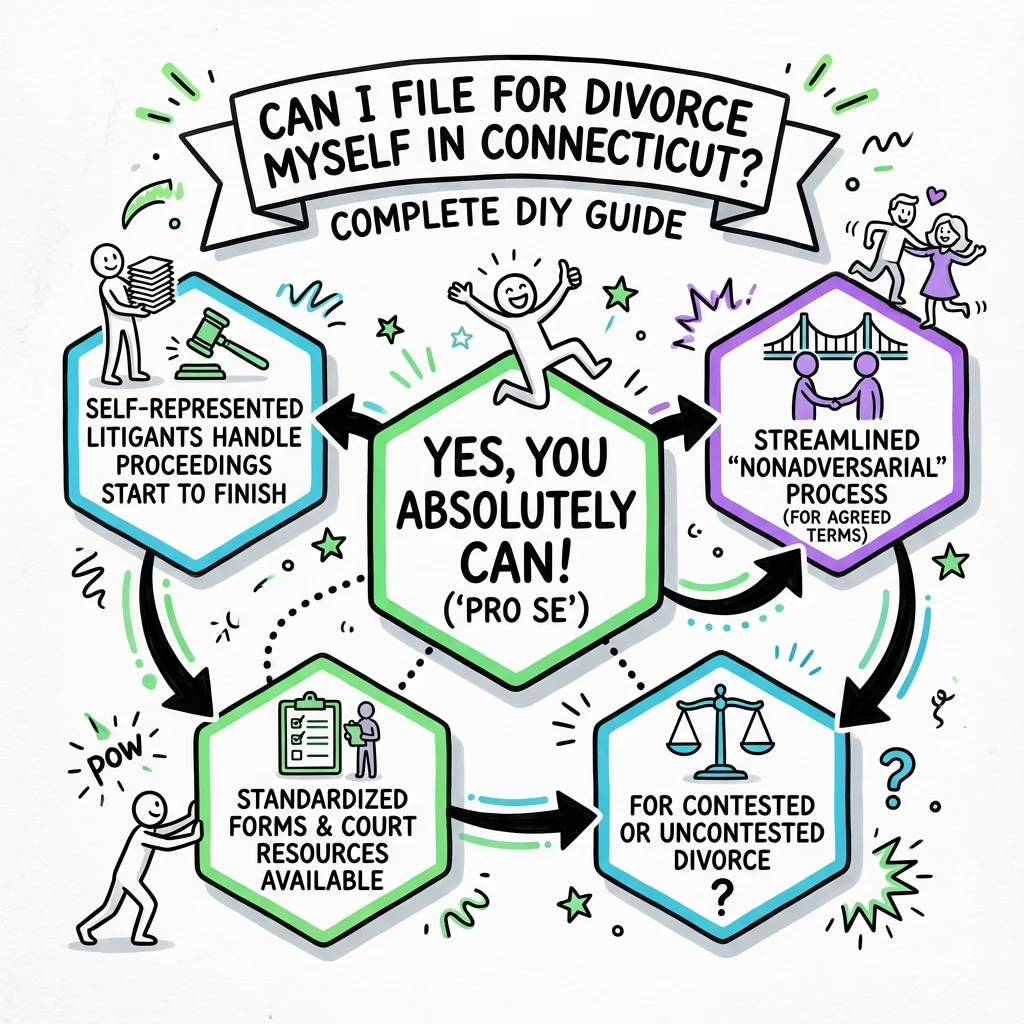
Yes, you can absolutely file for divorce yourself in Connecticut without hiring an attorney. Connecticut courts allow self-represented litigants (called "pro se" parties) to handle their own divorce proceedings from start to finish. Whether you're pursuing a contested or uncontested divorce, the state provides standardized forms, court resources, and even a streamlined "nonadversarial" process specifically designed for couples who agree on all terms. While navigating the legal system alone requires careful attention to detail, thousands of Connecticut residents successfully complete DIY divorces each year—saving thousands of dollars in attorney fees.
Understanding Your DIY Divorce Options in Connecticut
Connecticut offers two primary pathways for filing divorce yourself: the traditional dissolution process and the nonadversarial (uncontested) dissolution process. The path you choose depends largely on whether you and your spouse agree on the terms of your divorce.
The traditional dissolution process begins when one spouse (the plaintiff) files a complaint against the other spouse (the defendant). This method works whether you agree on everything or have disputes to resolve. Under C.G.S. § 46b-45, you'll file your complaint in the Superior Court for the judicial district where either you or your spouse lives, then arrange for your spouse to be formally served with the paperwork. Even if your spouse doesn't respond or appear, you can still proceed to judgment under Practice Book § 25-51—the court won't simply dismiss your case.
The nonadversarial dissolution process under C.G.S. § 46b-44a offers a faster, simpler path when both spouses agree on all issues. Instead of one person suing the other, you file a joint petition together. This option requires both parties to attest under oath that specific conditions exist, including agreement on all terms. The court assigns a disposition date no less than 30 days after filing, and if neither party revokes the petition, the decree can be entered on that date under C.G.S. § 46b-44c. This streamlined approach often costs less and involves fewer court appearances.
Residency Requirements You Must Meet
Before filing any divorce in Connecticut, you must satisfy the state's residency requirements under C.G.S. § 46b-44. Understanding these rules is essential because filing prematurely can result in your case being dismissed.
To file for divorce in CT, at least one spouse must have been a Connecticut resident for at least 12 months before the divorce decree can be entered. However, you can actually file your complaint as soon as either party establishes residence in the state—you just can't receive your final decree until the 12-month requirement is met. This means you can start the process, complete negotiations, and have everything ready so the court can finalize your divorce the moment you hit that one-year mark.
There are also exceptions to the standard residency rule. If the grounds for divorce arose after one party moved to Connecticut, you may qualify for a shorter waiting period. Additionally, if one spouse was a Connecticut resident at the time of the marriage but later moved away, returning to the state with intent to remain permanently can restart the residency clock. Tools like Untangle's guided questionnaire can help you determine whether you meet these requirements before you invest time in preparing your paperwork.
Essential Forms for Your DIY Connecticut Divorce
Filing for divorce yourself means becoming familiar with a specific set of court forms. Connecticut's Judicial Branch provides standardized forms that you must use—courts won't accept homemade versions or forms from other states.
| Form Number | Form Name | Purpose | When Required |
|---|---|---|---|
| JD-FM-003 | Summons - Family Actions | Officially notifies your spouse of the divorce action | All traditional dissolutions |
| JD-FM-159 | Divorce Complaint | States grounds for divorce and what you're requesting | All traditional dissolutions |
| JD-FM-006-short | Financial Affidavit (Short Form) | Discloses income, expenses, assets, and debts | When neither party earns over $75,000/year and assets are under $75,000 |
| JD-FM-006-long | Financial Affidavit (Long Form) | Comprehensive financial disclosure | When income or assets exceed short-form thresholds |
| JD-FM-175 | Certificate of Compliance | Confirms you've met all court requirements | Before final hearing |
The Financial Affidavit is particularly important—and often the most time-consuming to complete accurately. Under Practice Book § 25-5B, both parties must file sworn financial statements. For budget-conscious filers, the short form (JD-FM-006-short) applies when neither party's net income exceeds $75,000 annually and total assets are less than $75,000. Getting your financial information organized upfront with a tool like Untangle's asset inventory feature can save hours of frustration and help ensure accuracy.
Step-by-Step Process for Filing Divorce Yourself
Filing your own divorce requires following specific procedures in the correct order. Missing a step or filing forms incorrectly can delay your case by weeks or even months.
-
Gather your information - Collect marriage certificate, financial documents (tax returns, pay stubs, bank statements), property deeds, and information about any minor children.
-
Determine your filing location - File in the Superior Court for the judicial district where either you or your spouse resides (C.G.S. § 46b-42 gives Superior Court exclusive jurisdiction over dissolutions).
-
Complete required forms - Fill out the complaint, summons, and financial affidavit. Your complaint must include the date and place of marriage, residency facts, and information about any minor children per Practice Book § 25-2.
-
File with the court clerk - Submit your original documents plus copies for your spouse. Pay the filing fee (currently around $360 for a dissolution).
-
Serve your spouse - Arrange proper service through a state marshal or other authorized person. Your spouse can also sign a waiver of service to simplify this step.
-
Wait for response - Your spouse has a specified time to file an appearance and respond to your complaint.
-
Attend required appointments - Most cases require a Resolution Plan Date within 30-60 days where you'll meet with a family relations counselor who will recommend a case track under Practice Book § 25-50A.
-
Complete discovery and negotiations - Exchange financial information and work toward agreements on property division, support, and custody if applicable.
-
Attend final hearing - Present your agreement (or argue your case) before a judge who will issue the final decree.
Throughout this process, Untangle's task dashboard can help you track deadlines and major milestones to prevent common delays.
Automatic Court Orders That Apply Immediately
The moment you file for divorce—or are served with divorce papers—automatic court orders take effect. These orders under Practice Book § 25-5 restrict what both parties can do during the divorce process, and violating them can result in contempt charges.
For cases involving children, neither parent may permanently remove minor children from Connecticut without written consent from the other parent or a court order. If you move out of the family home, you must provide your mailing address within 48 hours. Both parents must facilitate the children's relationship with the other parent.
Financial restrictions apply to everyone. Neither party may sell, transfer, encumber, conceal, or dispose of marital property without consent or court approval. You cannot cancel or modify existing insurance policies. You also cannot incur unreasonable debts that would burden the marital estate. These orders exist to maintain the status quo and ensure neither party gains an unfair advantage during the divorce process.
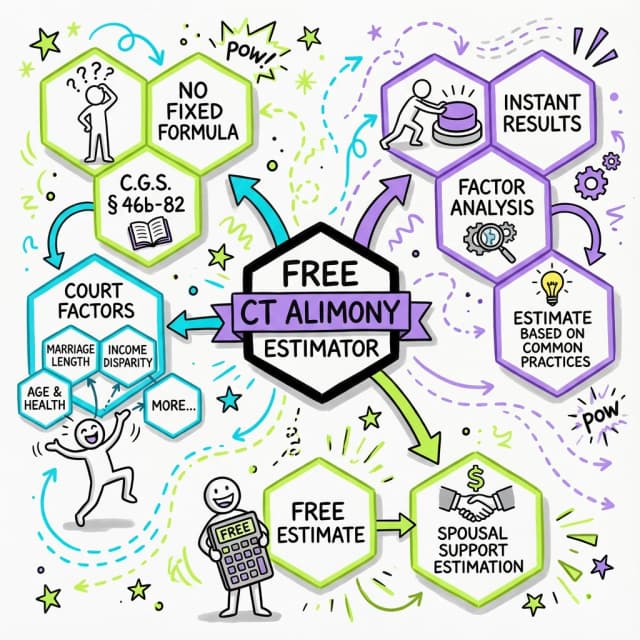
Try our free CT alimony calculator
Get an instant estimate based on Connecticut's statutory factors. No signup required.
What Makes the Nonadversarial Process Different
If you and your spouse agree on everything—property division, debt allocation, custody, support, and all other issues—the nonadversarial dissolution under C.G.S. § 46b-44a offers significant advantages for DIY filers.
The joint petition process requires both spouses to file together and attest that certain conditions exist: you agree on all terms, you've disclosed all assets and debts, and your agreement is fair and voluntary. Because you're filing jointly, automatic orders under Practice Book § 25-5B take effect immediately upon filing rather than upon service. Both parties must submit sworn financial statements with the initial petition.
The timeline is also much shorter. Under C.G.S. § 46b-44c, the court assigns a disposition date no less than 30 days after filing. If neither party files a notice of revocation before that date, the court can enter your divorce decree on the disposition date or within five days after. Compare this to contested divorces that can drag on for months or even years, and the appeal of the nonadversarial route becomes clear.
However, "uncontested" doesn't mean "simple." You still need a comprehensive separation agreement covering all aspects of your divorce. Using Untangle's settlement agreement builder can help you and your spouse work through every issue systematically, ensuring nothing falls through the cracks.
Realistic Cost Comparison: DIY vs. Attorney-Represented Divorce
One of the primary motivations for filing divorce yourself is cost savings. Understanding the actual expenses involved helps you make an informed decision.
| Expense Category | DIY Divorce | Attorney-Represented |
|---|---|---|
| Filing Fee | $360 | $360 |
| Service of Process | $50-100 | $50-100 |
| Certified Copies | $25-50 | $25-50 |
| Parent Education (if children) | $125 per person | $125 per person |
| Attorney Fees | $0 | $5,000-25,000+ |
| Legal Document Preparation | $0-500 | Included in fees |
| Total Estimated Cost | $435-1,035 | $5,560-25,635+ |
The savings can be substantial—potentially $5,000 to $25,000 or more depending on case complexity. However, these savings come with tradeoffs. You'll invest significant time learning procedures, completing forms, and attending court appointments. You also bear the risk of making mistakes that could cost you in the long run, particularly regarding property division or support calculations.
For budget-conscious filers, a middle-ground option exists: limited-scope representation, where an attorney handles specific tasks (like reviewing your settlement agreement) while you do the rest. This approach can provide professional oversight at a fraction of full-representation costs.
Common Mistakes DIY Filers Should Avoid
Self-represented litigants often make preventable errors that delay their cases or result in unfavorable outcomes. Being aware of these pitfalls helps you avoid them.
Incomplete financial disclosure tops the list. Connecticut requires full transparency about income, assets, and debts. Failing to disclose everything—even accounts you consider "yours" from before marriage—can result in your agreement being set aside later. Take time to document everything thoroughly.
Improper service is another frequent issue. Your spouse must be served according to specific rules. Having a friend hand over the papers doesn't count. Use a state marshal or follow proper procedures for waiver of service under C.G.S. § 46b-45.
Ignoring automatic orders can have serious consequences. Even if you're the one who filed, those orders apply to you too. Transferring assets, canceling insurance, or taking on significant new debt before your divorce is final can result in contempt findings and undermine your credibility with the court.
Unclear or incomplete agreements create problems down the road. Your separation agreement must address every issue: property division, debt allocation, alimony, child custody, child support, insurance, taxes, and more. Vague language leads to post-judgment disputes and additional legal expenses.
When DIY Divorce May Not Be Right for You
While filing for divorce yourself is possible in any Connecticut divorce, some situations benefit significantly from professional guidance.
Consider consulting an attorney if your case involves complex assets like businesses, stock options, pensions, or real estate in multiple states. Property division mistakes can cost far more than attorney fees would have. Similarly, if there's any history of domestic violence, hidden assets, or significant power imbalances between spouses, professional representation helps protect your interests.
Cases involving custody disputes also warrant careful consideration. Custody arrangements affect your children for years, and courts scrutinize parenting plans carefully. Even if you handle most of the divorce yourself, having an attorney review custody provisions can provide valuable protection.
If you're unsure whether DIY is right for your situation, it is worth consulting with a legal professional or using online assessment tools to understand the complexity of your specific circumstances and what level of legal support might be appropriate.
Getting Started with Your Connecticut DIY Divorce
Taking the first step toward divorce is often the hardest part. Having a clear roadmap makes the process less overwhelming.
Begin by honestly assessing your situation. Do you and your spouse generally agree on how to divide property and handle custody? Is communication between you possible, even if difficult? Are your finances relatively straightforward? If you answered yes to these questions, you're a good candidate for handling your own divorce.
Next, educate yourself on the process. Connecticut's Judicial Branch website offers resources for self-represented parties, and many courthouses have law libraries with staff who can help you find forms and procedural information (though they cannot give legal advice).
Finally, get organized. Successful DIY divorces depend on meticulous record-keeping and documentation. Create a filing system for court documents, correspondence, and financial records. Organizing everything in one place, tracking deadlines, and ensuring you're prepared for each step of the process is the best way to ensure a smooth dissolution.
Frequently Asked Questions
What are the steps to file for divorce without a lawyer in Connecticut?
To file for divorce without a lawyer in CT, you must complete the required court forms, file them with the Superior Court in your judicial district, pay the filing fee, serve your spouse with the paperwork, and attend all scheduled court hearings.
How much does it cost to file for divorce yourself in CT?
Filing for divorce yourself in Connecticut typically costs between $350-$400 in court filing fees, though fee waivers are available for those who qualify based on income.
What mistakes should I avoid when filing for divorce without an attorney?
Common DIY divorce mistakes include failing to properly serve your spouse, missing court deadlines, not fully disclosing assets, making errors on required forms, and overlooking important issues like retirement accounts or debt division.
When should I hire a divorce lawyer instead of filing myself in Connecticut?
You should consider hiring a divorce lawyer if your case involves significant assets, complex property division, child custody disputes, domestic violence, or if your spouse has retained an attorney.
How long does a DIY divorce take in Connecticut?
A DIY divorce in Connecticut takes a minimum of 90 days from the return date, though uncontested cases using the nonadversarial process can be finalized more quickly once the 30-day waiting period passes.
Legal Citations
- • C.G.S. § 46b-45 View Source
- • C.G.S. § 46b-44a View Source
- • C.G.S. § 46b-44c View Source
- • C.G.S. § 46b-44 View Source
- • C.G.S. § 46b-42 View Source