Can I Afford to Get Divorced in Connecticut? Financial Guide for Stay-at-Home Spouses
Learn how stay-at-home spouses in Connecticut can afford divorce through temporary support, property division, and attorney fee awards. Understand your financial options.
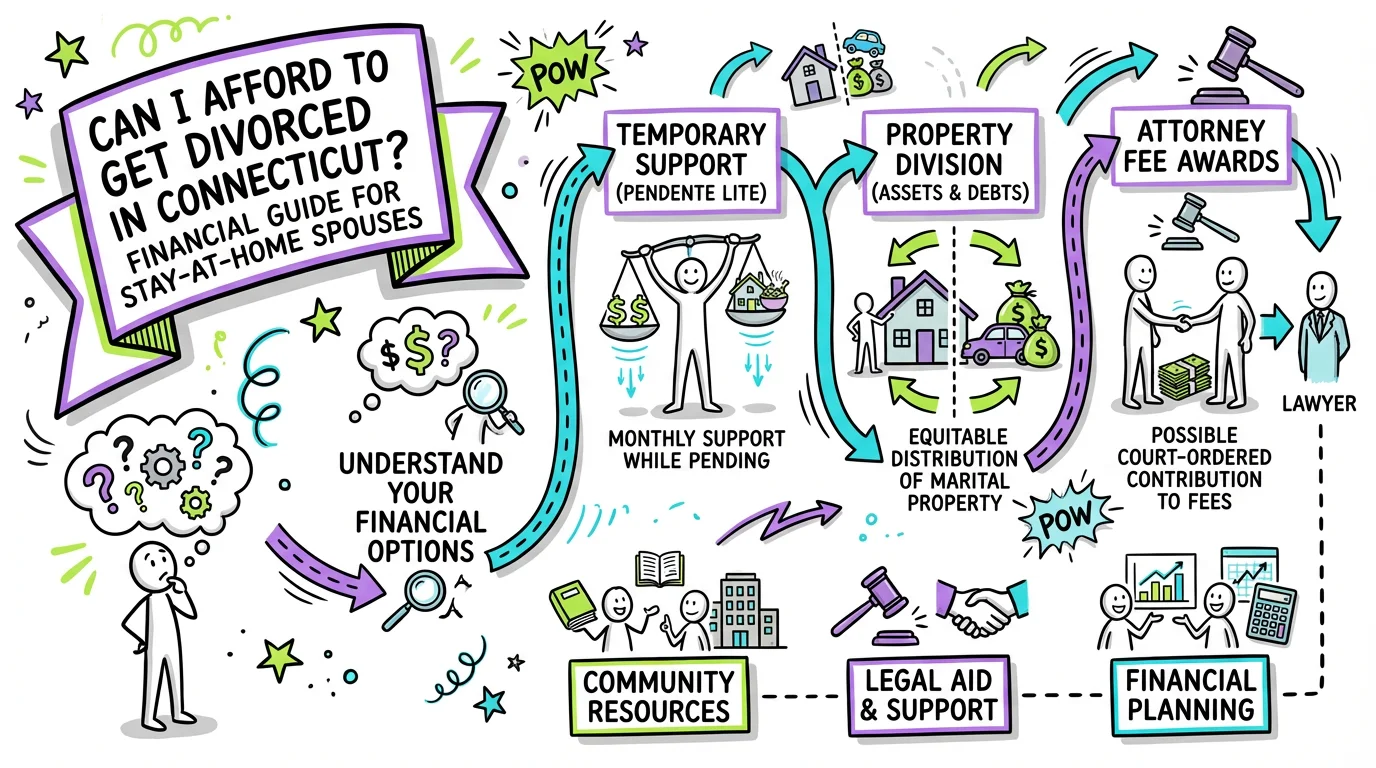
Yes, you can likely afford to get divorced in Connecticut even as a financially dependent spouse. Connecticut law specifically protects stay-at-home spouses through temporary support orders (called "pendente lite" support), equitable property division, and the ability to have your spouse ordered to pay your attorney's fees. The court recognizes that one spouse often sacrifices career advancement to support the family, and the law provides mechanisms to ensure you're not trapped in a marriage simply because you lack independent income.
Understanding Your Financial Protections as a Stay-at-Home Spouse
Connecticut's divorce laws are designed to prevent the financially stronger spouse from using money as a weapon. Under C.G.S. § 46b-83, the court can award you alimony and support "pendente lite"—a Latin term meaning "while the litigation is pending." This means you don't have to wait until your divorce is finalized to receive financial support. You can request temporary support from the very first court date, giving you the resources you need to survive and participate meaningfully in the divorce process.
The law also recognizes that your contributions as a stay-at-home spouse have real economic value. Years spent raising children, maintaining the household, and supporting your spouse's career are considered when the court divides assets and awards alimony. Under C.G.S. § 46b-82, the court specifically considers "the contribution of each of the parties in the acquisition, preservation or appreciation in value of their respective estates" and "the contribution of a party as a homemaker."
Perhaps most importantly, C.G.S. § 46b-62 allows the court to order your spouse to pay your attorney's fees "in accordance with their respective financial abilities." This means that if your spouse earns significantly more than you or controls most of the marital assets, they may be required to fund your legal representation—ensuring you have equal access to justice regardless of who controls the family finances.
What Financial Support Can You Request During Divorce?
Temporary Support (Pendente Lite Orders)
Once your divorce case is filed and the other party is served, you can immediately request temporary financial support. This "pendente lite" support can include alimony payments to cover your living expenses, continued access to marital funds, and an order that your spouse maintain existing insurance coverage. The court can also order that you remain in the family home while the divorce is pending.
Under Practice Book Rule § 25-5, automatic court orders take effect the moment the case begins. These orders prevent either spouse from selling, transferring, or depleting marital assets. They also require that existing insurance policies remain in place and prohibit either party from incurring excessive debt. These protections give you financial stability while the court sorts out the longer-term issues.
To request pendente lite support, you'll file a motion with the court accompanied by a financial affidavit. Tools like Untangle's financial affidavit helper can guide you through documenting your income, expenses, assets, and liabilities—information the court needs to determine appropriate temporary support amounts.
Property Division in Connecticut
Connecticut is an "equitable distribution" state, which means marital property is divided fairly—though not necessarily equally. Under C.G.S. § 46b-81, the court has broad authority to "assign to either spouse all or any part of the estate of the other spouse." This includes everything from bank accounts and retirement funds to real estate and business interests.
The court considers numerous factors when dividing property, including the length of your marriage, the causes for dissolution, each spouse's age, health, and earning capacity, and critically for stay-at-home spouses, "the opportunity of each for future acquisition of capital assets and income." If you've been out of the workforce for years, the court will factor in the time and resources you'll need to become financially self-sufficient.
What many stay-at-home spouses don't realize is that retirement accounts accumulated during the marriage are typically marital property subject to division. Even if your spouse's 401(k) or pension is solely in their name, you likely have a claim to a portion of the funds that accrued during your marriage. This can represent substantial value and provide crucial financial security for your future.
Alimony Awards
Alimony (also called spousal support or maintenance) is financial support paid from one spouse to the other during and after divorce. Under C.G.S. § 46b-82, the court considers factors including the length of your marriage, your age, health, and employability, the station of the parties, and whether the party seeking alimony sacrificed career opportunities for the marriage.
For stay-at-home spouses, alimony serves a crucial function: it provides time and resources to re-enter the workforce. If you've been out of your career field for years, you may need education, training, or certification updates before you can find employment at your potential earning level. Rehabilitative alimony addresses this need by providing support while you rebuild your career capacity.
The duration of alimony depends heavily on the length of your marriage. In long-term marriages, courts may award permanent alimony that continues until remarriage or death. In shorter marriages, you might receive time-limited support designed to help you transition to financial independence. Understanding what type of alimony might apply to your situation helps you plan realistically for your financial future. To gain a clearer understanding of potential alimony amounts based on Connecticut's specific factors, Untangle's alimony calculator can provide valuable insights.
What Will Divorce Actually Cost?
| Cost Category | Typical Range | Notes |
|---|---|---|
| Court Filing Fees | $350-$400 | Required to initiate divorce |
| Attorney Fees | $3,000-$25,000+ | Varies dramatically by complexity |
| Mediation | $3,000-$8,000 | Often split between spouses |
| Financial Experts | $1,500-$5,000+ | If complex assets need valuation |
| Guardian ad Litem | $2,000-$10,000+ | If custody is disputed |
| Parent Education Program | $100-$150 | Required if children are involved |
Understanding these costs helps you plan, but remember: you don't necessarily have to pay these expenses out of your own pocket. If your spouse has greater financial resources, the court can order them to contribute to or fully cover your legal costs.
For cases involving relatively modest incomes and assets, Connecticut offers a Short Form Financial Affidavit (Form JD-FM-006) for situations where neither party's net income exceeds $75,000 per year and total assets are less than $75,000. Using Untangle's document generation tools can help you complete these required forms accurately and efficiently, potentially reducing attorney time and associated costs.
How to Request Attorney Fee Contributions
If you're concerned about affording legal representation, you should specifically request that your spouse contribute to your attorney fees. This request can be made at the beginning of your case and at various points throughout the proceedings. The court evaluates requests for attorney fees using the same factors it considers for alimony: each party's financial ability and the overall circumstances of the case.
The case law in Connecticut demonstrates that courts take these requests seriously. In Giordano v. Giordano, the court awarded appellate attorney's fees to help ensure the financially disadvantaged spouse could fully participate in the legal process. Courts recognize that without access to counsel, a stay-at-home spouse cannot effectively protect their interests against a spouse who can afford full legal representation.
To support your request, you'll need to provide detailed financial documentation. Practice Book Rule § 25-32 requires automatic disclosure of tax returns, pay stubs, bank statements, and other financial records within 60 days of a request. This transparency helps the court understand each party's true financial picture and make appropriate orders.
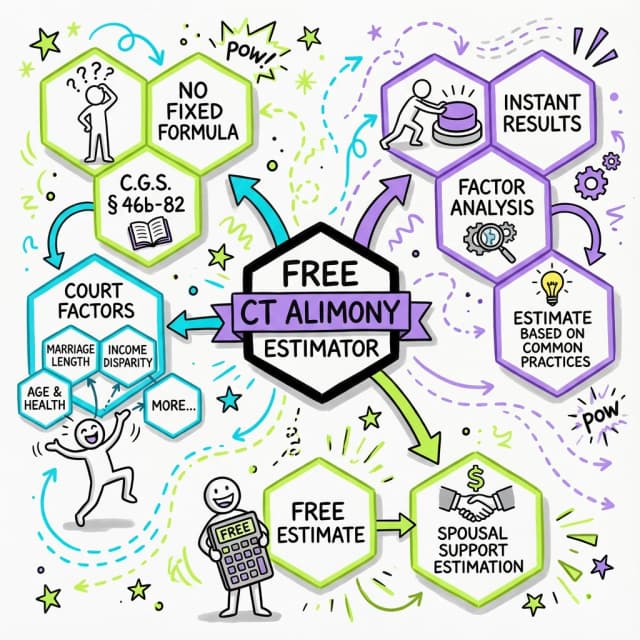
Try our free CT alimony calculator
Get an instant estimate based on Connecticut's statutory factors. No signup required.

Steps to Assess Your Divorce Affordability
-
Gather comprehensive financial information - Collect records of all income sources, bank accounts, investments, debts, and monthly expenses. You'll need this information for your financial affidavit and to understand your current financial picture.
-
Complete a preliminary budget - Calculate what you actually need to live on monthly, including housing, utilities, food, transportation, healthcare, and child-related expenses. Be thorough—courts rely on this information. Using Untangle's expense tracking features can help you build an accurate picture of your monthly financial needs—essential information for requesting appropriate support amounts.
-
Identify all marital assets - Make a list of everything acquired during the marriage, including retirement accounts, real estate equity, vehicles, and valuable personal property. These assets will be divided and can provide you with resources.
-
Research potential income - Consider what you could realistically earn if you returned to work, whether immediately or after additional training. This helps you and the court plan for your financial transition.
-
Consult with an attorney about fees - Many divorce attorneys offer free initial consultations. Ask specifically about their willingness to seek attorney fee contributions from your spouse and whether they'll work with you on payment arrangements.
-
Request pendente lite support early - Don't wait to ask for temporary support. File this motion promptly so you have financial resources throughout the divorce process.
Alternative Dispute Resolution Can Reduce Costs
Litigation isn't your only option. Mediation and collaborative divorce can significantly reduce the overall cost of ending your marriage, which benefits both parties. In mediation, a neutral third party helps you and your spouse negotiate agreements on all issues—property division, alimony, child support, and custody. You maintain control over the outcome rather than leaving decisions to a judge.
While mediation requires that both parties negotiate in good faith, it can be particularly beneficial when there's a significant income disparity. The money saved on attorney fees and court costs becomes available for division between the spouses or to fund the transition to separate households. Even in mediated cases, it's wise to consult with an attorney who can review any proposed agreements before you sign.
If your spouse refuses to negotiate fairly or you're concerned about power imbalances, traditional litigation with strong legal representation may better protect your interests. The key is understanding your options and choosing the approach most likely to achieve a fair outcome in your specific circumstances.
Building Your Post-Divorce Financial Foundation
Divorce isn't just about surviving the process—it's about positioning yourself for financial stability afterward. Consider requesting that alimony orders include cost-of-living adjustments or automatic increases tied to your spouse's income growth. Under C.G.S. § 46b-86, support orders can be modified if there's a substantial change in circumstances, as demonstrated in cases like Barber v. Barber, but building protections into the original order provides greater security.
Think strategically about property division. Sometimes accepting a larger share of liquid assets (cash, investment accounts) provides more immediate value than fighting over the family home, which comes with ongoing expenses. Consider tax implications—retirement account withdrawals may be taxable, while property transfers between divorcing spouses generally aren't.
Most importantly, start building credit in your own name if you haven't already. Apply for a credit card, ensure utility bills are in your name, and begin establishing the independent financial identity you'll need after divorce. Planning for this transition during the divorce process positions you for success afterward.
When to Seek Professional Help
While concerns about cost are valid, trying to handle a complex divorce without professional guidance can actually cost you more in the long run. You should seriously consider working with an attorney if your spouse has hired one, if you have significant assets to divide, if child custody is contested, or if you suspect your spouse is hiding assets or income.
Connecticut's family courts see many self-represented parties, and judges work to ensure proceedings are fair. However, an experienced family law attorney understands nuances you might miss—like how to properly value a business, structure alimony for optimal tax treatment, or protect your interest in your spouse's pension. If full representation isn't affordable, consider limited-scope representation where an attorney handles specific aspects of your case while you manage others.
Untangle's case management tools can help bridge the gap by providing tools to organize your financial information, understand Connecticut's divorce laws, and prepare for conversations with attorneys—making your paid legal consultations more efficient and productive. You deserve to make informed decisions about your future, and the right combination of professional guidance and self-advocacy can help you afford the divorce you need.
Frequently Asked Questions
How much does a divorce cost in Connecticut on average?
A Connecticut divorce typically costs between $15,000 and $30,000 for contested cases, though uncontested divorces can cost as little as $500 to $2,500 if both parties agree on all terms.
Can I get free legal help for my divorce in CT?
Yes, Connecticut offers free divorce legal aid through organizations like Statewide Legal Services and CT Free Legal Answers for those who meet income eligibility requirements.
Can the court make my spouse pay my attorney fees in a Connecticut divorce?
Yes, under C.G.S. § 46b-62, Connecticut courts can order the higher-earning spouse to pay the other spouse's attorney fees based on their respective financial abilities.
What is pendente lite support in a CT divorce?
Pendente lite support is temporary financial support ordered by the court to help a dependent spouse cover living expenses and legal costs while the divorce is still pending.
How can I afford a divorce if I'm a stay-at-home parent with no income?
Connecticut law protects financially dependent spouses through temporary support orders, equitable property division, and provisions that may require your spouse to pay your legal fees during the divorce process.
Legal Citations
- • C.G.S. § 46b-83 - Alimony, support and use of family home or other residential dwelling unit awarded pendente lite View Source
- • C.G.S. § 46b-82 - Alimony View Source
- • C.G.S. § 46b-62 - Orders for payment of attorney's fees View Source
- • C.G.S. § 46b-81 - Assignment of property and transfer of title View Source
- • Practice Book Rule § 25-5 - Automatic Orders upon Service of Complaint or Application View Source
- • Practice Book Rule § 25-32 - Mandatory Disclosure and Production View Source
- • C.G.S. § 46b-86 - Modification of alimony or support orders and judgments View Source
- • Giordano v. Giordano, 203 Conn. App. 652 View Source
- • Barber v. Barber, 193 Conn. App. 190 View Source
- • Financial Affidavit Short Form (JD-FM-006) View Source