Best Uncontested Divorce Services in Connecticut: Your Complete Guide
Compare the best uncontested divorce services in Connecticut. Learn about DIY filing, online platforms, mediation, and attorney options for couples who agree.
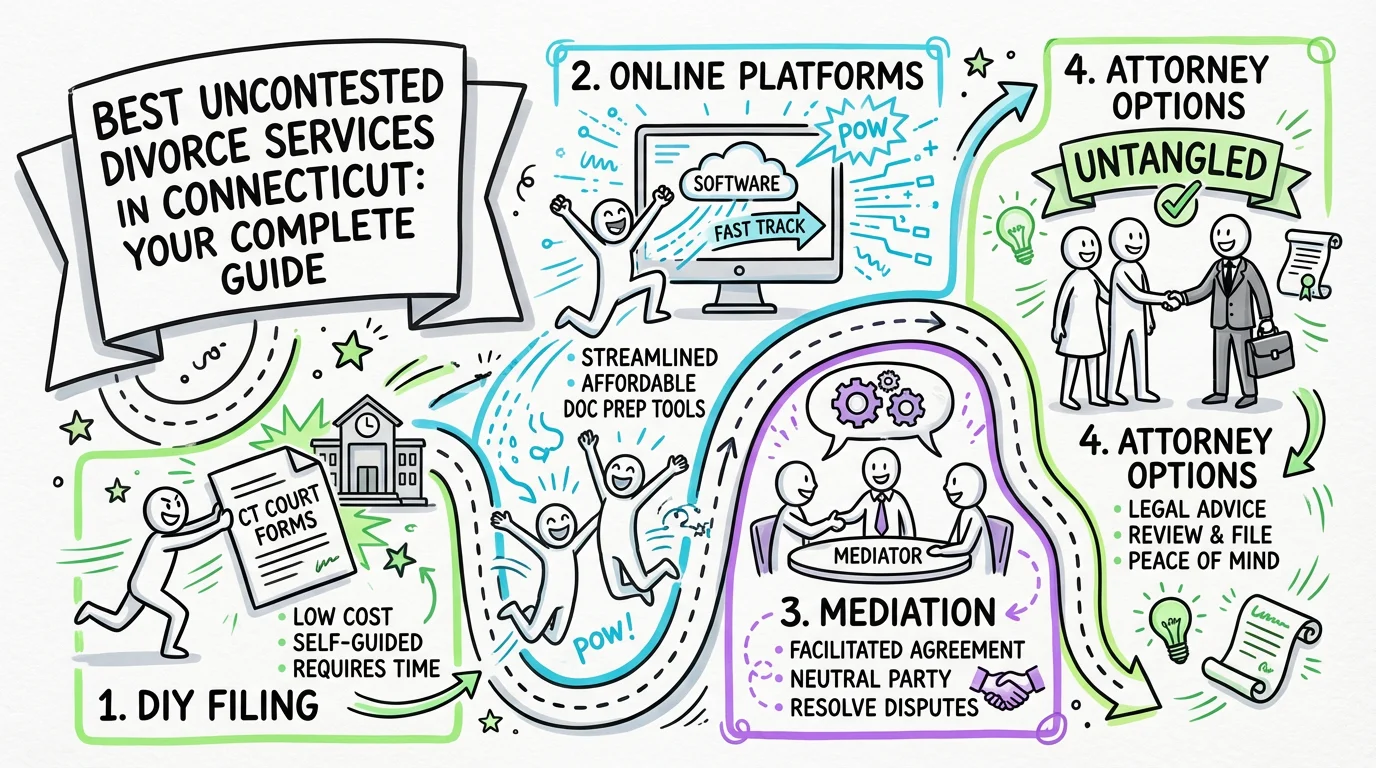
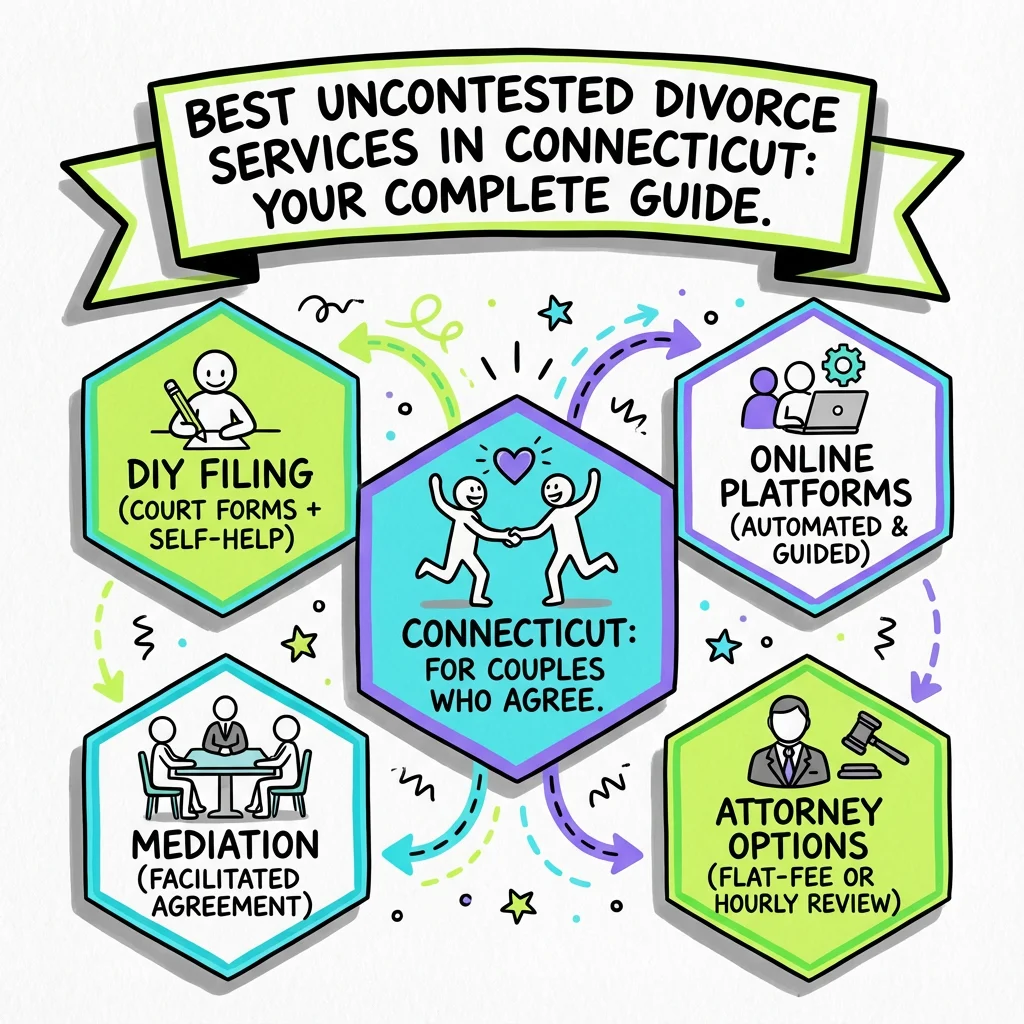
The best uncontested divorce services in Connecticut include DIY court filing for maximum savings, online divorce platforms like Untangle for guided document preparation, and limited-scope attorney assistance for legal oversight. While filing directly with the court costs approximately $350, using an online service or mediator ensures compliance with Connecticut's nonadversarial dissolution process established under C.G.S. § 46b-44a. These streamlined options allow eligible couples to finalize their divorce in as little as 35 days without a court appearance, provided they agree on all terms regarding property, support, and children.
Understanding Connecticut's Uncontested Divorce Process
Connecticut offers a unique pathway called "nonadversarial dissolution" that is specifically designed for couples who agree on everything. Unlike a traditional contested divorce that can drag on for a year or more, this streamlined process recognizes that not every divorce requires a courtroom battle. When both spouses see eye-to-eye on property division, support, and (if applicable) parenting arrangements, the state provides a faster, simpler route to your new beginning.
Under this process, you and your spouse file a joint petition together rather than one person "suing" the other. You'll attest under oath that you meet all the requirements and submit your complete settlement agreement at the same time. The court then reviews your paperwork, and if everything is fair and equitable, a judge can enter your divorce decree without either of you ever stepping foot in a courtroom. This cooperative approach not only saves time and money but also helps preserve the amicable relationship you've worked to maintain.
The key requirement is genuine agreement on all issues. Practice Book § 25-49 defines an "uncontested matter" as one where both parties appear and no aspect is disputed. If you're aligned on the major decisions—who gets what, how finances will be handled, and how you'll co-parent—you're an ideal candidate for these services.
Comparing Uncontested Divorce Service Options in Connecticut
| Service Type | Typical Cost | Best For | Timeline | Court Appearance |
|---|---|---|---|---|
| DIY Court Filing | $350-$400 (fees only) | Simple cases, no children, minimal assets | 35+ days | Usually not required |
| Online Divorce Platforms | $150-$500 + fees | Couples wanting guidance without attorneys | 35+ days | Usually not required |
| Court-Connected Mediation | Free-$300 | Couples with minor disagreements | 60-90 days | May be required |
| Limited-Scope Attorney | $500-$2,000 + fees | Moderate complexity, need legal review | 35-60 days | Depends on arrangement |
| Full Attorney Representation | $3,000-$10,000+ | Complex assets, business interests | 60+ days | Depends on case |
DIY Court Filing
Filing your uncontested divorce directly with the Connecticut Superior Court is the most affordable option. You'll need to obtain and complete the required forms, including the joint petition, settlement agreement, and sworn financial affidavits (Form JD-FM-006 for lower-income cases). The court filing fee is approximately $350, and you'll submit everything to the judicial district where one of you resides.
The challenge with DIY filing is ensuring you complete everything correctly without professional oversight. Missing information, improperly worded agreements, or overlooked legal requirements can delay your case or result in rejection. You'll need to strictly adhere to the formatting rules, understand what makes a settlement agreement "fair and equitable" in the court's eyes, properly calculate any support obligations, and ensure your parenting plan addresses all required elements under state law.
Online Divorce Platforms
Online divorce services have emerged as a middle ground between DIY filing and hiring an attorney. These platforms guide you through a series of questions about your situation, then generate the appropriate legal documents based on your answers. Quality platforms understand Connecticut's specific requirements and help ensure you don't miss critical details.
Rather than facing a stack of blank legal forms, you answer questions in plain English and receive properly formatted documents ready for filing. This approach reduces errors while keeping costs manageable. The best platforms also help you think through issues you might not have considered—like how you'll handle future modifications or what happens to retirement accounts—providing a safety net that pure DIY filing lacks.
Court-Connected Mediation Services
Connecticut offers mediation services through its court system under C.G.S. § 46b-53a. These services are available in designated judicial districts and address property, financial, child custody, and visitation issues. Even if you think you agree on everything, a mediator can help you work through the details and ensure your agreement is comprehensive.
One significant advantage of court-connected mediation is confidentiality. All communications made during mediation are privileged and cannot be used as evidence in any subsequent proceeding. This protection encourages open, honest discussion without fear that your words will be used against you if things don't work out. Mediation can be especially helpful for working through parenting schedules, holiday arrangements, and other details that might not have occurred to you initially.
Limited-Scope Attorney Services
If you want professional legal guidance without the cost of full representation, many Connecticut family law attorneys offer "limited scope" or "unbundled" services. You might hire an attorney solely to review your settlement agreement, help you understand your rights, or answer specific questions—while handling the rest yourself.
This approach gives you the best of both worlds: professional oversight on the most important aspects of your divorce while keeping costs down by doing the legwork yourself. It's particularly valuable when you have specific concerns—perhaps about retirement account division or how certain tax implications might affect you—but don't need hand-holding through the entire process.
The Nonadversarial Dissolution Process: Step by Step
-
Confirm Eligibility - Both spouses must agree on all terms including property division, alimony (if any), and parenting arrangements for minor children. At least one spouse must be a Connecticut resident.
-
Gather Financial Information - Under Practice Book § 25-30, you'll need to file sworn financial statements showing income, expenses, assets, and liabilities. Complete honesty here is essential—misrepresentation can invalidate your entire divorce.
-
Draft Your Settlement Agreement - This comprehensive document covers everything from who keeps the house to how you'll divide retirement accounts. The court reviews this under C.G.S. § 46b-66 to ensure it's "fair and equitable."
-
Complete Required Forms - You'll need the joint petition, settlement agreement, financial affidavits, and other supporting documents. Untangle's document generation features can help you organize and complete these correctly.
-
File with the Court - Submit your completed paperwork to the Superior Court in the judicial district where one of you lives. Pay the required filing fee. Ensure you keep copies of every document you submit for your own records.
-
Automatic Orders Take Effect - Upon filing, Practice Book § 25-5B's automatic orders become effective immediately. These prevent either party from hiding assets, canceling insurance, or taking other harmful actions during the divorce process.
-
Wait for Disposition Date - Under C.G.S. § 46b-44c, the court assigns a disposition date at least 30 days after filing. This waiting period gives either party the option to revoke their consent if circumstances change.
-
Court Review and Decree - If no revocation is filed and the court finds your agreement fair and equitable, a decree of dissolution can be entered on the disposition date—or within five days after—often without requiring your appearance.
What Makes a Settlement Agreement "Fair and Equitable"
Connecticut courts take their responsibility to review settlement agreements seriously. Under C.G.S. § 46b-44d, if the court cannot determine whether your agreement is fair and equitable, your case will be placed on the regular docket and you'll be required to appear. Understanding what courts look for can help you avoid this outcome.
The court examines whether both parties had full knowledge of the marital estate and whether the division reflects an informed decision. Significant disparities in what each spouse receives aren't automatically problematic, but the court wants to ensure neither party was taken advantage of. If one spouse is receiving substantially less, there should be a logical explanation—perhaps they're keeping the family home while the other receives more liquid assets.
For couples with children, the court pays particular attention to custody, visitation, and support arrangements. Connecticut requires that parenting plans serve the children's best interests, not just the parents' convenience. Untangle's parenting plan builder can help you create a comprehensive schedule that addresses regular custody, holidays, vacations, and decision-making authority in ways that courts expect to see.
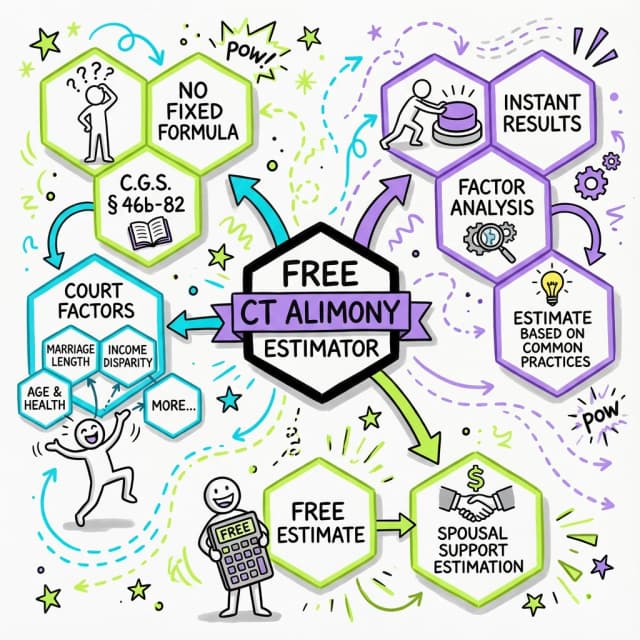
Try our free CT alimony calculator
Get an instant estimate based on Connecticut's statutory factors. No signup required.
Key Documents You'll Need
Success in an uncontested divorce often comes down to the quality and accuracy of your paperwork. The court relies entirely on these documents to make its decision since there is no hearing to explain details. Missing a single form or failing to notarize a signature can lead to your case being rejected or delayed, so it is crucial to assemble your packet with care.
To file for nonadversarial dissolution, you must prepare the following core documents:
- Joint Petition for Nonadversarial Dissolution - The foundational document where both spouses attest to meeting all requirements
- Settlement Agreement - Your comprehensive agreement covering all terms of the divorce
- Financial Affidavit (Form JD-FM-006) - Sworn statement of income, expenses, assets, and liabilities; use the short form if neither party's net income exceeds $75,000 and total assets are under $75,000
- Notice of Automatic Court Orders (Form JD-FM-158) - Acknowledges the restrictions that apply during the divorce process
- Parenting Plan - Required if you have minor children; details custody, visitation, and decision-making
- Child Support Guidelines Worksheet - If applicable, shows how support was calculated
Having all documents prepared correctly the first time prevents delays and additional court trips. Before you head to the court clerk's office, you must ensure that every financial figure is accurate and backed by evidence you have on hand. Furthermore, most of these documents require notarized signatures, so do not sign them until you are in the presence of a notary public or the court clerk.
Costs and Timeline Expectations
Understanding the total investment required for your divorce involves looking at both mandatory court fees and variable service costs. Every couple must pay the standard court filing fee of approximately $350, along with smaller fees for certified copies of the final decree. If you have children, you will also need to budget for the mandatory parent education program, which typically costs between $100 and $150 per parent.
Service costs vary significantly based on the level of support you choose. Online platforms generally range from $150 to $500 depending on whether you need simple document generation or premium support features. In contrast, hiring a limited-scope attorney to review your agreement might cost between $500 and $2,000, while mediation can range from free (through the court) to $300 per hour for private services. Choosing the right level of help balances these costs against the peace of mind provided by professional oversight.
Regarding the timeline, Connecticut's nonadversarial process is one of the fastest ways to divorce. Per C.G.S. § 46b-44c, your disposition date is set at least 30 days after filing. If everything is in order and no revocation is filed, your divorce can be finalized on or within five days of that date. Realistically, most uncontested divorces in Connecticut take 35-60 days from filing to final decree, compared to contested divorces which often exceed a year.
When You Might Need More Help
While uncontested divorce services work wonderfully for many Connecticut couples, certain complex situations benefit from professional legal guidance. For instance, if you have business interests, stock options, or multiple real estate properties, professional valuation is often necessary to ensure a fair division. Similarly, dividing pension or retirement accounts often requires a Qualified Domestic Relations Order (QDRO), a highly technical document best drafted by a specialist.
Spousal support and fairness concerns also warrant legal advice. If there is a significant disparity in income or if you are unsure whether the settlement proposed is truly fair, a consultation with a family law attorney can provide essential protection. This doesn't mean you need to hire a lawyer for the whole case; many attorneys offer flat-fee consultations to review specific issues, allowing you to proceed with confidence.
Even in these situations, you may not need full attorney representation. Many couples use online platforms or DIY methods for most of the process, then engage an attorney for targeted help on specific issues. You might also consult local court service centers or legal aid organizations if you need specific procedural questions answered without retaining private counsel.
Making Your Uncontested Divorce Successful
The couples who have the smoothest uncontested divorces in Connecticut share a few common traits: they communicate openly, they've gathered their financial information thoroughly, and they've thought through the details of their agreement before filing. Taking time upfront to discuss everything from who gets the dining room table to how you'll handle unexpected medical expenses for your children prevents surprises that can derail an otherwise smooth process.
Starting with a tool like Untangle's divorce preparation platform can help you work through these conversations systematically. The platform guides you through the decisions you need to make, helps you understand Connecticut's requirements, and ensures your paperwork is complete and accurate. For couples committed to an amicable split, this combination of guidance and efficiency helps you close this chapter respectfully and move forward with clarity.
Frequently Asked Questions
How much does an uncontested divorce cost in Connecticut?
An uncontested divorce in Connecticut can cost as little as $350 in court fees for DIY filing, with online divorce services and limited-scope attorney assistance adding additional costs depending on the level of help you need.
Are online divorce services legitimate and safe to use in CT?
Yes, reputable online divorce services like Untangle are legitimate and safe, providing guided document preparation that helps ensure your Connecticut divorce paperwork is completed correctly for the nonadversarial dissolution process.
How long does an uncontested divorce take in Connecticut?
Connecticut's nonadversarial dissolution process can finalize your uncontested divorce in as little as 35 days without a court appearance, provided both spouses agree on all terms and paperwork is complete.
What's the difference between DIY divorce and using an online divorce service?
DIY divorce requires you to research, prepare, and file all court documents yourself, while online divorce services guide you through the process with document preparation tools, reducing the risk of errors that could delay your case.
Do I need to go to court for an uncontested divorce in Connecticut?
No, under Connecticut's nonadversarial dissolution process (C.G.S. § 46b-44a), couples who agree on all terms can have their divorce finalized by a judge reviewing paperwork without either spouse appearing in court.
Legal Citations
- • C.G.S. § 46b-44a View Source
- • Practice Book § 25-49 View Source
- • C.G.S. § 46b-53a View Source
- • Practice Book § 25-30 View Source
- • C.G.S. § 46b-66 View Source
- • Practice Book § 25-5B View Source
- • C.G.S. § 46b-44c View Source
- • C.G.S. § 46b-44d View Source