Best Uncontested Divorce Services in Connecticut: Complete Guide to Nonadversarial Dissolution
Compare the best uncontested divorce services in Connecticut. Learn about nonadversarial dissolution, costs, timelines, and how to file a joint petition smoothly.
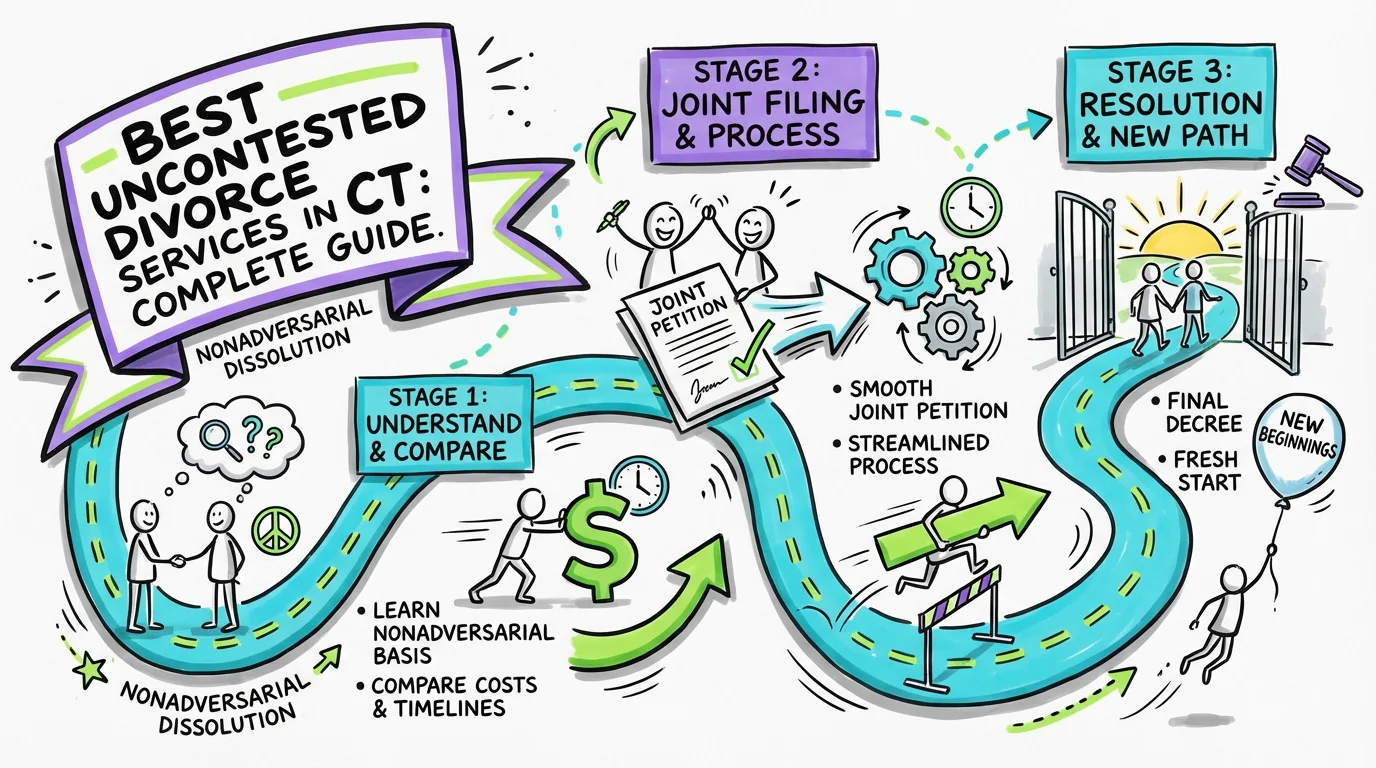
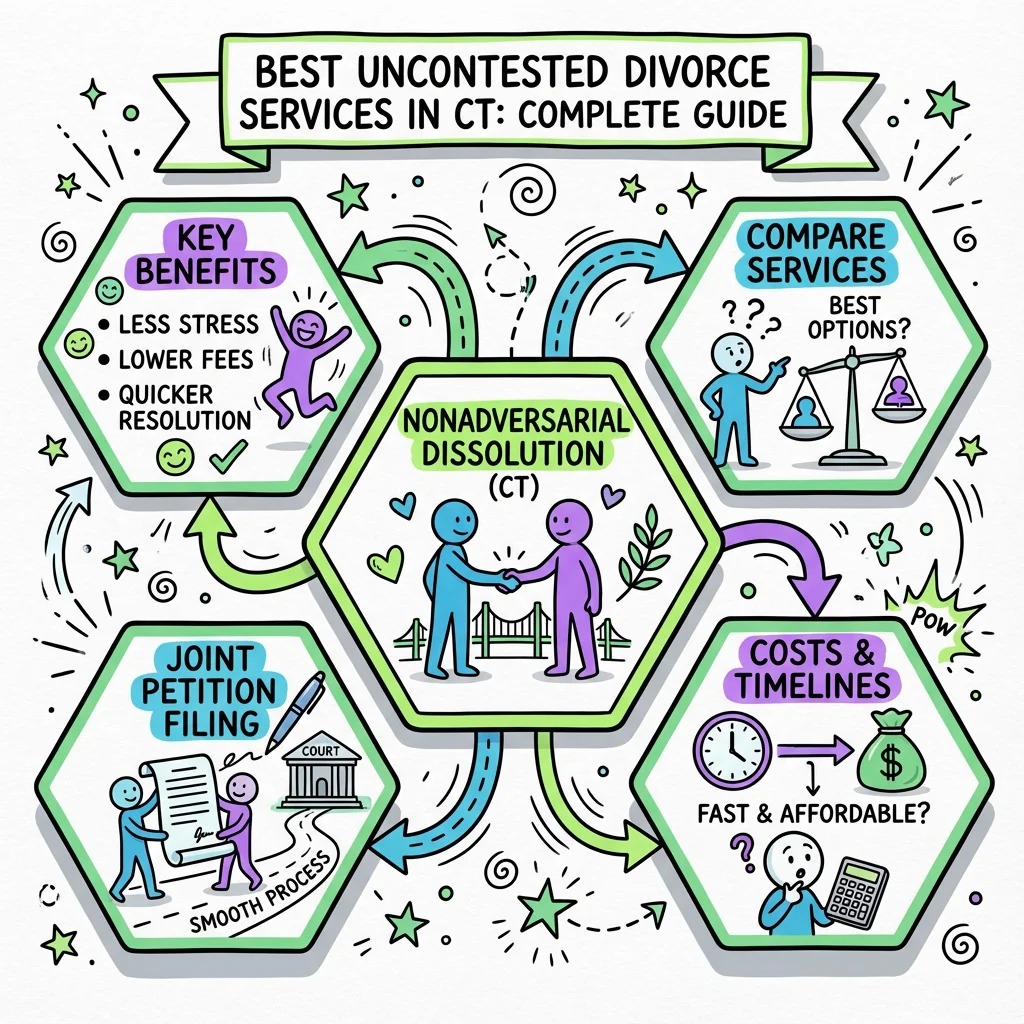
The best uncontested divorce services in Connecticut include specialized online platforms like Untangle, professional mediation services, and limited-scope attorney representation. These options enable couples to file a joint petition for nonadversarial dissolution under C.G.S. § 46b-44a, bypassing traditional court battles. By utilizing these services, agreeing spouses can prepare legally compliant settlement agreements and finalize their divorce in as little as 30 days without ever stepping inside a courtroom.
Understanding Connecticut's Nonadversarial Dissolution Process
Connecticut is one of the few states with a dedicated statutory framework specifically designed for couples who agree on their divorce terms. Under C.G.S. § 46b-44a, spouses can file a joint petition for nonadversarial dissolution of marriage in the judicial district where either party resides. This isn't just a simplified version of regular divorce—it's an entirely separate legal pathway created to make the process faster, less expensive, and less emotionally draining for couples who have already reached agreement.
The nonadversarial process differs fundamentally from contested divorce because both parties work together from the start. You'll file a notarized joint petition containing an attestation under oath that your marriage has broken down irretrievably. This eliminates the typical back-and-forth of serving papers, responding to complaints, and negotiating through attorneys. The court recognizes that when both spouses agree, extensive judicial oversight isn't necessary—though the judge will still review your settlement agreement to ensure it's fair and equitable.
What makes this process particularly appealing is the predictability it offers. Unlike contested divorces that can drag on for months or years, nonadversarial dissolutions follow a clear timeline established by C.G.S. § 46b-44c, which requires the court to assign a disposition date not less than 30 days after filing. If neither party files a notice of revocation before that date, the court can enter your divorce decree, often without requiring either party to appear in court.
What to Look for in Uncontested Divorce Services
Document Preparation Accuracy
The most critical factor in choosing an uncontested divorce service is accuracy in document preparation. Connecticut courts require specific forms filed in precise formats, and errors can delay your case or result in rejection. Quality services should help you complete the Divorce Complaint (JD-FM-159), the Financial Affidavit Short Form (JD-FM-006), and your comprehensive settlement agreement.
Financial disclosure is particularly important in Connecticut uncontested divorces. Practice Book Rule § 25-30 requires each party to file a sworn financial statement showing current income, expenses, assets, and liabilities. The short form financial affidavit is appropriate when neither party's net income exceeds $75,000 annually and total assets are below $75,000. Services that guide you through accurate financial disclosure help ensure your settlement agreement will pass judicial review under C.G.S. § 46b-66.
Tools like Untangle's document generation features can help ensure your financial affidavits and settlement agreements contain complete, accurate information that meets Connecticut court requirements—reducing the risk of delays caused by incomplete filings.
Settlement Agreement Support
Your settlement agreement is the heart of an uncontested divorce. Under C.G.S. § 46b-66, the court must review any agreement concerning custody, support, alimony, or property division and inquire into the financial resources and actual needs of both parties. If the court determines your agreement is fair and equitable, it becomes part of your final divorce decree. If the court has concerns, your case may be docketed for further review under C.G.S. § 46b-44d.
A comprehensive settlement agreement should address every aspect of your shared lives: property division (including real estate, vehicles, retirement accounts, and personal property), debt allocation, spousal support (if applicable), and—if you have children—custody arrangements, parenting schedules, and child support. The Child Support Guidelines Worksheet (CCSG-001) is essential for calculating appropriate support amounts that the court will approve.
The best services don't just fill in blanks—they help you think through scenarios you might not have considered. What happens to the house if one spouse can't refinance within a certain timeframe? How will you handle future disagreements about parenting decisions? Untangle's settlement agreement tools help couples work through these details systematically, creating agreements that address both current needs and future contingencies.
Types of Uncontested Divorce Services in Connecticut
| Service Type | Cost Range | Best For | Limitations |
|---|---|---|---|
| Online Document Preparation | $150-$500 | Simple cases, no children, limited assets | No legal advice, limited customization |
| Mediation Services | $500-$3,000 | Couples needing help reaching agreement | Mediator cannot provide legal advice to either party |
| Limited-Scope Attorney | $500-$2,000 | Reviewing agreements, specific legal questions | Not full representation |
| Full Attorney Representation | $2,500-$10,000+ | Complex assets, business interests | Most expensive option |
| Collaborative Divorce | $3,000-$15,000+ | High-conflict potential, multiple professionals | Requires both parties to hire attorneys |
Online Document Preparation Services
Online document preparation services offer the most affordable option for straightforward uncontested divorces. These platforms guide you through questionnaires and generate the required Connecticut court forms based on your answers. They're ideal for couples with no children, limited assets, and straightforward financial situations.
However, online services have significant limitations. They typically cannot provide legal advice, meaning you're on your own when deciding how to handle complex issues like retirement account division or tax implications. Additionally, generic templates may not address Connecticut-specific requirements or recent changes to Practice Book rules. The automatic orders that take effect upon filing under Practice Book Rule § 25-5B—including restrictions on removing children from Connecticut and selling marital property—require clear understanding that basic document services may not provide. For guidance and quick answers to your legal questions without the cost of an attorney, explore platforms that offer AI-powered legal chat.
Mediation Services
Divorce mediation involves a neutral third party who helps you and your spouse reach agreement on contested issues. While mediation is often associated with contested divorces, many Connecticut couples use mediators even when they largely agree—to ensure they haven't overlooked important details and to facilitate difficult conversations about sensitive topics.
Connecticut courts value mediated agreements, and the Pathways case management system under Practice Book Rule § 25-50A specifically considers settlement likelihood when assigning cases to tracks. Couples who arrive with well-crafted mediated agreements often receive Track A designation, which involves minimal court time. Mediators cannot represent either party or provide legal advice, but they can help you understand the issues you need to address and facilitate productive discussions.
Legal Technology Platforms
A newer category of service combines technology with legal expertise. Untangle represents this approach, using intelligent guidance to help couples navigate Connecticut's uncontested divorce requirements while ensuring nothing falls through the cracks. These platforms can help you understand the automatic orders that apply under Practice Book Rule § 25-5, calculate child support using Connecticut guidelines, and create comprehensive settlement agreements—all while providing resources to help you understand your legal rights.
Unlike standard forms services, modern legal technology adapts to your specific answers. For example, if you own a home, the software prompts for mortgage details and equity division options, ensuring the generated agreement satisfies the "fair and equitable" standard required by Connecticut judges. This dynamic approach bridges the gap between static DIY forms and expensive attorney representation, offering a balanced solution for amicable couples.
Step-by-Step Process for Uncontested Divorce in Connecticut
-
Confirm Eligibility for Nonadversarial Dissolution At least one spouse must be a Connecticut resident. Under C.G.S. § 46b-44a, you'll file in the judicial district where either party resides. Both parties must agree that the marriage has irretrievably broken down and be willing to sign a joint petition under oath.
-
Gather Financial Information Before preparing any documents, compile complete financial records: tax returns, pay stubs, bank statements, retirement account statements, mortgage documents, and records of all debts. This information is required for your sworn financial affidavits under Practice Book Rule § 25-30.
-
Draft Your Settlement Agreement Work together to create a comprehensive agreement covering all aspects of your divorce. This is where services like Untangle's guided settlement tools prove most valuable—ensuring you address every required element while creating terms that work for your specific situation.
-
Complete Required Forms Prepare your joint petition, financial affidavits, settlement agreement, and any parenting plans or child support worksheets. All documents must be notarized where required. The Notice of Automatic Court Orders (JD-FM-158) confirms both parties understand the restrictions that apply during the divorce process.
-
File with the Court Submit your complete packet to the appropriate Superior Court. For added convenience and to ensure accurate submission, consider using services that offer e-filing directly to the court. Under Practice Book Rule § 25-5B, automatic orders become effective immediately upon filing a joint petition. You'll receive a disposition date at least 30 days in the future.
-
Await Court Review The court reviews your settlement agreement to ensure it's fair and equitable. Under C.G.S. § 46b-44d, if the court cannot make this determination from the documents alone, your case will be scheduled for a hearing within 30 days of the original disposition date.
-
Receive Your Divorce Decree If no revocation is filed and the court approves your agreement, your divorce decree is entered. Under C.G.S. § 46b-44c, you may not even need to appear in court if all documents are in order.
Timeline and Cost Comparison
| Factor | DIY/Online Service | Mediation | Attorney-Assisted |
|---|---|---|---|
| Minimum Timeline | 30 days (statutory minimum) | 30-90 days | 30-90 days |
| Typical Timeline | 45-90 days | 60-120 days | 60-150 days |
| Filing Fees | ~$360 | ~$360 | ~$360 |
| Service Costs | $150-$500 | $500-$3,000 | $1,500-$5,000+ |
| Best For | Simple situations | Need facilitation | Complex issues |
Connecticut's filing fees are the same regardless of which service you use—the difference lies in preparation costs and complexity handling. The 30-day minimum waiting period under C.G.S. § 46b-44c applies to all nonadversarial dissolutions, but actual timelines depend on document accuracy and court workload.
Try our free CT child support calculator
Calculate your estimated child support using Connecticut's official guidelines formula.
Special Considerations for Couples with Children
If you have minor children, your uncontested divorce requires additional elements. Both parents must typically complete a court-approved Parent Education Program, and you'll need to file parenting plans alongside your settlement agreement. Connecticut courts take children's welfare seriously, and judges review custody and support provisions carefully even in uncontested cases.
Child support in Connecticut follows specific guidelines, and the Child Support Guidelines Worksheet is essential for calculating appropriate amounts. Deviations from the guidelines require written justification. Untangle's child support calculator helps ensure your proposed support amounts align with Connecticut guidelines, reducing the likelihood of court-required modifications.
The automatic orders under Practice Book Rule § 25-5 include important protections for children: no party may permanently remove minor children from Connecticut without written consent or court order, and parents living apart must facilitate access to the children as agreed or ordered. Understanding these obligations is essential even in amicable divorces.
When Professional Help Is Essential
While uncontested divorce services work well for many Connecticut couples, certain situations warrant professional legal assistance:
- Significant retirement assets: Dividing 401(k)s, pensions, or IRAs often requires Qualified Domestic Relations Orders (QDROs), which are complex legal documents
- Business ownership: Valuing and dividing business interests requires expertise beyond basic document preparation
- Real estate complications: Multiple properties, underwater mortgages, or properties in other states add complexity
- Significant spousal income disparity: Alimony calculations and tax implications benefit from professional guidance
- Special needs children: Trust arrangements and long-term support planning require specialized knowledge
Even in these situations, you can often reduce costs by using services like Untangle to prepare your basic documents and organize your information before consulting with an attorney for specific guidance.
Protecting Your Interests in an Amicable Divorce
Just because your divorce is amicable doesn't mean you should skip due diligence. Under C.G.S. § 46b-51, both parties—not their attorneys—must execute a written stipulation that the marriage has broken down irretrievably. This requirement exists because the court wants to ensure both spouses genuinely agree to the divorce terms, not just the divorce itself.
Complete financial disclosure protects both parties. The sworn financial affidavit requirements under Practice Book Rule § 25-30 exist to ensure neither spouse is hiding assets or misrepresenting their financial situation. Even if you trust your spouse completely, accurate disclosure creates a clear record that protects both of you if questions arise later.
The best uncontested divorce services help you maintain your amicable relationship while ensuring your legal rights are protected. By providing clear information about Connecticut law and guiding you through comprehensive settlement agreements, quality services like Untangle help couples conclude their marriage respectfully while building a foundation for whatever comes next.
Moving Forward with Confidence
Connecticut's nonadversarial dissolution process reflects a modern understanding that not all divorces need to be battles. When couples agree on terms, the law provides an efficient pathway to dissolve the marriage and move forward. The key to success is choosing services that combine legal accuracy with compassionate support—helping you navigate the process smoothly while ensuring your agreement will withstand court review.
Whether you choose online document preparation, mediation, or attorney assistance, the goal is the same: a fair agreement that protects both parties and any children involved, filed correctly with the Connecticut courts, and approved efficiently. By understanding your options and choosing the right level of support for your situation, you can complete your uncontested divorce with minimal stress and expense—preserving the cooperative relationship that made an amicable split possible in the first place.
Frequently Asked Questions
What are the requirements for an uncontested divorce in Connecticut?
To qualify for a nonadversarial dissolution in Connecticut under C.G.S. § 46b-44a, both spouses must agree on all terms, file a joint petition in the judicial district where either party resides, and attest under oath that the marriage has irretrievably broken down.
How long does an uncontested divorce take in Connecticut?
An uncontested nonadversarial dissolution in Connecticut can be finalized in as little as 30 days after filing the joint petition, making it significantly faster than contested divorce proceedings.
How much do divorce document preparation services cost in CT?
Divorce document preparation services in Connecticut typically range from $150 to $500, which is considerably less expensive than hiring a traditional divorce attorney for full representation.
What documents do I need for a Connecticut uncontested divorce?
You'll need a notarized joint petition for nonadversarial dissolution, a comprehensive settlement agreement covering property division and any custody arrangements, and financial affidavits from both spouses.
Can I file for uncontested divorce in Connecticut without a lawyer?
Yes, Connecticut allows couples to file for nonadversarial dissolution without attorneys, though many choose to use divorce document preparation services to ensure their paperwork is legally accurate and complete.
Legal Citations
- • C.G.S. § 46b-44a View Source
- • C.G.S. § 46b-44c View Source
- • Practice Book Rule § 25-30 View Source
- • C.G.S. § 46b-66 View Source
- • C.G.S. § 46b-44d View Source
- • C.G.S. § 46b-51 View Source