Best Strategies for Contested Divorce in Connecticut | Expert Legal Guide
Discover proven strategies for winning your contested divorce in Connecticut. Learn about discovery, financial disclosure, custody tactics, and protecting your interests.
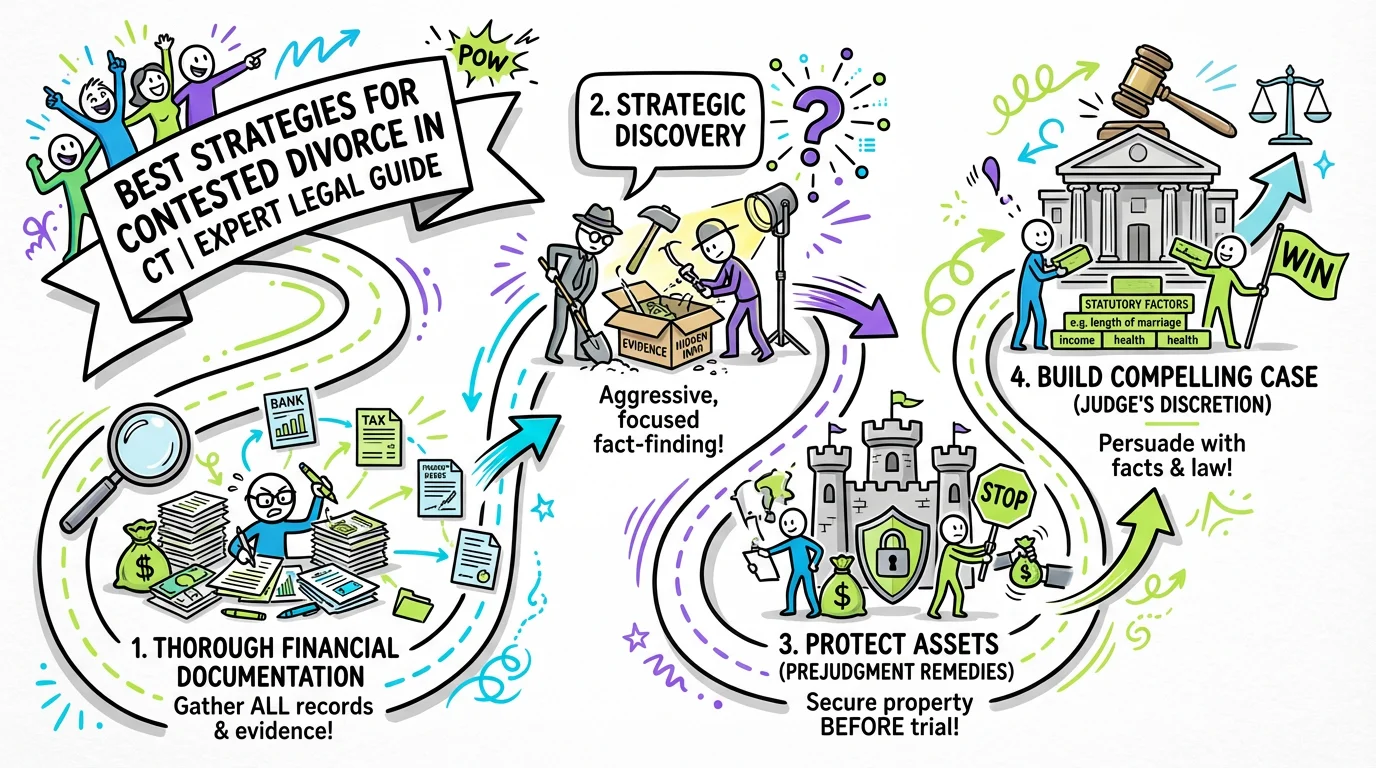
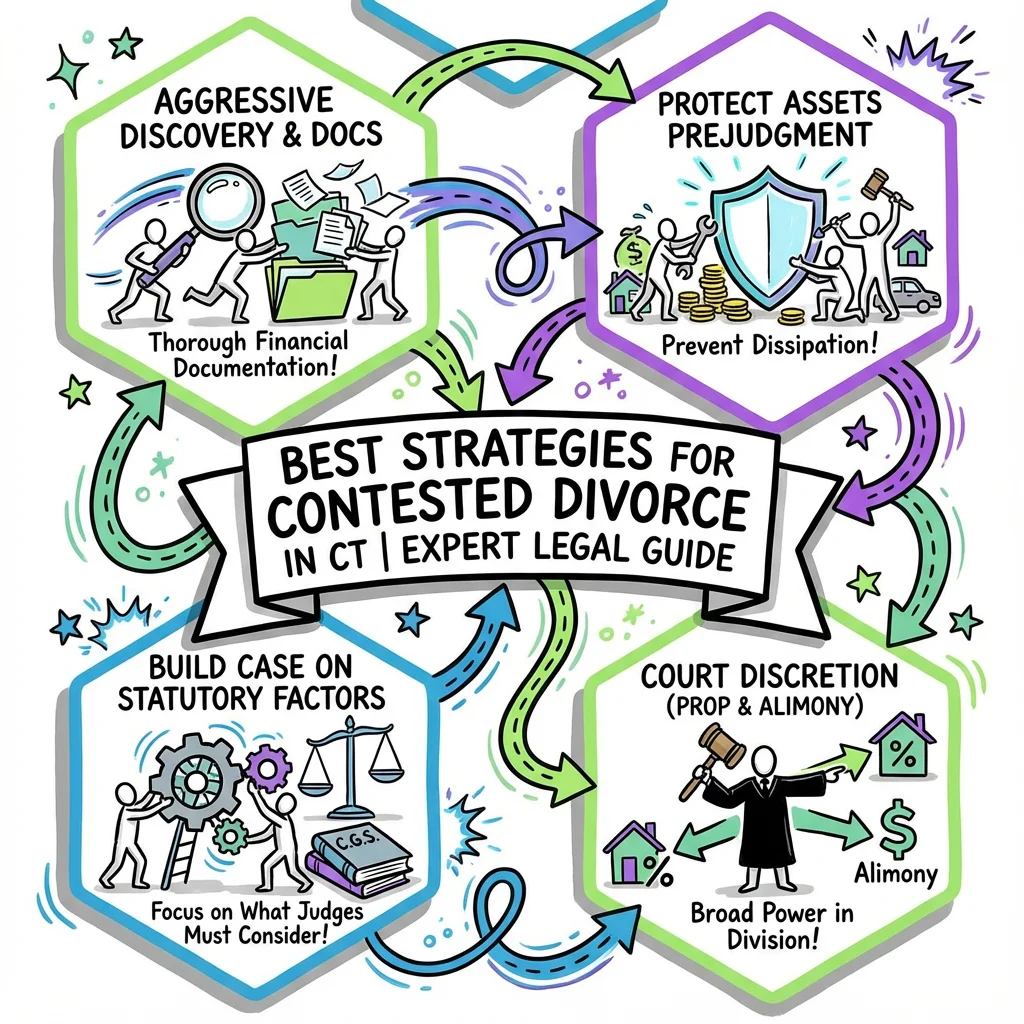
The best strategies for a contested divorce in Connecticut include thorough financial documentation, aggressive but strategic discovery, protecting assets through prejudgment remedies, and building a compelling case around the statutory factors judges must consider. Connecticut courts have broad discretion in dividing property and awarding alimony under C.G.S. § 46b-81 and C.G.S. § 46b-82, making preparation and documentation the foundation of any successful contested case. Success in a CT contested divorce isn't about "winning" in the traditional sense—it's about positioning yourself to achieve the most favorable outcome based on the specific factors the court must weigh.
Understanding the Connecticut Contested Divorce Landscape
A contested divorce occurs when spouses cannot agree on one or more critical issues: property division, alimony, child custody, or child support. Unlike uncontested cases that can resolve in weeks, contested divorces in Connecticut often take 12 to 24 months and require significant litigation strategy. The Connecticut Superior Court uses an equitable distribution model, meaning the judge divides assets fairly—not necessarily equally—based on numerous factors including the length of the marriage, the causes for dissolution, each spouse's age, health, occupation, and earning capacity.
The stakes in a contested divorce extend far beyond the immediate financial impact. Decisions made during this process will affect your financial security, your relationship with your children, and your ability to move forward with your life. Understanding Connecticut's legal framework gives you the strategic advantage needed to advocate effectively for your interests. Courts expect both parties to engage in good faith negotiations, but when agreement isn't possible, you need a clear litigation strategy. Navigating these complex legal requirements can be daunting. Tools like Untangle's AI legal chat can help you quickly understand legal terms, explore the implications of statutory factors, and formulate precise questions for your attorney.
Connecticut's Pathways program, established under Practice Book Rule § 25-50A, assigns contested cases to different tracks based on complexity. Track C cases—the most contentious—receive the most court resources and structured timelines. Knowing which track your case will follow helps you plan discovery, expert witness schedules, and overall case strategy accordingly.
Strategy #1: Master the Mandatory Disclosure Requirements
Connecticut's mandatory disclosure rules under Practice Book Rule § 25-32 require automatic exchange of extensive financial documents within 60 days of a request. This includes three years of tax returns, all W-2s and 1099s, 24 months of bank statements for every account, retirement account statements, and documentation of all real estate interests. Treating this requirement as your first offensive weapon—not just a compliance obligation—transforms how you approach your case.
Your spouse's financial documents often reveal hidden assets, unreported income, or suspicious transfers. Review every page of disclosed documents with forensic attention. Look for cash withdrawals that don't match lifestyle expenses, transfers to family members or unfamiliar accounts, and discrepancies between reported income and actual deposits. These inconsistencies become powerful leverage in negotiations or evidence at trial.
Simultaneously, ensure your own disclosures are complete and accurate. Judges take a dim view of parties who hide assets or provide incomplete financial information. Your credibility with the court is perhaps your most valuable asset in a contested case. Tools like Untangle's financial organization features can help you compile and organize the extensive documentation required, ensuring nothing falls through the cracks while creating a clear financial picture for your attorney.
Strategy #2: Utilize Prejudgment Remedies to Protect Your Interests
Connecticut law under C.G.S. § 46b-80 provides powerful prejudgment remedies to secure your financial interests while the divorce is pending. These include the ability to file a lis pendens on real property, preventing your spouse from selling or mortgaging the family home without court approval. You can also seek attachment of bank accounts, investment accounts, or other assets if you have reason to believe your spouse may dissipate marital property.
The automatic court orders that take effect upon service of the divorce complaint (Practice Book Rule § 25-5) prohibit both parties from transferring, concealing, or disposing of marital assets. If your spouse violates these orders, you can file a motion for contempt under Practice Book Rule § 25-27, which requires you to state the specific language of the order violated and the precise acts constituting contempt. Courts take violations seriously, and documented violations can influence the final property division.
Don't wait until assets disappear to take protective action. If you suspect your spouse is hiding money, making unusual transfers, or planning to drain accounts, act immediately. Request emergency relief from the court if necessary. Documenting your concerns and taking swift legal action demonstrates both the seriousness of the threat and your commitment to protecting marital assets for equitable division.
Strategy #3: Build Your Case Around Statutory Factors
Connecticut judges must consider specific statutory factors when dividing property and awarding alimony. Understanding these factors—and building evidence around each one—positions you for success. Under C.G.S. § 46b-81, property division factors include the length of marriage, causes for dissolution, age, health, station, occupation, amount and sources of income, vocational skills, employability, estate size, liabilities, needs, and the opportunity for future acquisition of assets.
| Statutory Factor | Evidence to Gather | Strategic Importance |
|---|---|---|
| Length of Marriage | Marriage certificate, timeline of relationship | Longer marriages typically mean more equal division |
| Causes for Dissolution | Documentation of fault grounds if applicable | Can influence property division percentages |
| Income & Earning Capacity | Pay stubs, tax returns, vocational assessments | Critical for alimony and support calculations |
| Health & Age | Medical records, expert testimony if needed | Affects ability to become self-supporting |
| Contribution to Marital Estate | Employment records, evidence of homemaker contributions | Non-monetary contributions are legally recognized |
| Liabilities & Needs | Debt statements, monthly expense documentation | Shapes division of both assets and debts |
For alimony specifically, C.G.S. § 46b-82 adds considerations including the length of the marriage, the causes for dissolution, the age, health, station, occupation, and employability of each spouse, and the amount and sources of income. Build a narrative around these factors that supports your position, gathering evidence for each element that favors your case.
Strategy #4: Develop a Child Custody Strategy Based on Best Interests
When children are involved, custody disputes often become the most emotionally charged aspect of a contested divorce. Connecticut courts make custody decisions based solely on the best interests of the child under C.G.S. § 46b-56. The court may assign parental responsibility jointly or to one parent, and can award joint legal custody, joint physical custody, or sole custody based on the specific circumstances.
Document your involvement in your children's daily lives meticulously. Keep records of school pickups and drop-offs, medical appointments you've attended, extracurricular activities you've participated in, and homework help you've provided. Courts want to see which parent has been actively engaged in parenting, not just who claims to be the better parent. Your documentation should paint a picture of consistent, meaningful involvement.
The court may appoint a guardian ad litem (GAL) under C.G.S. § 46b-54 to investigate and report on the children's best interests. Cooperate fully with the GAL—their recommendation carries significant weight with the judge. Be honest about your parenting strengths and weaknesses, and demonstrate your willingness to support a healthy relationship between your children and their other parent. Judges consistently favor parents who facilitate co-parenting over those who attempt to alienate children from the other parent.
Strategy #5: Perfect Your Financial Affidavit
Your sworn financial affidavit is perhaps the most important document in your contested divorce. Practice Book Rule § 25-30 requires filing this statement at least five business days before any hearing on alimony or support, and an updated version within 30 days before final judgment. Inaccuracies—whether from carelessness or intent—can destroy your credibility and affect the final outcome.
The financial affidavit requires detailed disclosure of your current income, expenses, assets, and liabilities. For income, include all sources: salary, bonuses, commissions, rental income, investment returns, and any other regular or irregular payments. For expenses, be thorough but realistic—inflated expenses are easily spotted and undermine your credibility. Use the Short Form Financial Affidavit if your net income is under $75,000 annually and total assets are below $75,000.
Ensuring your affidavit reflects your true financial picture is critical. Tools like Untangle's document generation features can help you accurately categorize expenses, identify overlooked income sources, and streamline the creation of your financial affidavit, ensuring it's complete and consistent with supporting documentation. Judges appreciate well-organized, clearly documented financial presentations.
Strategy #6: Control the Discovery Process
Discovery is your opportunity to gather evidence, expose weaknesses in your spouse's position, and build leverage for negotiations or trial. Beyond mandatory disclosure, you can serve interrogatories (written questions requiring sworn answers), requests for production of documents, and requests for admission. You can also depose your spouse and relevant witnesses under oath.
Strategic discovery focuses on areas where you suspect problems: hidden income, understated assets, inflated expenses, or misrepresentation of facts relevant to custody. If your spouse owns a business, subpoena business records, tax returns, and profit-and-loss statements. If you suspect hidden accounts, request documentation from financial institutions directly. If your spouse claims inability to work, obtain employment records and medical documentation. When formulating interrogatories or understanding complex legal requests, consult with your attorney to ensure questions are precise and cover all necessary ground.
Don't overlook digital discovery. Emails, text messages, social media posts, and electronic financial records can reveal affairs, hidden assets, or inappropriate behavior relevant to custody. However, be cautious about how you obtain this evidence—illegally obtained information may be inadmissible and could expose you to liability. Work with your attorney to conduct discovery within legal bounds while maximizing the information gathered.

Try our free CT alimony calculator
Get an instant estimate based on Connecticut's statutory factors. No signup required.
Strategy #7: Prepare for Multiple Resolution Paths
Even in heavily contested cases, most Connecticut divorces settle before trial. Your litigation strategy should prepare you for trial while keeping settlement options open. The strongest negotiating position comes from thorough preparation—when opposing counsel knows you're ready for trial, settlement offers often improve.
Connecticut's Pathways program includes a Resolution Plan Date 30-60 days after the return date, where parties meet with a family relations counselor to identify areas of agreement and assess settlement likelihood. Use this opportunity strategically. Coming prepared with organized documentation and clear positions demonstrates seriousness and can influence the counselor's track recommendation.
Consider mediation as a parallel track to litigation. Even in contested cases, a skilled mediator can help resolve specific issues while litigation continues on others. Partial settlements reduce trial time and allow you to focus resources on truly contested matters. Keeping organized records of settlement proposals helps you track what's been agreed versus what remains disputed.
Practical Steps for Your Contested Divorce Strategy
-
Gather all financial documents immediately - Bank statements, tax returns, pay stubs, retirement account statements, property records, and debt documentation. Create both physical and digital backups stored securely outside the marital home.
-
Document your parenting involvement - Start a contemporaneous log of time spent with children, activities attended, and parenting responsibilities handled. Include dates, times, and specifics.
-
Identify and value all marital assets - Real estate, retirement accounts, investments, businesses, vehicles, and valuable personal property. Obtain professional appraisals where needed.
-
Research your spouse's financial situation - Review joint tax returns for income discrepancies, identify all accounts you're aware of, and note any recent unusual financial activity.
-
Comply fully with automatic court orders - Don't give your spouse ammunition by violating orders regarding asset transfers, child relocation, or insurance maintenance.
-
File your financial affidavit accurately and completely - Review every line item against your bank statements and receipts to ensure nothing is overlooked and all figures are supportable.
-
Respond to discovery requests thoroughly and timely - Incomplete or late responses can result in court sanctions and harm your credibility.
-
Prepare for each court appearance - Contested cases involve multiple hearings. Know what's being decided at each one and have relevant evidence organized and accessible.
Contested Divorce Timeline and Costs in Connecticut
| Phase | Typical Timeline | Key Activities |
|---|---|---|
| Filing & Service | 1-2 weeks | File complaint, serve spouse, automatic orders take effect |
| Resolution Plan Date | 30-60 days from return | Meet with family relations, receive track assignment |
| Discovery Period | 3-6 months | Exchange mandatory documents, conduct depositions |
| Motions Practice | Ongoing | Address temporary orders, discovery disputes, prejudgment remedies |
| Settlement Negotiations | Ongoing | Mediation, four-way meetings, settlement conferences |
| Trial Preparation | 1-3 months before trial | Witness preparation, exhibit organization, trial briefs |
| Trial | 1-5 days typical | Present evidence, examine witnesses, closing arguments |
| Post-Judgment | Varies | Appeals, enforcement, modifications |
Contested divorce costs vary dramatically based on complexity and contentiousness. Attorney fees typically range from $15,000 to $100,000 or more for highly contested cases. Expert witnesses—business valuators, forensic accountants, custody evaluators—add additional costs. The more organized and prepared you are, the fewer attorney hours you'll consume on document gathering and organization versus actual legal strategy.
When to Escalate—and When to Settle
Not every issue deserves the same level of fight. Strategic litigants identify their priorities and allocate resources accordingly. Fighting over every piece of furniture while neglecting retirement account division is poor strategy. Similarly, spending $10,000 in legal fees to win a $5,000 asset makes no financial sense.
However, some issues warrant maximum effort: custody arrangements that protect your children's wellbeing, discovery of hidden assets that could significantly affect your settlement, and violations of court orders that establish patterns of bad faith. When your spouse demonstrates dishonesty or attempts to gain unfair advantage, documenting and addressing these issues protects both your immediate interests and your long-term position.
Consider consulting with a forensic accountant if you suspect significant hidden assets or complex business valuation issues. These experts can identify irregularities that might escape notice and provide testimony that influences judicial decisions. The cost of expert analysis often pays for itself many times over in improved settlement outcomes.
Building Your Support Team
A contested divorce requires more than just a good attorney. Your team might include a forensic accountant, a business valuator, a custody evaluator, and a therapist to help you manage the emotional toll. Each professional serves a distinct purpose, and coordinating their efforts maximizes effectiveness.
Your attorney leads the legal strategy, but you remain the most important team member. No one knows your marriage, your finances, and your children better than you do. Stay actively involved in case strategy, provide your attorney with complete and accurate information, and communicate promptly about developments. The attorney-client relationship works best as a collaboration, not a delegation.
Use technology to stay organized and informed. Untangle's case management features can help you track deadlines, organize documents, and maintain the detailed records that support your legal strategy. Being organized reduces attorney time spent on administrative tasks and keeps you informed about your case status.
Conclusion: Winning Means Getting the Outcome You Need
In a contested Connecticut divorce, "winning" isn't about defeating your spouse—it's about achieving an outcome that protects your financial security, preserves your relationship with your children, and allows you to move forward with your life. The strategies outlined here—mastering disclosure, utilizing prejudgment remedies, building evidence around statutory factors, and maintaining impeccable documentation—position you for the best possible outcome.
Remember that judges see hundreds of divorce cases. What impresses them is preparation, honesty, and reasonableness. The party who presents organized evidence, complies with court orders, and demonstrates genuine concern for children's welfare often fares better than the party who approaches litigation as warfare. Be strategic, be thorough, and be the party the judge wants to believe.
Frequently Asked Questions
How long does a contested divorce take in Connecticut?
A contested divorce in Connecticut typically takes 12 to 24 months to resolve, depending on the complexity of issues like property division, custody disputes, and the willingness of both parties to negotiate.
What evidence should I gather for a contested divorce in CT?
You should gather thorough financial documentation including tax returns, bank statements, retirement account records, property valuations, and any evidence related to marital misconduct or parenting concerns that could influence custody decisions.
How can I protect my assets during a contested divorce in Connecticut?
You can protect assets through prejudgment remedies available under Connecticut law, which may include requesting court orders to prevent your spouse from dissipating, hiding, or transferring marital property during the divorce proceedings.
What factors do Connecticut judges consider when dividing property in a contested divorce?
Under C.G.S. § 46b-81, Connecticut judges consider factors including the length of the marriage, causes for dissolution, each spouse's age, health, occupation, earning capacity, and contributions to the marital estate when making equitable distribution decisions.
What is Connecticut's Pathways program for contested divorce cases?
Connecticut's Pathways program, established under Practice Book Rule § 25-50A, is a case management system that assigns contested divorce cases to specific tracks designed to streamline the litigation process and encourage resolution.
Legal Citations
- • C.G.S. § 46b-81 View Source
- • C.G.S. § 46b-82 View Source
- • C.G.S. § 46b-56 View Source
- • C.G.S. § 46b-80 View Source
- • C.G.S. § 46b-54 View Source