Best Strategies for Contested Divorce in Connecticut | Expert Guide
Learn proven strategies for winning a contested divorce in Connecticut. Expert tactics for property division, custody battles, and protecting your interests when your spouse won't cooperate.
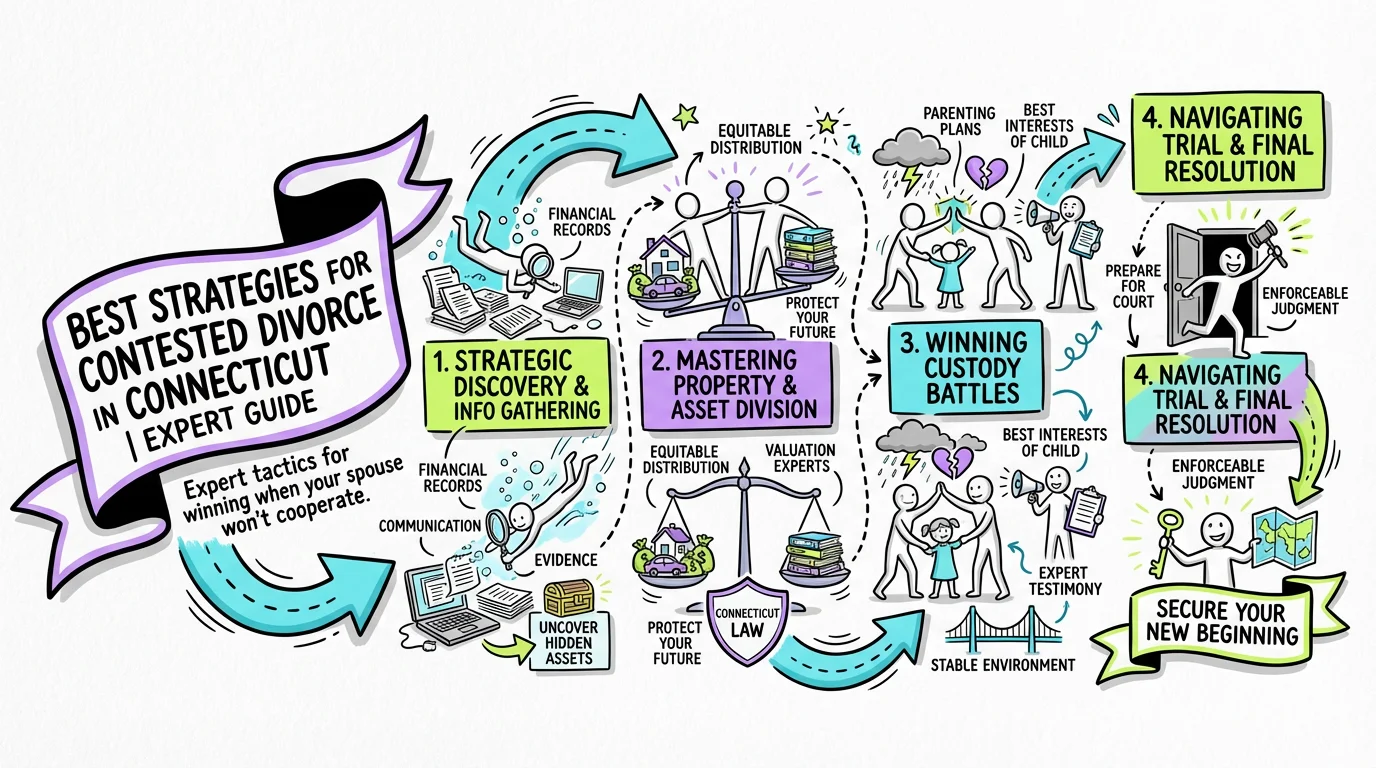
The most effective strategies for a contested divorce in Connecticut include thorough financial documentation, understanding the court's track system, leveraging mandatory discovery rules, and knowing when to fight versus when to negotiate. When your spouse refuses to cooperate, success depends on meticulous preparation, strategic use of court procedures, and protecting yourself through Connecticut's automatic court orders while building the strongest possible case for property division, alimony, and custody.
Understanding What Makes a Connecticut Divorce "Contested"
A contested divorce occurs when spouses cannot agree on one or more key issues—property division, alimony, child custody, or child support. In Connecticut, the court doesn't require you to prove fault to obtain a divorce; under C.G.S. § 46b-40, you can pursue dissolution based on "irretrievable breakdown" of the marriage. However, when your spouse disputes the terms, you're heading into litigation that requires strategic planning.
Connecticut's family courts handle contested cases through a structured "Pathways" system that assigns your case to one of three tracks based on complexity. Under Practice Book Rule § 25-50A, within 30-60 days of filing, you'll meet with a family relations counselor who evaluates your case and recommends Track A (minimal court involvement), Track B (moderate complexity), or Track C (complex, high-conflict cases). Understanding which track your case will likely land on helps you prepare appropriately—contested divorces typically fall into Track B or C, meaning more court dates, longer timelines, and greater need for documentation.
The reality of contested divorce is that it's both a legal battle and an information war. Your spouse may try to hide assets, delay proceedings, or use the children as leverage. Your strategy must account for all of these possibilities while keeping your focus on the outcomes that matter most to you.
Strategy #1: Master the Discovery Process
Connecticut's mandatory disclosure rules are your most powerful tool in a contested divorce. Practice Book Rule § 25-32 requires both parties to automatically exchange comprehensive financial information within 60 days of request, including three years of tax returns, W-2s, 1099s, bank statements for all accounts (covering 24 months), retirement account statements, and business records if either spouse owns a closely held entity.
When your spouse won't cooperate, these mandatory disclosure requirements give you legal leverage. If they fail to produce required documents, you can file a motion to compel, and continued non-compliance can result in sanctions, adverse inferences (where the court assumes the hidden information would hurt them), or even contempt proceedings. The key is to make your discovery requests early and document every instance of non-compliance meticulously.
Beyond mandatory disclosure, consider these discovery tactics:
- Interrogatories: Written questions your spouse must answer under oath about income, assets, debts, and employment
- Requests for Production: Demands for specific documents like credit card statements, loan applications, or business records
- Depositions: Sworn testimony where your attorney questions your spouse directly—expensive but invaluable for complex asset cases
- Subpoenas to Third Parties: Request records directly from banks, employers, or business partners if you suspect your spouse is hiding information
Tools like Untangle's case management features help you systematically track what you've received, what's missing, and how the information connects to build your case.
Strategy #2: Perfect Your Financial Affidavit
Your sworn financial statement is arguably the most important document in your contested divorce. Under Practice Book Rule § 25-30, you must file this affidavit at least five business days before any hearing on alimony, support, or counsel fees. This document lists your income, expenses, assets, and liabilities—and it's submitted under oath, meaning inaccuracies can destroy your credibility.
In contested cases, judges scrutinize financial affidavits closely. Any inconsistency between your affidavit and your discovery documents gives your spouse's attorney ammunition to attack your credibility. Conversely, finding inconsistencies in your spouse's affidavit can be powerful evidence of hidden assets or income manipulation.
Take time to gather documentation for every figure on your affidavit. If you claim $500 monthly in childcare expenses, have receipts ready. If you report $3,200 in mortgage payments, have the statement to prove it. Untangle's financial affidavit tools can help you organize expenses and ensure your numbers are accurate and defensible. For most contested cases, you'll use either the Short Form Financial Affidavit (Form JD-FM-006) if both parties earn under $75,000 annually and have less than $75,000 in assets, or the Long Form for higher-income or high-asset cases.
Strategy #3: Understand How Connecticut Divides Property
Connecticut is an "equitable distribution" state, which means the court divides property fairly—but not necessarily equally. Under C.G.S. § 46b-81, the court can assign to either spouse "all or any part of the estate of the other spouse," considering factors like the length of marriage, causes of divorce, each spouse's age, health, occupation, income, vocational skills, employability, and the needs of each party.
This "all-property" approach is actually unusual among states. It means the court can consider property acquired before marriage, inheritances, and gifts—not just assets accumulated during the marriage. In a contested divorce, this gives you both opportunities and vulnerabilities depending on your situation.
| Property Division Factor | How It Might Help You | How It Might Hurt You |
|---|---|---|
| Length of marriage | Longer marriages typically mean more equal division | Short marriages may limit claims to spouse's assets |
| Cause of breakdown | Spouse's misconduct can affect distribution | Your behavior may be scrutinized too |
| Earning capacity | Lower earner may receive more assets | Higher earner may need to provide more |
| Contribution to acquisition | Direct financial contributions matter | Homemaker contributions also count |
| Liabilities | Marital debt is also divided equitably | You may share responsibility for spouse's debts |
Your strategy should identify which factors favor you and gather evidence to support those arguments. If you sacrificed career advancement to support your spouse's career or raise children, document that contribution. If your spouse dissipated marital assets through gambling, affairs, or reckless spending, gather evidence of that misconduct.
Strategy #4: Build Your Custody Case Around "Best Interests"
When children are involved in a contested divorce, custody battles often become the most emotionally charged aspect of the case. Connecticut courts decide custody based on the child's best interests under C.G.S. § 46b-56, which gives judges broad discretion to consider factors including each parent's ability to meet the child's needs, the child's developmental needs, the stability of each proposed living arrangement, and each parent's willingness to facilitate a relationship with the other parent.
That last factor—willingness to co-parent—is critical and often overlooked. Judges in Connecticut take a dim view of parents who try to alienate children from the other parent or who weaponize custody to "win" the divorce. Even if your spouse is being unreasonable, your strategy should demonstrate that you're focused on the children's wellbeing, not revenge.
Document everything related to your children: who takes them to doctor's appointments, who attends school events, who helps with homework, who arranges playdates. Untangle's children's information management can help you keep all these vital details organized and accessible. If you have concerns about your spouse's parenting—substance abuse, neglect, exposing children to inappropriate situations—document those concerns with dates, times, and any witnesses. But avoid the temptation to over-document normal parenting disagreements; judges can tell the difference between legitimate concerns and attempts to manufacture a case.
Connecticut requires parents in divorce cases with minor children to complete a Parent Education Program. Taking this requirement seriously and completing it promptly demonstrates to the court that you prioritize your children's adjustment to the divorce.

Try our free CT alimony calculator
Get an instant estimate based on Connecticut's statutory factors. No signup required.

Strategy #5: Use Motions Strategically
In a contested divorce, motions are how you ask the court to take action during the case—before the final judgment. Strategic use of motions can protect your interests, put pressure on an uncooperative spouse, and shape the ultimate outcome.
Pendente Lite Motions (motions "pending litigation") let you request temporary orders for custody, support, or exclusive possession of the marital home while the divorce is ongoing. These temporary orders often influence the final outcome because they establish the status quo that judges are reluctant to disrupt.
Motions for Contempt under Practice Book Rule § 25-27 are your enforcement tool when your spouse violates court orders. Each motion must state the specific order violated, the precise acts constituting contempt, and the relief you're requesting. Under C.G.S. § 46b-87, if your spouse is found in contempt, the court can award you reasonable attorney's fees.
Motions to Compel force a non-compliant spouse to produce discovery. Use these when your spouse ignores disclosure requirements.
Motions for Protective Orders can prevent your spouse from dissipating assets, harassing you, or taking other harmful actions during the divorce.
The key to strategic motion practice is being selective. Filing too many motions makes you look unreasonable and wastes resources. Focus on motions that address genuine violations or secure important rights.
Strategy #6: Know the Alimony Factors
If alimony (spousal support) is at issue in your contested divorce, understanding C.G.S. § 46b-82 is essential. Connecticut courts consider numerous factors when awarding alimony, including the length of marriage, causes of divorce, each spouse's age, health, income, earning capacity, vocational skills, and the time and expense needed for the dependent spouse to acquire sufficient education or training.
| Alimony Type | Typical Purpose | Duration |
|---|---|---|
| Temporary (Pendente Lite) | Support during divorce proceedings | Until final judgment |
| Rehabilitative | Help spouse become self-supporting | Fixed period (often 2-5 years) |
| Permanent | Long-term support after lengthy marriage | Indefinite (until death, remarriage, or modification) |
| Nominal | Preserve ability to modify later | Ongoing but minimal amount |
Your strategy depends on which side of the alimony equation you're on. If you're seeking alimony, document your financial needs, the lifestyle during marriage, any career sacrifices you made, and the time you'll need to become self-supporting. If you're defending against alimony claims, gather evidence of your spouse's earning capacity, any hidden income or assets, and their ability to support themselves.
Untangle's alimony calculator can help you estimate potential alimony based on Connecticut factors, giving you realistic expectations for negotiations or trial.
Strategy #7: Prepare for Every Hearing
Contested divorces involve multiple court appearances: status conferences, motion hearings, settlement conferences, and potentially trial. Your preparation for each hearing directly impacts your outcome.
- Review all filed documents before each hearing—your filings, your spouse's filings, and any court orders
- Organize your evidence so you can quickly locate any document the judge might ask about
- Prepare a concise summary of your position on each issue being addressed
- Anticipate your spouse's arguments and prepare responses
- Dress professionally and arrive early
- Remain calm and respectful regardless of what your spouse says or does
- Address the judge directly and honestly—never exaggerate or misrepresent facts
If you're representing yourself (pro se), understand that judges will hold you to the same procedural rules as attorneys. The Connecticut Judicial Branch provides self-help resources, but contested cases are complex enough that professional representation is strongly advisable.
Strategy #8: Consider Settlement Strategically
Even in contested divorces, over 95% of cases settle before trial. Settlement isn't surrendering—it's recognizing that you often get better outcomes through negotiation than by leaving decisions to a judge who doesn't know your family's nuances.
Strategic settlement means:
- Knowing your priorities: What matters most? Keeping the house? Maximizing parenting time? Protecting retirement assets?
- Understanding your BATNA: Your "Best Alternative to Negotiated Agreement" is what happens if you go to trial. If trial outcomes are uncertain, settlement becomes more attractive.
- Making strategic concessions: Give on issues that matter less to you to gain on issues that matter more
- Documenting everything: Any settlement must be reduced to writing and approved by the court
Untangle's financial comparison tools let you model different outcomes, helping you see how various settlement options affect your financial future and compare them to likely trial outcomes.
When to Get Professional Help
While this guide provides strategic framework, contested divorce in Connecticut involves complex legal procedures, evidentiary rules, and courtroom advocacy that benefit significantly from professional representation. Consider hiring an attorney when:
- Significant assets or debts are at stake
- Custody is disputed, especially if abuse or substance issues are alleged
- Your spouse has an attorney (the power imbalance is real)
- You're unfamiliar with court procedures
- High emotions make objective decision-making difficult
- Your spouse is hiding assets or income
Even if you handle parts of your divorce yourself, consultations with a family law attorney at key decision points can prevent costly mistakes. Many attorneys offer unbundled services where they handle specific aspects while you manage others.
Contested divorce is a marathon, not a sprint. The spouses who succeed are those who stay organized, remain focused on their core priorities, and don't let emotion override strategy. With thorough preparation and the right support, you can navigate this difficult process and emerge ready for the next chapter of your life.
Frequently Asked Questions
How long does a contested divorce take in Connecticut?
A contested divorce in Connecticut typically takes 12 to 24 months depending on the complexity of issues and which Pathways track (A, B, or C) your case is assigned to.
What should I bring to my first contested divorce court date in CT?
Bring thorough financial documentation including tax returns, bank statements, pay stubs, property deeds, and retirement account statements, as Connecticut courts require comprehensive financial disclosure early in the process.
Can I negotiate a settlement during a contested divorce in Connecticut?
Yes, you can negotiate and settle at any point during a contested Connecticut divorce, and courts often encourage settlement through mandatory mediation and pretrial conferences.
How does custody get decided in a CT contested divorce?
Connecticut family courts decide custody based on the best interests of the child, considering factors like each parent's involvement, the child's preferences, stability, and any history of domestic violence or substance abuse.
What are automatic court orders in a Connecticut divorce?
Automatic court orders in Connecticut take effect immediately upon service of divorce papers and prevent both spouses from hiding assets, changing insurance policies, or relocating children out of state without court permission.
Legal Citations
- • Practice Book Rule § 25-50A View Source
- • Practice Book Rule § 25-32 View Source
- • Practice Book Rule § 25-30 View Source
- • Practice Book Rule § 25-27 View Source