Best Online Divorce for Fast Filing in Connecticut: Nonadversarial Dissolution Guide
Connecticut's nonadversarial dissolution can finalize your divorce in 35 days. Learn eligibility requirements, steps, and how online tools speed up CT divorce filing.
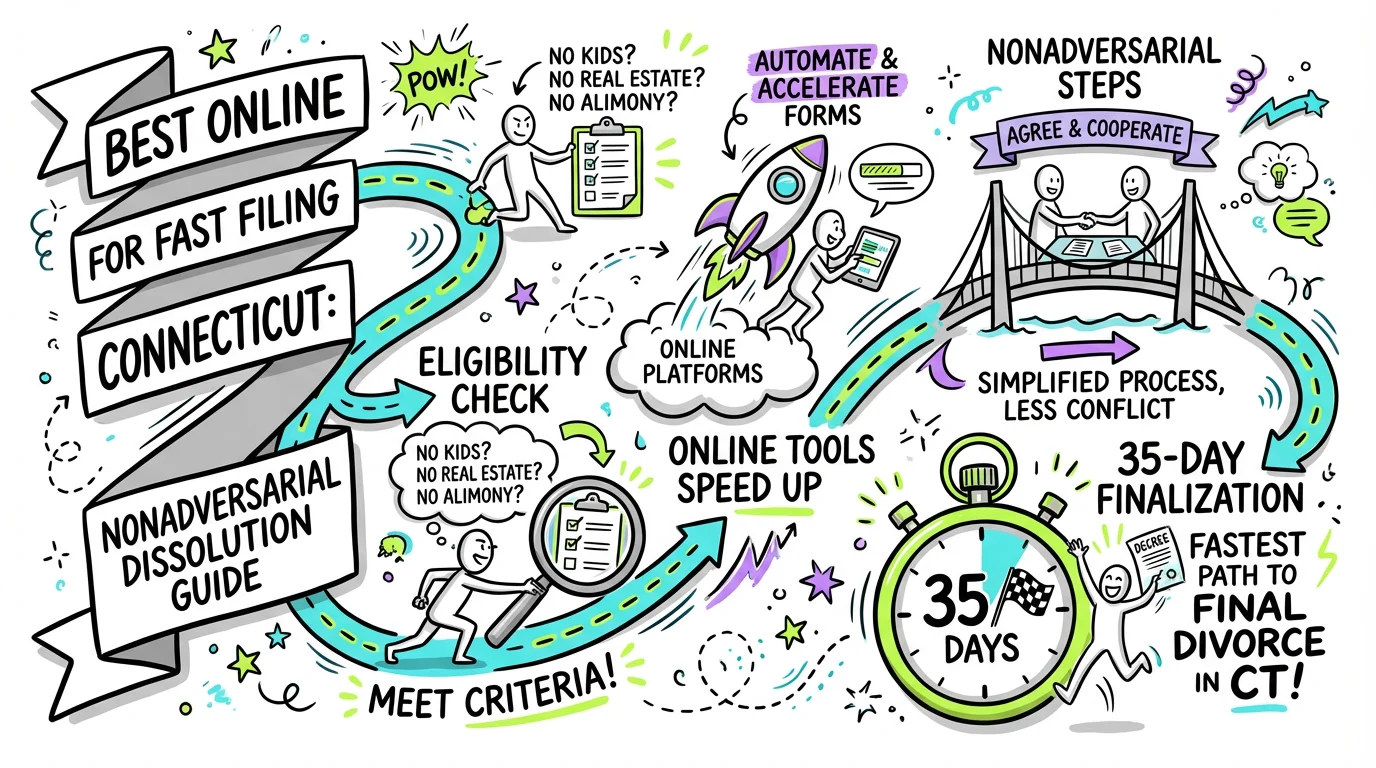
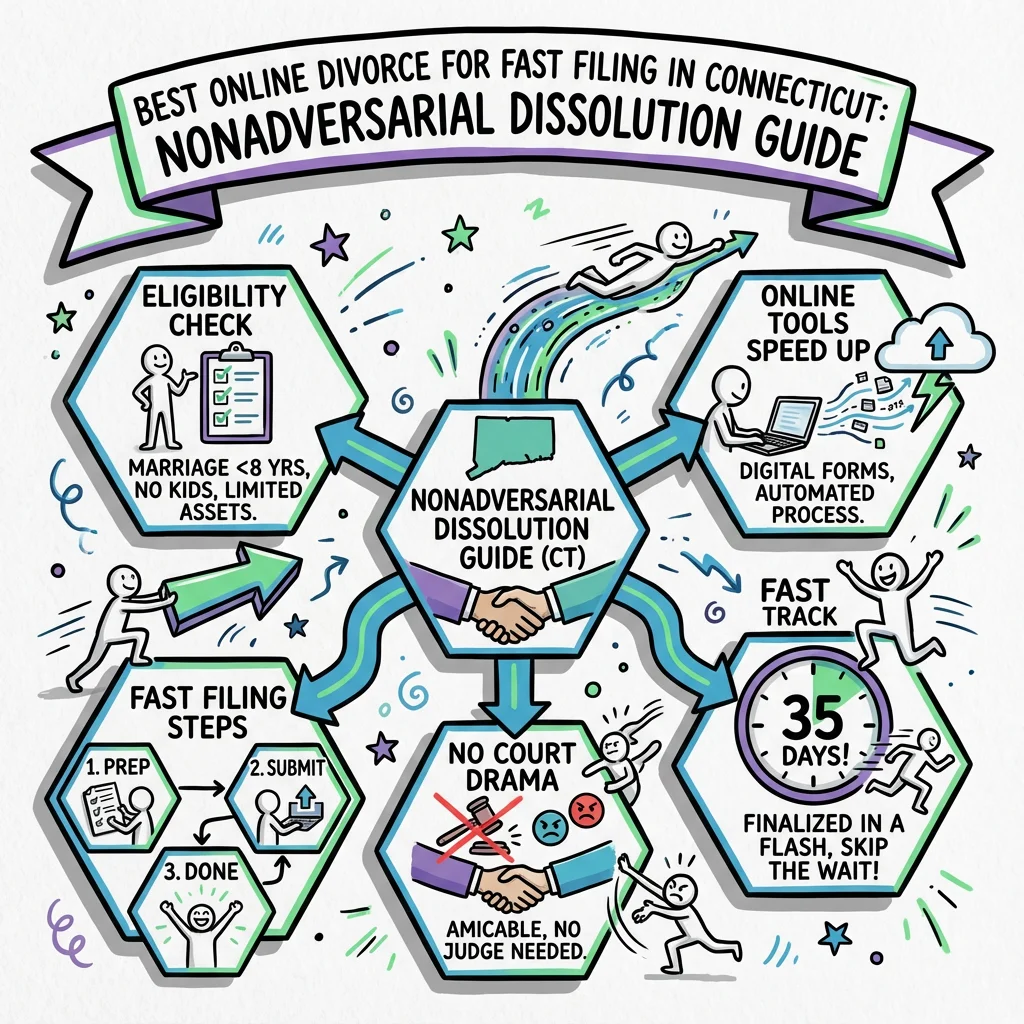
The best online divorce option for fast filing in Connecticut involves using digital tools to file for nonadversarial dissolution, which can finalize your marriage in as few as 35 days. This process—significantly faster than the standard 90-day minimum for contested divorces—is available to couples who agree on all terms, have no minor children, and meet other statutory requirements. Online divorce services can help you generate the necessary paperwork quickly, but understanding the specific legal procedures is essential to ensure your filing isn't rejected.
Understanding Connecticut's Fast-Track Divorce Options
Connecticut offers two primary divorce pathways, and choosing the right one determines how quickly you can finalize your case. The nonadversarial dissolution under C.G.S. § 46b-44a is designed specifically for couples who agree on everything and want minimal court involvement. This process eliminates the traditional waiting period and adversarial procedures that slow down standard divorces.
The key advantage of the nonadversarial process is that the court assigns a disposition date just 30 days after filing, per C.G.S. § 46b-44c. If neither party files a revocation notice and your settlement agreement is deemed fair and equitable, the court can enter your divorce decree on that date or within five days afterward. Compare this to standard contested divorces, which require waiting until the second day after the return date before the court can even begin proceedings under C.G.S. § 46b-67.
For the nonadversarial route, you and your spouse file a joint petition together rather than one spouse serving papers on the other. Both parties must sign and notarize the petition, attesting under oath that you meet all eligibility requirements. This collaborative approach eliminates the delays associated with service of process and waiting for a response.
Eligibility Requirements for Nonadversarial Dissolution
Not every couple qualifies for Connecticut's expedited divorce process. Understanding these requirements upfront prevents wasted time and filing fees. Under C.G.S. § 46b-44a, you must meet all of the following conditions at the time of filing:
- Complete agreement on all issues including property division, debt allocation, and spousal support
- No minor children from the marriage (children from other relationships don't disqualify you)
- No pending pregnancy at the time of filing
- Residency requirement met—at least one spouse must live in Connecticut
- No requests for title transfers of real property requiring court orders
- Both parties willing to file jointly and appear for any required court dates
If you have minor children, you cannot use the nonadversarial process regardless of how amicable your divorce is. You'll need to file a standard uncontested divorce, which takes longer but can still be streamlined if you agree on custody, parenting time, and child support. Tools like Untangle's Free AI consultation can help you quickly determine which process fits your situation.
The requirement for complete agreement extends to every financial and practical aspect of ending your marriage. Even one disputed issue—whether it's who keeps a piece of furniture or how to divide a retirement account—disqualifies you from the fast-track process. This is where thorough preparation pays off in time savings.
Step-by-Step Process for Fast Connecticut Divorce Filing
Following these steps in order minimizes delays and keeps your divorce on the fastest possible track:
- Confirm eligibility for nonadversarial dissolution by verifying you meet all statutory requirements
- Gather financial documents including tax returns, bank statements, retirement account statements, and debt records
- Complete sworn financial affidavits using the Short Form Financial Affidavit (JD-FM-006) if neither party earns over $75,000 annually and total assets are under $75,000
- Draft your settlement agreement covering all property division, debt allocation, and spousal support terms
- Prepare the joint petition with all required attachments and attestations
- File together at the Superior Court in the judicial district where either spouse resides
- Wait for disposition date (assigned 30+ days from filing)
- Attend hearing if required—the court may waive appearances if your agreement is clearly fair and complete
The financial affidavit requirement under Practice Book § 25-30 trips up many couples seeking fast divorces. You must file sworn financial statements with your joint petition, and they must be accurate and complete. Incomplete or inconsistent financial disclosures can trigger court review that delays your case by 30 days or more under C.G.S. § 46b-44d.
Tools like Untangle's financial affidavit generation help you compile asset and debt information systematically, ensuring your financial affidavits are accurate and complete the first time. This preparation prevents the back-and-forth that delays many DIY divorces.
Timeline Comparison: Connecticut Divorce Options
| Divorce Type | Minimum Timeline | Court Appearances | Best For |
|---|---|---|---|
| Nonadversarial Dissolution | 30-35 days | Often none required | Couples without children who agree on everything |
| Uncontested (with children) | 90+ days | 1-2 appearances typical | Parents who agree on all terms |
| Contested Divorce | 6-18+ months | Multiple appearances | Couples with disputes requiring court resolution |
| Mediated Divorce | 3-6 months | 1-2 appearances | Couples willing to negotiate with professional help |
The timeline differences are substantial. A nonadversarial dissolution can be finalized in approximately one month, while even an uncontested divorce with children typically takes three months or longer. Contested cases requiring trial can stretch beyond a year, especially if discovery disputes arise—as illustrated in Ponns Cohen v. Cohen, where procedural complications significantly extended the litigation timeline.
Connecticut's Pathways case management system under Practice Book § 25-50A assigns cases to different tracks based on complexity. Uncontested matters go to Track A, which requires minimal court time and moves fastest. Your goal is to keep your case on Track A by ensuring everything is agreed upon and properly documented before filing.
What Online Divorce Services Actually Provide
Online divorce services marketed for Connecticut typically offer document preparation assistance, not legal representation. Understanding this distinction helps you set realistic expectations. These services generally provide:
- Questionnaire-based document generation that creates forms based on your answers
- Filing instructions explaining where and how to submit paperwork
- Customer support for technical questions about their platform
- Template settlement agreements you can customize
What online services don't provide includes legal advice about Connecticut-specific issues, court representation, or guarantees about outcomes. They also cannot file documents on your behalf in Connecticut—you must still submit paperwork to the court yourself or through an attorney.
The value proposition of online divorce services depends largely on how straightforward your situation is. For truly simple cases (no children, minimal assets, complete agreement), a basic document preparation service may suffice. However, Connecticut's specific requirements—like the attestation language required for nonadversarial dissolutions—mean generic national services sometimes produce paperwork that doesn't meet local court standards.
Tools like Untangle's automatic document generation can account for these local requirements while helping you understand whether your situation truly qualifies for the expedited process. Rather than just generating forms, it helps you think through the substantive issues that determine whether your divorce will proceed smoothly or hit obstacles.
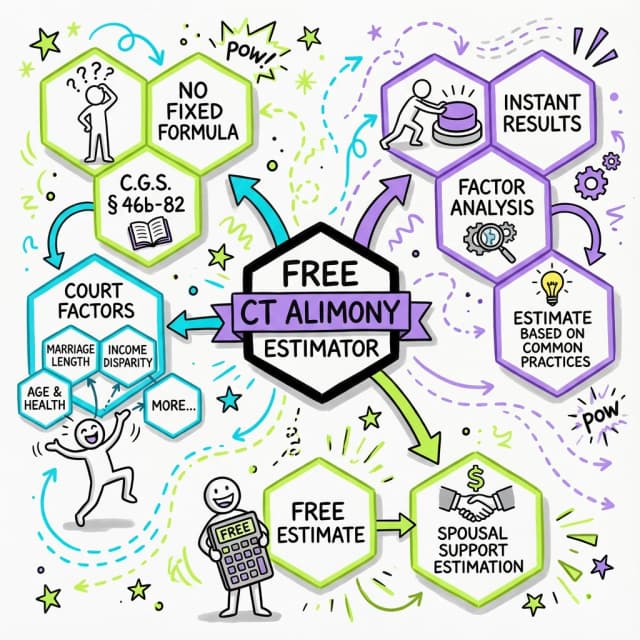
Try our free CT alimony calculator
Get an instant estimate based on Connecticut's statutory factors. No signup required.
Automatic Orders and Immediate Obligations
The moment you file a joint petition for nonadversarial dissolution, automatic orders take effect under Practice Book § 25-5B. These orders restrict what both spouses can do with marital property and require specific behaviors throughout the divorce process:
- No selling, transferring, or encumbering assets without written consent or court order
- Maintain existing insurance policies including health, life, and auto coverage
- No changing beneficiaries on life insurance, retirement accounts, or similar instruments
- No incurring unreasonable debts that could affect property division
Violating these automatic orders can result in contempt findings and sanctions. More practically for speed-seekers, violations create disputes that can convert your streamlined nonadversarial case into a contested matter requiring additional court involvement.
Understanding these restrictions before filing helps you sequence your financial moves appropriately. If you need to make significant financial changes—like refinancing a mortgage or selling a vehicle—coordinate with your spouse and document the agreement before filing.
Common Delays and How to Avoid Them
Even couples who qualify for fast-track dissolution sometimes experience delays. The most common causes are preventable with proper preparation:
Incomplete or inaccurate financial affidavits trigger court review. Under C.G.S. § 46b-44d, if the court cannot determine whether your settlement agreement is fair and equitable, your case gets docketed for an additional hearing 30 days later. Complete, accurate financial disclosure prevents this delay.
Vague settlement agreements create similar problems. Your agreement must address every aspect of property division, debt allocation, and spousal support with sufficient specificity that the court can enforce it. Saying "we'll split everything 50/50" isn't enough—you need to specify which assets go to which spouse.
Filing in the wrong location wastes time and money. You must file in the judicial district where at least one spouse resides. Filing elsewhere results in dismissal or transfer, adding weeks to your timeline.
Missing signatures or notarization causes immediate rejection. Both spouses must sign the joint petition, and it must be properly notarized. This seems basic, but incomplete execution is a common reason for rejected filings.
Tools like Untangle's AI legal guidance help ensure your settlement agreement covers all required topics with appropriate specificity, reducing the risk of court-ordered revisions that extend your timeline.
Cost Comparison for Fast Connecticut Divorce
| Service Type | Typical Cost Range | What's Included | Timeline Impact |
|---|---|---|---|
| DIY (self-prepared) | $350-400 (filing fees only) | Nothing but forms | Varies widely based on preparation quality |
| Online document service | $150-500 + filing fees | Form preparation, instructions | Moderate—quality varies |
| Limited-scope attorney | $500-1,500 + filing fees | Document review, specific advice | Often faster—catches issues early |
| Full representation | $3,000-10,000+ | Complete handling | Fastest if complex; overkill if simple |
The filing fee for nonadversarial dissolution in Connecticut is approximately $350, payable when you submit your joint petition. This fee applies regardless of whether you use online services, an attorney, or prepare documents yourself.
For truly simple situations, investing in some level of professional review often pays off in time savings. A limited-scope attorney can review your documents before filing, catching issues that might otherwise cause delays or rejection. This middle-ground approach balances cost savings with risk reduction.
When to Get Professional Help
While many couples successfully navigate Connecticut's nonadversarial dissolution process without attorneys, certain situations warrant professional guidance even when speed is your priority:
Complex asset situations involving businesses, stock options, pensions, or significant real estate benefit from professional valuation and division planning. Mistakes in these areas can cost far more than attorney fees and may require post-judgment modifications that take months to resolve.
Uncertainty about fairness should prompt consultation. If you're unsure whether your proposed agreement is equitable—or if your spouse seems to be getting a significantly better deal—a brief consultation with a family law attorney can provide clarity. Courts can reject agreements they deem unfair, which delays finalization.
Any hesitation about proceeding suggests you need more time or information. Connecticut's nonadversarial process includes a revocation period specifically because the legislature recognized that some people move too quickly. Filing for divorce is a significant legal action with lasting consequences—speed shouldn't come at the expense of informed decision-making.
Tools like Untangle's personalized task dashboard help you work through these considerations systematically, identifying potential issues before they become obstacles. For straightforward situations, it provides the structure and information you need to proceed confidently. For more complex cases, it helps you identify specific questions to discuss with an attorney, making any professional consultation more efficient and cost-effective.
Frequently Asked Questions
How long does an uncontested divorce take in Connecticut?
An uncontested nonadversarial divorce in Connecticut can be finalized in as few as 35 days from filing, compared to the 90-day minimum for contested divorces.
Is online divorce legally valid in Connecticut?
Yes, online divorce services are valid in Connecticut as long as you properly complete and file the required court forms and meet all statutory eligibility requirements.
What is the difference between nonadversarial dissolution and regular divorce in CT?
Nonadversarial dissolution is a faster, simplified process for couples who agree on all terms and have no minor children, while regular divorce involves adversarial procedures and longer waiting periods.
Can I download Connecticut divorce forms online for free?
Yes, official Connecticut divorce forms are available for free download from the Connecticut Judicial Branch website, though online divorce services can help you complete them correctly.
How much does an online divorce cost in Connecticut?
Online divorce preparation services in Connecticut typically range from $150 to $500, plus the required court filing fees, making them a more affordable alternative to hiring an attorney.
Legal Citations
- • C.G.S. § 46b-44a - Filing of joint petition for nonadversarial dissolution of marriage View Source
- • C.G.S. § 46b-44c - Disposition of nonadversarial dissolution of marriage View Source
- • C.G.S. § 46b-44d - Review of settlement agreement in nonadversarial dissolution View Source
- • C.G.S. § 46b-67 - Time frame for court to proceed in dissolution actions View Source
- • Connecticut Practice Book § 25-5B - Automatic Orders upon Filing of Joint Petition View Source
- • Connecticut Practice Book § 25-30 - Statements To Be Filed View Source
- • Connecticut Practice Book § 25-50A - Case Management under Pathways View Source
- • Ponns Cohen v. Cohen, 342 Conn. 354 View Source
- • Short Form Financial Affidavit (JD-FM-006) View Source