Best Divorce Resources for Stay-at-Home Parents in Connecticut
Essential Connecticut divorce resources for stay-at-home parents including financial protections, alimony rights, attorney fee assistance, and practical support tools.
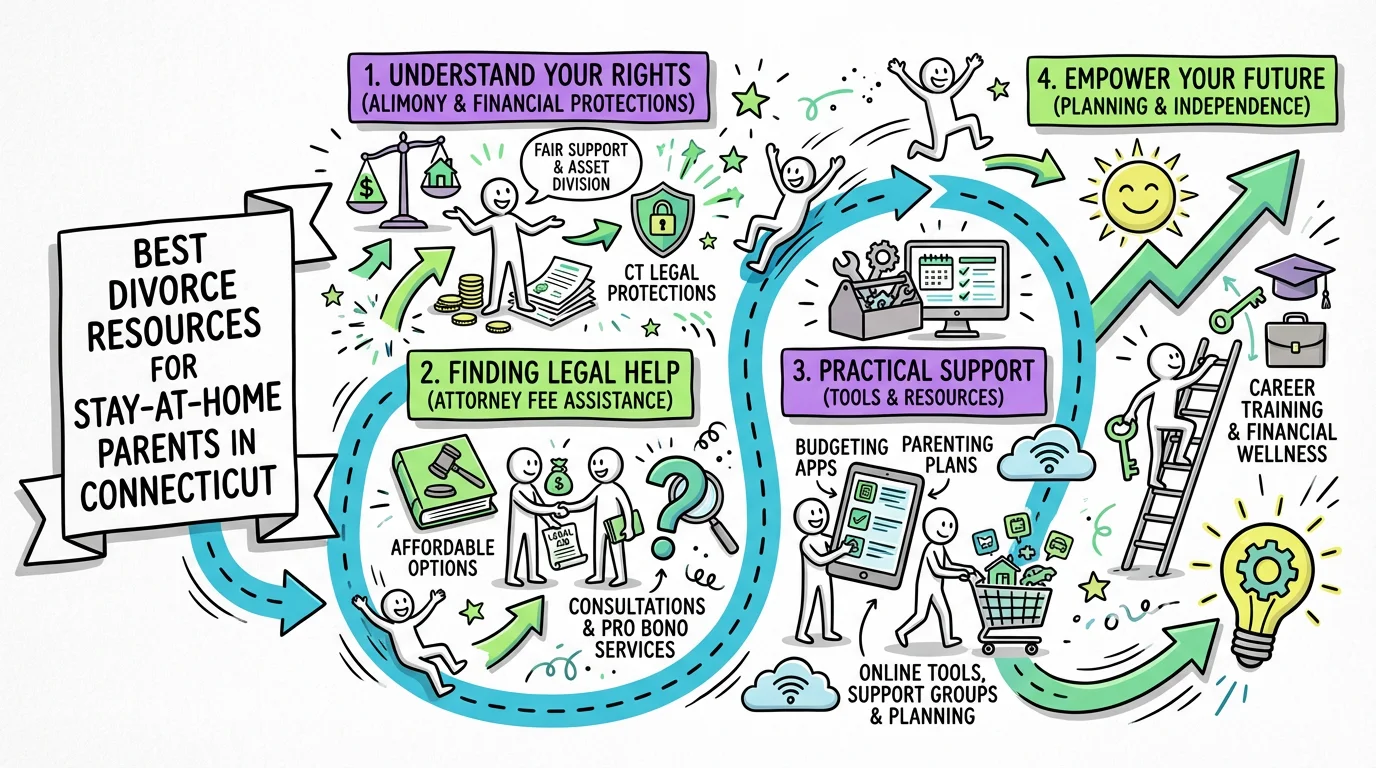
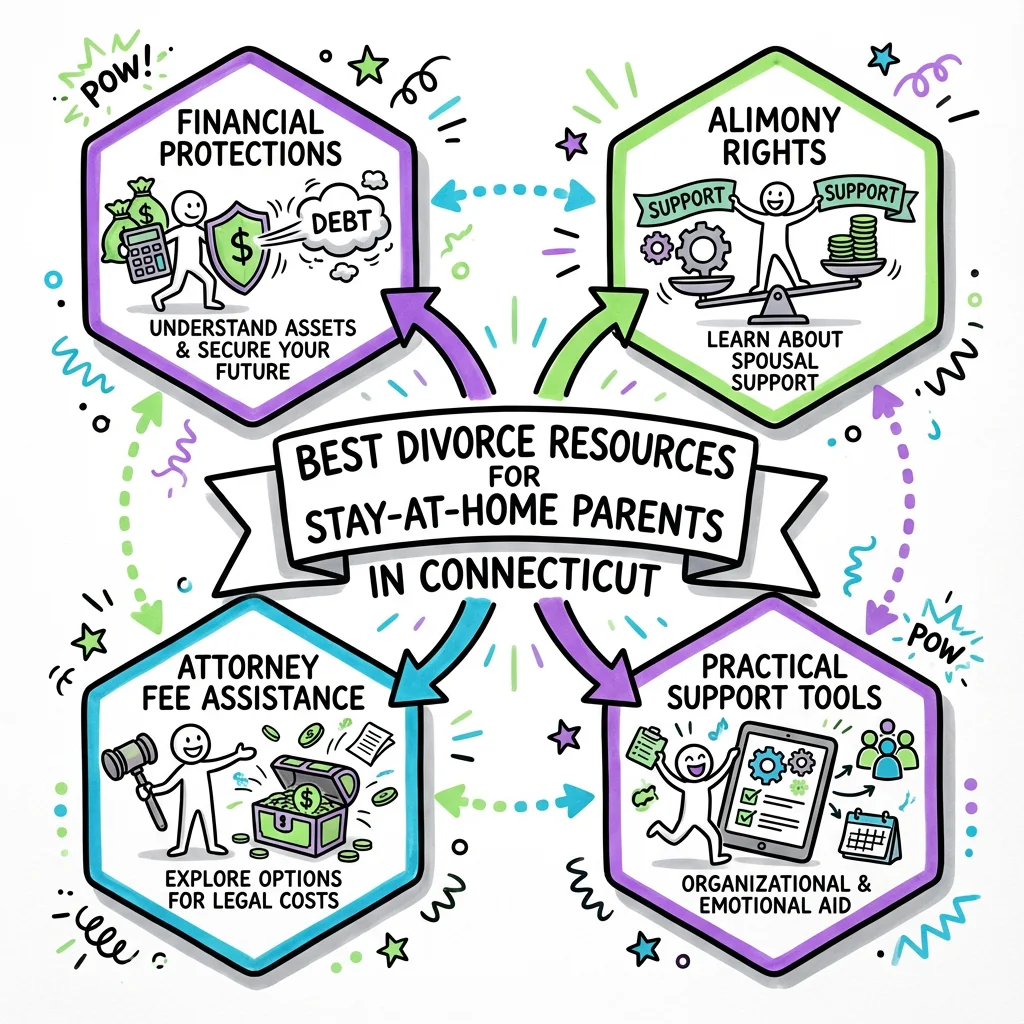
Stay-at-home parents in Connecticut have significant legal protections and resources available during divorce, including the right to request temporary support (alimony pendente lite), potential attorney fee assistance from your spouse, and equitable division of marital assets regardless of who earned the income. Connecticut courts specifically recognize that raising children and managing a household is a valuable contribution to the marriage, and the law is designed to ensure financially dependent spouses aren't left vulnerable during or after divorce proceedings.
Understanding Your Financial Protections Under Connecticut Law
Connecticut is an equitable distribution state, which means courts divide marital property fairly—not necessarily equally—based on numerous factors. For stay-at-home parents, this is particularly important because under C.G.S. § 46b-81, the court considers each spouse's contribution to the acquisition, preservation, or appreciation of assets, including "services as a homemaker." This means your years of caregiving, household management, and enabling your spouse's career advancement are legally recognized contributions that factor into property division.
The court examines the length of your marriage, your age and health, your occupation and employability, the sources and amount of each spouse's income, and vocational skills. Longer marriages typically result in more substantial awards for stay-at-home spouses because courts recognize that extended time out of the workforce significantly impacts earning capacity. Courts also consider the "opportunity of each for future acquisition of capital assets and income," acknowledging that a spouse who paused their career faces unique challenges re-entering the job market.
What makes Connecticut particularly protective of stay-at-home parents is the broad discretion courts have in assigning property. The court may assign "all or any part of the estate of the other spouse" to you, meaning assets accumulated during the marriage—retirement accounts, real estate, investments, business interests—are all subject to division regardless of whose name appears on the account.
Temporary Support: Getting Financial Help During Your Divorce
One of the most critical resources for stay-at-home parents is pendente lite support—temporary alimony and child support that begins while your divorce is pending. Under C.G.S. § 46b-83, you can file a motion requesting temporary support "at any time after the return day" of your divorce complaint. This means you don't have to wait months for your final divorce decree to receive financial assistance.
The process for obtaining pendente lite support has been streamlined in Connecticut. You file a motion accompanied by an affidavit on a court-prescribed form, and the court can award support "from the date of the filing" of your application. This is designed to prevent financial hardship during what can be a lengthy divorce process. Courts understand that a spouse who hasn't worked outside the home cannot suddenly generate income, and temporary support bridges this gap.
Your pendente lite motion can also request exclusive use of the family home. If you've been the primary caregiver and leaving the home would disrupt your children's lives, courts often allow the stay-at-home parent to remain in the residence while the divorce proceeds.
Alimony Considerations for Stay-at-Home Spouses
Connecticut's alimony statute, C.G.S. § 46b-82, provides comprehensive support for financially dependent spouses. When determining alimony, courts consider numerous factors directly relevant to stay-at-home parents: the length of marriage, causes of divorce, age and health of each spouse, occupation and vocational skills, employability, estate and needs of each party, and—critically—"the desirability and feasibility of the party seeking alimony obtaining employment."
The case of Oudheusden v. Oudheusden demonstrates how Connecticut courts approach alimony for stay-at-home spouses in marriages involving significant income disparity. In that case, the court awarded substantial monthly alimony that was not modifiable in duration or amount, recognizing the non-working spouse's contributions and the earning spouse's ability to pay. This illustrates that courts take seriously the long-term financial impact of one spouse sacrificing career advancement to support the family. To get a preliminary understanding of potential alimony based on Connecticut factors, tools like Untangle's alimony calculator can be very helpful.
Connecticut courts may order alimony to be rehabilitative (designed to support you while you gain skills or education to become self-supporting), permanent (ongoing support with no set end date), or a combination. For stay-at-home parents who have been out of the workforce for many years, courts often recognize that becoming fully self-supporting may take considerable time or may never be fully achievable at the same standard of living. The statute explicitly allows courts to consider "award of the family residence or the right to live therein for a reasonable period of time," which can be invaluable for maintaining stability for you and your children.
Attorney Fees: Getting Legal Help When You Can't Afford It
One of the most important resources for stay-at-home parents is the ability to have your spouse pay for your attorney fees. Under C.G.S. § 46b-62, the court may order your spouse to pay your reasonable attorney's fees "in accordance with their respective financial abilities." This provision exists precisely because Connecticut recognizes that a dependent spouse shouldn't be disadvantaged in divorce proceedings simply because they lack independent income.
To request attorney fee assistance, you'll need to demonstrate the disparity in financial resources between you and your spouse. Courts examine both parties' ability to pay and the reasonableness of the fees requested. If your spouse has been the primary earner and you have limited or no income, you have a strong argument for fee assistance. Many attorneys will take cases knowing they can seek fees from the other spouse, so don't assume you can't afford representation.
This request can be made at any point during proceedings—you don't have to wait until the final judgment. Filing early for attorney fee contribution ensures you have resources to properly advocate for yourself throughout the divorce process. Untangle's asset disclosure tools can help you compile the financial records needed to demonstrate the income disparity that supports your fee request.
Essential Connecticut Court Forms for Stay-at-Home Parents
| Form Number | Form Name | Purpose | When to File |
|---|---|---|---|
| JD-FM-006 | Financial Affidavit (Short Form) | Documents income, expenses, assets, and liabilities | Required 5 business days before hearings; updated 30 days before judgment |
| JD-FM-158 | Notice of Automatic Court Orders | Outlines restrictions on both parties during divorce | Served with divorce complaint |
| JD-FM-159 | Divorce Complaint | Initiates divorce proceedings | At case start |
| JD-FM-242 | Joint Petition - Nonadversarial Divorce | For uncontested divorces where parties agree | When both parties agree on all terms |
| CCSG-001 | Child Support Guidelines Worksheet | Calculates child support obligations | Before any hearing involving child support |
The Financial Affidavit is particularly important for stay-at-home parents. Under Practice Book Rule § 25-30, you must file a sworn statement showing your current income, expenses, assets, and liabilities. Even if your income is zero, this form documents your financial needs and your spouse's ability to pay support. Use the Short Form (JD-FM-006) if neither party's gross income exceeds $75,000 annually and total assets are under $75,000. For this crucial form, tools for financial affidavit generation can significantly streamline the process, ensuring accuracy and compliance with court requirements.
Understanding Automatic Court Orders and Your Protections
When a divorce action begins in Connecticut, automatic orders under Practice Book Rule § 25-5 immediately protect both parties. These orders prevent either spouse from hiding assets, canceling insurance, or making major financial changes without court approval. For stay-at-home parents, these protections are crucial because they prevent a working spouse from suddenly cutting off access to funds or changing beneficiaries on insurance policies.
Key protections include: neither party can transfer, encumber, or dispose of any property except for reasonable living expenses; health and dental insurance must be maintained for all family members; existing beneficiary designations must remain in place; and both parties must continue meeting existing debt obligations. If you're worried about your spouse trying to hide money or change financial arrangements, know that violations of these automatic orders can result in contempt findings and other sanctions.
For families with children, additional automatic orders apply. Neither parent can permanently remove children from Connecticut without written consent or court order. Both parents must help children maintain relationships with family members. These protections ensure that despite the divorce, you and your children maintain stability.
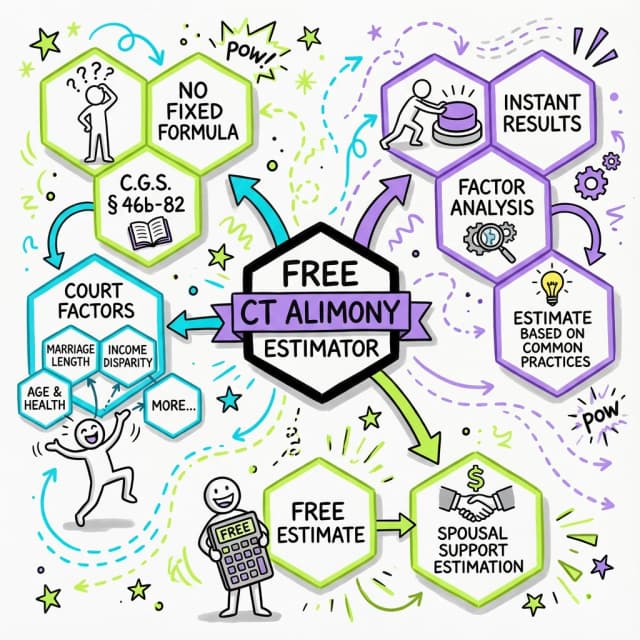
Try our free CT alimony calculator
Get an instant estimate based on Connecticut's statutory factors. No signup required.
The Mandatory Discovery Process: Building Your Case
Connecticut's mandatory disclosure rules under Practice Book Rule § 25-32 are a powerful resource for stay-at-home parents who may not have full visibility into marital finances. Within 60 days of request, your spouse must provide: three years of federal and state tax returns, W-2s and 1099s, current pay stubs, statements for all financial accounts going back 24 months, loan applications, statements for retirement accounts and pensions, life insurance information, and credit card statements.
This comprehensive discovery ensures you have access to all the financial information needed to advocate for fair support and property division. Many stay-at-home spouses discover assets they didn't know existed through this process. If your spouse fails to comply with mandatory disclosure, the court can impose sanctions and draw negative inferences about hidden assets.
For stay-at-home parents unfamiliar with family finances, reviewing these documents can feel overwhelming. Untangle's bank statement analysis can help you organize and understand this information, identifying patterns in spending, potential hidden accounts, and the true picture of marital assets. Having a clear understanding of finances is essential to ensuring you receive appropriate support.
Navigating the Court Process: Pathways and Case Management
Connecticut uses a case management system called Pathways, outlined in Practice Book Rule § 25-50A. After filing, you'll meet with a family-relations counselor who helps identify agreements, likelihood of settlement, and needed resources. Based on this meeting, your case is assigned to Track A (minimal court involvement), Track B (moderate complexity), or Track C (complex cases requiring more court time).
Understanding your track assignment helps you plan for the process ahead. Track A cases typically involve parties who largely agree and can resolve matters quickly. Track C cases might involve contested custody, complex assets, or domestic violence issues. Stay-at-home parents with young children and significant asset disparity often fall into Track B or C, as there are more issues requiring court attention.
The scheduling order that results from your Pathways meeting sets important deadlines for discovery, motions, and trial preparation. Missing these deadlines can result in sanctions, so staying organized is essential. Many stay-at-home parents find the legal process overwhelming on top of childcare responsibilities, making organizational tools invaluable for keeping everything on track.
Practical Steps for Stay-at-Home Parents Preparing for Divorce
-
Gather financial documents now. Start copying tax returns, bank statements, retirement account statements, and pay stubs. Even if you don't have direct access, note account numbers and institutions for later discovery requests.
-
Open an individual bank account. Having your own account ensures you have access to funds and a place to deposit any support payments. Use reasonable amounts from joint accounts to establish this—the automatic orders allow for "reasonable living expenses."
-
Document your contributions. Keep a record of childcare responsibilities, household management, volunteer activities, and any career sacrifices you made. This information supports alimony requests.
-
Research health insurance options. Under COBRA, you can continue coverage through your spouse's employer for 36 months after divorce, though you'll pay the premium. Alternatively, explore ACA marketplace options for post-divorce coverage.
-
Consider future employment. While courts don't require immediate employment, demonstrating efforts toward future self-sufficiency—researching education programs, updating skills, exploring job opportunities—can positively influence proceedings.
-
Consult with an attorney. Even if you ultimately proceed pro se (self-represented), an initial consultation provides crucial information about your rights. Many attorneys offer free or low-cost initial consultations.
Resources Beyond the Courtroom
Connecticut offers several community resources specifically helpful for stay-at-home parents navigating divorce. Legal aid organizations provide assistance to those who qualify financially. The Connecticut Judicial Branch Self-Help Center offers guidance for self-represented parties. Court-based family services can help with custody evaluations and parenting coordination.
Parent education programs are mandatory in Connecticut divorces involving children. While this might feel like another burden, these programs provide valuable information about helping children adjust to divorce and can connect you with support resources. If attendance creates hardship, form JD-FM-149 allows you to request relief from the requirement.
Online resources have transformed how divorcing parents access information and support. Untangle's AI legal guidance provides Connecticut-specific guidance, document preparation assistance, and tools designed specifically for the challenges stay-at-home parents face—from understanding financial affidavits to tracking case deadlines. Having support tailored to your situation makes a complex process more manageable.
When Professional Help Is Essential
While many divorce resources are available for self-guided use, certain situations require professional assistance. If your spouse has complex business interests, significant assets, or you suspect hidden income, a forensic accountant may be necessary. If there's any history of domestic violence or abuse, safety planning with a domestic violence advocate is essential before taking legal action.
Complex custody disputes—especially those involving relocation, parental alienation allegations, or special needs children—benefit from experienced family law attorneys. Similarly, if your spouse has retained aggressive legal counsel, proceeding without representation puts you at a significant disadvantage regardless of available resources. The stakes of divorce proceedings—your financial security and relationship with your children—are simply too high in these situations to navigate alone.
Frequently Asked Questions
How do stay-at-home parents qualify for alimony in Connecticut?
Connecticut courts award alimony to stay-at-home parents based on factors including the length of marriage, each spouse's income and earning capacity, and the homemaker's contributions to the marriage under C.G.S. § 46b-82.
What financial assistance is available for stay-at-home moms during a CT divorce?
Stay-at-home moms in Connecticut can request temporary alimony (alimony pendente lite), ask the court to order their spouse to pay attorney fees, and may qualify for state assistance programs like SNAP, HUSKY health insurance, and cash assistance through DSS.
Do stay-at-home parents have better custody rights in Connecticut divorces?
Connecticut courts determine custody based on the child's best interests rather than which parent worked or stayed home, though being the primary caregiver is a significant factor the court considers when establishing custody arrangements.
Are there job training programs for divorcing stay-at-home parents in Connecticut?
Connecticut offers workforce development programs through the Department of Labor's CTHires system, community college certificate programs, and some courts may order a spouse to pay for vocational training as part of rehabilitative alimony.
Where can I find divorce support groups for stay-at-home moms in CT?
Connecticut stay-at-home moms can find divorce support through local family resource centers, the Connecticut chapter of DivorceCare, online communities, and mental health services often available on a sliding scale through community health centers.
Legal Citations
- • C.G.S. § 46b-81 View Source
- • C.G.S. § 46b-83 View Source
- • C.G.S. § 46b-82 View Source
- • C.G.S. § 46b-62 View Source
- • Practice Book Rule § 25-5 View Source
- • Practice Book Rule § 25-30 View Source
- • Practice Book Rule § 25-32 View Source
- • Practice Book Rule § 25-50A View Source
- • Oudheusden v. Oudheusden, 338 Conn. 761 View Source