Best Divorce Financial Planning Tools in Connecticut | Complete Guide
Discover the best divorce financial planning tools for Connecticut residents. Learn how to protect assets, plan budgets, and secure your financial future during divorce.
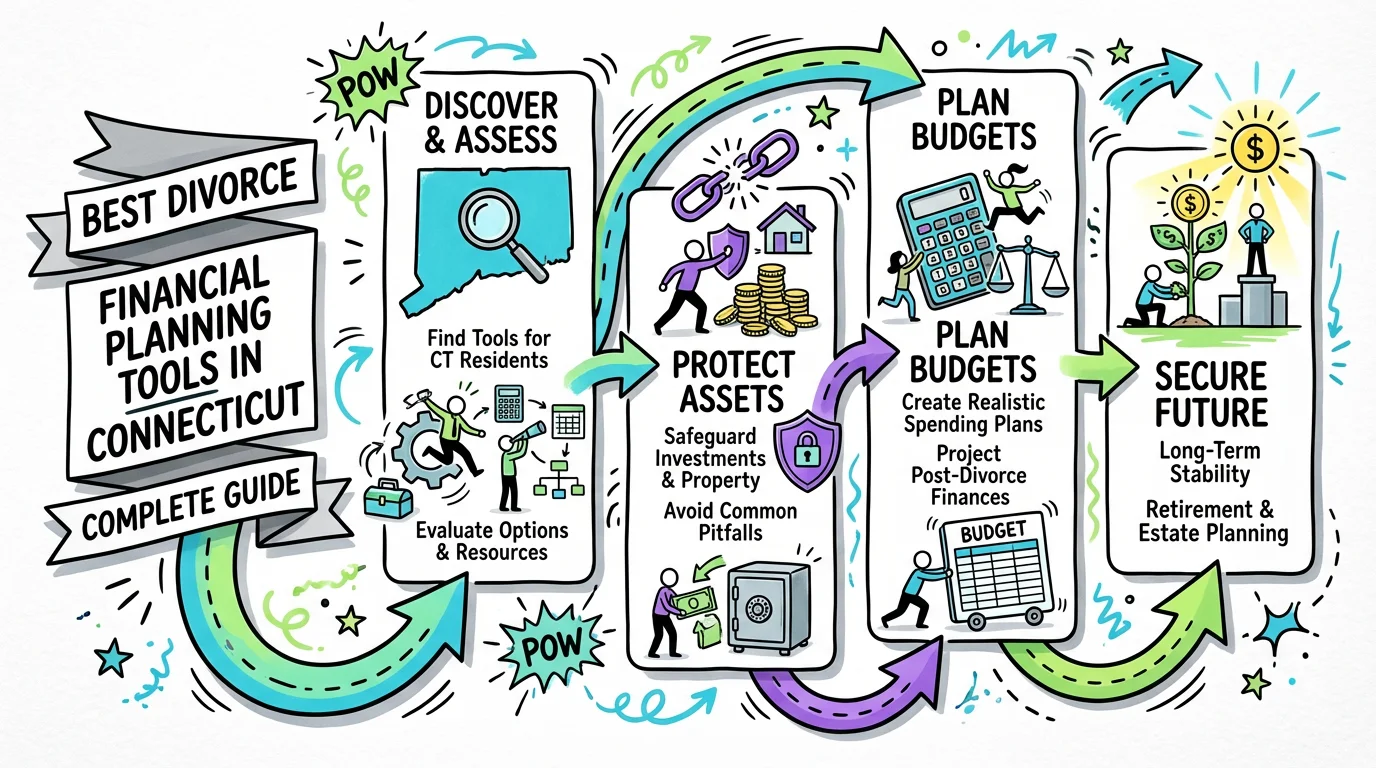
The best divorce financial planning tools combine comprehensive asset tracking, budget projection capabilities, and Connecticut-specific calculations for child support and alimony. Essential tools include financial affidavit preparation software, asset division calculators, post-divorce budget planners, and child support worksheets that align with Connecticut's statutory guidelines. For CT residents navigating divorce, the most effective approach integrates digital planning tools with proper documentation to ensure accurate financial disclosure and informed decision-making throughout the process.
Why Financial Planning Tools Matter in Connecticut Divorce
Connecticut is an equitable distribution state, meaning courts divide marital property fairly—though not necessarily equally—based on numerous factors. This makes thorough financial documentation absolutely critical. The court will examine everything from your income and assets to your future earning capacity when making financial orders. Without proper planning tools, you risk undervaluing assets, missing hidden accounts, or agreeing to terms that leave you financially vulnerable for years.
The anxiety many people feel about divorce finances is completely understandable. You're essentially untangling years or decades of shared financial life while simultaneously planning for an uncertain future. Good financial planning tools help transform this overwhelming task into manageable steps, giving you clarity and confidence when you need it most. They also ensure you're presenting accurate information to the court, which is both a legal requirement and essential for fair outcomes.
Connecticut courts require complete financial disclosure through mandatory financial affidavits. Using the right tools to organize this information not only helps you comply with legal requirements but also positions you to advocate effectively for your interests. When you understand your complete financial picture, you can make informed decisions about settlements rather than accepting terms out of fear or confusion.
Essential Financial Affidavit Preparation Tools
Under Connecticut Practice Book § 25-30, every divorcing spouse is required to file a sworn statement of current income, expenses, assets, and liabilities. The specific form depends on your income and asset levels. The Short Form Financial Affidavit (JD-FM-006) applies when neither party's net income exceeds $75,000 annually and total assets are below $75,000. Higher-income or higher-asset cases require the long form, which demands even more detailed financial disclosure.
Preparing your financial affidavit accurately requires systematic tracking of income, expenses, assets, and liabilities. Tools like Untangle's financial affidavit generation can help you gather and categorize the required information, ensuring nothing falls through the cracks. The affidavit becomes a cornerstone document in your case—courts rely heavily on it when making support and property division decisions, and inaccuracies can have serious consequences.
Beyond the basic forms, you'll benefit from tools that help you verify the information your spouse provides. Discrepancies between affidavits often reveal hidden assets or unreported income. Cross-referencing your spouse's claimed expenses against bank statements, tax returns, and lifestyle indicators can protect you from an unfair settlement.
Child Support Calculation Tools
Connecticut uses specific guidelines to calculate child support, and understanding these calculations is essential for financial planning. The Worksheet for Child Support and Arrearage Guidelines (CCSG-001) provides the official calculation framework. However, the guidelines allow for deviations based on several factors that planning tools can help you anticipate.
According to C.G.S. § 46b-215a and state regulations, courts may deviate from presumptive support amounts when considering "substantial assets, including both income-producing and non-income-producing property" available to either parent. This means your complete financial picture—not just income—can affect support calculations. Planning tools that help you model different scenarios based on asset division choices can reveal how property decisions ripple through to ongoing support obligations. Tools like Untangle's child support calculator and alimony calculator can help you model these scenarios, providing clarity on how various financial decisions impact your future.
The coordination of total family support adds another layer of complexity. Connecticut guidelines specifically allow consideration of "division of assets and liabilities, provision of alimony, and tax planning considerations" when these won't result in lesser economic benefit to children. Tools that integrate child support, alimony, and property division calculations help you see the complete picture rather than negotiating each element in isolation.
Asset Tracking and Division Planning
Accurate asset tracking forms the foundation of fair property division. Connecticut courts consider numerous factors when dividing property under C.G.S. § 46b-81, and the case of Marzaro v. Marzaro demonstrates how even assets held in trusts can be subject to equitable distribution. In that case, the court found that a marital residence held in a revocable trust with both parties as cotrustees was appropriately included in the property division. This underscores why comprehensive asset discovery matters.
| Asset Category | Documentation Needed | Planning Considerations |
|---|---|---|
| Real Estate | Deeds, mortgage statements, appraisals | Current value, equity, refinancing options |
| Retirement Accounts | Statements, plan documents | QDRO requirements, tax implications |
| Bank Accounts | Statements, transaction history | Tracing separate vs. marital funds |
| Investments | Brokerage statements, cost basis | Capital gains implications, liquidity |
| Business Interests | Valuations, tax returns, operating agreements | Buyout terms, ongoing income |
| Vehicles | Titles, loan documents, valuations | Depreciation, loan payoff amounts |
| Debts | Statements, account agreements | Responsibility allocation, joint liability |
Effective asset tracking tools should help you document not just current values but also the history of each asset. Connecticut law distinguishes between marital and separate property, and tracing funds can sometimes protect assets you brought into the marriage or received as inheritance. The Tilsen v. Benson case illustrates how courts carefully examine financial arrangements and agreements when making property division decisions.
Post-Divorce Budget Planning Tools
One of the most critical—yet often overlooked—aspects of divorce financial planning is projecting your post-divorce budget. Many people focus so intently on the divorce settlement itself that they don't adequately plan for life afterward. Budget planning tools help you model your expected income, expenses, and financial needs once the divorce is final.
Start by creating two budgets: your current household budget and your projected single-household budget. Many expenses increase when maintaining separate households—housing costs, utilities, insurance, and basic necessities often don't split in half. Understanding your current spending is crucial for future planning. Tools like Untangle's expense tracking with AI can help you accurately project these changes and understand what settlement terms you actually need to maintain financial stability.
Your post-divorce budget should account for both immediate needs and long-term financial goals. Consider factors like:
- Housing costs (rent or mortgage, utilities, maintenance)
- Healthcare and insurance premiums
- Children's expenses (education, activities, healthcare)
- Retirement savings contributions
- Emergency fund rebuilding
- Debt repayment obligations
Understanding these projected expenses helps you negotiate more effectively. Rather than accepting an alimony amount because it "sounds reasonable," you can demonstrate exactly why certain support levels are necessary based on documented needs and realistic projections.
Try our free CT child support calculator
Calculate your estimated child support using Connecticut's official guidelines formula.

Tax Planning and Projection Tools
Divorce has significant tax implications that financial planning tools should help you anticipate. The way you structure property division, alimony, and asset transfers can dramatically affect your tax burden for years to come. While tax laws change, the fundamental principle remains: consider after-tax values rather than face values when evaluating settlement options.
Connecticut's child support guidelines explicitly recognize the importance of tax planning, allowing deviations from presumptive support amounts for "tax planning considerations" when they benefit the overall family situation. This means strategic tax planning isn't just smart—it's built into Connecticut's approach to family support. Tools that model the tax implications of different settlement scenarios help you compare apples to apples.
Key tax considerations include the treatment of retirement account divisions (which may require Qualified Domestic Relations Orders to avoid penalties), capital gains implications of selling versus keeping various assets, and the loss of certain filing status benefits.
Step-by-Step Financial Planning Process
Organizing your divorce financial planning into clear steps helps manage the overwhelming nature of the task:
-
Gather all financial documents - Collect tax returns, bank statements, investment accounts, retirement accounts, property documents, debt statements, and insurance policies for at least the past three years.
-
Create a comprehensive asset inventory - List every asset and debt, noting current values, account numbers, and whether each is jointly or individually held.
-
Complete your financial affidavit draft - Use the appropriate Connecticut form to organize your income, expenses, assets, and liabilities before filing.
-
Calculate baseline support estimates - Use the Connecticut child support worksheet to understand presumptive support levels before negotiating.
-
Model different settlement scenarios - Compare various property division and support arrangements to understand their long-term financial impact.
-
Project post-divorce budgets - Create realistic monthly budgets for your anticipated single-household life.
-
Analyze tax implications - Evaluate how different settlement structures affect your tax situation.
-
Review and verify spouse's disclosures - Cross-reference your spouse's financial affidavit against known information to identify discrepancies.
Comparison of Financial Planning Approaches
| Approach | Best For | Limitations | Cost Range |
|---|---|---|---|
| DIY Spreadsheets | Simple finances, low conflict | Time-intensive, error-prone | Free |
| Online Divorce Calculators | Basic estimates, preliminary planning | May not reflect CT-specific rules | Free-$50 |
| Divorce Financial Software | Moderate complexity, self-guided process | Learning curve, may miss nuances | $50-$300 |
| Untangle Platform | Comprehensive CT-specific planning | Requires document input | Varies |
| Certified Divorce Financial Analyst | Complex estates, significant assets | Higher cost, scheduling constraints | $150-$400/hour |
| Full Attorney Representation | High conflict, complex issues | Most expensive option | $300-$500/hour |
When Professional Financial Help Is Essential
While financial planning tools can handle many aspects of divorce financial preparation, certain situations call for professional guidance. If your marriage involves business ownership, complex investment portfolios, stock options, pensions, or significant separate property claims, consider engaging a Certified Divorce Financial Analyst (CDFA) alongside your legal representation.
Connecticut courts have broad discretion in property division, as illustrated in cases like Gershon v. Back and Ingles v. Ingles, where appellate courts reviewed complex financial determinations. When substantial assets are at stake, professional financial analysis helps ensure you're making informed decisions and presenting your case effectively. The cost of professional help often pays for itself many times over in better settlement outcomes.
Even with professional support, personal engagement with financial planning tools remains valuable. The more you understand your own finances, the better you can work with professionals, evaluate their advice, and ultimately make decisions you're confident about. Tools like Untangle's smart bank statement analysis can help you organize information before professional consultations, making those expensive hours more productive.
Protecting Your Financial Future
The financial decisions you make during divorce will affect your life for years—sometimes decades—to come. Taking time to use proper financial planning tools isn't just about getting through the divorce; it's about building a foundation for your future financial security. The anxiety you feel about money right now is valid, but it can be channeled into productive planning that protects your interests.
Remember that financial planning is an iterative process. As negotiations progress and circumstances change, revisit your projections and adjust your strategy. Connecticut courts retain jurisdiction to modify certain orders based on changed circumstances, but property division is typically final. Getting it right the first time matters enormously. With the right tools and thorough preparation, you can approach your divorce with confidence, knowing you've done everything possible to secure your financial future.
Frequently Asked Questions
What is the best free divorce budget spreadsheet template for Connecticut?
Free divorce budget templates from legal aid organizations and financial planning websites can help CT residents track expenses, but should be customized to include Connecticut-specific costs like court filing fees and mandatory parenting education classes.
How do I organize my finances before filing for divorce in CT?
Start by gathering at least three years of tax returns, bank statements, retirement account statements, mortgage documents, and credit card statements, then use a financial affidavit checklist aligned with Connecticut's mandatory disclosure requirements.
What software can calculate divorce settlement amounts in Connecticut?
Software like DivorceHelp123, SupportPay, and specialized family law programs can estimate Connecticut divorce settlements, but results should be reviewed by a professional since CT courts use equitable distribution rather than fixed formulas.
Are there apps to track assets and debts during a Connecticut divorce?
Apps like Mint, YNAB, and divorce-specific platforms like Onward help track marital assets and debts, which is essential for completing Connecticut's mandatory financial affidavit accurately.
What should be on a financial checklist for divorce preparation in CT?
A Connecticut divorce financial checklist should include income documentation, real estate appraisals, retirement account valuations, business interests, debt statements, and a completed draft of Form JD-FM-6 (Connecticut's financial affidavit).
Legal Citations
- • Short Form Financial Affidavit (JD-FM-006) View Source
- • Worksheet for Child Support and Arrearage Guidelines (CCSG-001) View Source
- • Marzaro v. Marzaro, 231 Conn. App. 85 View Source
- • Tilsen v. Benson, 347 Conn. 758 View Source
- • Ingles v. Ingles, 216 Conn. App. 782 View Source
- • Gershon v. Back, 201 Conn. App. 225 View Source