Best Apps for Divorce Case Preparation in Connecticut | Contested Divorce Tools
Discover the best apps for preparing your Connecticut contested divorce case. Compare tools for financial tracking, document organization, and evidence gathering.
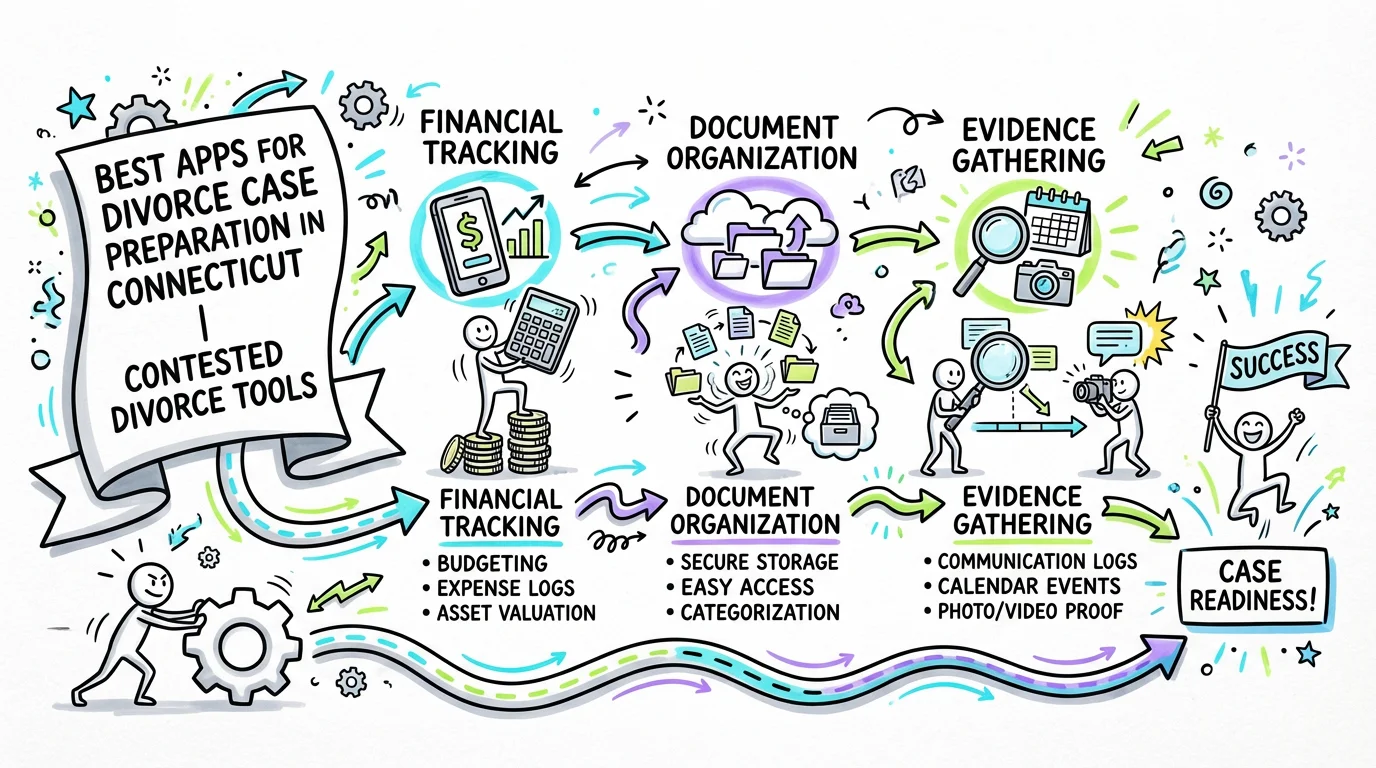
The best apps for contested divorce preparation in Connecticut combine financial tracking, document organization, secure communication logging, and evidence management into one platform. When your spouse won't cooperate and you're facing litigation, you need tools that help you build a compelling case with organized financial records, timestamped documentation, and court-ready reports that meet Connecticut's strict disclosure requirements.
Why App-Based Preparation Matters in Contested CT Divorces
When divorce becomes contentious, organization isn't just helpful—it's essential to your case outcome. Connecticut courts require comprehensive financial disclosure through forms like the Financial Affidavit (JD-FM-006), and judges have little patience for incomplete or disorganized submissions. In contested cases, the spouse who presents clear, well-documented evidence often gains a significant advantage.
Connecticut case law demonstrates just how critical proper documentation can be. In Jacques v. Jacques, a breach of contract claim arose because one spouse allegedly failed to disclose liquidated annuities before dissolution proceedings. This case underscores that incomplete financial documentation doesn't just create court problems—it can lead to years of additional litigation even after your divorce finalizes. The right preparation tools help you avoid becoming either the victim or the accused in such scenarios.
Beyond legal requirements, practical reality demands excellent organization. Contested divorces in CT can span 12-24 months or longer, generating hundreds of documents, dozens of communications, and complex financial histories. Without a systematic approach using purpose-built tools, critical evidence gets lost, deadlines slip, and your attorney spends billable hours organizing rather than strategizing.
Essential Features for Contested Divorce Apps
Financial Tracking and Asset Documentation
Connecticut courts divide marital property using equitable distribution principles, examining the full financial picture of both spouses. The most effective divorce preparation apps help you track bank accounts, investment portfolios, retirement funds, real estate values, and debts in one centralized location. Look for tools that can import bank statements, categorize transactions, and flag unusual activity like hidden transfers or suspicious spending patterns.
The Marshall v. Marshall case illustrates why thorough financial documentation matters. The court examined the defendant's employment history to determine earning capacity, ultimately finding he could earn $350,000 annually despite being unemployed for five years. Apps that help you document your spouse's historical earnings, job offers declined, or voluntary underemployment can prove invaluable when arguing for appropriate support calculations. [Untangle's income source tracking](/features#income-tracking) helps you compile this exact type of earning history and asset documentation in formats that attorneys can immediately use.
Your financial tracking app should also help you prepare Connecticut's mandatory Financial Affidavit—either the short form for incomes under $75,000 or the long form (JD-FM-006) for higher earners. This affidavit requires detailed breakdowns of income, expenses, assets, and liabilities. [Untangle's Financial Affidavit generation](/features#financial-affidavit) aligns its categories with the affidavit's structure, saving enormous time and reducing errors that could damage your credibility with the court.
Document Management and Evidence Organization
Contested divorces generate enormous paper trails: tax returns, pay stubs, property deeds, vehicle titles, insurance policies, business records, and more. The best preparation apps provide secure cloud storage with intelligent organization—tagging documents by category, date, and relevance to specific issues like custody, property division, or support.
Beyond storage, look for apps offering optical character recognition (OCR) that makes documents searchable, annotation capabilities for highlighting key passages, and export functions that create court-ready document packages. When your attorney requests "all bank statements showing transfers over $5,000," you should be able to produce that report in minutes, not days.
Evidence integrity also matters in contested proceedings. Apps with timestamp features, version tracking, and secure sharing help establish that documents haven't been altered. Some platforms even integrate with e-discovery tools attorneys use, streamlining the handoff between your preparation work and your legal team's case building.
Communication Logging and Timestamping
When cooperation breaks down, every communication with your spouse becomes potential evidence. Texts showing refusal to share information, emails documenting verbal agreements later denied, and voicemails revealing true intentions all matter in contested proceedings. The best divorce apps help you capture, organize, and preserve these communications with legally defensible timestamps.
Look for apps that can import text message threads, archive emails, and even transcribe voicemails. Beyond simple storage, effective tools let you annotate communications—noting what was discussed, what promises were made, and how they connect to your case theory. [Untangle's case management features](/features#case-management) include communication logging that helps you build a clear narrative from scattered messages across multiple platforms.
Connecticut courts increasingly see evidence from digital communications. However, screenshots can be challenged as altered or taken out of context. Apps with proper archiving functions that preserve metadata provide stronger evidentiary support than simple photo captures of your phone screen.
Top App Categories for CT Divorce Preparation
| App Category | Key Features | Best For |
|---|---|---|
| All-in-One Divorce Platforms | Financial tracking, document storage, communication logs, attorney collaboration | Comprehensive case building |
| Financial Aggregators | Bank account linking, spending analysis, net worth tracking | Complex asset cases |
| Document Scanners | OCR, cloud storage, folder organization | Paper-heavy preparation |
| Communication Archivers | Text/email backup, timestamp verification, export functions | High-conflict situations |
| Co-Parenting Apps | Custody calendars, expense sharing, message documentation | Cases with children |
| Legal Project Management | Deadline tracking, task lists, attorney communication | Self-represented parties |
All-in-One Divorce Platforms
Dedicated divorce preparation platforms offer the most value for contested cases because they're designed specifically for what you're facing. Rather than cobbling together generic financial apps with separate storage solutions and communication tools, all-in-one platforms understand the divorce workflow and court requirements.
Untangle represents this category well, offering Connecticut-specific guidance alongside financial organization, document management, and preparation tools. The platform helps you understand what Connecticut courts require for disclosure, organizes your information accordingly, and generates reports your attorney can immediately use. For contested cases especially, having everything in one searchable, exportable location proves invaluable during discovery and trial preparation. [Untangle's automatic document generation](/features#document-generation) can streamline preparing court-ready reports.
When evaluating all-in-one platforms, consider whether they understand your state's specific requirements. Connecticut's Certificate of Compliance (JD-FM-175) requires parties to certify they've provided mandatory disclosure—platforms that help you track what you've disclosed and what you still need reduce compliance headaches significantly.
Specialized Financial Tools
For high-asset contested divorces, dedicated financial tracking apps may supplement your primary platform. These tools excel at connecting to multiple financial institutions, categorizing transactions automatically, and generating spending reports over custom date ranges. When arguing that your spouse has been dissipating marital assets or hiding income, these detailed financial timelines become essential evidence.
Some financial apps also help identify lifestyle spending to support alimony arguments. Connecticut courts consider each spouse's standard of living during the marriage when setting support. Apps that can demonstrate consistent spending patterns—country club memberships, luxury purchases, vacation spending—help establish what maintaining that lifestyle actually costs.
The challenge with standalone financial tools is integration. Make sure any specialized app you use can export data in formats your primary divorce platform or attorney can import. Redundant data entry wastes time and introduces errors.
Building Your Case: A Strategic Approach
Step 1: Audit Your Current Documentation
Before selecting any app, inventory what you already have and what you need. Pull together existing financial statements, tax returns, property records, and relevant communications. Identify gaps—missing account statements, unclear asset ownership, undocumented verbal agreements. This audit shapes which app features matter most for your situation.
Step 2: Establish Your Primary Platform
Choose one central platform for your case preparation—trying to use multiple primary systems creates confusion and gaps. For contested Connecticut divorces, prioritize platforms that understand state-specific requirements like the Financial Affidavit format and mandatory disclosure rules.
Step 3: Import and Organize Historical Data
The strongest contested divorce cases present comprehensive historical pictures. Import bank statements going back at least three years (longer for high-asset cases). Upload tax returns for the marriage's duration. Gather all property documentation—deeds, titles, appraisals. Your app should let you tag this historical data by asset type, date range, and relevance to specific disputed issues.
Step 4: Establish Forward-Looking Tracking
From this point forward, every financial transaction and communication matters. Set up automatic imports where possible—linked bank accounts that update daily, email forwards to your documentation system, regular photo uploads of receipts. The goal is capturing everything in real-time rather than reconstructing history later.
Step 5: Create Attorney-Ready Reports
Before major attorney meetings or court dates, generate organized reports from your app. Group documents by issue: one package for income documentation, another for asset listings, another for communication evidence supporting specific claims. Apps that let you create shareable reports or secure attorney access to relevant sections dramatically improve attorney efficiency—and reduce your legal bills.
Try our free CT alimony calculator
Get an instant estimate based on Connecticut's statutory factors. No signup required.
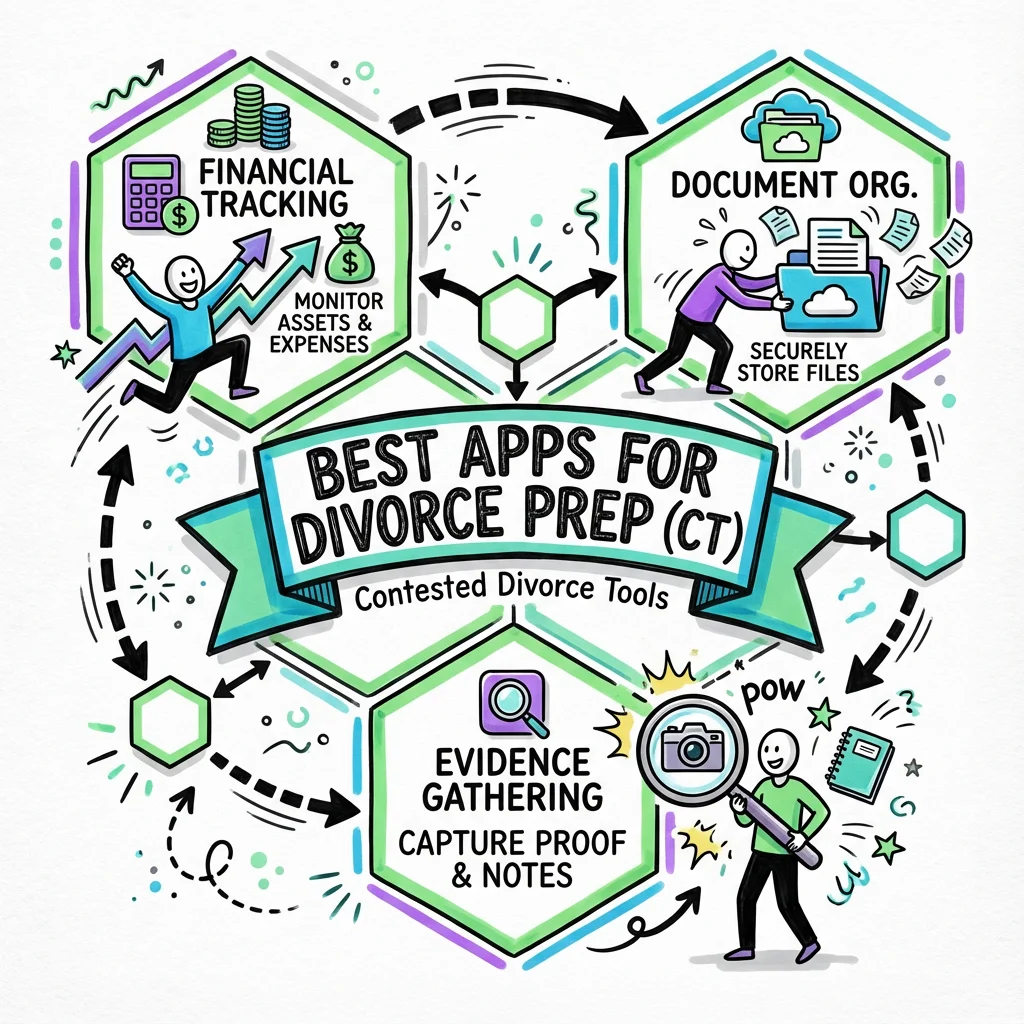
Cost and Time Comparison: Preparation Approaches
| Approach | Monthly Cost | Setup Time | Attorney Hour Savings | Case Strength Impact |
|---|---|---|---|---|
| No formal system | $0 | None | None (increases hours) | Weakened |
| Generic apps (spreadsheets, cloud storage) | $0-15 | 10-20 hours | Moderate | Neutral |
| Dedicated divorce platform | $15-50 | 3-5 hours | Significant | Strengthened |
| Platform + attorney collaboration | $15-50 | 2-3 hours | Maximum | Significantly strengthened |
The math often favors dedicated platforms even when free alternatives exist. Attorney hourly rates in Connecticut contested divorces typically range from $250-500+. If a $30/month platform saves just one attorney hour monthly through better organization, it pays for itself immediately while simultaneously strengthening your case presentation.
Protecting Your Digital Evidence
Security Considerations
Your divorce preparation app contains your most sensitive information: financial records, personal communications, and litigation strategy. Choose platforms with strong encryption, two-factor authentication, and clear privacy policies. Avoid apps that sell user data or have vague security practices.
For contested divorces especially, consider whether your spouse might attempt to access your preparation materials. Use unique passwords, secure your devices with biometrics where possible, and never use shared computers for case preparation. Some apps offer "panic" features that quickly lock or hide the application—useful if your living situation remains contentious.
Maintaining Evidence Integrity
Digital evidence faces challenges that paper documents don't. Metadata can be stripped, files can be altered, and timestamps can be questioned. Use apps that maintain audit trails, preserve original file metadata, and offer verification features. If your communications archive might become trial evidence, understand your app's data integrity certifications and how to demonstrate authenticity to the court.
When DIY Preparation Isn't Enough
While preparation apps dramatically improve your organization and case strength, they don't replace professional guidance in truly contested situations. Consider escalating to more intensive attorney involvement when:
- Your spouse has hidden assets or income sources you can't document
- Complex business valuations require forensic accounting
- Custody disputes involve allegations of abuse or parental unfitness
- Your spouse has retained aggressive legal representation
- High-value assets like businesses, pensions, or stock options require expert analysis
The best approach combines thorough self-preparation using quality apps with strategic professional support. Your organized documentation reduces attorney hours spent on basic tasks, freeing your legal budget for complex strategy and courtroom advocacy. Tools like [Untangle's task dashboard](/features#task-dashboard) bridge this gap effectively, letting you handle organization while your attorney focuses on winning your case.
Connecticut contested divorces demand both comprehensive preparation and professional guidance. The right apps give you the organizational foundation; skilled attorneys build the legal strategy on top. Together, they position you for the best possible outcome when cooperation has failed and litigation becomes unavoidable.
Frequently Asked Questions
What are the best free apps for organizing divorce documents in Connecticut?
Popular free options include Google Drive and Dropbox for basic document storage, though dedicated divorce apps like OurFamilyWizard offer free trials with more specialized features for CT court requirements.
How do expense tracking apps help during a Connecticut divorce?
Expense tracking apps help you document spending patterns, separate marital vs. individual expenses, and generate reports that support accurate completion of Connecticut's required Financial Affidavit (JD-FM-006).
What co-parenting apps do Connecticut family courts recommend?
Connecticut family courts commonly see parents using OurFamilyWizard, Talking Parents, and AppClose because these apps create timestamped, unalterable communication records that can be submitted as evidence.
Can I use financial planning software to prepare for divorce asset division in CT?
Yes, financial planning software like Quicken or specialized divorce tools can help you inventory assets, project post-divorce budgets, and prepare for Connecticut's equitable distribution requirements.
How long should I keep divorce preparation app data after my CT divorce is finalized?
You should retain all divorce-related app data and documentation for at least 3-7 years after finalization, as Connecticut cases like Jacques v. Jacques show that financial disclosure disputes can arise years later.
Legal Citations
- • Jacques v. Jacques, 223 Conn. App. 501 View Source
- • Marshall v. Marshall, 224 Conn. App. 45 View Source
- • Financial Affidavit (JD-FM-006) View Source
- • Certificate of Compliance (JD-FM-175) View Source