Connecticut Alimony Calculator: How CT Courts Determine Spousal Support
Learn how Connecticut calculates alimony. CT has no fixed formula—courts use 17 statutory factors. Understand what determines your spousal support amount.
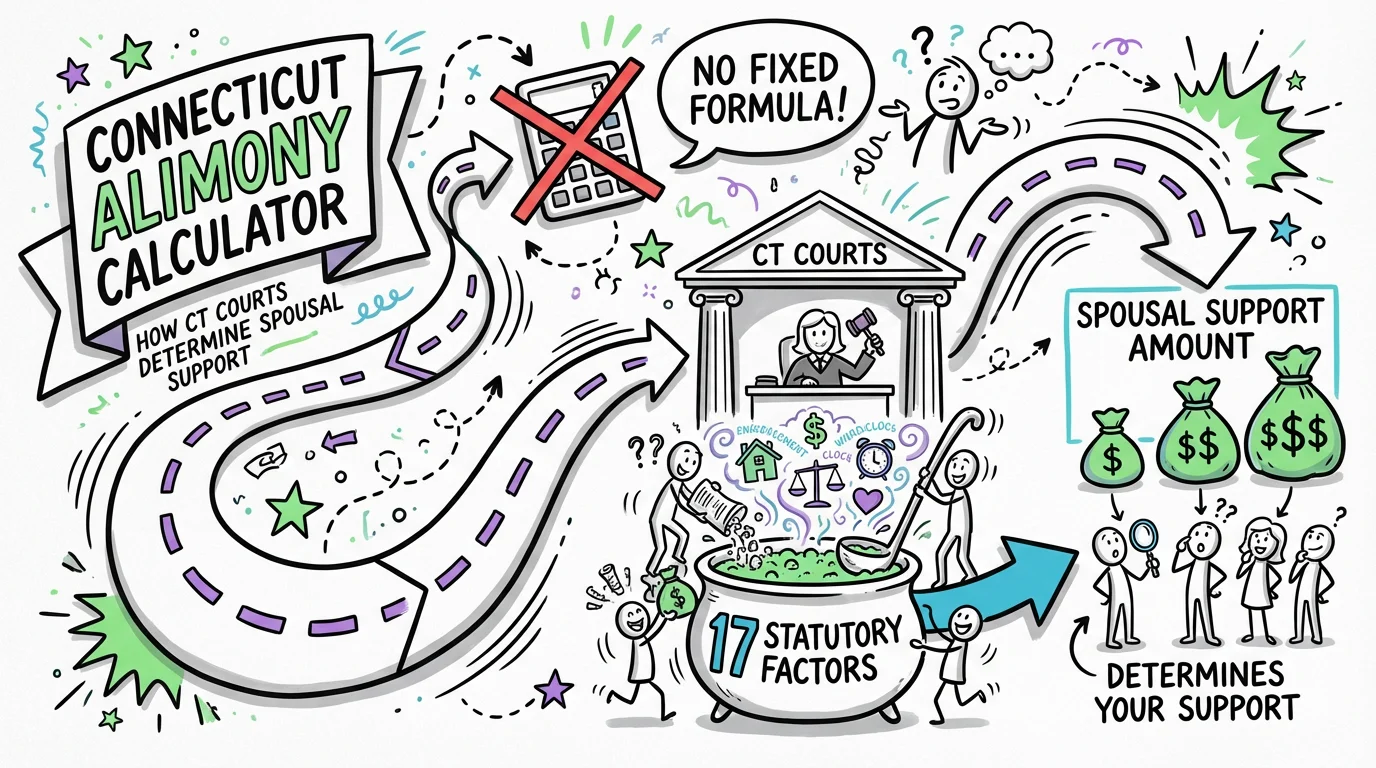
Connecticut does not have an official alimony calculator or fixed formula for determining spousal support. Unlike child support, which follows specific guidelines, Connecticut courts have broad discretion to award alimony based on 17 statutory factors outlined in C.G.S. § 46b-82. This means your alimony amount depends on your unique circumstances—your marriage length, your contributions as a stay-at-home spouse, your earning capacity, and your financial needs—rather than a simple mathematical calculation.
Why Connecticut Doesn't Use an Alimony Formula
Many states have moved toward alimony calculators or guidelines that provide predictable outcomes, but Connecticut remains a "discretionary" state when it comes to spousal support. The Connecticut legislature and courts have intentionally preserved judicial flexibility because every marriage involves different circumstances that a rigid formula cannot adequately address.
This approach can feel frustrating when you're trying to plan for your financial future, especially if you've spent years as a stay-at-home parent and are re-entering the workforce. However, this discretion can also work in your favor. A judge can consider the full picture of your marriage—the career opportunities you passed up, the support you provided that enabled your spouse's career advancement, and your realistic ability to become self-supporting—rather than reducing your situation to numbers in a spreadsheet.
Connecticut courts recognize that marriages are partnerships, and the economic consequences of divorce should be addressed fairly. As the Connecticut Appellate Court affirmed in Carten v. Carten, trial courts have "broad discretion" in making alimony determinations, and their decisions will be upheld as long as they properly consider the statutory factors. Understanding these factors is essential to anticipating what alimony might look like in your case.
The 17 Statutory Factors Connecticut Judges Must Consider
Under C.G.S. § 46b-82, Connecticut courts must evaluate a comprehensive list of factors when determining whether to award alimony and, if so, how much and for how long. While judges aren't required to give equal weight to each factor, they must consider all of them.
Financial Factors
The court examines the length of the marriage, the causes for the dissolution (if relevant), the age, health, station, occupation, amount and sources of income, earning capacity, vocational skills, education, employability, estate, and needs of each party. For a stay-at-home spouse, several of these factors are particularly significant:
- Earning capacity vs. actual income: Courts look not just at what you're earning now, but what you could reasonably earn given your education, skills, and time away from the workforce
- Vocational skills and employability: If your skills have become outdated during your marriage, this weighs in favor of alimony
- The estate of each party: This includes all assets and property, not just income
- Needs of each party: Your realistic monthly expenses and financial obligations
Contributions to the Marriage
Connecticut law explicitly recognizes that stay-at-home spouses make valuable contributions to the marriage. The statute requires courts to consider "the contribution of each of the parties in the acquisition, preservation or appreciation in value of their respective estates." Critically, this includes homemaker contributions—raising children, managing the household, and supporting your spouse's career advancement.
The law also considers "the contribution of each of the parties to the acquisition of income or earning capacity of the other party." If you supported your spouse through graduate school, relocated for their career, or handled childcare so they could work long hours, these contributions matter significantly in alimony determinations.
Future Considerations
Courts must also weigh the opportunity of each party for future acquisition of capital assets and income. A spouse who has been out of the workforce faces real barriers: gaps in employment history, outdated skills, age discrimination, and the time needed for retraining. Judges understand these challenges and factor them into their decisions.
Tools like Untangle's financial analysis features can help you organize your financial information and understand how these factors apply to your specific situation before you ever step into a courtroom.
Types of Alimony in Connecticut
Connecticut courts can award different types of alimony depending on your circumstances. Understanding these categories helps you know what to request and what to expect.
| Type of Alimony | Duration | Purpose | Common Situations |
|---|---|---|---|
| Permanent/Periodic | Indefinite (until death, remarriage, or modification) | Maintain standard of living | Long marriages, significant income disparity, older spouses |
| Rehabilitative | Fixed term (typically 3-10 years) | Support while gaining employment skills | Shorter marriages, younger spouses with earning potential |
| Lump Sum | One-time payment | Clean break between parties | When ongoing payments are impractical |
| Pendente Lite | During divorce proceedings | Temporary support until final judgment | When one spouse controls finances |
Pendente Lite (Temporary) Alimony
Under C.G.S. § 46b-83, you can request temporary alimony while your divorce is pending. This is crucial for stay-at-home spouses who may have limited access to funds during what can be a lengthy divorce process. Pendente lite alimony ensures you can pay bills, hire an attorney, and maintain stability while the case proceeds.
You can file a motion for pendente lite alimony any time after your divorce complaint is filed. The court will hold a hearing and make a temporary order based on both parties' financial affidavits. This temporary order remains in effect until your final divorce judgment.
Permanent vs. Rehabilitative Alimony
The distinction between permanent and rehabilitative alimony often comes down to your realistic ability to become self-supporting. In Onyilogwu v. Onyilogwu, the Connecticut Appellate Court examined how trial courts determine alimony duration, emphasizing that courts must consider the full picture of each spouse's income sources and earning capacity.
For stay-at-home parents after long marriages, courts often recognize that full self-sufficiency may not be realistic, particularly if you're older or have been out of the workforce for many years. In these cases, longer-term or permanent alimony may be appropriate.
How to Estimate Your Potential Alimony
While Connecticut has no official calculator, you can develop a reasonable estimate by gathering comprehensive financial information and understanding how courts typically approach cases similar to yours.
Step 1: Complete Your Financial Affidavit
The Financial Affidavit (Form JD-FM-006) is the foundation of any alimony determination. This sworn document details your income, expenses, assets, and liabilities. Connecticut Practice Book Rule § 25-30 requires both parties to file financial affidavits at least five business days before any hearing on alimony.
Be thorough and accurate. Include all your reasonable monthly expenses, from housing and utilities to healthcare, transportation, and personal needs. Don't underestimate your costs—this document helps establish your financial needs. Untangle provides guided tools for creating your financial affidavit, helping you ensure accuracy and completeness.
Step 2: Document Your Contributions
Create a detailed record of your contributions to the marriage. This might include:
- Years spent as primary caregiver for children
- Career opportunities you declined or postponed
- Relocations you made for your spouse's career
- Support you provided during your spouse's education or career advancement
- Household management responsibilities you handled
Step 3: Research Your Earning Capacity
Courts will consider what you could reasonably earn, so it helps to research realistic employment options. Consider:
- What were you earning before you stopped working?
- What training or education would you need to re-enter your field?
- What entry-level positions are available given your current skills?
- How long would it take to reach a sustainable income level?
Utilize Untangle's income tracking features to help you project potential earnings and understand your earning capacity, strengthening your argument for appropriate alimony.
Step 4: Analyze Both Parties' Full Financial Picture
Under Connecticut's mandatory disclosure rules (Practice Book Rule § 25-32), both parties must exchange extensive financial documentation within 60 days, including tax returns, pay stubs, bank statements, and investment account records. This information reveals the true financial picture of your marriage.
Systematic organization of these documents is essential during discovery to ensure you are presenting complete, accurate financial information to the court.
What Affects Alimony Duration in Connecticut
The length of your alimony award depends on several factors, with marriage duration being among the most significant. However, duration is rarely the only deciding factor.
Short-Term Marriages (Under 10 Years)
In shorter marriages, courts typically award rehabilitative alimony for a defined period—often a few years—to help the lower-earning spouse gain skills and employment. The goal here is usually not to maintain the marital standard of living indefinitely, but to provide a bridge to self-sufficiency while the recipient re-enters the workforce.
However, even in shorter marriages, significant contributions or sacrifices can justify longer support. If you left a high-paying career to care for a newborn and now face a steep climb back up the ladder, the court may award support that lasts longer than the standard rehabilitation period to account for that specific economic loss.
Medium-Term Marriages (10-20 Years)
Courts have arguably the most flexibility in medium-term marriages. Alimony might be awarded for half the length of the marriage, the full length, or another duration entirely. There is no automatic rule, so the specific statutory factors—such as health, age, and causes of the dissolution—play a pivotal role in swaying the judge's decision.
Your realistic employment prospects weigh heavily in this category. A judge will look closely at your vocational skills and how long it will take you to achieve a standard of living comparable to what you enjoyed during the marriage. If there is a massive income disparity that is unlikely to close, alimony awards tend to be more generous in duration.
Long-Term Marriages (20+ Years)
After decades of marriage, particularly when one spouse has been out of the workforce for most of that time, courts often award longer-term or permanent alimony. The recognition is that someone who left the workforce at 30 and is now 55 faces very different employment prospects than they would have had without that career interruption.
In these scenarios, the "station" of the parties becomes a critical factor. The court aims to allow the lower-earning spouse to maintain a lifestyle reasonably similar to the one established during the marriage, rather than forcing a drastic reduction in their standard of living simply because the marriage ended.
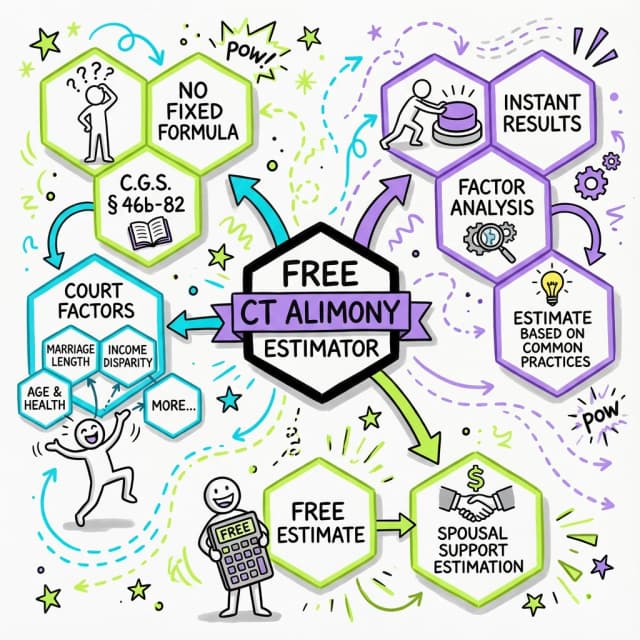
Try our free CT alimony calculator
Get an instant estimate based on Connecticut's statutory factors. No signup required.
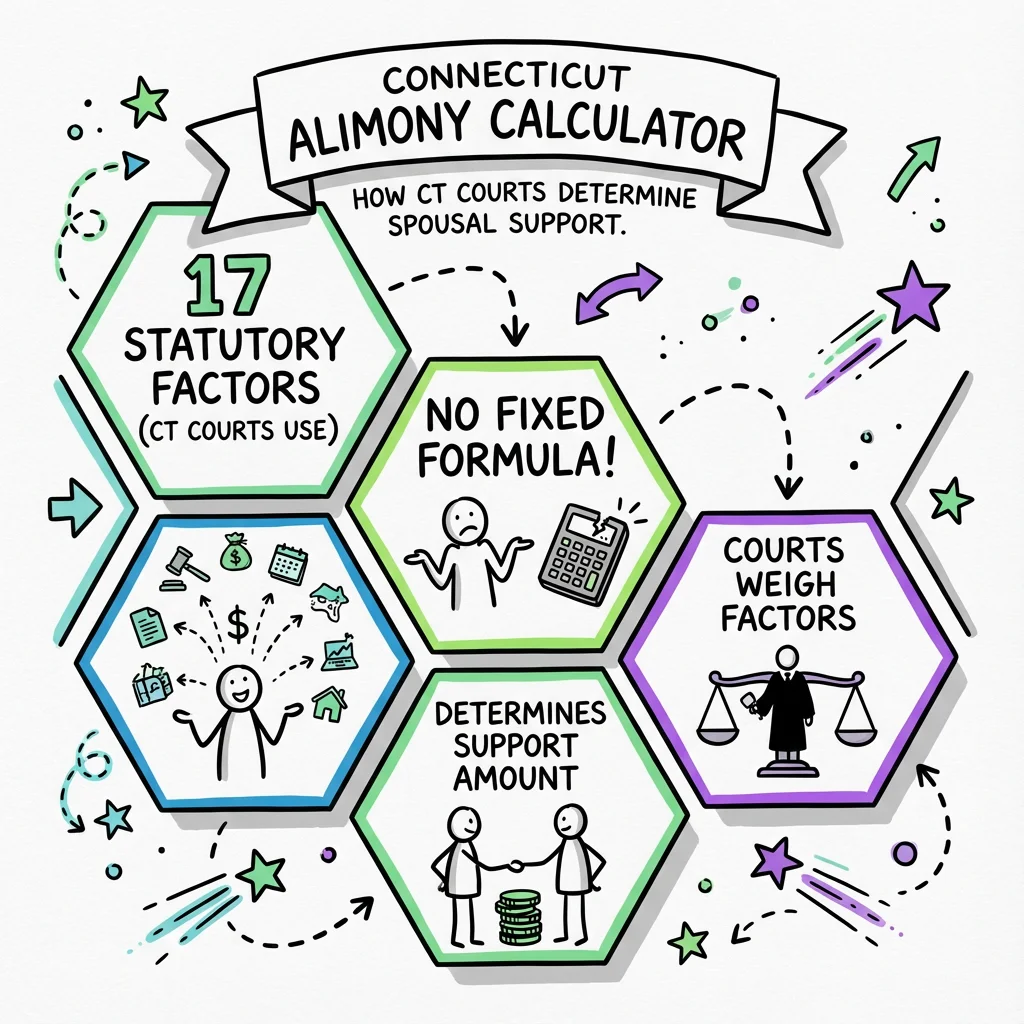
Modifying Alimony After Divorce
Your alimony order isn't necessarily permanent. Under C.G.S. § 46b-86, alimony can be modified if there's a "substantial change in circumstances" for either party. Common reasons for modification include:
- Job loss or significant income reduction
- Serious illness or disability
- The receiving spouse's cohabitation with a new partner
- The receiving spouse becoming self-sufficient sooner than expected
- Retirement of the paying spouse
However, some divorce agreements include provisions that limit or prohibit modifications. This is why it's crucial to carefully consider the terms of any alimony agreement before finalizing your divorce. Practice Book Rule § 25-26 outlines the procedures for modification motions.
Preparing Your Case: Practical Steps
If you're a stay-at-home spouse concerned about your financial future, taking proactive steps now will strengthen your position in alimony negotiations.
-
Gather financial documents systematically: Collect tax returns, bank statements, investment records, and evidence of marital assets. Untangle's secure document storage helps you organize everything in one place.
-
Create a realistic post-divorce budget: Document what you actually need to maintain a reasonable standard of living, including housing, healthcare, transportation, and daily expenses.
-
Research career options and training programs: Understanding what it would take to become employable—and how long that would take—helps you make informed arguments about alimony duration.
-
Document your contributions: Write down everything you've contributed to the marriage, from childcare to career support to household management.
-
Understand the mandatory disclosure requirements: Familiarize yourself with what financial information you're entitled to receive from your spouse under Practice Book Rule § 25-32.
-
Consider pendente lite support: If you need financial support during the divorce process, file for temporary alimony as soon as your case begins.
When to Seek Professional Help
While online tools and calculators can provide general guidance, Connecticut's discretionary alimony system means that professional advice is often essential—especially for stay-at-home spouses with significant financial concerns.
Consider consulting with a family law attorney if:
- Your marriage involved significant assets or complex finances
- Your spouse owns a business or has variable income
- You've been out of the workforce for many years
- There's a substantial income disparity between you and your spouse
- Your spouse is hiding assets or being uncooperative with financial disclosure
A skilled attorney understands how local judges typically apply the statutory factors and can help you present your case effectively. Many attorneys offer initial consultations to help you understand your options.
Even before consulting an attorney, organizing your financial information and understanding the basics of Connecticut alimony law puts you in a stronger position. Untangle's guided divorce tools can help you prepare by walking you through the financial analysis process and helping you understand what factors matter most in your situation.
Understanding Your Financial Future
Not having a simple alimony calculator in Connecticut can feel overwhelming, especially when you're worried about supporting yourself after years as a stay-at-home spouse. But the discretionary system exists precisely because cookie-cutter formulas can't capture the reality of your marriage and your contributions.
The key is preparation: understanding the statutory factors, documenting your contributions and needs, gathering complete financial information, and knowing what type of alimony makes sense for your situation. With the right preparation, you can advocate effectively for a fair outcome—whether through negotiation, mediation, or court proceedings.
Your years of contributions to your family have value, and Connecticut law recognizes that. Understanding how alimony works in CT is the first step toward securing the financial stability you deserve as you move into this new chapter of your life.
Frequently Asked Questions
How long does alimony last in Connecticut?
Connecticut alimony duration varies based on the length of the marriage and other factors, with courts typically awarding shorter-term alimony for brief marriages and longer or indefinite alimony for marriages lasting 15-20+ years.
Can alimony be modified in CT after the divorce is finalized?
Yes, Connecticut allows alimony modifications if there is a substantial change in circumstances, such as job loss, retirement, or significant income changes, unless the divorce agreement specifically prohibits modification.
What factors do Connecticut courts consider when determining alimony?
Connecticut courts consider 17 statutory factors under C.G.S. § 46b-82, including marriage length, each spouse's age and health, earning capacity, contributions as a homemaker, and the causes for the dissolution of the marriage.
What is the difference between lump sum and periodic alimony in Connecticut?
Lump sum alimony is a one-time payment that cannot be modified, while periodic alimony consists of regular ongoing payments (usually monthly) that may be modified if circumstances change.
Does Connecticut have alimony guidelines or a formula like child support?
No, Connecticut does not have official alimony guidelines or a fixed formula—courts have broad discretion to determine spousal support amounts based on the specific circumstances of each case.
Legal Citations
- • C.G.S. § 46b-82 - Alimony View Source
- • C.G.S. § 46b-83 - Alimony pendente lite View Source
- • C.G.S. § 46b-86 - Modification of alimony or support orders View Source
- • Carten v. Carten, 203 Conn. App. 598 View Source
- • Onyilogwu v. Onyilogwu, 217 Conn. App. 647 View Source
- • Connecticut Practice Book Rule § 25-30 - Statements To Be Filed View Source
- • Connecticut Practice Book Rule § 25-32 - Mandatory Disclosure and Production View Source
- • Connecticut Practice Book Rule § 25-26 - Modification of Custody, Alimony or Support View Source
- • Financial Affidavit Long Form (JD-FM-006) View Source